Last updated: 20 March 2026
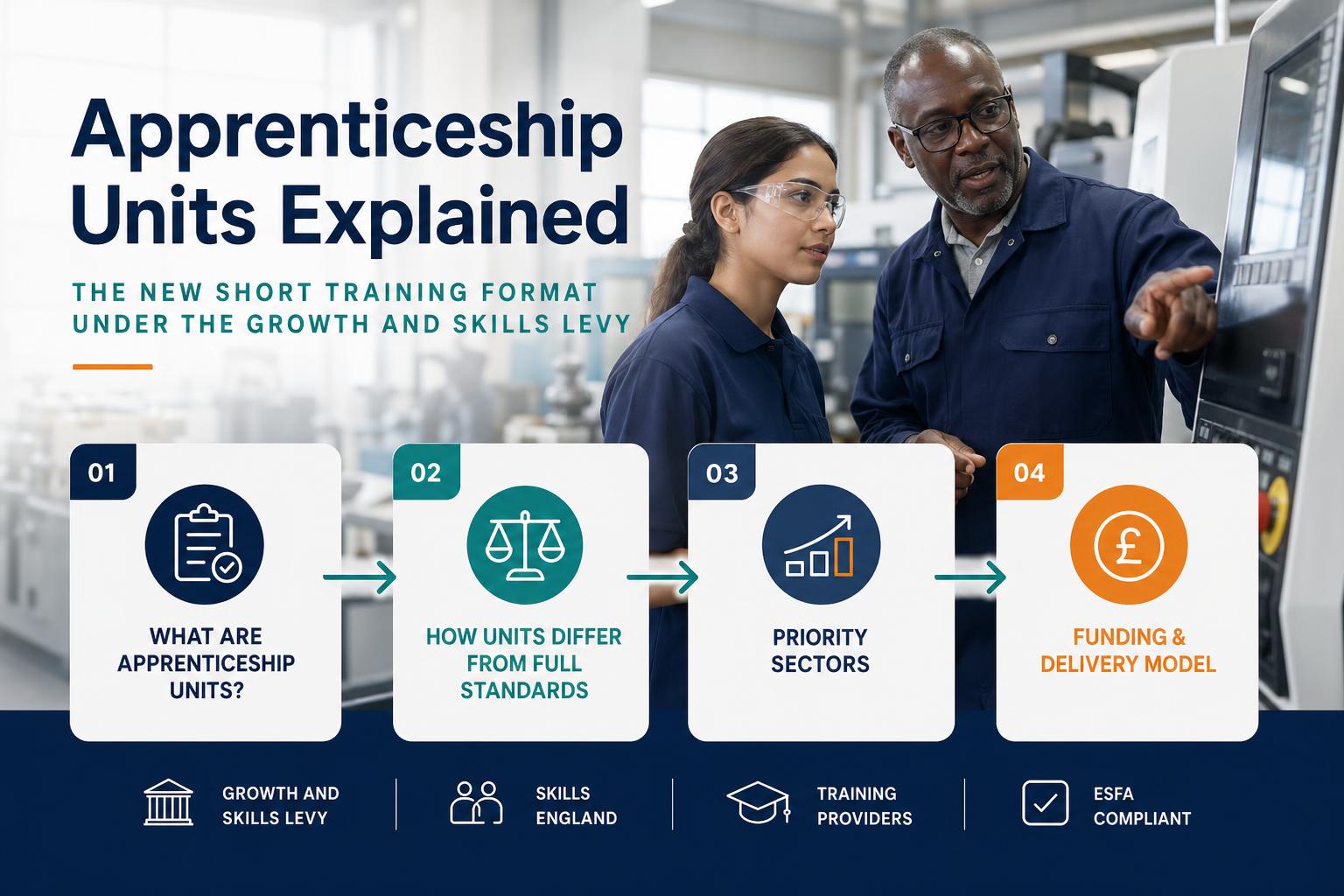
What Are Apprenticeship Units?
Apprenticeship units are short, flexible training modules introduced as part of the Government’s Growth and Skills Levy reforms. Announced on 16 March 2026 as part of a wider youth employment package, they represent a genuinely new product in the publicly funded training landscape — not a simplified version of an apprenticeship standard, and not an alternative qualification route, but a distinct, levy-eligible, short-form training format designed for targeted upskilling in priority sectors.
The key innovation is funding flexibility. Previously, employers with levy accounts could only use their levy funds to pay for full apprenticeship standards — programmes lasting a minimum of 12 months, with employed apprentices, off-the-job training obligations, and an End-Point Assessment gateway. Levy funds that went unspent simply expired. Apprenticeship units change this by allowing employers to direct levy money towards shorter, modular training without those conditions. For many employers, this resolves a longstanding frustration with the rigidity of the original Apprenticeship Levy.
The March 2026 announcement named specific examples of units being developed: welding, AI leadership, electric vehicle (EV) charging installation, and solar PV maintenance. These examples reflect the Government’s Industrial Strategy priorities — clean energy, advanced manufacturing, and digital technology — and signal the types of sectors where unit development will be concentrated. Skills England, the body established to oversee skills system reform, is responsible for confirming which units are approved and setting their funding rates.
Importantly, apprenticeship units are designed to be accessible to young people as part of the youth employment drive announced alongside the March 2026 package. They are intended as a route into employment-linked training for younger cohorts who may not yet be ready for, or suited to, a full 12-month apprenticeship commitment.
How Apprenticeship Units Differ from Full Standards and Foundation Apprenticeships
Understanding the structural differences between apprenticeship units, full apprenticeship standards, and foundation apprenticeships is essential before any provider builds a delivery model. These are three distinct products with different compliance obligations, evidence structures, learner statuses, and funding mechanics. Treating them interchangeably creates significant risk.
- Full apprenticeship standard: minimum 12 months’ duration; the learner must be employed as an apprentice; an apprenticeship employment contract is required; off-the-job training obligation applies (typically 20% of contracted hours); full Knowledge, Skills and Behaviours (KSB) mapping framework; End-Point Assessment (EPA) gateway; commitment statement; regulated compliance framework under ESFA funding rules.
- Foundation apprenticeship: 6–12 months’ duration; employed apprentice required; April 2026 launch; entry-level occupational pathway for learners aged 16–21 and career changers; no full EPA gateway in the same form as a full standard; lighter evidence model than full KSB mapping; designed as a progression route into full Level 3 standards.
- Apprenticeship unit: short duration measured in weeks, not months; no apprenticeship employment contract requirement; learners are not classified as apprentices; no OTJ obligation; no EPA gateway; no KSB mapping framework; assessment is built into the unit’s end requirements; designed as a standalone upskilling module for workers already in employment.
The most important distinction for providers is learner status. Learners enrolled on an apprenticeship unit are not apprentices. This has material consequences: ILR reporting, funding claims, evidence collection, employer obligations, and compliance audit trails are all governed by different rules from those that apply to apprenticeship learners. Applying apprenticeship compliance processes to unit learners — including commitment statements, OTJ tracking, progress reviews structured around the apprenticeship framework, or EPA workflow management — creates incorrect evidence expectations, wrong ILR records, and potential funding claim errors.
Providers cannot treat a unit as “a short apprenticeship.” It is a different product requiring a separate delivery model, separate evidence framework, and separate system support.
Units Are Not Apprenticeships — Don’t Treat Them as One
Apprenticeship units are a separate product from apprenticeship standards and foundation apprenticeships. They do not carry apprenticeship employment obligations, OTJ requirements, EPA gateways, or KSB mapping frameworks. Applying apprenticeship compliance processes to unit learners creates incorrect evidence expectations, wrong ILR records, and potential funding claim errors. Build your unit delivery model from the unit specification — not from adapted apprenticeship templates.
Priority Sectors for Apprenticeship Units
Units are being developed in alignment with the Government’s Industrial Strategy priority sectors. The March 2026 announcement specifically named four units as illustrative examples of the direction of travel:
- Welding — advanced manufacturing and engineering
- AI leadership — digital and technology
- EV charging installation — clean energy and automotive
- Solar PV maintenance — clean energy and green industries
These examples were named as indicative, not as a complete list. Skills England is responsible for confirming which units are approved and setting their funding rates. Providers should not develop delivery programmes for units that have not been formally confirmed through a Skills England or ESFA publication. Sector alignment with the Industrial Strategy is not the same as a confirmed unit specification.
The priority sector focus does, however, provide a reasonable signal for providers planning ahead. Health and social care, construction, and advanced manufacturing are all areas identified as Industrial Strategy priorities and are likely to see unit development — but individual unit specifications must be monitored as they are published, rather than assumed from sector presence alone.
The youth employment framing of the March 2026 announcement is also relevant to sector selection. Units that provide accessible entry points into employment for young people — particularly in sectors with known skills shortages — are likely to be prioritised in the early wave of approvals. Providers with established employer relationships in manufacturing, clean energy, and digital technology are best positioned to move quickly when unit specifications are confirmed.
How Apprenticeship Units Are Funded
Apprenticeship units are funded through the Growth and Skills Levy — the successor to the original Apprenticeship Levy, which came into effect as part of the 2025–26 funding reforms. The central purpose of units within this framework is to give levy-paying employers a legitimate way to spend their levy accounts on shorter, targeted training without the 12-month minimum commitment of a full standard.
The funding mechanics for units will follow a similar structure to apprenticeship standards, with each unit assigned a funding band by Skills England and the ESFA. However, because units are shorter in duration, their funding bands will be lower than those for full standards. Providers are paid per unit completion, not per learner programme — a structural difference from the monthly payment model used for apprenticeship starts.
For levy-paying employers, units are claimed through the Digital Apprenticeship Service (DAS) account — the same mechanism used for apprenticeship funding. The specific DAS claiming process for units, including the programme type codes and payment trigger points, will be set out in ESFA guidance as individual unit specifications are published. Providers must not assume that the DAS claiming workflow for apprenticeship standards applies to units without verification.
For non-levy employers (typically SMEs), a co-investment model is expected to apply. The contribution rate and funding cap for units will differ from those for full apprenticeship standards — ESFA guidance will confirm the specific co-investment terms for each unit. Providers should not quote funding rates to employers until ESFA has published confirmed bands for the relevant unit.
ILR data collection for units will use different fields and programme type codes from those used for apprenticeship starts. This is a critical operational point: providers whose ILR processes are built entirely around apprenticeship data collection will need to update their data workflows before their first unit start. The ESFA will publish unit-specific data specification guidance; providers must review this before submitting any unit returns.
Delivery Model Considerations for Providers
Apprenticeship units require a distinct delivery model — not a shortened version of an apprenticeship programme. Every aspect of the delivery structure that is tied to apprenticeship status does not apply to unit learners.
There is no off-the-job training requirement. OTJ is a statutory condition of apprenticeship delivery, linked to the learner’s employment as an apprentice. Unit learners have no apprenticeship employment contract, so the OTJ obligation has no legal basis and must not be applied. Tracking OTJ hours for unit learners generates meaningless data and creates compliance confusion in the event of an audit.
There are no progress reviews in the apprenticeship sense. The tripartite relationship between provider, learner, and employer that governs apprenticeship progress reviews exists because the employer has obligations as an apprenticeship employer. That relationship does not exist for unit delivery. Providers may choose to include employer engagement touchpoints as a quality measure, but these are not the statutory 12-weekly reviews required for apprenticeships.
There is no EPA gateway. Assessment for units is built into the unit specification itself and does not involve an independent EPA organisation. Providers should not contract with EPAOs for unit learner assessment or apply EPA gateway criteria to unit completions.
What is required for compliant unit delivery:
- A defined curriculum aligned to the confirmed unit specification published by Skills England
- Qualified tutors with genuine current occupational expertise in the relevant sector — units in welding, EV installation, or solar PV maintenance require tutors with demonstrable hands-on sector knowledge
- Completion evidence aligned to the unit’s stated outcomes
- Compliant ILR reporting using unit-specific data fields and programme type codes
- Compliant DAS funding claims against the confirmed unit funding band
The shorter duration of units means higher throughput than apprenticeship programmes. A provider delivering unit programmes at volume needs delivery infrastructure that can handle rapid starts and completions — scheduling, assessment, and reporting at a pace that a typical apprenticeship delivery model is not built for. Providers should assess their capacity before taking on unit delivery at scale.
Multi-unit learners add further complexity. An employer may send multiple employees through different units across different timeframes. The provider’s systems need to track individuals across multiple short programmes without creating apprenticeship-style compliance overhead for each enrolment. This is a different data management challenge from managing a cohort of apprentices through a single standard.
Platform and Systems Requirements for Unit Delivery
Training Management Systems built exclusively around apprenticeship workflows will not handle unit delivery without significant manual workarounds. The compliance structure of apprenticeship delivery — commitment statements, OTJ trackers, KSB portfolios, EPA workflow management, 12-weekly review scheduling — is baked into the architecture of systems designed for that purpose. Unit delivery does not use any of those components.
Providers assessing their platform readiness for unit delivery should evaluate five specific capability areas:
- Non-apprenticeship programme templates: the platform must be able to create programme types that do not include OTJ trackers, commitment statement workflows, EPA stages, or KSB mapping structures. If every programme template in your TMS inherits these components, unit delivery will generate spurious compliance data and create audit risk.
- Flexible ILR reporting: units will have different programme type codes, funding line codes, and data fields from apprenticeship starts. The platform’s ILR export must be configurable to produce unit-compliant returns without requiring manual data manipulation outside the system.
- High-volume short-programme management: units turn over significantly faster than apprenticeships. The platform needs to handle rapid starts, completions, and re-enrolments without the administrative overhead that slows down apprenticeship programme management. Batch enrolment, automated completion triggers, and rapid reporting generation are all relevant.
- Employer billing against DAS: levy-paying employers funding units through DAS need billing processes that work for unit funding bands and payment triggers — which differ from the monthly payment model for apprenticeship starts. The platform’s employer billing module must support this without treating unit completions as apprenticeship completions.
- Tutor scheduling for short cohorts: shorter units mean more frequent cohort changeovers. Tutor scheduling and timetabling functions need to support rapid cohort cycling, particularly where a provider is delivering multiple unit types simultaneously across different employer groups.
What to Look for in a Platform
When evaluating whether your TMS can support unit delivery, ask three questions: (1) Can it create programme templates with no OTJ tracker, commitment statement, or EPA workflow? (2) Does it support ILR data fields for non-apprenticeship funded provision? (3) Can it manage high-volume, short-duration programmes with rapid starts and completions? If the answer to any of these is no, your current system will require significant manual workarounds to support unit delivery at scale.
Ofsted and Quality Considerations
Units funded through the Growth and Skills Levy will be subject to Ofsted inspection under the Education Inspection Framework (EIF), in the same way as any other publicly funded provision. The fact that units are shorter in duration, or that the compliance framework is lighter than for full apprenticeship standards, does not reduce Ofsted’s quality expectations.
The EIF’s “intent, implementation, impact” framework applies to unit delivery in full. Inspectors will look for:
- Intent: a clearly articulated curriculum rationale that explains why the unit is structured as it is, what occupational outcomes it is designed to achieve, and how it meets the needs of the learners and employers it serves.
- Implementation: tutors with genuine, current occupational expertise in the relevant sector; well-sequenced lesson design; appropriate use of practical and theoretical content proportionate to the unit’s vocational nature.
- Impact: evidence that learners are achieving the unit’s stated outcomes and that those outcomes have value in the relevant sector. Progression data — where available — will be of interest to inspectors evaluating whether units are contributing to employment outcomes for young people.
Occupational expertise is particularly important for the named unit types. Welding, EV charging installation, and solar PV maintenance are highly technical vocational areas. Ofsted inspectors with sector knowledge will identify quickly whether tutors have current hands-on expertise or are delivering from out-of-date materials. Providers should not staff unit delivery with generalist tutors who lack direct sector experience.
Safeguarding and British values obligations are unchanged from longer-form provision. Given that units are specifically designed to be accessible to young people as part of the youth employment package, providers should ensure their safeguarding arrangements are calibrated for younger cohorts where relevant.
Personal development outcomes are harder to demonstrate meaningfully in a short unit than over a 12-month apprenticeship programme. Providers should think carefully about how they will evidence personal development for unit learners — Ofsted will look for this, and “it’s only a short unit” is not an acceptable response to a finding on personal development outcomes.
The risk for providers treating units as easy, light-touch volume is real. Units that are staffed cheaply, delivered without genuine curriculum intent, and managed without quality oversight will attract inspection findings. The short duration means there is less time to demonstrate impact — which makes upfront curriculum design and tutor quality even more important, not less.
Quick Reference Checklist
- Monitor Skills England for confirmed unit specifications and funding rates before building any delivery programme
- Do not apply apprenticeship compliance frameworks (OTJ, commitment statements, EPA) to unit learners
- Ensure your TMS can support non-apprenticeship programme types with separate evidence structures
- Verify the ILR data specification for units before your first unit start — ESFA will publish unit-specific fields
- Identify employer partners in priority sectors (welding, AI, EV and clean energy) who might commission units
- Build tutor pipelines with genuine current occupational expertise for priority sectors — units need demonstrable sector knowledge
- Prepare separate programme templates for each unit — do not reuse apprenticeship templates
Frequently Asked Questions
Are apprenticeship units the same as apprenticeship standards?
No. Apprenticeship units are short, flexible training modules — not full apprenticeship programmes. Learners on an apprenticeship unit are not classified as apprentices, do not have an apprenticeship employment contract, and are not subject to the same compliance requirements (OTJ, commitment statements, EPA gateway, KSB mapping). The only shared element is that they can be funded through the Growth and Skills Levy. Every other aspect of delivery, evidence, and reporting is different.
Can employers use their existing levy account to pay for apprenticeship units?
Yes — this is one of the central purposes of the Growth and Skills Levy reform. Employers who previously found their levy “burning” unused because they could only spend it on full apprenticeship standards will be able to direct levy funds to units. The exact funding mechanics, rates, and DAS claiming process for units will be confirmed in ESFA guidance as individual unit specifications are published by Skills England.
When will the first apprenticeship units be available for delivery?
As of March 2026, individual unit specifications and funding rates have not been published. The March 2026 announcement named examples (welding, AI leadership, EV charging, solar PV) as illustrative of the direction. Providers should monitor Skills England and ESFA publications for confirmed unit specifications, funding bands, and start dates for each unit. Do not build delivery programmes until the relevant unit specification is confirmed.
Sources & further reading
- GOV.UK — “Major employment drive to help unlock 200,000 new jobs and apprenticeships for next generation”, 16 March 2026 — the announcement naming apprenticeship units and the priority sectors for unit development
- ESFA — Apprenticeship funding rules and Growth and Skills Levy guidance — GOV.UK: the statutory funding and compliance framework applicable to all levy-funded provision including units
- Skills England — GOV.UK: the body responsible for confirming approved unit specifications, funding rates, and priority sector alignment