Last reviewed: 15 July 2026. This is operational guidance, not legal advice; confirm requirements for your sector and workforce.
There is no universal UK compliance course list
Searches for “mandatory training UK” often produce a fixed annual bundle. That is convenient, but it is not how most legal duties work. The right programme depends on the organisation's activities, workplace risks, regulated permissions, job responsibilities and locations.
Some legislation expressly requires training. Other law requires an outcome—safe work, appropriate technical and organisational security, prevention of harassment or adequate procedures—and training is one part of how an employer meets and evidences that outcome. Regulators may then set more detailed expectations for a particular sector.
Mark each item as an explicit training duty, a regulator or contractual requirement, or a risk-control decision. This stops “best practice” being presented as statute while still giving managers clear actions.
Common compliance areas and what they actually require
| Area | Training position | Who normally needs depth |
|---|---|---|
| Health and safety | Employers must provide adequate information, instruction and training. Content follows the risk assessment and role. | New starters, people changing role or equipment, managers and people exposed to specific hazards. |
| Data protection | UK GDPR does not name one mandatory course, but accountability and security require appropriate measures. The ICO expects comprehensive, role-aware training and records. | Everyone handling personal data; extra depth for DPO, HR, marketing, IT, security and request-handling teams. |
| Equality and harassment | The law focuses on employer duties and reasonable steps, not a named annual module. Current, effective training can be important evidence, but stale box-ticking may carry little weight. | All staff, with scenario and response training for managers, HR and complaint handlers. |
| Financial services | FCA rules and competence requirements depend on regulated activity and role. Firms must map the applicable Handbook and certification requirements. | Advisers, supervisors, certified staff and anyone performing a controlled or regulated activity. |
| Bribery, fraud and financial crime | Training can support prevention procedures, but the design should reflect exposure, markets, intermediaries and role rather than assume one generic module is sufficient. | Sales, procurement, finance, gifts and hospitality approvers, overseas operations and senior managers. |
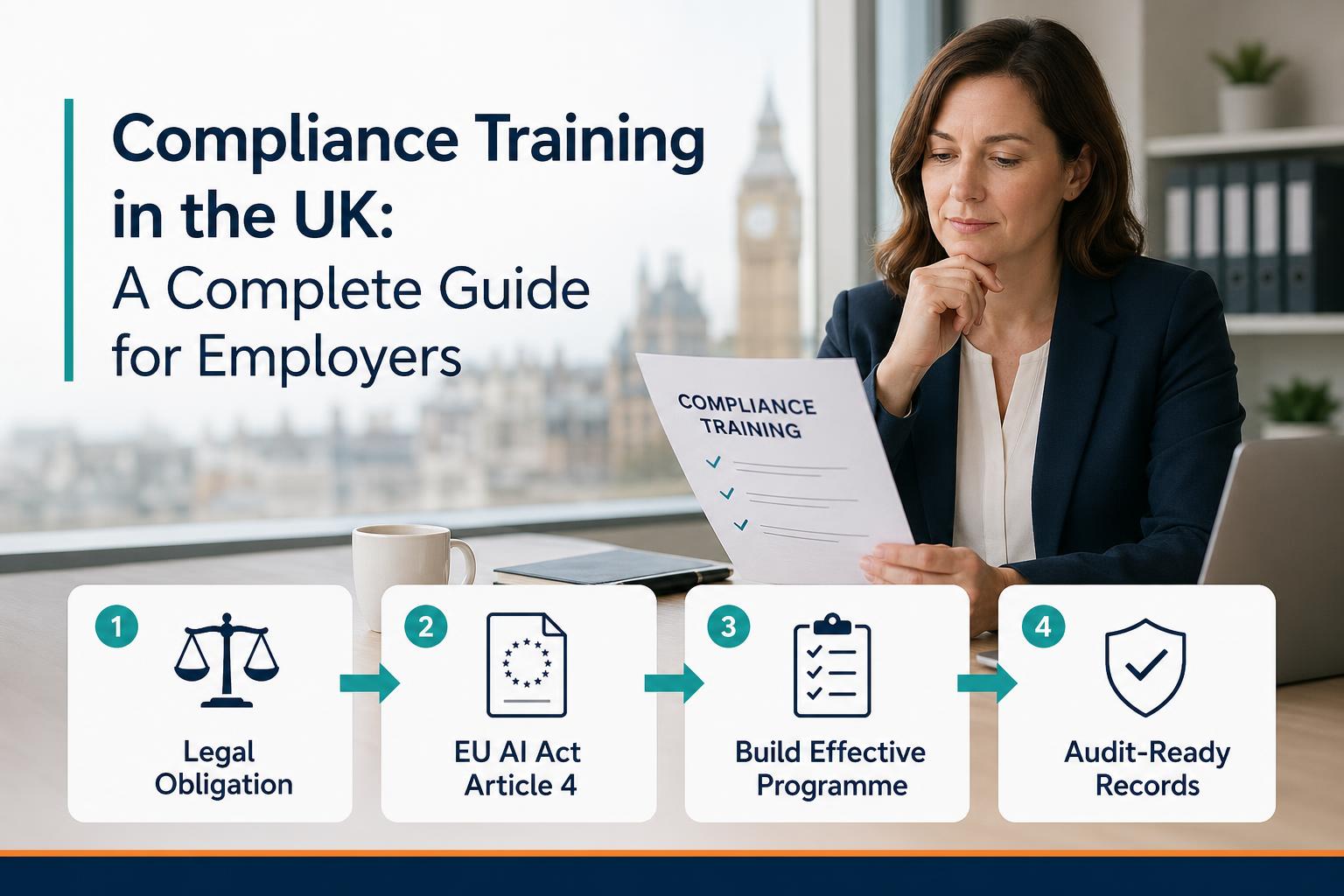
| AI literacy | EU AI Act Article 4 requires sufficient AI literacy for in-scope providers and deployers. Territorial scope and appropriate depth depend on the organisation, system, role and affected people. | Users, approvers, procurement, risk, HR, technical teams and leaders—with different learning outcomes. |
Add sector-specific duties for safeguarding, food safety, clinical practice, transport, construction, education, public service and any professional licence. Also separate legal requirements from insurer, customer, framework and certification conditions: each can be mandatory for the business even when it is not legislation.
Build the programme from roles and risks
- Inventory obligations. Name the legislation, regulator, contract, policy or risk decision behind every requirement.
- Map roles. Assign by exposure and decision authority, not only department or job title.
- Set outcomes. Define what a person must know, decide, perform or escalate after training.
- Choose the intervention. Use a course where teaching is needed; use briefing, supervised practice, drill, job aid or competence observation where those fit better.
- Define proof and frequency. Decide how understanding will be tested, what records will exist, who reviews exceptions and what triggers a refresh.
A new starter may need an all-staff baseline before access is granted. A procurement manager selecting an AI vendor needs scenario-based due diligence and escalation practice. A fire marshal or regulated adviser needs a role-specific standard. Giving all three the same video wastes time and leaves the higher-risk decisions under-trained.
What an audit-ready record should show
- the obligation or risk that created the requirement;
- the employee, role and assignment rule;
- course or intervention title, version and learning outcomes;
- assignment, completion and expiry or review dates;
- participation and assessment result, including attempts where relevant;
- attestation wording, if an attestation is used;
- reasonable adjustment or alternative delivery provided;
- manager follow-up, competence observation or remedial action; and
- approved exceptions with owner, reason and end date.
Retain the actual content version or a controlled reference to it. A row saying “GDPR complete” cannot show what the employee was taught after the course is replaced.
Set refresh cycles from change and evidence
An annual cycle is an organisational control, not a universal legal rule. Use it where the risk case supports it. Also trigger training when:
- law, regulatory guidance or internal policy changes;
- a person changes role, responsibility, location or system access;
- new equipment, suppliers, AI systems or processing activities are introduced;
- an incident, near miss, complaint or audit finding exposes a gap;
- assessment results or observation show weak understanding; or
- material content has changed since the person's last completion.
Measure effectiveness as well as attendance. Sample staff explanations, review decisions and incident patterns, and test whether people use the escalation route correctly. Repeating an ineffective module every year does not improve the control.
The management view
A useful compliance dashboard answers operational questions: Which high-risk people lack a current requirement? Which teams have overdue assignments? Which course version did they take? Which exceptions expire this month? Where are assessment failures clustering? What changed after the last incident?
Start with the downloadable employee training matrix template, then add ownership, evidence links and change triggers. The goal is a defensible chain from obligation to role, learning, understanding and follow-up—not a wall of completion percentages.
Frequently asked questions
What compliance training is legally required for UK employers?
There is no single statutory course list for every employer. Duties depend on hazards, roles and sector. Health and safety law expressly requires adequate information, instruction and training. Other regimes, including data protection, equality, anti-bribery and financial services, create duties or regulator expectations that appropriate training often helps an employer satisfy and evidence. Start with a legal and risk assessment, not a generic annual bundle.
How often should compliance training be refreshed?
Most laws do not prescribe one annual interval. Refresh when risk, law, policy, systems, responsibilities or evidence of understanding changes. High-risk roles may need a shorter cycle. Record why each interval was selected and use incidents, complaints, audit findings and assessment results to trigger earlier retraining.
How long should compliance training records be kept?
Retention depends on the underlying obligation, limitation period, regulatory rule and organisational retention schedule. There is no universal three-, five- or seven-year rule for all training. Keep identifiable records only as long as necessary, document the rationale, restrict access and retain the version of the material and assessment standard as well as the completion date.
Does a completion certificate prove compliance?
Not by itself. A certificate shows an event occurred; it does not show that the right people received role-relevant training, understood it, applied it or were retrained after change. Strong evidence connects needs analysis, assigned content, participation, assessment, follow-up and management action.
Does EU AI Act Article 4 apply to a UK employer?
It can. Article 4 applies to providers and deployers of AI systems within the Act's scope, including some organisations outside the EU where the Act's territorial conditions are met. A UK-only employer should assess scope rather than assume either automatic coverage or exemption. Role- and system-specific AI literacy is also useful governance even where Article 4 does not apply.
Sources & further reading
- Health and Safety Executive — Provide information and training
- Information Commissioner's Office — Training and awareness accountability controls
- Financial Conduct Authority — Training and Competence sourcebook
- European Commission — AI literacy questions and answers
- Equality and Human Rights Commission — Sexual harassment and harassment at work guidance