Last updated: 26 March 2026
What Is Responsible AI Training?
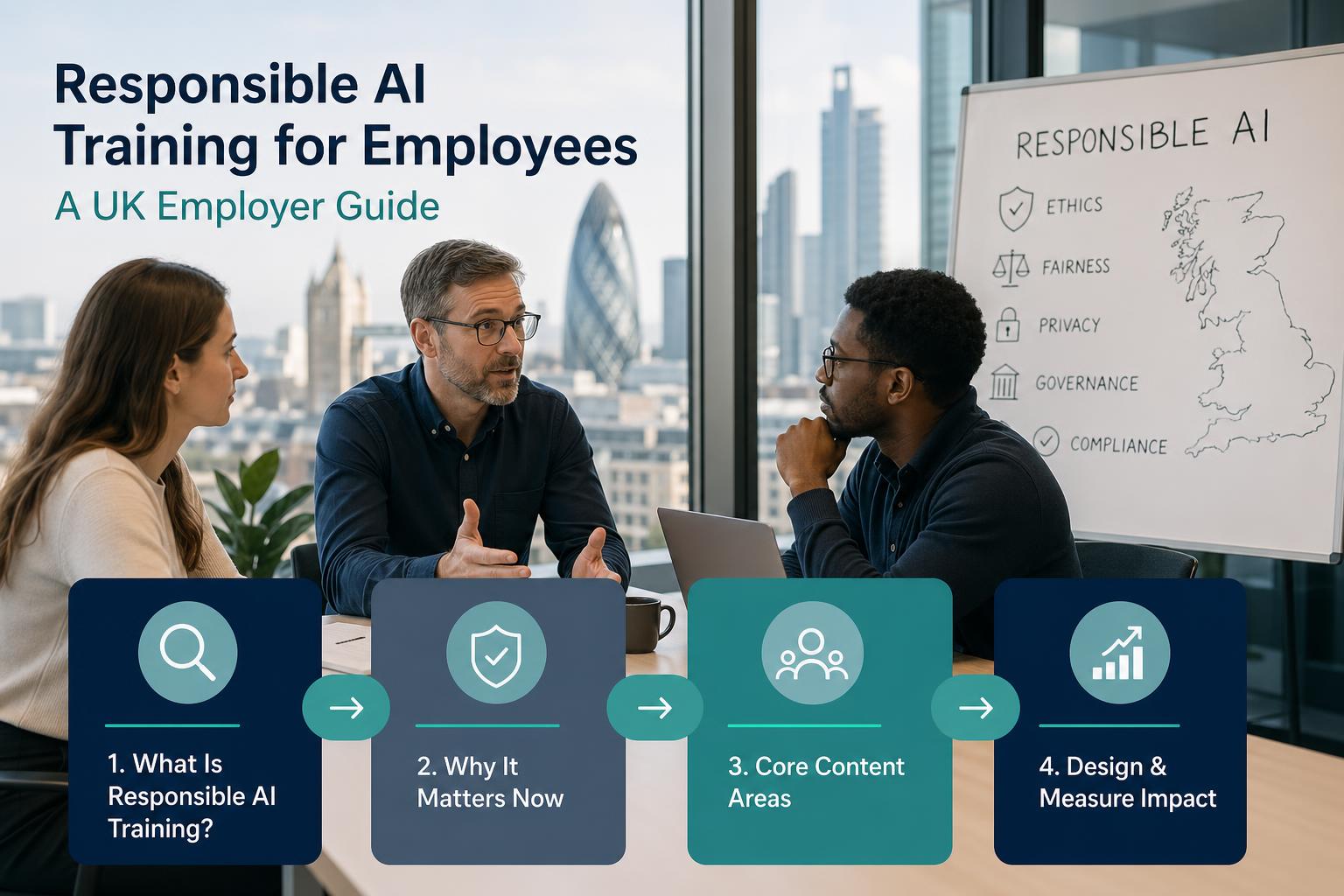
Responsible AI training equips employees with the knowledge and skills to use AI tools in ways that are ethical, safe, and consistent with the organisation’s legal and governance obligations. It is distinct from AI awareness training — which introduces employees to what AI is — and from AI literacy training — which teaches employees to use AI tools effectively. Responsible AI training addresses a third, complementary dimension: the values, judgements, and oversight practices that determine whether AI use creates value or creates risk.
The distinction matters because organisations can deploy AI tools at scale and train employees to use them proficiently while still producing outcomes that are biased, discriminatory, or harmful — if the responsible AI dimension is absent from the training programme. Employees who are technically proficient with AI tools but have not been trained to identify and challenge biased outputs, to protect the data rights of individuals, or to exercise appropriate human oversight of AI-assisted decisions are a governance liability, not just an L&D gap.
Why Responsible AI Training Matters Now
Three converging forces are making responsible AI training an operational necessity in 2026 rather than an aspiration.
Regulatory pressure. The EU AI Act Article 4 specifically requires AI literacy that includes responsible use as a component. The UK ICO has published detailed guidance on AI and data protection that creates practical obligations for organisations using AI to process personal data. The FCA has issued AI-specific supervisory expectations for financial services firms. The CQC is incorporating AI governance into care quality inspections. Sector by sector, the expectation that organisations train staff on responsible AI use is moving from guidance to requirement.
Client and procurement expectations. Large organisations are beginning to include responsible AI training evidence in procurement due diligence. B2B clients, particularly in financial services, healthcare, and the public sector, are asking suppliers to demonstrate that their workforce is trained on responsible AI use as a condition of contract award or renewal. Organisations without a documented responsible AI training programme are increasingly at a commercial disadvantage.
Incident exposure. The volume of AI-related incidents — discriminatory hiring AI outputs, AI-generated content published as fact, personal data submitted to third-party AI tools without authorisation — is growing rapidly. The reputational, regulatory, and legal costs of AI incidents are significant. Organisations with documented responsible AI training programmes are better positioned to demonstrate that they took reasonable steps to prevent foreseeable harm, which is relevant both in regulatory investigations and in civil liability contexts.
Core Content Areas
Responsible AI training for employees should cover five core content areas. These are distinct from the technical content of AI literacy programmes and require different teaching approaches — less tool demonstration, more scenario-based discussion and ethical reasoning practice.
AI bias and fairness. Employees should understand that AI systems learn from historical data, which means they can encode and amplify historical biases. This is not a theoretical risk — it has produced documented harmful outcomes in hiring, credit, criminal justice, and healthcare AI systems. Training should make this concrete using examples from the employee’s own industry or role context. The practical skill is the ability to identify when AI output may be biased and to challenge or escalate appropriately rather than acting on a biased output without question.
Human oversight and the right to challenge AI. A central principle of responsible AI — reflected in the EU AI Act, the UK ICO’s guidance, and the OECD AI Principles — is that consequential decisions affecting individuals should have meaningful human oversight. Employees who make or inform decisions using AI outputs need to understand both their right and their obligation to apply independent judgement rather than treating AI output as definitive. This requires training that builds the habit of critical evaluation, not just the knowledge that evaluation is required.
Data protection and privacy in AI use. AI tools — particularly generative AI and large language models — often process data in ways that are not fully transparent to users. Submitting personal data (of employees, customers, learners, or patients) to third-party AI tools without understanding the data processing implications is one of the most common and consequential responsible AI failures in UK workplaces. Training should equip employees with a clear decision framework: what data is personal data, which tools are approved for personal data use, and what to do when they are unsure.
Transparency and explainability. Employees who use AI to inform communications, decisions, or outputs shared with others — including clients, learners, patients, or the public — have an obligation to be transparent about AI use where it is material. This is not just an ethical principle; it is increasingly a legal one in regulated sectors. Training should address when AI use should be disclosed, how to disclose it appropriately, and what constitutes misleading use of AI outputs.
Escalation and governance. Every employee needs to know what to do when they encounter an AI system that appears to be producing harmful, biased, or erroneous outputs. The escalation pathway — who to tell, how to document the concern, and what to expect as a response — should be specific to the organisation, not generic. Training that identifies the governance structure without making it concrete and operational does not produce the escalation behaviour it intends.
Programme Design: Integrating Responsible AI Into Existing Training
Responsible AI training is most effective when it is integrated into, rather than separated from, the broader AI literacy programme. Standalone responsible AI training — delivered as a one-off ethics module disconnected from the tools employees actually use — tends to produce the same disengagement that afflicts standalone compliance training: completion without behaviour change.
The most effective design integrates responsible AI content into each tier of the AI literacy programme. In the awareness tier, this means including responsible AI principles in the conceptual introduction to AI: what AI can do is taught alongside what can go wrong. In the application tier, it means building responsible AI practice into every tool-specific module: employees practice not just using the tool but evaluating its outputs critically and applying the data protection rules relevant to that specific tool. In the governance tier, it means dedicated responsible AI content for decision-makers: bias identification, oversight obligation, transparency requirements, and escalation governance.
An ethics module that discusses AI bias in the abstract does not produce the same behaviour change as a module on using a specific AI hiring tool that includes concrete examples of bias in that tool category and practised workflows for identifying and challenging biased outputs. Build responsible AI content into your role-specific application modules, not as a separate programme.
Measuring Responsible AI Training Outcomes
Measuring responsible AI training is harder than measuring technical AI literacy, because the outcomes are behavioural rather than demonstrable skills. You cannot observe an employee “applying responsible AI principles” in a quiz question. But you can design measurement that gets close.
Scenario-based assessment — presenting employees with realistic AI-related dilemmas and measuring the quality of their reasoning and decisions — is a significantly better predictor of real-world behaviour than knowledge recall. Pre and post-training scenario assessments allow you to measure whether training has changed reasoning quality. Manager observation assessments — structured conversations between managers and employees about recent AI use — can surface whether responsible AI habits are being applied in practice. Incident reporting rates — the number of AI-related concerns escalated through the governance pathway — are a lagging indicator of whether escalation training has taken effect.
Frequently asked questions
What is responsible AI training?
Responsible AI training equips employees to use AI tools ethically, safely, and in accordance with their organisation’s governance obligations. It goes beyond AI awareness (what AI is) and AI literacy (how to use AI tools) to address the ethical dimensions of AI use: understanding and identifying AI bias, applying data protection principles when using AI, exercising appropriate human oversight of AI outputs, and escalating AI-related concerns. It is increasingly required by regulators, clients, and governance frameworks including the EU AI Act.
How is responsible AI training different from AI literacy training?
AI literacy training focuses on capability — ensuring employees can use AI tools effectively and understand how they work. Responsible AI training focuses on governance — ensuring employees understand the ethical and regulatory obligations that govern AI use, can identify when AI outputs may be biased or harmful, and know how to apply human oversight appropriately. Both are needed; responsible AI training is typically delivered as a layer on top of, rather than instead of, AI literacy training.
Is responsible AI training legally required in the UK?
There is no single UK law that mandates responsible AI training by name. However, a combination of existing legal obligations creates practical requirements: UK GDPR requires organisations to ensure staff understand their data protection obligations when using AI tools; EU AI Act Article 4 requires AI literacy including responsible use for organisations operating in the EU; sector regulators including the FCA, CQC, and Ofsted are increasingly including AI governance in their supervisory frameworks. Organisations deploying AI in high-stakes decisions are most exposed.
Sources & further reading
- ICO: AI and data protection guidance — ico.org.uk
- OECD AI Principles — oecd.ai/en/ai-principles
- GOV.UK: AI Regulation in the UK — gov.uk/government/publications/ai-regulation-a-pro-innovation-approach