Last updated: 26 March 2026
Why Completion Rate Is Not Enough
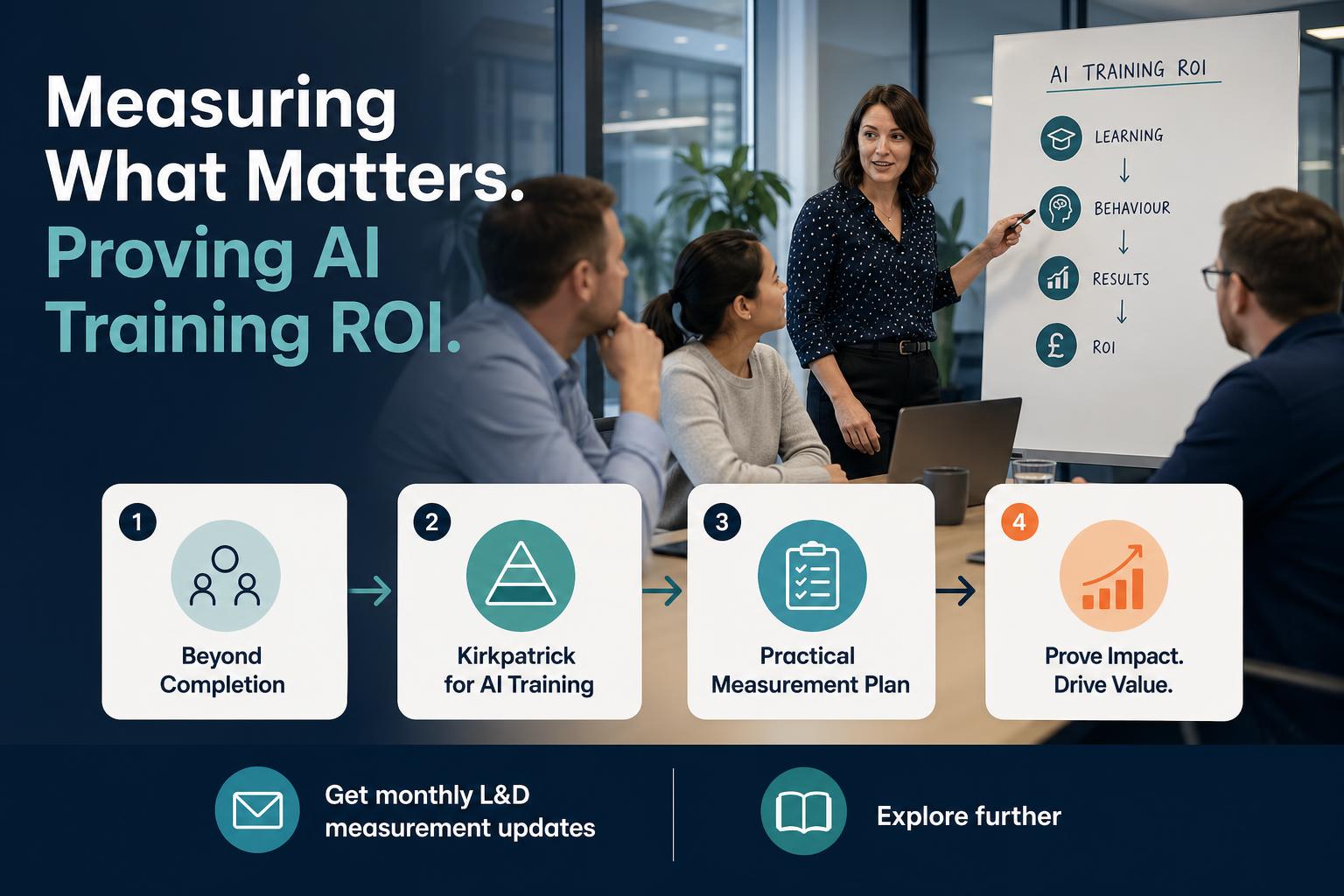
Most organisations measure AI training by completion rate. This is understandable — it is the easiest metric to collect and the one that satisfies governance and audit requirements. But completion rate measures only whether employees attended training. It says nothing about whether they learned anything, whether their behaviour changed, or whether the organisation’s AI capability improved as a result.
The gap between completion and impact is not unique to AI training — it is a well-documented problem across L&D. But it is particularly acute for AI training because the stakes of AI incompetence are higher than for many other training areas. An employee who completes a data protection training module but retains nothing is a compliance risk, but a slow-moving one. An employee who completes AI training but leaves without the ability to critically evaluate AI outputs, recognise hallucinations, or apply appropriate data governance is an active daily risk — because they are using AI tools in their work with false confidence about their ability to use them safely.
The solution is not to abandon completion tracking — it remains important for compliance documentation and programme management. The solution is to build a measurement framework that goes beyond completion to track learning, behaviour change, and business impact.
Adapting the Kirkpatrick Framework for AI Training
The Kirkpatrick model — which organises training measurement into four levels: reaction, learning, behaviour, and results — provides a useful structure for AI training measurement, with some adaptations for the specific characteristics of AI skills.
Level 1: Reaction
Reaction measurement asks: did learners find the training relevant, useful, and engaging? For AI training specifically, the most diagnostic reaction questions are about relevance to actual work rather than general satisfaction. “This training will change how I use AI tools in my role” and “The examples in this training were relevant to my actual work” are more predictive of behaviour change than “I found the training enjoyable.” Low relevance scores at Level 1 are a strong predictor of limited behaviour change, because employees who did not find the training applicable to their role have no reason to apply it. If reaction scores show a relevance gap, the curriculum needs to be more role-specific — not just better presented.
Level 2: Learning
Learning measurement assesses what knowledge and skills employees gained from the training. For AI literacy, this means pre/post assessment that tests actual capability rather than information recall. The most useful assessments are scenario-based: present employees with realistic AI use situations and measure the quality of their decisions, not just whether they can answer a multiple-choice question about AI terminology. A pre/post comparison of scenario assessment scores gives you a direct measure of learning gain that completion rate cannot provide.
For responsible AI training specifically, scenario-based assessments are essential rather than optional. You cannot adequately assess critical evaluation, bias recognition, or escalation judgement with knowledge recall questions. The assessment must involve applying judgement to a realistic situation.
Level 3: Behaviour
Behaviour measurement is the most important level for demonstrating that AI training has delivered real value — and the hardest to do well. The key principle is that behaviour measurement must be grounded in observable, concrete changes in what employees do at work, not self-reported confidence or attitudes.
The most reliable behavioural indicators for AI training are: tool adoption rate — the percentage of trained employees actively using approved AI tools in their work, measured via platform analytics; review rate — evidence that employees are applying human oversight before acting on AI outputs (observable through workflow data, manager observation, or quality review); data governance compliance — absence of unauthorised personal data submissions to AI tools, measured through IT monitoring and incident reports; and escalation behaviour — whether employees are raising AI-related concerns through the governance pathway, which indicates that escalation training has been applied.
Level 4: Results
Results measurement connects AI training investment to business outcomes. This is genuinely difficult — isolating the causal contribution of training to business metrics requires controls that most organisations cannot practically implement. But proxies exist that provide useful directional evidence.
Time savings attributed to AI-assisted work — measured through time tracking or workflow analysis before and after training — is one of the most commonly cited productivity benefits of AI upskilling. Error rates in AI-assisted outputs compared to non-AI-assisted equivalents indicate quality impact. Customer or learner satisfaction scores for products or services that involve AI-assisted delivery provide an output quality signal. These measures will not produce a precise ROI calculation, but they provide a credible narrative of business impact that supports continued investment in AI training.
Every measurement approach described here requires a baseline taken before the training programme begins. Tool adoption rate, error rate, time-on-task, scenario assessment score — all of these require a pre-training baseline to be meaningful. If you start measuring only after training has finished, you have missed the comparison point and your data will tell you where you are, not how far you have come. Build baseline data collection into the programme design from day one.
A Practical Measurement Plan
The AI reskilling ROI calculator gives you a defensible starting figure for the business case, which you can then refine with the baselines this plan produces.
For most organisations, a practical AI training measurement plan looks like this:
Before training: Run a needs assessment that captures baseline AI tool adoption rates, self-assessed confidence levels, and scenario assessment scores across the target population. Collect baseline time-on-task data for roles where productivity impact will be measured. Document baseline incident rates and data governance compliance metrics.
Immediately post-training: Collect reaction scores including relevance ratings. Run the post-training version of the scenario assessment. Record completion rates and assessment pass rates. These are your learning measures.
30 days post-training: Measure tool adoption rates — which trained employees are actively using AI tools in their work? Conduct a short manager observation survey to capture early behavioural signals. Review any early governance incidents. This is your first behaviour measure.
90 days post-training: Full behaviour measurement cycle: tool adoption, quality review rates, data governance compliance, escalation behaviour. Run results measures: time savings data, error rate comparison, output quality scores. This is the measure that tells you whether training has produced lasting change — not just a post-training performance spike that faded without reinforcement.
Frequently asked questions
How do you measure ROI of AI training?
ROI of AI training is best measured across four levels adapted from the Kirkpatrick model: reaction (learner satisfaction and relevance ratings), learning (pre/post knowledge and skill assessment), behaviour (tool adoption rates, quality of AI-assisted outputs, responsible use practices), and results (productivity metrics, error rates, time savings attributed to AI use). Completion rate alone measures only whether employees attended training, not whether it changed anything.
What KPIs should L&D use for AI training programmes?
The most useful KPIs for AI training programmes are: (1) AI tool adoption rate — are employees using approved AI tools in their work post-training? (2) Output quality — are AI-assisted outputs meeting quality standards? (3) Review rate — are employees applying human oversight before acting on AI outputs? (4) Incident rate — are AI-related errors or governance issues being reported? (5) Time-to-proficiency — how long after training do employees reach confident independent use? Set baselines before training starts.
How long after AI training should outcomes be measured?
Measure at three points: immediately post-training (reaction and learning), 30 days post-training (early behaviour change signals: tool adoption, first independent use), and 90 days post-training (established behaviour: consistent use patterns, quality metrics, manager observation). The 90-day measure is the most meaningful indicator of whether training has produced lasting behaviour change rather than short-term performance that fades without reinforcement.
Sources & further reading
- GOV.UK AI Labour Market Survey 2025 — gov.uk/government/publications/ai-labour-market-survey-2025-report
- Kirkpatrick Partners: The Kirkpatrick Model — kirkpatrickpartners.com
- CIPD: Measuring learning effectiveness — cipd.org/en/knowledge/factsheets/evaluation