Last updated: 25 March 2026
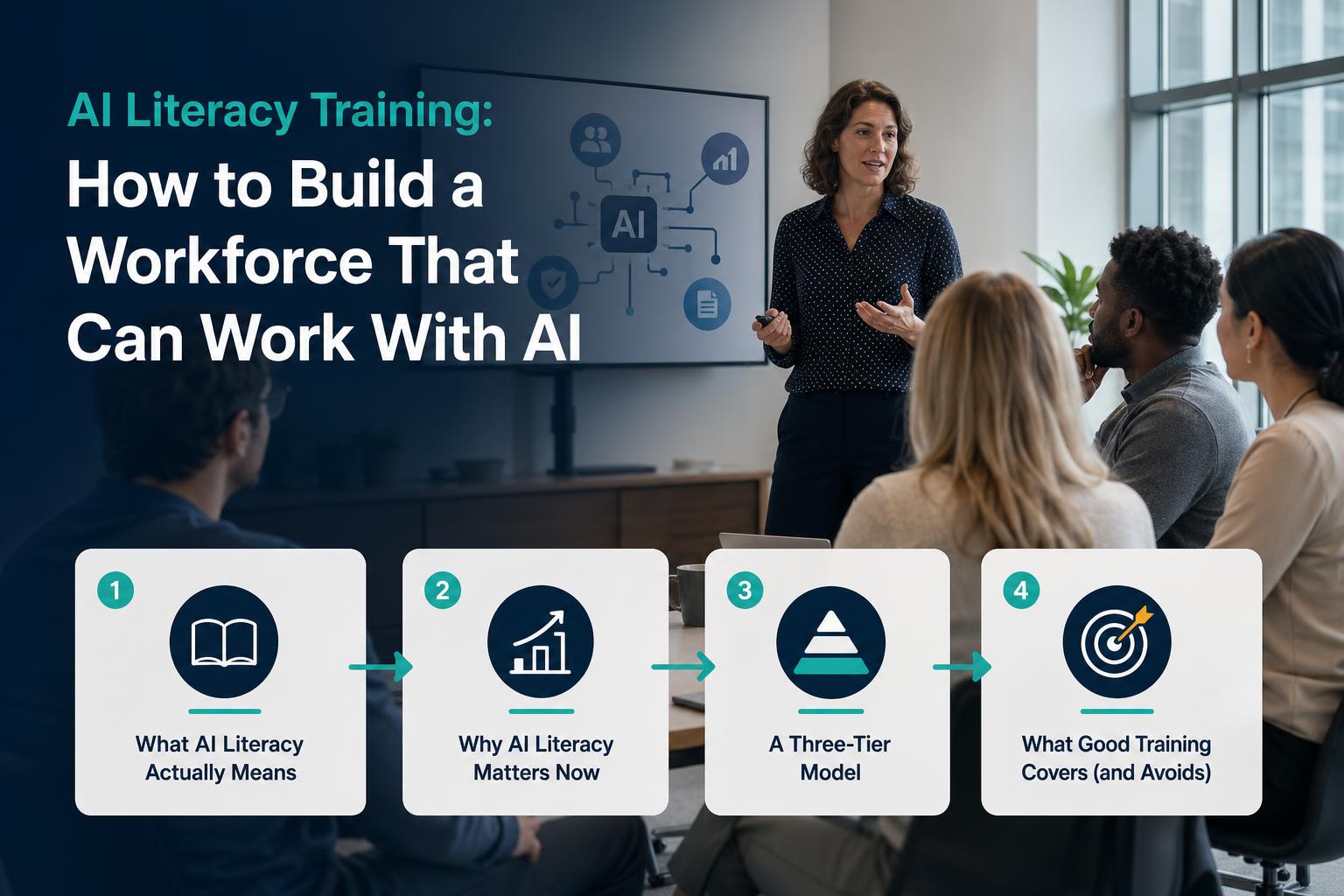
What AI Literacy Actually Means
Ask ten people in a room what AI literacy means and you will get answers ranging from “knowing how to use ChatGPT” to “understanding machine learning algorithms.” Both answers are wrong — or at least insufficient — and the gap between them is where most AI literacy programmes fail before they start.
AI literacy is best understood as a spectrum with three distinct levels. At one end is awareness: understanding what AI tools are, what they can and cannot do, where they are typically applied in your sector, and what the basic risks are. This level is not about using AI — it is about being an informed citizen in an organisation that uses AI. Every employee needs awareness-level literacy.
The middle of the spectrum is application: knowing how to use specific AI tools relevant to your role safely, effectively, and appropriately. This is where role-specific training sits. A marketing manager needs application-level literacy around AI content tools. A finance analyst needs it around AI data interpretation tools. An HR professional needs it around AI screening and reporting tools. Application literacy is not the same for everyone — it is tightly scoped to the tools and workflows of a particular role.
At the advanced end is critical evaluation: the ability to assess AI outputs for accuracy, bias, and appropriateness before acting on them, to identify when AI is likely to be unreliable, and to make informed decisions about when to rely on AI outputs and when to override them. This level is essential for managers, leads, and anyone whose role involves making decisions based on AI-generated information. It requires not just familiarity with tools but an understanding of how AI systems produce their outputs — and why that process has systematic failure modes.
Designing an AI literacy programme without this three-level framework leads directly to the most common failure mode: a single “AI awareness” training session that tells all employees the same thing, regardless of whether their role requires them to use AI tools at all, and regardless of the level of judgment those tools will require.
Why AI Literacy Matters Now
The urgency argument for AI literacy in 2026 is not theoretical. The UK Government’s AI Opportunities Action Plan, published in January 2025, commits to making the UK a global leader in AI adoption — and identifies workforce skills as a primary constraint. The plan explicitly calls on employers to invest in AI skills across their workforces, not just in specialist technical roles. This signals a policy environment in which employer-led AI upskilling is expected, not optional.
The skills gap data reinforces the urgency. CIPD’s Learning at Work Survey consistently identifies digital and technology skills as among the hardest to recruit for, and the gap between AI capability in tools and AI capability in workforces is widening faster than most organisations’ training programmes are closing it. McKinsey’s research on AI in the workplace estimates that the share of tasks that can be partially or fully automated by AI has grown significantly in the past two years — but actual adoption in organisations lags behind technical possibility precisely because the workforce does not yet have the skills to use new tools effectively.
There is also a risk dimension that makes AI literacy training a governance necessity rather than just a competitive advantage. Employees who use AI tools without understanding their failure modes create risks that are genuinely costly: AI-generated content published as factual that contains errors, GDPR violations arising from personal data being submitted to third-party AI systems, and decisions made on AI outputs that were not appropriately reviewed. These are not hypothetical scenarios — they are well-documented organisational incidents from 2024 and 2025, and they are disproportionately likely in organisations that deployed AI tools without accompanying literacy training.
A Three-Tier Model for Workforce AI Literacy
Translating the awareness-application-critical evaluation spectrum into a practical training architecture produces a three-tier model that most organisations can implement within existing L&D resource constraints.
Tier 1: Awareness (all staff)
The awareness tier is a recommended organisation-wide baseline, calibrated to who actually deals with AI systems and how. It covers: what AI tools are and are not, how the organisation uses or plans to use AI, approved tools and data boundaries, and how to escalate uncertainty. A short module may be sufficient for a low-exposure role, while other roles need deeper learning. The EU AI Act does not prescribe a universal course or duration; where Article 4 applies, measures should reflect existing knowledge, context and risk.
Tier 2: Application (role-specific)
Application modules are designed by role family, not by individual. Group employees into clusters based on the AI tools they will encounter in their work: content and communications roles, data and analytics roles, customer-facing roles, operational and logistics roles, and so on. Each cluster receives a 4–8 hour application module delivered over several weeks — not in a single day — that covers practical use of the specific AI tools relevant to that role, with worked examples drawn from actual role tasks. Prompt engineering basics belong here for roles that involve using generative AI: not the sophisticated multi-step prompt chaining that technical users employ, but the practical skill of giving AI tools sufficient context and constraints to produce useful outputs. This module is also where GDPR implications are made concrete and specific: which data types must not be submitted to which tools, why, and what the consequences are.
Tier 3: Governance (managers and leads)
Managers and leads who are responsible for decisions informed by AI outputs, or for teams using AI tools, need additional training that goes beyond awareness and application. The governance tier covers: how to evaluate AI outputs critically rather than accepting them at face value, how to identify likely failure modes in the specific tools their team uses, how to build review processes into AI-assisted workflows, how to discuss AI use with their team including addressing concerns and resistance, and how to escalate potential AI governance issues. This tier is typically delivered as a facilitated workshop rather than e-learning, because the critical evaluation skills it builds require discussion and practice rather than information consumption.
What Good AI Literacy Training Actually Covers
Beyond the tier structure, there are specific content areas that distinguish AI literacy training that changes behaviour from AI literacy training that fills a calendar slot.
How AI works at a conceptual level. Employees do not need to understand gradient descent or neural network architecture. They do need to understand that large language models are pattern-completion engines, not knowledge retrieval systems — and that this distinction explains why AI can produce a fluent, confident, grammatically correct sentence that is factually false. This conceptual model takes twenty minutes to teach and explains the majority of AI failure modes that employees will encounter. Without it, employees tend to either over-trust AI outputs (because they are coherent and authoritative in tone) or dismiss AI tools entirely (because the first failure they encountered destroyed trust). The conceptual model provides the calibration that makes appropriate use possible.
Where AI fails and hallucinates. Every AI literacy programme should include a section specifically on hallucination — the technical term for AI generating confident but false information — with worked examples from the specific content domains employees work in. Abstract examples do not create vigilance. Seeing a convincing AI output about a topic you know well, and realising it contains a specific factual error, does.
Data privacy and GDPR implications. This is not a theoretical concern. UK GDPR requires that personal data be processed lawfully, and submitting employee, learner, or customer personal data to a third-party AI system without a data processing agreement in place is a potential breach. Many AI tools process data in ways that are genuinely unclear, and training should equip employees with a simple decision rule: if you are not sure whether data is personal data, treat it as if it is, and if you are not sure whether a tool is approved for personal data, do not use it for that data until you have confirmation.
Practical tool use for specific roles. AI literacy training that never involves actually using tools is not adequate preparation for using those tools at work. Role-specific modules must include hands-on practice with the actual approved tools employees will use, with scenarios drawn from their real work context. Sandbox environments where employees can experiment without the risk of live errors are valuable here.
Prompt engineering basics. The ability to give AI tools sufficiently specific, contextual instructions to produce useful outputs is a learnable skill that most employees do not have without explicit training. A two-hour module on the principles of effective AI prompting — providing context, specifying format, setting constraints, iterating on outputs — produces measurable improvements in the quality of AI-assisted work and reduces the frustration that leads employees to abandon AI tools after initial disappointing results.
Common Mistakes in AI Literacy Programmes
The organisations that report disappointing outcomes from AI literacy training tend to have made one or more of a small set of identifiable mistakes.
One-size training for a diverse workforce. An organisation where some employees use AI tools daily and others have not yet encountered them in their work cannot run a single AI literacy module and call the programme complete. The awareness tier is universal; everything above it must be differentiated. Delivering advanced application content to employees who have no near-term use case for it produces exactly the “this doesn’t apply to me” disengagement that kills training programmes.
Too technical for non-technical staff. L&D teams often commission AI literacy content from technology specialists who are genuinely expert but who calibrate content for their own level of prior knowledge. A module that spends time on transformer architecture, embedding spaces, or token limits will lose most of a non-technical audience in the first section. The conceptual models that matter for workplace AI literacy are accessible to everyone — but they need to be taught, not assumed.
No reinforcement mechanism. The most significant predictor of whether AI literacy training changes behaviour is whether it is reinforced after the initial module. A single training event — however well-designed — does not produce sustained behaviour change in adults. Spaced repetition, manager coaching, team discussions about AI use, and short refresher microlearning modules are the mechanisms that convert initial awareness into lasting practice. Organisations that run AI literacy as a one-off compliance checkbox and then move on should expect compliance checkbox outcomes: completion rates without behaviour change.
The awareness module can be delivered in a day. The habits, judgments, and practical skills that make that awareness useful at work take months to build. Plan your programme accordingly: initial module, role-specific application, spaced reinforcement, manager coaching, and a formal review of behaviour change at 90 days. Organisations that invest in the full programme consistently report better outcomes than those that treat AI literacy as a box to tick.
Designing the Programme
A practical AI literacy programme design starts with a needs assessment, not a content brief. Before commissioning or building content, answer three questions: which roles in the organisation are already using AI tools, which roles will be using AI tools within the next 12 months, and what are the highest-risk AI use cases in terms of data governance and output quality? These answers determine the tier structure, the sequence, and the priority.
On content format, the evidence for microlearning is relevant here. AI literacy content that is chunked into 10–20 minute modules, delivered over several weeks rather than in a single day, and interspersed with practical application tasks produces significantly better retention than equivalent content delivered as a half-day or full-day event. This is not a formatting preference — it reflects the conditions under which adult learning produces durable memory. Spaced repetition of key concepts (such as the hallucination model, the data privacy rules, and the prompt engineering principles) should be built into the design from the start, not added retrospectively.
On measurement, the most important principle is that completion is not an outcome. Measuring whether employees completed the AI literacy modules tells you nothing about whether the programme achieved its purpose. Define behavioural outcomes before the programme launches: what should employees be doing differently as a result of this training? Then build measurement around those behaviours — tool adoption rates, AI output review practices, data governance compliance, and manager observation of team practice. Set baselines before the programme and review at 30, 60, and 90 days after completion.
UK Learning and Funding Routes
AI Skills Boost lists free partner courses that can support general learning, although employers still need to add their own tools, policy, data boundaries and escalation routes. Skills Bootcamps are separately commissioned programmes lasting up to 16 weeks; local availability and content vary. For an existing employee, the published employer contribution is normally 10% for an organisation with 1–249 employees and 30% for an organisation with 250 or more.
Do not describe the Growth and Skills Levy as a generic AI literacy budget. Its current approved products are apprenticeships, foundation apprenticeships and the exact apprenticeship units listed by Skills England. The live AI leadership units are for qualifying employed leaders, and ST1512 is a full Level 4 apprenticeship for a genuine AI and automation occupation. Use commercial or internally developed learning where no approved product fits.
AI Literacy Programme Design Checklist
Before launching your AI literacy programme, work through this checklist:
- Needs assessment completed — roles mapped to AI tools in current or near-term use
- Three-tier structure planned — awareness (all staff), application (role-specific), governance (managers/leads)
- Conceptual model for how AI works included — accessible to non-technical employees
- Hallucination and failure mode content included with role-specific examples
- GDPR and data handling rules translated into specific, actionable employee guidance
- Hands-on practice included — not purely information-transfer content
- Microlearning format with spaced delivery — not a single all-day event
- Behavioural outcomes defined and measurement baseline set before launch
Frequently asked questions
What is AI literacy in the workplace?
AI literacy in the workplace is the ability to understand what AI tools do, where they are reliable, where they fail, and how to use them appropriately within a specific role. It is not the same as AI programming or data science skills. A working definition spans three levels: awareness (understanding what AI is and what it is not), application (knowing how to use specific AI tools relevant to your role safely and effectively), and critical evaluation (being able to assess AI outputs for accuracy, bias, and appropriateness before acting on them). Most employees need awareness and application-level literacy; governance and leadership roles also need critical evaluation capability.
How long does AI literacy training take?
AI literacy training is not a one-day event. For meaningful behaviour change across a workforce, organisations should plan for a 6–12 month programme. This typically begins with a 2–4 hour awareness module for all staff, followed by role-specific application modules of 4–8 hours spread over 6–8 weeks, and then ongoing reinforcement through microlearning, team practice, and manager coaching. The awareness module can be delivered in a day; the behaviour change that makes that awareness useful takes months of reinforcement.
How do you measure AI literacy outcomes?
The most common mistake is measuring AI literacy by completion rate or quiz score. These measure whether learners attended and whether they can recall information; they do not measure whether behaviour has changed. Effective measurement of AI literacy outcomes looks at: (1) tool adoption rates — are employees actually using approved AI tools in their work? (2) output quality — are AI-assisted outputs being reviewed appropriately before use? (3) error rate — are AI-generated errors being caught before they reach customers or create compliance problems? (4) manager observation — are teams applying critical evaluation habits when working with AI outputs? Set baselines before the programme and measure at 30, 60, and 90 days after completion.
Sources & further reading
- GOV.UK AI Opportunities Action Plan — gov.uk/government/publications/ai-opportunities-action-plan
- European Commission: AI literacy questions and answers — digital-strategy.ec.europa.eu
- GOV.UK: AI Skills Boost explainer — gov.uk
- CIPD Learning at Work Survey — cipd.org/en/knowledge/reports/learning-work-survey
- McKinsey Global Institute: The economic potential of generative AI — mckinsey.com/capabilities/mckinsey-digital/our-insights