Last updated: 15 July 2026
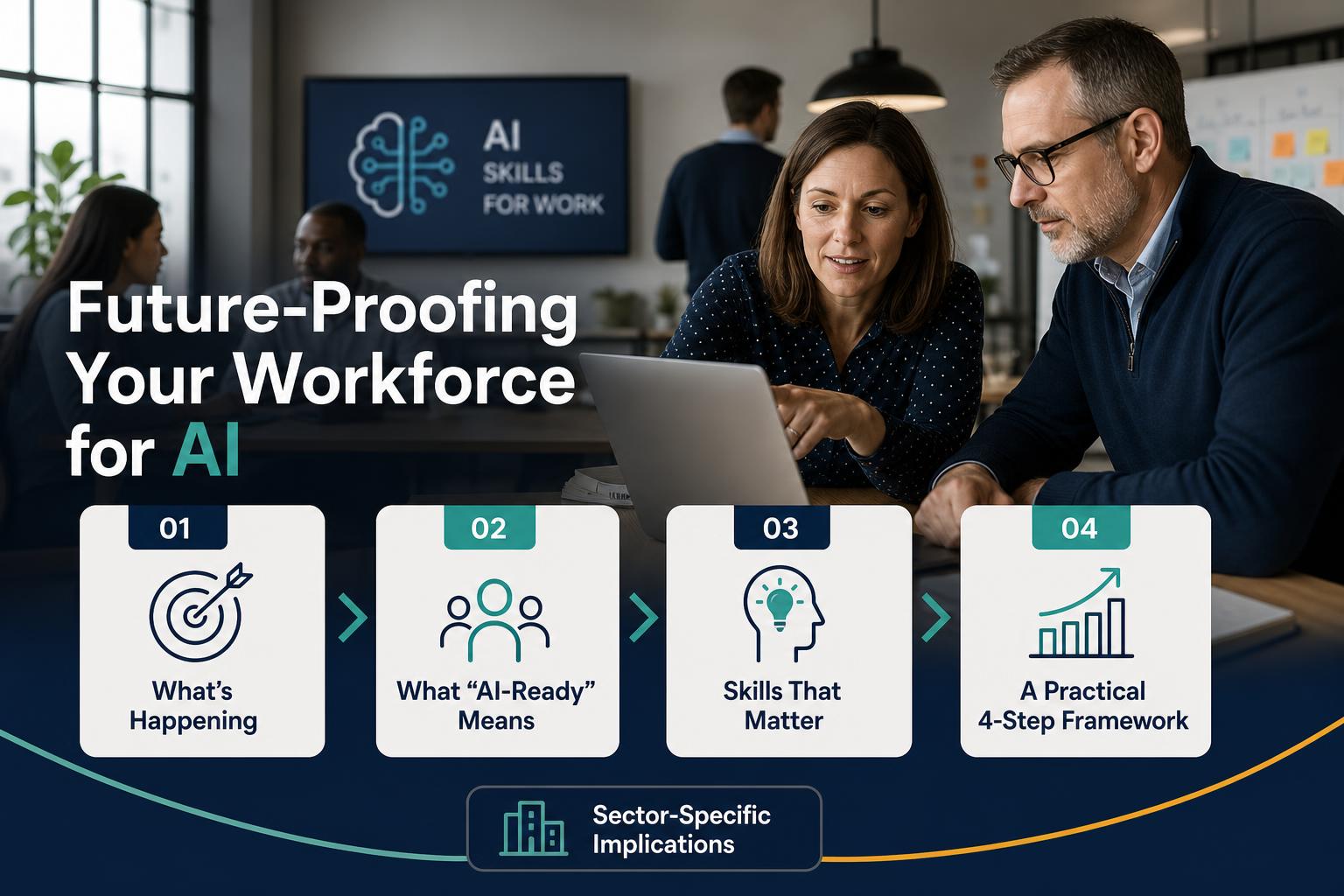
The Context: This Is Already Happening
The framing of AI as a future workforce challenge is no longer accurate. In 2026, the change is not imminent — it is in progress. The World Economic Forum’s Future of Jobs Report documents the accelerating pace at which AI is augmenting, displacing, or restructuring tasks across every major sector. What was projected as a medium-term shift has become a present-tense operational reality for most knowledge-intensive organisations.
This matters for how HR and L&D approach the challenge. Framing AI readiness as preparation for a future state produces programmes that are too slow, too cautious, and too theoretical. The more useful frame is: what do our people need to be able to do right now, given the AI tools that are available to them and the AI-augmented workflows they are increasingly operating in? That is a present-tense skills gap, not a speculative one, and it requires a present-tense response.
The gap between AI capability in tools and AI capability in workforces is real and measurable. McKinsey’s research consistently shows that adoption of AI tools in organisations lags well behind their technical availability — and that the primary constraint is not technology but skills. Employees who have not been equipped to use AI tools effectively either do not use them, use them incorrectly, or use them in ways that create governance and quality risks. In all three cases, the organisation is not getting the productivity and quality benefits the tools are capable of delivering, and may be accumulating risk.
The stakes of inaction are higher than they appear in most internal discussions. Organisations that build AI-ready workforces faster than their competitors gain a compound advantage: AI-assisted employees become more productive, which creates capacity for further learning and adoption, which accelerates the gap with organisations that have not yet started. This is not a linear catch-up dynamic — it is an accelerating one.
What “AI-Ready” Actually Means for Most Organisations
The phrase “AI-ready workforce” generates anxiety in organisations that interpret it as meaning every employee needs data science skills or a working knowledge of machine learning. This interpretation is wrong, and it paralyses organisations that could otherwise make rapid progress.
AI readiness for most workforces is not about replacing existing skills with technical ones. It is about augmenting existing roles with AI capabilities — and that requires a different, narrower, and more achievable set of skills than the technical framing suggests. A customer service representative who can use AI-assisted response drafting tools to reduce handle time by 30% without sacrificing quality does not need to understand how large language models work. They need to know how to use the specific tool in their workflow, when to trust its outputs, when to override it, and what not to put into it. That is a training challenge, not a recruitment challenge.
The skills gap between current workforce capability and AI-ready workforce capability is primarily an application and judgment gap, not a technical knowledge gap. Employees need: AI literacy sufficient to use approved tools safely and effectively; adaptability habits that allow them to integrate new tools into their workflows without extended resistance periods; critical thinking skills to evaluate AI outputs appropriately rather than either blindly accepting or reflexively rejecting them; communication skills to work effectively in environments where some outputs are AI-generated; and human judgment in AI-assisted decision workflows — the ability to identify when a decision requires human authority rather than automated output.
These are skills that L&D teams know how to build. They are not new disciplines. The novelty is the context in which they are applied — and the urgency with which they are needed.
The Skills That Matter Most
Five skill areas are consistently identified by research and by practitioner experience as the most important for AI-ready workforces. Each requires a different training design approach.
AI literacy is the foundational layer. Without sufficient understanding of what AI tools do and where they fail, employees cannot use them effectively or safely. Awareness-level AI literacy — understanding that AI pattern-matches rather than “knows,” that it hallucinates with confidence, and that data privacy rules apply to everything submitted to it — is the minimum viable foundation. Role-specific application training builds on this. (See our separate guide on designing AI literacy programmes for a detailed treatment of this area.)
Adaptability as a developed capability, not just a personality trait, matters because the specific AI tools and workflows in use will continue to change. Employees who have a rigid relationship with their tools and processes — who require extended time and support to integrate changes — will face recurring disruption as AI capabilities evolve. Adaptability is trainable: it requires repeated experience of learning new tools in low-stakes environments, with positive reinforcement for the behaviours of experimentation, asking for help, and iterating from imperfect first attempts.
Critical thinking applied to AI outputs is distinct from general critical thinking because it requires specific knowledge of where AI systems fail. Employees who know that AI can produce plausible but incorrect factual claims, biased assessments based on training data, and confident-sounding outputs in areas of genuine uncertainty are much better equipped to catch errors before they propagate. This is a specific, teachable sub-skill — not a generic reference to “thinking carefully.”
Communication in AI-augmented workflows matters because the dynamic of how teams communicate is changing as AI-generated content becomes part of the information environment. Employees need to be able to identify when content is AI-generated, to evaluate it appropriately, and to communicate clearly about the provenance and limitations of information they share. This is becoming a basic professional competency.
Human judgment in AI-assisted decisions is the highest-stakes skill in this set. As AI tools take on more of the analytical and data-processing aspects of decision workflows, the distinctly human contribution becomes the exercise of judgment: weighing competing considerations, accounting for context that the AI cannot access, and taking responsibility for outcomes. Building this skill requires scenarios in which employees practice making judgment calls in AI-assisted workflows — not just understanding abstractly that human judgment matters.
A Practical 4-Step Framework
The organisations that make the most effective progress on AI readiness tend to follow a similar pattern. The steps below are not novel, but the discipline of following them in order — rather than jumping to step 3 or 4 — is what separates programmes that produce measurable outcomes from those that produce completion rates.
Step 1: Audit current capabilities against AI-augmented role requirements
Before designing training, establish what you are working with and what you are aiming for. This means conducting a role-by-role review of: which tasks in each role are already being or could be AI-augmented; what skills employees in those roles currently have relative to what effective AI-augmented performance requires; and where the highest-priority gaps are in terms of both risk and opportunity. This audit does not need to be exhaustive or perfectly precise — a working estimate is sufficient to set training priorities. What it must not be is skipped in favour of immediately building content.
Step 2: Prioritise the highest-impact gaps
The capability audit will reveal more gaps than can be addressed simultaneously. Prioritise based on two dimensions: impact (where will closing this gap produce the most organisational value?) and risk (where is the current gap creating the most exposure?). Roles that are already using AI tools with significant governance risk — submitting personal data to unapproved systems, publishing AI-generated content without review — are high priority on the risk dimension regardless of their value ranking. Roles that are closest to customer-facing or revenue-generating processes typically rank highly on the impact dimension. Focus the first phase of the programme on the intersection of high impact and high risk.
Step 3: Design blended learning that builds behaviours, not just awareness
The training design principle that distinguishes effective AI readiness programmes from ineffective ones is a relentless focus on behaviour change rather than information transfer. An employee who has watched a 30-minute AI awareness video and scored 80% on a quiz has acquired information. An employee who has practised using an AI tool in a realistic work scenario, received feedback on their prompt quality and output review process, and applied those skills in their actual work the following week has changed their behaviour. These are very different outcomes, and only one of them makes the organisation more AI-ready.
Blended designs that combine short digital learning modules with facilitated practice sessions, peer discussion, and manager coaching produce better behavioural outcomes than purely digital programmes — particularly for the judgment and evaluation skills that cannot be built through information consumption alone. Spaced delivery over weeks rather than a single immersive day produces better retention. Scenario content drawn from actual role tasks produces better transfer to the job than generic examples.
Step 4: Measure at behaviour level, not activity level
Define what AI-ready behaviour looks like for each priority role before the programme launches, and build measurement around those definitions. Activity metrics — completion rates, quiz scores, session attendance — are not measures of AI readiness. They are measures of programme delivery. Outcome metrics — tool adoption rates, output review behaviour, time on AI-augmented tasks, manager observation of critical evaluation practice — are measures of AI readiness. The organisations that can demonstrate genuine progress on AI readiness to their boards and leadership teams are the ones that invested in outcome measurement from the start, not the ones that can produce impressive completion dashboards.
Sector-Specific Implications
What AI readiness looks like in practice varies significantly by sector, and AI readiness programmes that ignore this variation tend to produce generic content that resonates poorly with the specific roles and contexts employees are working in.
In manufacturing and logistics, AI readiness focuses on human-machine interface skills, AI-assisted quality inspection, and predictive maintenance tools. The critical evaluation skills needed here are different from knowledge work: employees need to be able to interpret AI-generated anomaly flags, understand the confidence levels associated with AI predictions, and make appropriate escalation decisions when AI systems flag potential issues.
In professional services (legal, financial, consultancy), AI readiness centres on AI-assisted research and drafting, data interpretation, and client communication. The highest risk in this sector is over-reliance on AI-generated content in high-stakes documents — so the critical evaluation and review skills are paramount. GDPR and confidentiality implications of using AI tools with client data are also particularly acute.
In healthcare and social care, AI readiness must be designed with extreme care around clinical decision-support tools. The governance tier is especially important: clinical staff need to understand the appropriate role of AI in decision workflows, the limits of AI clinical recommendations, and the professional and legal responsibilities that cannot be delegated to AI systems. The training design for healthcare AI readiness is fundamentally different from corporate L&D — it requires clinical governance input from the start.
In education and training, AI readiness affects both how staff work — AI-assisted content development, marking support, administrative tools — and how they support learners in working with AI appropriately. Training providers and education institutions have a dual challenge: building their own workforce’s AI readiness while also developing their approach to AI literacy for learners.
The Manager’s Role in AI Readiness
No AI readiness programme achieves its objectives without manager buy-in and capability. Managers are the primary reinforcement mechanism for training — the people who make it possible or difficult for employees to apply new skills in their work, who model the behaviours they expect from their teams, and who create or undermine the psychological safety required for employees to experiment with new tools and be honest about what is not working.
The manager AI readiness programme is not the same as the programme for individual contributors. Managers need: the same AI literacy as their team members, plus the ability to evaluate AI-assisted outputs produced by their team and to identify when review is adequate or inadequate; skills to lead teams through the discomfort and uncertainty of AI adoption — addressing fears about job security, managing the variability in adoption rates across team members, and maintaining fairness in how performance is evaluated when some employees are more AI-augmented than others; and the governance awareness to identify when AI use in their team is creating organisational risk and to escalate appropriately.
The most effective AI readiness programmes invest in manager capability first, before the organisation-wide rollout. Managers who understand the programme, believe in it, and have the skills to support their team’s adoption are the single most important factor in whether the programme achieves behaviour change or simply achieves completion.
Organisations that frame AI readiness as “deciding which roles to protect from AI” are solving the wrong problem. The organisations with a durable competitive advantage are those whose workforces can continuously integrate new AI capabilities as they emerge — because they have built the meta-skills of learning, experimentation, and critical evaluation that make rapid adoption possible. That is a training design objective, not a technology deployment objective.
UK Policy Context
The UK Government’s AI Opportunities Action Plan, published in January 2025, includes actions on AI skills and talent. It creates a useful policy signal for employers, but it does not impose a general legal duty on every employer to run a particular workforce-training programme.
Under the 2026/27 Growth and Skills Levy rules, employers can use eligible funds for approved products: apprenticeships, foundation apprenticeships and the apprenticeship units that have actually been approved. That is not a general allowance for any short AI course. Check the live product, learner and provider eligibility before describing an intervention as levy-funded; use commercial funding where no approved route fits.
Skills Bootcamps may provide a separate route where an appropriate locally available programme accepts employer-sponsored learners. Current national employer guidance says employers contribute 10% for an SME with 1 to 249 employees or 30% for an employer with 250 or more employees. Bootcamps are separate from an employer’s levy account, so confirm availability and terms with the relevant provider or commissioner.
What Organisations Get Wrong: 4 Pitfalls
Treating it as a one-off project. AI readiness is not a project with a completion date. AI capabilities continue to evolve, the tools available to employees continue to change, and the skills required to use them effectively continue to develop. Organisations that complete their AI readiness programme and then stop investing in ongoing development will find themselves back at the start within 18–24 months. Build AI readiness into the ongoing L&D and performance management cycle from the beginning.
Focusing on tools instead of behaviours. The goal of AI readiness training is not that employees know how to use specific tools. It is that employees behave differently — that they use AI tools appropriately, review outputs critically, handle data safely, and make better decisions because of AI augmentation. Tool knowledge is a means to this end, not the end itself. Training programmes that focus exclusively on how to use specific tools produce employees who know how to use those specific tools — and are no better equipped when the tools change.
Ignoring middle management. The most common failure mode in AI readiness programmes is excellent content, poor adoption, and the root cause is middle management. When managers are not equipped to support their team’s AI adoption — or actively resist it — the programme’s impact on the front line is minimal regardless of how well designed the content is. Investing in manager capability is not optional; it is the prerequisite for everything else working.
No measurement framework. Organisations that cannot measure AI readiness cannot manage it. The absence of outcome metrics means that programme decisions — what to invest in, what to change, what to stop — are made on anecdote and assumption rather than evidence. This is fixable with modest investment in defining behavioural outcomes and setting measurement baselines before the programme launches. It is much harder to fix retrospectively after the programme is already running.
5 Actions to Start This Quarter
If your organisation has not yet started a structured AI readiness programme, these are the five actions that will create the most progress in the next 90 days:
- Run the capability audit. Identify the 5–10 roles in your organisation where AI augmentation is already happening or will happen within 12 months. Map the specific AI tools in use or planned. Document the capability gaps for those roles. This takes two to three weeks and is the foundation for everything else.
- Define your AI-ready behavioural outcomes. For each priority role, write a concrete description of what AI-ready performance looks like. What does the employee do differently? What behaviours indicate they are using AI tools appropriately? These definitions become your measurement framework and your training design brief.
- Brief and equip your managers. Before the organisation-wide programme launches, run a half-day workshop for the managers of priority roles. Ensure they understand the programme, believe in its value, have the AI literacy to support their teams, and know how to coach AI adoption. This investment will multiply the impact of every subsequent step.
- Run one pilot with one role family. Do not attempt to roll out the full programme simultaneously. Choose one role family, run the application module, measure behavioural outcomes at 30 and 60 days, and use what you learn to improve the programme before scaling. The pilot phase is where you find the content gaps, the resistance points, and the measurement challenges — better to find them with 20 people than 2,000.
- Set your 12-month programme plan. Based on the capability audit, the behavioural outcome definitions, and the pilot learnings, build the 12-month delivery plan: which role families, in what sequence, with what content, with what measurement approach, and with what governance. Present this to leadership as a business initiative with a value case attached — not as a training calendar.
Frequently asked questions
What does an AI-ready workforce actually look like?
An AI-ready workforce is not one where every employee is a technical AI specialist. It is one where employees at all levels have sufficient AI literacy to work effectively alongside AI tools in their specific roles, where managers understand how to lead teams through AI adoption and how to evaluate AI-assisted outputs, and where the organisation has the processes and governance in place to use AI tools responsibly. Practically, this means: awareness of what AI tools are and are not, role-specific skills to use approved tools safely and effectively, critical evaluation habits for assessing AI outputs before acting on them, and a culture that supports experimentation and learning from AI use rather than punishing errors.
How long does it take to future-proof a workforce for AI?
There is no point at which workforce AI readiness is complete — AI capabilities continue to evolve and the skills required to use them effectively evolve with them. A realistic planning horizon for the first phase of AI readiness is 12–18 months: initial awareness training across the workforce (2–3 months), role-specific application training (3–6 months), management capability building (ongoing from month 1), and a first formal review of behavioural outcomes against the baseline (month 12). After that, AI readiness becomes part of the ongoing L&D and performance management cycle rather than a discrete project.
How do you measure whether your workforce is becoming AI-ready?
The most useful measures of AI readiness are behavioural, not knowledge-based. Track: tool adoption rates (are employees actually using approved AI tools in their work, and at what frequency?), output review behaviour (are AI-generated outputs being reviewed before use, or published directly?), escalation behaviour (are employees raising AI governance concerns appropriately?), and performance indicators that are plausibly connected to AI-assisted work (time on specific tasks, error rates, output quality scores). Completion rates for AI literacy training tell you nothing about AI readiness. Manager observation data and 360 feedback on AI-related behaviours are more useful than any automated metric.
Sources & further reading
- GOV.UK AI Opportunities Action Plan — gov.uk/government/publications/ai-opportunities-action-plan
- World Economic Forum: Future of Jobs Report — weforum.org/reports/the-future-of-jobs-report-2025
- CIPD Learning at Work Survey — cipd.org/en/knowledge/reports/learning-work-survey