Last updated: 19 March 2026
Why ROI Has Become the Critical Question for L&D
L&D has always needed to justify its budget. But in 2026, that justification has to survive a much more rigorous interrogation than in previous years. CFOs who approved broad learning budgets during pandemic-era workforce transformation are now asking harder questions: What did we actually get? Which programmes changed behaviour? Where did we overspend on delivery?
At the same time, AI-powered training platforms have matured to the point where a genuine like-for-like comparison with traditional delivery is possible. The data on cost-per-learner, completion rates, and time-to-competency is no longer limited to vendor case studies — independent research bodies have accumulated enough evidence to support a credible analytical framework.
This article is written for CLOs, HR directors, and L&D managers who need to make a defensible budget decision — not one driven by enthusiasm for technology or by institutional resistance to change. The honest answer to “is AI training better ROI than traditional training?” is: it depends, and here is a framework for working out the answer in your specific context.
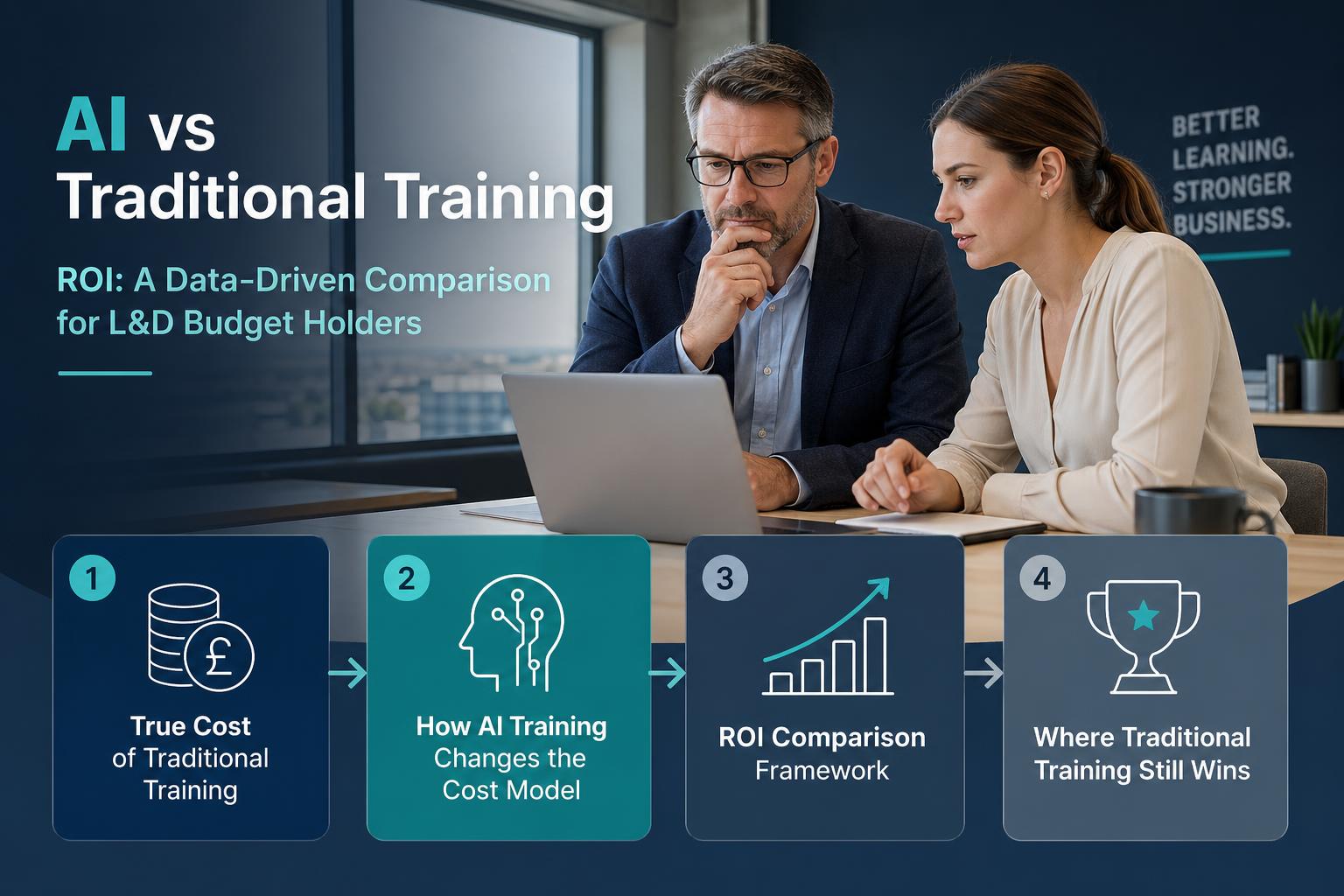
Section 1: The True Cost of Traditional Training
Most L&D teams significantly underestimate what traditional training actually costs. The visible costs — facilitator day rates, venue hire, catering — are easy to capture. The hidden costs are where the real budget leakage lives.
Direct delivery costs
Instructor-led training (ILT) carries fixed costs that do not scale efficiently. A one-day management development programme for 15 participants might involve:
- Facilitator fee: £1,200–£2,000 per day (external specialist)
- Venue and AV hire: £400–£800
- Printed materials, catering: £200–£400
- L&D coordinator time for logistics, pre-comms, follow-up: 6–8 hours
At 15 participants, the direct cost per learner is roughly £120–£210 before any learner productivity cost is counted. Scale that across 200 managers and multiple cohorts per year, and direct delivery costs alone reach six figures.
The productivity cost nobody budgets for
The most consistently underestimated cost of traditional training is lost productivity: the value of the time learners spend off the job attending training. For a 15-person cohort attending a full-day programme, with an average fully loaded salary cost of £45,000 per year (£173 per day), the productivity cost is £2,595 for that single session — before any travel time is factored in.
Brandon Hall Group research found that organisations typically underestimate learner productivity costs by a factor of three, because they calculate cost using direct salary rather than fully loaded cost (including NI, pension, benefits, and overheads). When L&D teams present the true cost of traditional delivery to finance, the figure is frequently higher than CFOs expected.
Travel and venue at scale
For geographically distributed workforces — common in UK retail, logistics, healthcare, and professional services — travel costs compound substantially. A regional manager attending a London training day may spend four to six hours in transit and incur £80–£200 in rail or accommodation costs. Multiply across a 500-person middle management layer attending four training days per year, and travel costs alone can reach £200,000–£400,000 annually — a cost that rarely appears on L&D budget lines because it is absorbed across departmental expenses.
Low completion rates and sunk costs
Traditional training has an attrition problem that is poorly measured but financially significant. Classroom no-shows and cancellations typically run at 15–25% for non-mandatory programmes, according to Towards Maturity research. For multi-module programmes delivered across several months, cumulative attrition frequently exceeds 40%.
The consequence is that a meaningful proportion of your training investment funds sessions that do not reach the intended learners. When you divide your total training spend by the number of learners who actually complete a programme, the true cost-per-completion is substantially higher than the cost-per-enrolled figure most L&D teams report.
Administration costs: the invisible overhead
Scheduling multi-cohort ILT programmes across a complex organisation is a significant administrative undertaking. Research from the Learning and Performance Institute suggests that for every hour of ILT delivered, training administrators spend 45–60 minutes on logistics, scheduling, reminders, attendance tracking, and reporting. For large programmes, this administrative overhead represents a meaningful proportion of total programme cost — one that is rarely surfaced in cost-per-learner calculations.
Section 2: How AI Training Changes the Cost Model
AI-powered training does not simply take traditional training and deliver it more cheaply. It changes the underlying cost structure in ways that create genuinely different economics — with different trade-offs.
Content reuse and amortisation
The most significant structural difference between AI-powered digital learning and traditional ILT is the relationship between content creation cost and delivery cost. In ILT, delivering to twice as many learners roughly doubles the cost — you need more facilitators, more venues, more sessions. In AI-powered digital learning, marginal delivery cost is near-zero: once content is developed, delivering it to 50 learners or 5,000 learners costs approximately the same.
This changes the ROI trajectory fundamentally. AI training has higher upfront costs — content development is not free — but the cost-per-learner falls sharply as learner volume increases and as the content is reused across cohorts and years. A compliance module built this year is still delivering value in three years, at effectively zero additional delivery cost.
Personalised pacing and time efficiency
AI-adaptive platforms adjust content delivery based on learner performance. Learners who demonstrate mastery of a concept move on faster; learners who are struggling receive additional practice and support before progressing. This personalisation has a concrete time-efficiency benefit: IBM research on digital learning programmes found that adaptive AI platforms reduced time-to-competency by approximately 40% compared to fixed-pace classroom equivalents.
The mechanism is straightforward: classroom training delivers the same content to everyone at the same pace, regardless of what individuals already know. An experienced manager attending a leadership programme may spend 60% of the time on content they already understand. An AI-adaptive programme concentrates their time on genuine gaps. The result is faster competency development at lower productivity cost.
Automated administration
AI-native training platforms eliminate or substantially reduce the administrative overhead that makes traditional training expensive to run. Automated scheduling, enrolment reminders, progress nudges, at-risk learner alerts, and compliance reporting — tasks that require significant coordinator time in traditional models — are handled by the platform. For training providers managing large learner cohorts, this administration saving is frequently the largest single component of AI training ROI.
In UK apprenticeship and vocational training specifically, AI automation of evidence tagging — mapping learner work products to Knowledge, Skills and Behaviours (KSB) frameworks — saves 10–15 minutes per learner per session. For a provider managing 300 active learners, that represents 50–75 hours of assessor time saved per month: the equivalent of a part-time headcount.
Section 3: ROI Comparison Framework
Comparing AI versus traditional training ROI requires a consistent framework across four metrics: cost-per-learner, completion rate, time-to-competency, and knowledge retention. The table below uses representative figures drawn from Brandon Hall Group, CIPD, and Towards Maturity research, applied to a hypothetical 500-learner compliance programme.
| Metric | Classroom ILT | Generic eLearning | AI-Powered Platform |
|---|---|---|---|
| Direct cost per learner | £180–£260 | £30–£60 | £40–£80 (yr 1) / £15–£30 (yr 3) |
| Productivity cost per learner | £150–£220 (full day) | £30–£50 (2–3 hrs) | £20–£35 (1–2 hrs, adaptive) |
| Average completion rate | 72–80% (mandatory ILT) | 15–30% (non-mandatory) | 70–85% |
| Time to competency | Baseline | −10–20% | −35–45% |
| 30-day knowledge retention | ~10–15% unaided recall | ~8–12% unaided recall | ~25–35% (with spaced practice) |
| Administration time (per 500 learners) | 80–120 hrs/yr | 30–50 hrs/yr | 8–15 hrs/yr |
| Total cost per completion | £415–£600 | £200–£370 | £75–£140 (yr 3) |
Note: Figures are illustrative ranges drawn from Brandon Hall Group, CIPD, and Towards Maturity benchmarks. Total cost per completion divides combined direct and productivity costs by the completion rate. Year 3 AI platform figures assume content amortised over three annual cohorts.
Cost-per-learner: the number that changes everything
The single most important shift in the table above is the cost-per-completion figure in year 3 for AI-powered training. The common mistake is to compare year 1 AI costs (including content development) against steady-state ILT costs. A fair comparison must account for the fact that ILT costs reset each year — every new cohort requires a new facilitator, a new venue, new materials — while AI training content continues delivering value as the development cost is amortised across growing learner populations.
This means AI training ROI is not always compelling in year 1. For small learner populations with content that needs to be created from scratch, ILT may be cheaper in the short term. The ROI advantage compounds over time and at scale — which is precisely why the business case must model a minimum three-year horizon.
Completion rates: where generic eLearning fails
The completion rate comparison is where generic eLearning performs worst. The 15–30% completion rate for non-mandatory digital learning is not a technology problem — it is a design and relevance problem. Generic eLearning that is not adaptive, not relevant to individual learner roles, and not integrated into accountability structures (manager visibility, reminders, consequence for non-completion) produces completion rates that make the cost-per-completion economically indefensible.
AI platforms address this through personalisation (content feels relevant because it adapts to learner level and role), automated nudges (the platform chases learners so managers do not have to), and at-risk flags (training managers see disengaged learners before they drop out rather than after). The result is completion rates that are closer to mandatory ILT — without the ILT cost structure.
Knowledge retention: the metric L&D rarely tracks
The Ebbinghaus Forgetting Curve — widely cited, consistently underestimated in its practical implications — predicts that learners forget approximately 70% of new information within 24 hours without reinforcement. Traditional classroom training front-loads information delivery and provides limited spaced practice: ideal conditions for rapid forgetting.
AI platforms with built-in spaced repetition — delivering practice questions and retrieval exercises at intervals calibrated to each learner’s performance — consistently outperform both classroom and generic eLearning on 30-day and 90-day retention measures. Research from cognitive science literature supports a 25–35% unaided recall rate for content delivered with spaced practice, versus 10–15% for massed classroom delivery. If the goal of training is knowledge application on the job — rather than performance on an immediate post-test — retention data is the metric that actually matters.
Section 4: Where Traditional Training Still Wins
An intellectually honest ROI comparison must acknowledge where traditional delivery retains a genuine advantage. There are training contexts where AI platforms cannot match the outcomes of skilled human facilitation — and where attempting to substitute AI for human delivery will produce measurably worse results.
Complex interpersonal skills development
The development of complex interpersonal competencies — navigating conflict, building trust under pressure, managing diverse teams through ambiguity — benefits from the unpredictability, nuance, and relational depth of human interaction. A skilled facilitator can read the room, adapt to group dynamics, and create conditions for genuine reflection and behaviour change that AI-facilitated learning cannot currently replicate.
AI coaching tools are improving rapidly and provide valuable practice for interpersonal scenarios. But the development of deep interpersonal capability — especially at senior levels — still requires human-facilitated learning experiences. Programmes that attempt to move senior leadership development entirely to AI-powered digital learning typically see lower engagement and weaker behaviour change outcomes than blended approaches that retain skilled human facilitation for the highest-complexity elements.
Culture-critical and values-driven moments
Some training interventions are not primarily about knowledge transfer — they are about signalling, community-building, and cultural alignment. An organisation-wide leadership conference, an onboarding cohort experience designed to build relationships across a new hire class, or a CEO-delivered values workshop — these are events where the human dimension of the experience is the point. Digitising them efficiently is not the goal; the shared, live, relational nature of the experience is the mechanism of impact.
ROI frameworks that apply cost-per-learner metrics to these interventions without accounting for their cultural function will systematically undervalue them. Not all training investment is knowledge transfer, and not all knowledge transfer is the right target for AI optimisation.
Senior leadership and executive development
Senior leadership development — working with small groups of executives on strategy, decision-making, and organisational leadership — is characterised by high-touch facilitation, peer learning dynamics, and the kind of frank conversation that requires trust and confidentiality. The economics of AI-powered training (scale, content reuse) are largely irrelevant at this level, because the group sizes are small and the content is bespoke. The ROI case for AI in executive development is weak relative to lower-level, higher-volume programmes.
Section 5: Building the Business Case — A 3-Year ROI Model
The following model is designed to be adapted by L&D and HR teams building a business case for moving from traditional to AI-powered training. It uses conservative assumptions and is structured to survive CFO scrutiny.
Model inputs: a realistic scenario
Organisation: 1,200-person UK employer in professional services. Training scope: annual compliance programme, management skills programme, onboarding programme. Current delivery: primarily ILT supplemented by generic eLearning. Total annual learner population: 900 (accounting for overlap).
| Year 1 | Year 2 | Year 3 | |
|---|---|---|---|
| CURRENT ILT COSTS (baseline) | |||
| Facilitator & venue costs | £108,000 | £108,000 | £108,000 |
| Learner productivity cost (time off job) | £155,000 | £155,000 | £155,000 |
| Travel and accommodation | £42,000 | £42,000 | £42,000 |
| Administration and coordinator time | £22,000 | £22,000 | £22,000 |
| Total baseline cost | £327,000 | £327,000 | £327,000 |
| AI PLATFORM COSTS | |||
| Platform licence (900 learners) | £36,000 | £36,000 | £36,000 |
| Content development (one-off) | £55,000 | £12,000 | £8,000 |
| Implementation and change management | £18,000 | £4,000 | £2,000 |
| Retained ILT (high-complexity modules) | £28,000 | £28,000 | £28,000 |
| Learner productivity cost (reduced) | £62,000 | £58,000 | £55,000 |
| Total AI platform cost | £199,000 | £138,000 | £129,000 |
| Annual saving | £128,000 | £189,000 | £198,000 |
| Cumulative 3-year saving | £515,000 | ||
All figures are illustrative for a 900-learner programme and should be adjusted to reflect your actual facilitator costs, average salary, and content complexity. The model assumes 70% of ILT volume is migrated to AI-powered delivery, with 30% retained as face-to-face for high-complexity content.
What the model does not capture
Two caveats are important for an honest presentation of this model. First, it does not attempt to quantify the quality-of-outcome differences between delivery modalities — it captures cost, not learning effectiveness. If your high-complexity leadership programme produces measurably better on-the-job performance than an AI equivalent would, that quality difference has a business value that should be incorporated into the comparison.
Second, change management costs are frequently underestimated. Migrating an organisation from ILT to digital-first learning requires learner communication, manager briefing, L&D team reskilling, and sometimes culture change. The £18,000 implementation line in year 1 is a placeholder — for organisations with strong resistance to digital learning or limited existing digital capability, real change management costs can be substantially higher.
Presenting the business case to CFOs and senior leadership
Three things strengthen the credibility of an AI training ROI business case with finance audiences.
Use full productivity cost. Calculate learner time at fully loaded cost, not basic salary. Finance teams understand this calculation and will question a business case that uses basic salary — it looks like an L&D team that does not understand cost accounting.
Model conservatively on outcomes. If your baseline ILT completion rate is 75% and AI platform evidence suggests 80% completion, model at 75% in your business case. If you achieve 80%, the ROI is better than projected. Finance teams are more receptive to conservative cases that under-promise and over-deliver than optimistic projections that rest on vendor claims.
Propose a pilot with defined success metrics. Rather than requesting full programme migration budget in year 1, propose a 90-day pilot on a single programme with pre-agreed success metrics (cost-per-completion, completion rate, learner satisfaction). A pilot converts an investment decision into an experiment, which is substantially easier to approve and creates internal evidence that supports full rollout.
- Baseline costs include direct delivery, full productivity cost (fully loaded), travel, and administration
- AI platform costs include licence, content development, implementation, and retained ILT
- Model spans minimum 3 years to capture content amortisation benefit
- Completion rate assumptions are conservative, not vendor-claim based
- Change management cost is explicitly included and not embedded in licence fees
- Qualitative benefits (retention improvement, at-risk learner detection) are noted separately, not baked into cost projections
Frequently Asked Questions
What ROI should I realistically expect from AI training?
Brandon Hall Group research indicates 40–60% cost-per-learner reduction over three years compared to ILT-dominant programmes, after accounting for content development investment. The range is wide because it depends heavily on learner volume, current ILT costs, and content complexity. Organisations with large, geographically distributed workforces, high-frequency compliance requirements, and significant ILT travel costs tend to see the largest savings. Smaller organisations with complex, bespoke content needs tend to see more modest returns.
How much faster do learners reach competency with AI training?
IBM research on AI-adaptive digital learning programmes found an average 40% reduction in time-to-competency compared to fixed-pace classroom equivalents. The mechanism is personalised pacing: learners advance past content they already understand and spend concentrated time on genuine gaps. Results are strongest for technical and procedural content; complex interpersonal skills see more modest time-to-competency gains because mastery requires practice and reflection, not just information delivery.
Does AI training work for all training types?
AI-powered training delivers strongest ROI on high-volume, repeatable content: compliance, onboarding, product knowledge, technical skills, and procedural training. Traditional face-to-face delivery retains a genuine advantage for complex interpersonal skills, culture-critical leadership moments, and senior executive development. The highest-ROI strategy for most organisations is a blended model — AI-powered for volume and scale, human-facilitated for high-complexity and high-touch moments.
How do I build a business case that survives CFO scrutiny?
Model four cost categories: direct delivery, learner productivity (at fully loaded cost), administration, and failure costs (non-completion and knowledge attrition requiring rework). Compare all four against AI platform costs including licence, content development, implementation, and change management. Model over three years minimum. Use conservative completion rate assumptions, not vendor-claimed figures. Propose a pilot with pre-agreed success metrics rather than requesting full migration budget upfront.
What completion rate improvement should I expect?
Generic eLearning without personalisation or accountability structures averages 15–30% completion for non-mandatory programmes. AI-adaptive platforms with automated nudges and at-risk learner alerting report 70–85% completion for equivalent programmes, closer to mandatory ILT levels. The improvement comes from personalisation (content feels relevant), automated accountability (the platform manages reminders), and reduced friction (learners work at their own pace). Conservative modelling should assume 65–75% completion — material improvements over generic eLearning, without overstating AI platform performance.
Sources & further reading
- Brandon Hall Group, Learning Technology Study: How AI is Reshaping L&D Cost and Effectiveness — brandonhall.com
- CIPD, Learning at Work Survey 2025 — cipd.org/en/knowledge/reports/learning-work-survey
- Towards Maturity, Continuous Learning Benchmark Report — towardsmaturity.org
- IBM Institute for Business Value, The ROI of Digital Learning: Evidence from Enterprise Training Programmes — ibm.com/thought-leadership/institute-business-value