Last updated: 19 March 2026
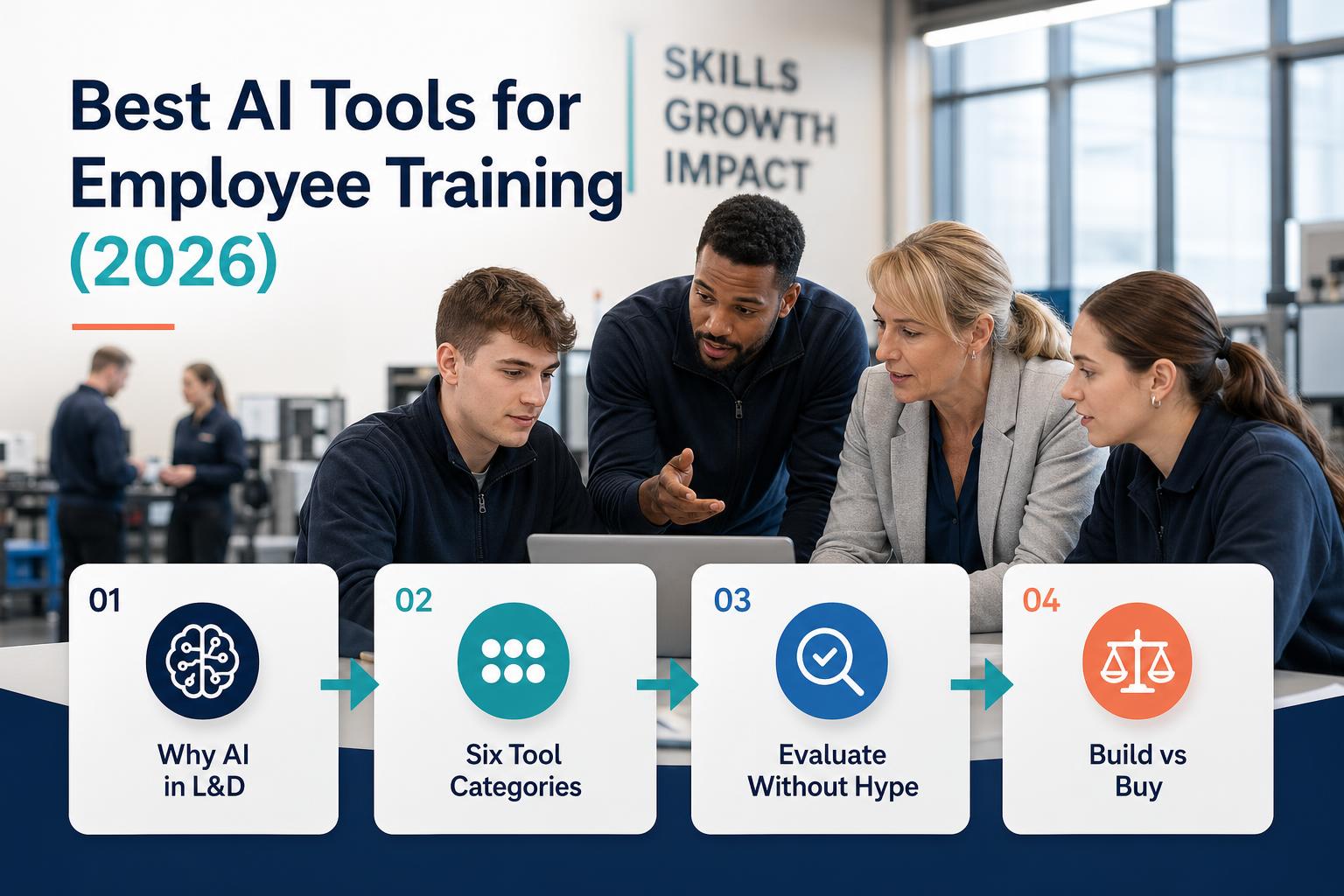
Why AI Has Become Central to L&D in 2026
L&D teams in 2026 are facing a structural mismatch. Training demands have grown substantially — driven by AI adoption programmes, evolving compliance requirements, workforce reskilling, and leadership development — while L&D budgets and headcount have remained flat or declined. The tools of five years ago cannot close this gap through effort alone.
AI has emerged as the primary lever available to L&D teams who need to deliver more with the same resources. Not as a replacement for L&D expertise — good learning design still requires experienced practitioners — but as a multiplier: faster content production, automated administration, smarter analytics, and more personalised learner experiences at a scale that was previously impossible without significant additional headcount.
Two failure modes are equally common. The first is ignoring AI tools entirely — continuing with legacy processes whilst peers adopt tools that produce the same outputs in a fraction of the time. The second, and arguably more expensive, is over-investing in AI hype: purchasing platforms that claim transformational results but bolt “AI” onto unchanged workflows, producing expensive licence fees without meaningful time savings.
This guide is built around a third path: practical evaluation of where AI genuinely changes outcomes, grounded in the categories that are delivering results for L&D teams in 2026 — not the categories that generate the most press coverage.
The Six Categories of AI Training Tools
The AI training tools market is broad and fragmented. Before evaluating specific platforms, it helps to understand the six functional categories — what each does, where it performs best, and where it consistently falls short.
AI content authoring
AI content authoring tools accelerate the creation of training materials — e-learning modules, scripts, quiz questions, scenario branches, and supporting visuals. Tools in this category include AI-assisted authoring platforms (such as Articulate Rise with AI Assist), Adobe Firefly for L&D illustration, and custom GPT-based authoring assistants configured for specific content types.
What it does: Generates course outlines from a brief, drafts scenario text and branching logic, produces multiple-choice questions from source content, and creates synthetic imagery for illustration without a design team or stock photo licence.
Best for: High-volume content teams, subject matter expert (SME)-authored content where the SME provides raw knowledge and AI produces the structure, and rapid content refreshes where existing modules need updating.
Limitation: AI-generated content requires subject matter expert review before publication. Tone, accuracy, and contextual appropriateness are not reliable without human oversight — especially for technical, regulated, or emotionally sensitive topics. The time saved on drafting is real; the time required for review is also real and must be budgeted.
AI-powered LMS/TMS platforms
AI-native learning and training management platforms embed AI directly into platform workflows rather than offering it as an add-on feature. The practical outputs are adaptive learning paths that adjust to learner performance, automated progress tracking, at-risk learner flagging, and — for regulated training contexts — automated evidence tagging and compliance reporting.
What it does: Monitors learner engagement and performance in real time, surfaces anomalies (learners behind schedule, disengaged cohorts, compliance gaps), and reduces the manual reporting work that consumes significant training manager time. For UK apprenticeship and vocational training providers, AI-native platforms like TIQPlus automate evidence tagging against Knowledge, Skills and Behaviours (KSB) frameworks and generate draft progress review content — tasks that previously required 10–15 minutes of manual work per learner per session.
Best for: Organisations with large learner populations, complex compliance requirements, or multi-employer training delivery where tracking across programmes would otherwise require dedicated administration resource.
Limitation: AI performance on a training platform is directly limited by the quality and volume of underlying data. Platforms with thin learner data, poor completion rates, or inconsistent input from tutors will produce less reliable AI outputs. Garbage in, garbage out applies here as much as anywhere.
AI skills assessment
AI skills assessment tools evaluate learner competence at a scale and frequency that manual assessment cannot match. Use cases range from automated role-play scoring (an AI evaluates how a salesperson handled an objection) to written assessment analysis (an AI scores a management reflection against a competency framework) to coding challenge evaluation.
What it does: Provides formative feedback without requiring a human assessor to review every submission, enables skills gap mapping across large populations, and delivers pre-hire assessment at volume without proportional recruiter time investment.
Best for: Large-scale skills audits where individual assessment is impractical, pre-hire screening, and low-stakes formative assessment where fast feedback improves learner engagement.
Limitation: High-stakes assessments — professional qualifications, certification, anything with regulatory weight — must retain meaningful human oversight. AI scoring can carry bias from training data, and this bias may not be visible until it has affected a cohort. Any AI assessment tool used in high-stakes contexts requires documented bias testing and a clear human review protocol.
AI coaching tools
AI coaching tools deliver conversational practice and feedback for interpersonal and behavioural skills — management conversations, sales objection handling, communication under pressure, and leadership scenario practice. Learners interact with an AI interlocutor and receive structured feedback on their performance.
What it does: Provides unlimited low-stakes practice that human coaching cannot deliver at volume. A manager who needs to practise a difficult performance conversation can run that scenario ten times before their actual meeting, receiving feedback each time, at a fraction of the cost of human coaching.
Best for: Manager development programmes, sales enablement, customer service training, and any context where repeated deliberate practice of interpersonal skills is the primary development method.
Limitation: Relationship-based coaching — the kind that builds self-awareness over time, challenges deeply held assumptions, and navigates complex personal dynamics — requires human coaches. AI coaching supplements this; it does not replace it. Programmes that attempt to use AI as a complete substitute for human coaching in personal development contexts typically see lower engagement and poorer long-term outcomes.
AI analytics and reporting
AI analytics tools go beyond traditional LMS reporting dashboards. Rather than presenting historical data, they identify patterns: which learner characteristics predict disengagement, which programme elements correlate with performance improvement, and which cohorts are most at risk of non-completion.
What it does: Learns from historical patterns to flag at-risk learners before they disengage, rather than after. Generates narrative summaries of cohort performance for leadership reporting, reducing the manual data-to-story translation that consumes significant L&D manager time. Surfaces correlations between training activity and business performance metrics where data integration permits.
Best for: L&D teams with a mandate to demonstrate training impact to leadership, training providers managing large multi-employer cohorts, and organisations with enough historical data to generate statistically meaningful predictions.
Limitation: Predictive models require sufficient historical data to be reliable. An organisation with 50 learners and two years of data will not generate useful at-risk predictions. Smaller organisations should focus on AI-assisted reporting (automating data narrative) rather than AI-predictive analytics until data volume justifies the latter.
AI translation and localisation
AI translation tools have matured significantly. For standard business and training content, AI translation now achieves sufficient accuracy that post-editing (human review of AI translation) is substantially faster than full translation from scratch — typically 60–70% faster according to professional translation benchmarks.
What it does: Translates completed e-learning modules, policy documents, and supporting materials at speed. Generates captions and subtitles from audio. Adapts content for regional variants of a language where cultural context affects meaning.
Best for: Multinational organisations managing training across multiple languages, UK organisations with significant non-English-speaking learner populations, and global L&D teams where translation backlog is a consistent programme delivery constraint.
Limitation: Technical, legal, and sector-specific content requires post-editing review by a qualified translator with domain knowledge. AI translation of generic business English is reliable; AI translation of medical device instructions or legal compliance content is not production-ready without expert review.
How to Evaluate AI Training Tools Without Getting Lost in Hype
The AI tools market rewards confident claims over evidence. Vendors with the most sophisticated marketing are not reliably the vendors with the most effective products. A structured evaluation approach protects against this.
Questions to ask every vendor
Before investing significant time in a product demonstration, use these questions to separate substantive tools from marketing-heavy ones:
- What specifically does the AI do? Demand a technical explanation, not a marketing one. If the vendor cannot explain the mechanism clearly, that is informative in itself.
- What data is the AI trained on, and how is bias mitigated? Responsible vendors have documented answers to both questions. Absent documentation is a red flag.
- What is the accuracy rate and how is it measured? “Highly accurate” is not an answer. Ask for the specific metric, how it is calculated, and who verified it.
- Can a human override or correct AI outputs? Any AI tool applied to individual learner decisions must have a clear human override pathway. If the answer is no, the tool should not be in scope for regulated or high-stakes contexts.
- How is learner data handled under UK GDPR? Ask specifically: does the vendor process data under a DPA, is learner data used to train the vendor’s models, and where is data stored?
- What happens when the AI makes a wrong call? The vendor’s answer to this question tells you more about the product maturity than any feature list.
Pilot before you commit
No AI tool should be purchased on the basis of a vendor demonstration alone. Vendor demos are optimised to perform well under demo conditions; real-world performance with your content, your learners, and your workflows may be substantially different.
Structure a meaningful pilot: define a specific use case, set a time limit (four to eight weeks is typically sufficient), and agree a success metric before the pilot begins. Measure actual time saved — not vendor-claimed time saved — by comparing pre-pilot and post-pilot task completion times for the specific workflow being automated.
Critically: gather feedback from the people who will use the tool daily. Tutors, trainers, and assessors have a completely different perspective on AI tool usability than L&D managers evaluating from a strategic level. Both perspectives are required for an honest evaluation.
Some tools are existing products with a ChatGPT API call added. The AI produces generic output that still requires significant human editing — in some cases more editing than simply writing the content without AI assistance. Before purchasing, ask for a live demonstration on your own content, not a pre-prepared demo scenario. Feed the tool a real piece of your training content and evaluate the output honestly.
Build Your Own AI Tools vs Buy a Platform
As large language models have become more accessible, some organisations — particularly larger enterprises with in-house data and engineering capability — are exploring building bespoke AI tools rather than purchasing platforms. The honest assessment of when this makes sense is narrower than most internal advocates assume.
When building may make sense: Your organisation is large enough to justify a dedicated AI engineering team; you have proprietary training data that generic tools cannot access; your use case is genuinely unique and no commercial product addresses it adequately; you have a long runway for development and can absorb the iteration costs before the tool reaches production quality.
When buying almost certainly makes more sense: For the majority of L&D teams — including most enterprise teams — commercial platforms will deploy faster, be maintained by a vendor whose core business is keeping the model current, and carry lower infrastructure overhead. The total cost of building LLM-powered tools in-house is significantly higher than most internal estimates account for: not just development cost, but ongoing model management, data pipeline maintenance, security review, and the opportunity cost of engineering time.
The hybrid approach: The most practical path for organisations with some technical capability is to buy a platform with open APIs and customise at the integration layer. This provides the platform vendor’s core AI capability whilst allowing bespoke workflow integration with internal systems — getting meaningful customisation without full build cost.
Before committing to a build decision, L&D and technology teams should run a realistic total cost of ownership comparison against the best-fit commercial platform. In most cases, the commercial platform wins on total cost over a three-year horizon, even at significant licence cost.
Quick Reference: AI Training Tool Evaluation Checklist
Use this checklist before committing budget to any AI training tool:
- Defined use case before evaluation (not “AI” as a goal in itself)
- Accuracy rate evidence obtained from the vendor — not marketing copy, documented evidence
- UK GDPR and data processing documentation reviewed by your data or legal team
- Human override capability confirmed for all learner-facing AI decisions
- Live pilot with real content planned — not assessed solely on vendor demo
- Feedback mechanism from end users (tutors, learners) built into the pilot design
- Total cost of ownership calculated over 12 months, including integration, training, and change management
- Success metric and review date defined before purchase — not after go-live
Frequently asked questions
What are the most useful AI tools for employee training?
The AI tools L&D teams find genuinely useful fall into four categories: AI content authoring (tools that accelerate course creation using AI text, image, and video generation), AI-powered LMS/TMS platforms (platforms with built-in analytics, adaptive paths, and automated evidence or progress tracking), AI skills assessment (tools that evaluate skills gaps at scale without manual testing), and AI coaching tools (conversational AI that delivers feedback on communication, leadership, or role-specific behaviours). The most impactful single investment for most organisations is an AI-native training platform that handles multiple use cases rather than a collection of point tools.
How much time can AI actually save in L&D?
Research from the Learning and Performance Institute and vendor case studies consistently shows that AI content authoring tools reduce course development time by 40–60% for text-based content. AI evidence tagging in apprenticeship and compliance contexts saves 10–15 minutes per assessment session. AI-generated progress summaries and reports save training managers 2–4 hours per week on cohort administration. The highest impact comes from combining AI across content, assessment, and reporting rather than applying it to one isolated task.
What should L&D teams avoid when evaluating AI training tools?
Avoid tools that use 'AI' as a marketing label without a clear explanation of what the AI does and how it was trained. Key red flags: no transparency on accuracy rates, no human override capability, no GDPR compliance documentation for AI-processed learner data, and AI outputs that cannot be audited or explained. The best AI tools are transparent about their limitations and keep humans in control of decisions that affect individual learners.
Sources & further reading
- Learning and Performance Institute Annual Report — thelpi.org
- GOV.UK AI Opportunities Action Plan — gov.uk/government/publications/ai-opportunities-action-plan
- CIPD Learning at Work Survey — cipd.org/en/knowledge/reports/learning-work-survey