Last updated: 19 March 2026
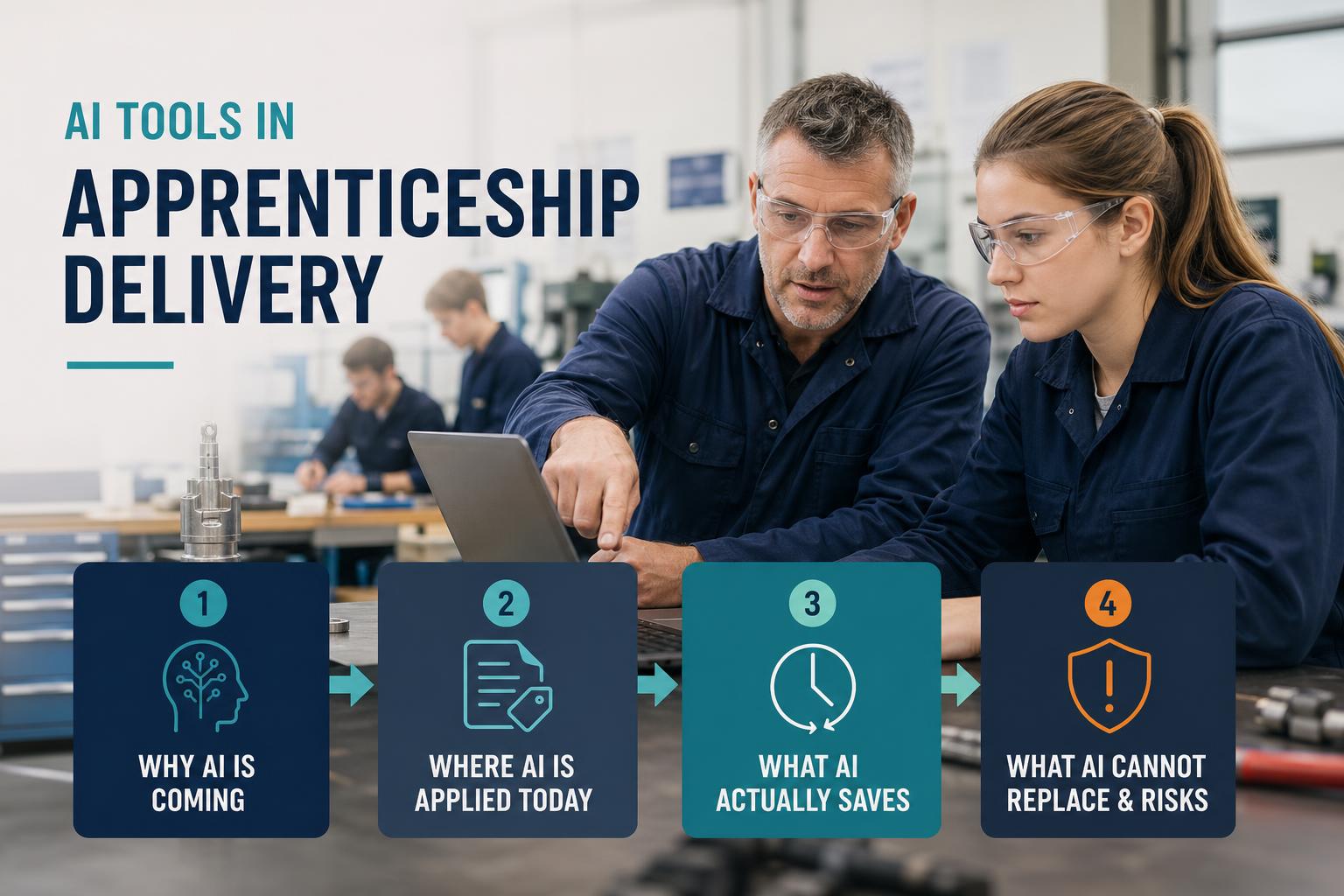
Why AI Is Coming to Apprenticeship Delivery
The administrative burden on UK training providers has grown significantly over the past five years. Funding rule complexity, ILR reporting requirements, Ofsted’s emphasis on learner file quality, and the introduction of new pathways under the Growth and Skills Levy have all added to the load on already stretched delivery teams. At the same time, the tutor-to-learner ratio at many providers leaves little room for the kind of intensive individual support that drives strong outcomes.
AI is being positioned — by vendors, by the sector, and increasingly by DfE — as a way to recover some of that capacity. The argument is straightforward: if AI can handle evidence classification, flag at-risk learners automatically, and draft structured review notes, tutors spend less time on low-value administrative tasks and more time on high-value interactions with learners and employers.
That argument has genuine merit. But it only holds if the AI is implemented carefully, with appropriate human oversight, and with a clear understanding of where it helps and where it creates new risk. Poorly implemented AI in apprenticeship delivery does not just fail to save time — it can generate incorrect evidence mappings, introduce bias into at-risk scoring, and create Ofsted exposure if professional practice is displaced rather than supported.
This guide covers both sides: where AI is working, where it isn’t, and what to look for when evaluating platforms that include AI features.
Where AI Is Being Applied Today
AI evidence tagging
The most mature and widely deployed use of AI in apprenticeship platforms is evidence tagging: the automatic classification of learner portfolio submissions against the Knowledge, Skills and Behaviours (KSBs) defined in the apprenticeship standard. When a learner uploads a reflective account or work product, the AI reads the content and suggests which KSBs it provides evidence for.
Done well, this works. Models trained on a specific standard can achieve high accuracy on initial suggestions, particularly for standards with well-defined, distinct KSBs. The tutor reviews and confirms or amends the AI’s suggestions rather than starting the mapping process from scratch.
The key safeguard: every AI suggestion must be reviewable and overridable by the tutor. Systems that apply KSB tags without tutor confirmation introduce compliance risk — if the AI is wrong, the learner’s portfolio contains incorrect mappings that could affect EPA readiness.
Automated progress review drafting
Some platforms now use AI to generate a structured draft of a progress review record, drawing on the learner’s recent activity data: evidence submitted, OTJ hours logged, previous review targets, and any missed interactions. The tutor receives a populated draft that summarises the learner’s position and suggests talking points — rather than beginning with a blank form.
This is practically useful. Review preparation is one of the more time-consuming parts of a tutor’s week, particularly for tutors managing large caseloads. A well-structured AI draft that surfaces the right information means tutors can focus the review time on the conversation rather than the administration.
The important caveat: the draft is a starting point, not a finished record. The tutor must add the substance of the actual conversation, confirm OTJ hours with the employer, and ensure the record reflects the specific individual rather than a data summary.
At-risk learner identification
AI pattern recognition is being used to flag learners who may be at risk of non-completion or delayed gateway. Common signals the model watches for include: missed review windows, OTJ hours falling below expected pace, declining evidence submission frequency, gaps in employer engagement, and functional skills progress stalling.
When implemented correctly, this gives providers an earlier warning system than manual monitoring can typically achieve. A tutor managing 40 learners cannot realistically track every at-risk signal continuously; an AI system that flags the three learners most at risk at any given time makes intervention more targeted and timely.
Employer engagement analysis
Some platforms apply natural language processing to communication logs — emails, notes from employer calls, review sign-off patterns — to assess the health of the employer relationship. Consistently short or delayed employer responses, low engagement at review sign-off, and declining participation are indicators that the employer relationship needs attention.
This is an emerging application and less consistently implemented across platforms than evidence tagging or at-risk flagging. It is most useful in large-scale delivery where it is genuinely difficult to maintain visibility across a large employer base.
ILR data validation
AI is being used to validate Individualised Learner Record data before submission — catching field errors, inconsistencies between linked records, and values outside expected ranges before they reach the ESFA. This reduces the frequency of ILR rejections and the correction cycles that follow, which are a significant time sink for MIS teams at most providers.
What AI Actually Saves
It is worth being specific about the time savings, because they vary significantly by task and implementation quality.
- Evidence tagging: Without AI, mapping a learner submission to relevant KSBs takes a trained tutor 10–20 minutes per submission, depending on the standard’s complexity and the length of the piece. With well-implemented AI tagging, the tutor reviews and confirms suggestions in 2–3 minutes. For a tutor reviewing 30 submissions a week, that is a meaningful reduction.
- Review preparation: Pulling together a learner’s current position — OTJ hours, evidence coverage, open targets, functional skills status — before a review typically takes 10–15 minutes per learner. An AI-generated prep pack reduces that to a review-and-check taking 2–3 minutes.
- At-risk monitoring: The time saving here is less about duration and more about reliability. Manual monitoring misses signals when tutors are busy; automated flagging does not. The value is in earlier intervention, which reduces the cost of recovery.
- ILR validation: Correction cycles after an ILR rejection can take MIS teams several hours per error batch. AI pre-submission validation that catches common errors eliminates a significant proportion of those cycles.
Realistic expectation-setting
The time savings from AI in apprenticeship delivery are real but not transformative on their own. AI does not replace the need for skilled tutors, meaningful employer relationships, or a well-designed programme. It removes friction from specific administrative tasks — which frees capacity for higher-value work, but only if that capacity is actively redirected.
What AI Cannot — and Should Not — Replace
The marketing of AI in apprenticeship platforms sometimes implies a level of autonomy that is neither technically achievable nor professionally appropriate. Several things must remain firmly in the hands of qualified tutors and managers.
- Professional judgement in reviews: The assessment of whether a learner is genuinely competent — not just whether they have submitted evidence that the AI has tagged to KSBs — requires a qualified practitioner who knows the learner, their workplace context, and the standard in depth. AI can surface information; it cannot make the professional judgement.
- Quality of learner relationships: Apprenticeship outcomes are strongly correlated with the quality of the tutor–learner relationship. AI cannot build trust, notice that a learner is struggling in ways that don’t appear in submission patterns, or provide the kind of coaching support that drives genuine development.
- Safeguarding decisions: Any concern about a learner’s welfare must be handled by a trained safeguarding officer following the provider’s safeguarding policy. AI has no role in safeguarding decisions, and any platform that presents AI output as relevant to welfare risk should be treated with extreme caution.
- Complex welfare issues: Where a learner is experiencing mental health difficulties, workplace problems, or personal crises, the response requires human judgement, empathy, and access to appropriate support services. AI can flag that a learner’s engagement has dropped; what to do about it is a human decision.
- Gateway recommendations: The decision to put a learner forward for EPA gateway is a formal professional judgement with significant consequences for the learner. It must be made by a qualified member of staff, not generated by an algorithm.
Risks of Poorly Implemented AI in Apprenticeships
Hallucinated KSB mappings
AI language models — including those used for evidence tagging — can generate confident-sounding but incorrect outputs. A model might tag a learner’s reflective account to KSBs that are only loosely related to the content, or miss the most relevant KSBs entirely. If these suggestions are accepted without tutor review, the learner’s portfolio contains incorrect mappings — which creates problems at EPA and in any Ofsted deep dive on learner files.
The risk is highest when evidence tagging AI is deployed without a clear requirement for tutor confirmation before tags are recorded, or where tutors are under time pressure and treat AI suggestions as authoritative rather than advisory.
Bias in at-risk scoring
At-risk models trained on historical data can embed patterns that reflect historical inequalities rather than genuine predictors of learner need. If a model was trained on data from a cohort where learners from certain demographic groups had lower completion rates due to systemic disadvantage rather than individual factors, the model may replicate that bias in its scoring — flagging learners from those groups as at-risk on the basis of demographic proxies rather than actual programme signals.
Providers adopting AI at-risk flagging need to understand how the model was trained, whether it has been tested for bias, and how any demographic signals are — or are not — used in scoring.
Over-reliance reducing tutor engagement
A subtler risk: if tutors come to rely on AI-generated review drafts and evidence suggestions without critically engaging with them, the quality of their own professional attention to learners can decline. The review becomes a form-processing exercise rather than a genuine learning conversation. Ofsted’s inspection framework assesses the quality of education — including whether tutors genuinely know their learners — not whether the administrative records are well-maintained. An AI that produces polished records but reduces tutor engagement is a quality risk, not a quality improvement.
Ofsted implications
Ofsted inspectors are increasingly aware of AI’s presence in delivery systems. If a provider cannot explain how evidence was tagged, why a learner was or was not flagged as at-risk, or what professional judgement underpins a review record, that creates an inspection exposure regardless of how technically sophisticated the underlying system is. Inspectors assess whether learners are receiving high-quality education and training — AI-generated documentation that does not reflect genuine professional practice will not stand up to scrutiny.
What to Look For When Evaluating AI Platforms
When you are comparing apprenticeship management platforms that include AI features, the following questions are the ones that matter most for operational and compliance purposes.
Accuracy rate on evidence tagging
Ask vendors for evidence of their tagging accuracy rate on the specific standard(s) you deliver. A credible vendor should be able to provide this. Accuracy rates below 80% mean tutors spend as much time correcting the AI as they would have spent doing the task manually. Rates above 90% suggest the model is well-trained on that standard. Be sceptical of claimed accuracy that is not broken down by standard.
Transparency and explainability
Can the platform explain why a piece of evidence was tagged to a particular KSB? Can it show which signals caused a learner to be flagged as at-risk? A “black box” AI that produces outputs without explanation creates compliance risk: you cannot defend a KSB mapping or an at-risk intervention decision if you cannot explain the basis for it. Under the ICO’s AI and data protection guidance, individuals have rights in relation to automated decision-making — your platform needs to support those rights.
Tutor override capability
Every AI-generated output — tag, risk flag, review draft — must be modifiable by the tutor with the modification logged. This is non-negotiable for compliance. Platforms that lock in AI-generated content, or that make override cumbersome enough that tutors rarely do it, are building compliance liability into your delivery workflow.
No vendor lock-in on your data
Confirm that you can export all learner data in a usable format at any point, and on contract termination. This applies to AI-generated content too: review drafts, evidence tags, and risk flags generated by the AI are your data, not the vendor’s. If a vendor’s AI has been trained on your data, understand what rights you retain and whether your data is used to improve models that serve other customers.
GDPR compliance for AI processing
Processing learner data through AI systems triggers UK GDPR obligations. Ask vendors: what is the lawful basis for AI processing of learner data? Is a Data Protection Impact Assessment (DPIA) available? Where are AI models hosted, and are sub-processors named in the Data Processing Agreement? A vendor that cannot answer these questions clearly is not ready for compliant deployment in a UK apprenticeship context.
Ask for a live demonstration on your standard
Do not accept a vendor’s AI demonstration on a generic example. Before signing, ask them to demonstrate the evidence tagging function on real submissions from one of your own apprenticeship standards. The accuracy and relevance of the tags in a live test is far more informative than any claimed benchmark figure.
How AI Fits Into Ofsted Evidence Expectations
The Education Inspection Framework assesses the quality of education and training — whether learners are developing genuine knowledge, skills and behaviours, whether the curriculum intent is coherent, and whether tutors are effective practitioners. AI platforms that surface evidence faster or reduce administrative load can support inspection readiness, but they do not change what inspectors are looking for.
Specifically: Ofsted does not award better grades for more evidence. A well-maintained learner portfolio with accurate KSB mappings is beneficial; an AI-generated portfolio that is internally consistent but does not reflect genuine learning is not. Inspectors will speak to learners, ask them about their targets and their programme, and assess whether the documentation reflects what is actually happening in the apprenticeship.
AI-assisted platforms should therefore be evaluated not on how much they can automate, but on whether the automation supports or replaces professional practice. A platform that helps tutors prepare better, intervene earlier, and maintain more accurate records — while keeping tutors in control of every decision — is an asset in an Ofsted inspection. A platform that generates polished records with minimal tutor input is an inspection liability.
One practical implication: if you are using AI evidence tagging, tutors must be able to explain — in an inspector’s deep dive — why evidence is mapped to a particular KSB and what the learner’s demonstrated competence is. If the tutor’s answer is “the system tagged it”, that is a finding.
AI Platform Evaluation Checklist
- Vendor can provide accuracy rate data for AI evidence tagging on the specific standards you deliver
- Every AI-generated tag or output can be reviewed and overridden by the tutor, with the override logged
- The platform can explain why a piece of evidence was tagged to a particular KSB (explainability)
- At-risk scoring methodology is documented and has been tested for demographic bias
- Learner data can be exported in full at any time and on contract termination
- A Data Processing Agreement names all AI sub-processors and confirms UK GDPR compliance
- A DPIA is available or can be provided before contract signature
- The platform documents whether and how your data is used to train shared AI models
- Tutor workflows require confirmation of AI suggestions before they are recorded — not just the option to override
- The vendor can demonstrate the AI live on your standard, not on a generic example
- AI features do not disable or replace manual input — tutors can always complete any task without AI assistance
Frequently asked questions
Can AI replace a tutor's judgement in an apprenticeship progress review?
No. AI can assist by drafting structured review notes from data, flagging at-risk learners, and surfacing evidence gaps — but the professional judgement required to assess a learner's actual competence, manage welfare concerns, and make gateway recommendations must remain with a qualified tutor. Ofsted assess the quality of learning and professional practice, not the sophistication of the software.
What accuracy rate should I expect from AI evidence tagging in apprenticeship portfolios?
Well-implemented AI evidence tagging should achieve 85–92% accuracy on initial suggestions when trained on a specific apprenticeship standard. The critical safeguard is that every AI-generated tag must be reviewable and overridable by the tutor. Any platform that does not offer full tutor override capability introduces compliance risk, because incorrect KSB mappings can compromise EPA readiness.
Does using AI in apprenticeship delivery create GDPR obligations?
Yes. Using AI to process learner data — including portfolio submissions, review records, and engagement logs — triggers obligations under UK GDPR, including the requirement for a lawful basis, transparency in how automated processing works, and a data protection impact assessment (DPIA) where processing is likely to result in high risk. The ICO has published specific guidance on AI and data protection that providers should review before adopting any AI-powered platform.
Sources & further reading
- Apprenticeship delivery quality guidance — Apprenticeship delivery quality guidance
- Guidance on AI and data protection — Guidance on AI and data protection
- Further Education and Skills Inspection Handbook — Further Education and Skills Inspection Handbook