Last updated: 15 July 2026
What Are Progress Reviews?
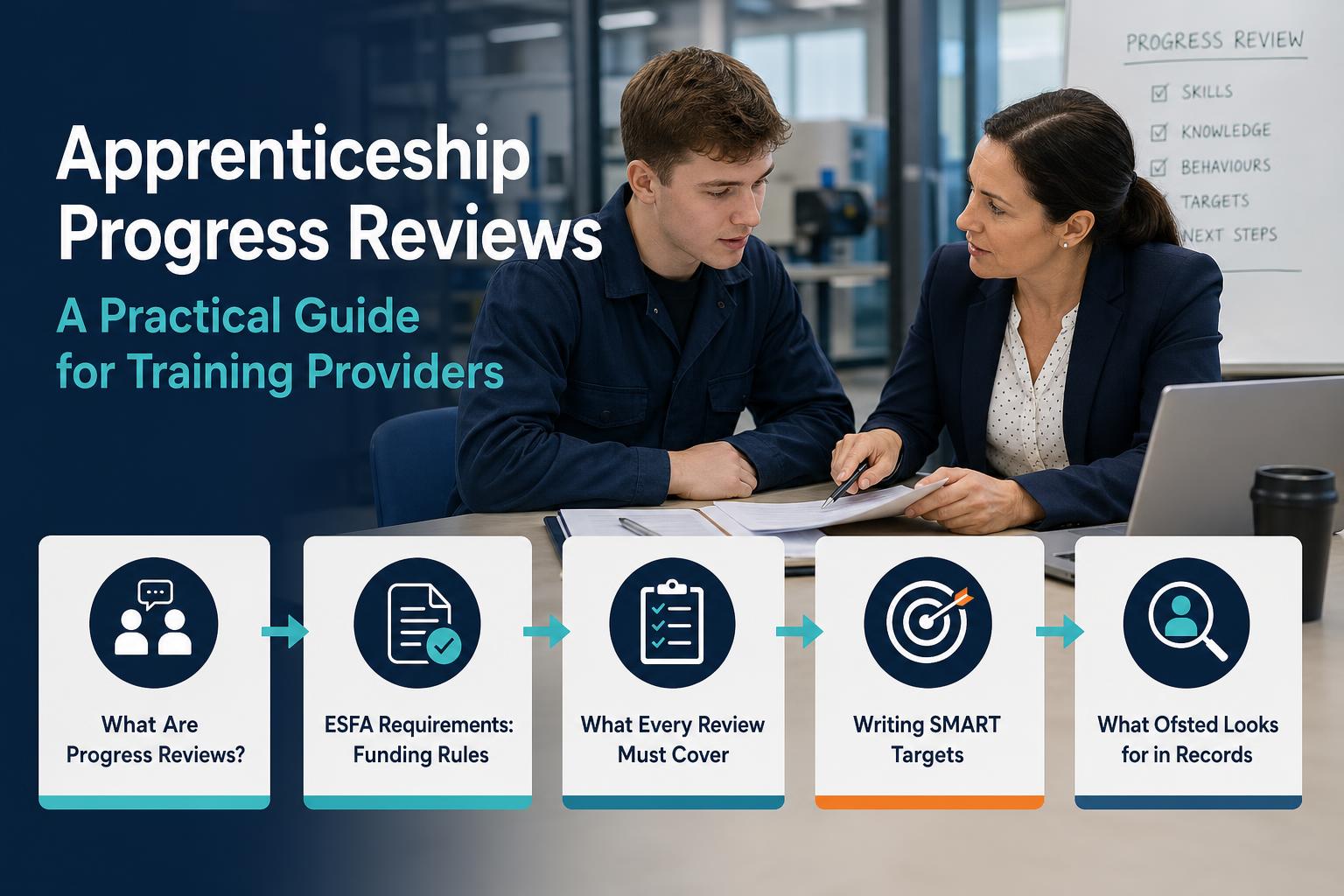
A progress review is a structured three-way discussion between the apprentice, employer and training provider about progress against the agreed training plan. Under the 2026 to 2027 rules it can be face to face, virtual or by email. The discussion must be documented, its summary shared with all parties, and actions agreed for the next review.
For the apprentice, it is an opportunity to reflect on development, identify barriers and agree next steps. For the provider and employer, it is a way to check previous actions, training delivered, overall progress, off-the-job training slippage and changes that may require the training plan to be updated.
Ofsted does not prescribe a progress-review form. Its current inspection approach triangulates conversations, learners' work, relevant records and employer evidence to understand typical experiences and impact. A useful review record supports that evidence chain; it is not a substitute for effective training or what apprentices and employers say.
What the 2026 to 2027 Funding Rules Say
The DWP apprenticeship funding rules apply to starts from 1 August 2026. Earlier apprentices remain subject to the rules for their start date. For 2026 to 2027 starts:
- Default frequency: at least every three calendar months during the practical period. A review on 1 August must be followed by the next review on or before 30 November.
- Alternative frequency: an evidenced delivery reason may justify another timetable only where the employer agrees it before the programme starts; reviews must remain no more than six months apart.
- Three-way discussion: the apprentice, employer and provider are involved. If the employer cannot attend, they must be offered a chance to contribute and must still attend physically or virtually in the majority of reviews for that apprentice.
- Documented summary: the outcome must be shared with all parties and signed, at minimum, by the provider and apprentice.
- Training-plan progress: check previous actions and training, collect or agree relevant evidence, review overall progress and document any slippage against planned off-the-job training.
- Next actions: discuss concerns or new information, update the training plan where appropriate, and agree and document actions for the next review.
Employer input is not the same as employer attendance
An employer who cannot attend must be given an opportunity to contribute, but this cannot become the default. Track attendance for each apprentice: the employer must attend physically or virtually in the majority of occurrences. Share every summary with all parties; the rules require signatures from at least the provider and apprentice, rather than a universal three-signature rule.
A Practical Review Agenda
1. Review of previous SMART targets
Start with the actions from the previous review. Were they completed? What evidence was produced? If an action was not met, why not — and what does that mean for the revised plan? This provides continuity and supports the funding-rule requirement to check previously agreed actions.
Document the outcome of each previous target explicitly: completed with evidence, partially completed, not completed with documented reason. Don't roll over incomplete targets without analysis.
2. KSB progress and coverage
Every review should check progress against the knowledge, skills and behaviours defined in the apprenticeship standard. Which KSBs have been developed or evidenced? Which are under-developed or not yet started? Are there gaps that put the applicable gateway or gateway-to-completion requirements at risk?
This doesn't mean reviewing every KSB in detail at every session — that's impractical for complex standards. It means having a running coverage view that is updated at each review and discussed in terms of trajectory: is the learner on pace? Where is the plan to address any gaps?
3. OTJ hours update
Check overall progress against the training plan and document any slippage against the planned off-the-job training volume. Review the training delivered since the previous review, agree evidence that sits outside the provider's control, and re-plan missed activity where necessary.
There is no universal 20% off-the-job requirement for current starts. The minimum volume is published on each Skills England standard and may be reduced for evidenced relevant prior learning, although a funded programme cannot fall below the rules' absolute floor. Use the requirement and training plan that apply to the apprentice's standard and start date.
4. English and Maths progress
Apply the English and maths rules by the apprentice's age when training began and the level of the apprenticeship. For 2026 to 2027 starts, English and maths are mandatory for 16- to 18-year-olds without an acceptable equivalent; the exit requirement differs between level 2 and level 3-or-higher apprenticeships. For apprentices aged 19 or over at the start, standalone English and maths are normally optional where the employer agrees to include them, unless a mandatory qualification makes them essential.
Where standalone English or maths is in the signed training plan, review progress and keep the plan current. Do not count that learning as off-the-job training. For older cohorts or restarts, check the funding rules that apply to that apprentice rather than applying the current new-start rule retrospectively.
5. Learner wellbeing and any support needs
The funding rules require the review to allow concerns, changes of circumstance and newly identified learning-difficulty, disability or support needs to be discussed. Ofsted's toolkit also considers how providers identify individual needs, reduce barriers and respond when engagement or wellbeing changes.
Record information that is relevant to the training and the action taken, with appropriate confidentiality. A template wellbeing statement is less useful than evidence that a genuine need was identified, supported and reviewed.
6. New SMART targets for the next period
Every review must agree and document actions for the next review. The rules do not require the SMART acronym, but a specific owner, outcome and due date make each action easier to deliver and follow up.
Writing SMART Targets That Work
SMART targets in apprenticeship reviews are frequently written poorly — either too generic to be actionable or so prescriptive that they don't leave room for genuine learner agency. The purpose is to agree specific activities that will produce specific evidence of specific competencies.
A useful framework for each target:
- Specific: names the exact KSB(s) the activity is designed to develop, and the specific workplace activity or task
- Measurable: defines what evidence will be produced — a reflective account, a work product with annotation, a voice journal entry, an observation record
- Achievable: is realistically within the learner's capacity given their current workload and workplace access
- Relevant: connects directly to a gap in coverage or a next stage in programme development
- Time-bound: has a completion date before the next review, not "ongoing" or "by end of programme"
Poor SMART target: "Continue to develop communication skills and reflect on professional interactions."
Useful SMART-style target: "By 10 April, explain a recent situation where you adapted your communication style for a specific stakeholder, link it to the relevant KSBs and submit the agreed evidence through the learner portal."
Ofsted evaluates impact, not a SMART template
The current toolkit focuses on whether apprentices gain and apply knowledge, skills and behaviours, make progress and receive the support they need. Clear actions can help demonstrate that process, but Ofsted does not publish a prescribed SMART-target format or grade a review form in isolation.
What Ofsted Looks for in Progress Review Records
Inspectors use professional discussion, visits, conversations with apprentices and employers, work sampling and relevant records to understand typical experiences. Training and review records may form part of that evidence, but they are considered alongside what happens in practice.
Genuine three-way involvement
A tutor-completed record with no substantive employer input does not by itself demonstrate the required three-way discussion. Employer conversations and relevant records may show how the employer contributed to actions, training-plan progress, workplace development and off-the-job delivery. A counter-signature alone is not evidence of the quality of that contribution.
Learner knowledge of their programme
Inspectors speak to apprentices to understand their typical experience, learning and progress. If an apprentice cannot explain their programme, current actions or how work and training connect to the standard, that may prompt further exploration alongside other evidence. Write review summaries with the apprentice as an active participant, not as a third-party subject.
Evidence of actual progression
Records and apprentices' work may help inspectors understand progress over time when considered with conversations and first-hand evidence. Repeated unresolved actions or static KSB coverage should therefore be understood and addressed, rather than hidden behind a generic “on track” statement.
At-risk identification and response
The toolkit considers how providers identify changing needs and barriers, support engagement, and improve progress and achievement. If off-the-job training is slipping, record the reason, agreed recovery action and impact on the training plan; then show at the next review whether the action worked.
Common Mistakes in Progress Reviews
Treating reviews as form-filling exercises
A common problem in progress review documentation is generic content: every apprentice in a cohort has the same actions, wellbeing notes and employer comments. This makes the record less reliable as evidence of an individual three-way discussion. Templates can be efficient, but the completed content should reflect the apprentice's actual progress and circumstances.
Retrospective documentation
Reconstructing review records after the event — particularly where the required three-way discussion did not take place — creates an audit risk and weakens the reliability of the evidence. Keep a timely summary of the actual conversation, contributions, progress and actions rather than backfilling a template.
Employer actions not followed up
Review records frequently assign actions to employers that then never appear in subsequent reviews. If the employer committed to arranging a workplace observation, that commitment should appear as a reviewed item in the next review. Unreviewed employer actions signal that the three-way relationship exists on paper but not in practice.
OTJ slippage recorded without action
The provider remains responsible for delivering and evidencing all required off-the-job training, even when another party delivers it. Use the review to reconcile relevant evidence, document slippage and update or re-plan the training plan. A number without the evidence and response behind it does not show that the requirement has been met.
The Progress Review Checklist
- Review involved the apprentice, employer and provider; any employer absence and opportunity to contribute were evidenced
- Employer attendance was tracked per apprentice and remained the majority of review occurrences
- Previous actions were reviewed — outcomes documented against each action
- Progress against the standard and training plan was updated with relevant evidence and trajectory
- Progress against the planned off-the-job training volume was reviewed and any slippage documented and re-planned
- English and maths progress was reviewed where it formed part of the apprentice's start-specific training plan
- The apprentice had an opportunity to raise concerns, changes and support needs; relevant actions were documented appropriately
- New actions were agreed and documented; where SMART wording was used, each had a clear owner, outcome and date
- Any at-risk signals were noted with specific action plans — named owners and dates
- Actions assigned to employer were recorded with completion date for follow-up at next review
- Summary was shared with all parties and signed, at minimum, by provider and apprentice
- Review was completed within three calendar months, or within an evidenced pre-agreed alternative timetable of no more than six months
Frequently asked questions
How often must progress reviews take place for apprentices?
For apprenticeships starting from 1 August 2026, the funding rules require reviews at least every three calendar months during the practical period. If an evidenced delivery reason, such as module length, makes another frequency more appropriate, the provider and employer must agree it before the programme starts and reviews must be no more than six months apart. Any separate learning-support review requirement still applies every three calendar months.
Who must be present at an apprenticeship progress review?
The review is a three-way discussion involving the apprentice, employer and provider. It may be face to face, virtual or by email. If the employer cannot attend, they must have an opportunity to contribute, but absence must not become the default: for each apprentice, the employer must attend physically or virtually in the majority of reviews. The summary must be shared with everyone and signed, at minimum, by the provider and apprentice.
What should SMART targets in progress reviews include?
The funding rules require agreed and documented actions for the next review; they do not prescribe the SMART acronym. A useful action names the activity or capability, evidence or outcome, owner and due date, and relates to the apprentice's training plan. Providers may use SMART targets where that makes actions clearer and easier to follow up.
What do Ofsted inspectors look for in progress review records?
Ofsted's current toolkit focuses on learners' and apprentices' experiences, progress, participation, support and the impact of curriculum and training. Inspectors triangulate conversations, work, relevant records and employer evidence; they do not require a special review template. Review records can help show how previous actions were followed up, how the training plan and off-the-job training are progressing, how individual needs are supported and how employers contribute.
Sources & further reading
- Apprenticeship Funding Rules, 2026 to 2027 — Apprenticeship Funding Rules, 2026 to 2027
- Further Education and Skills Inspection Toolkit and Operating Guides — Further Education and Skills Inspection Toolkit and Operating Guides
- Apprenticeship Finder — Apprenticeship Finder