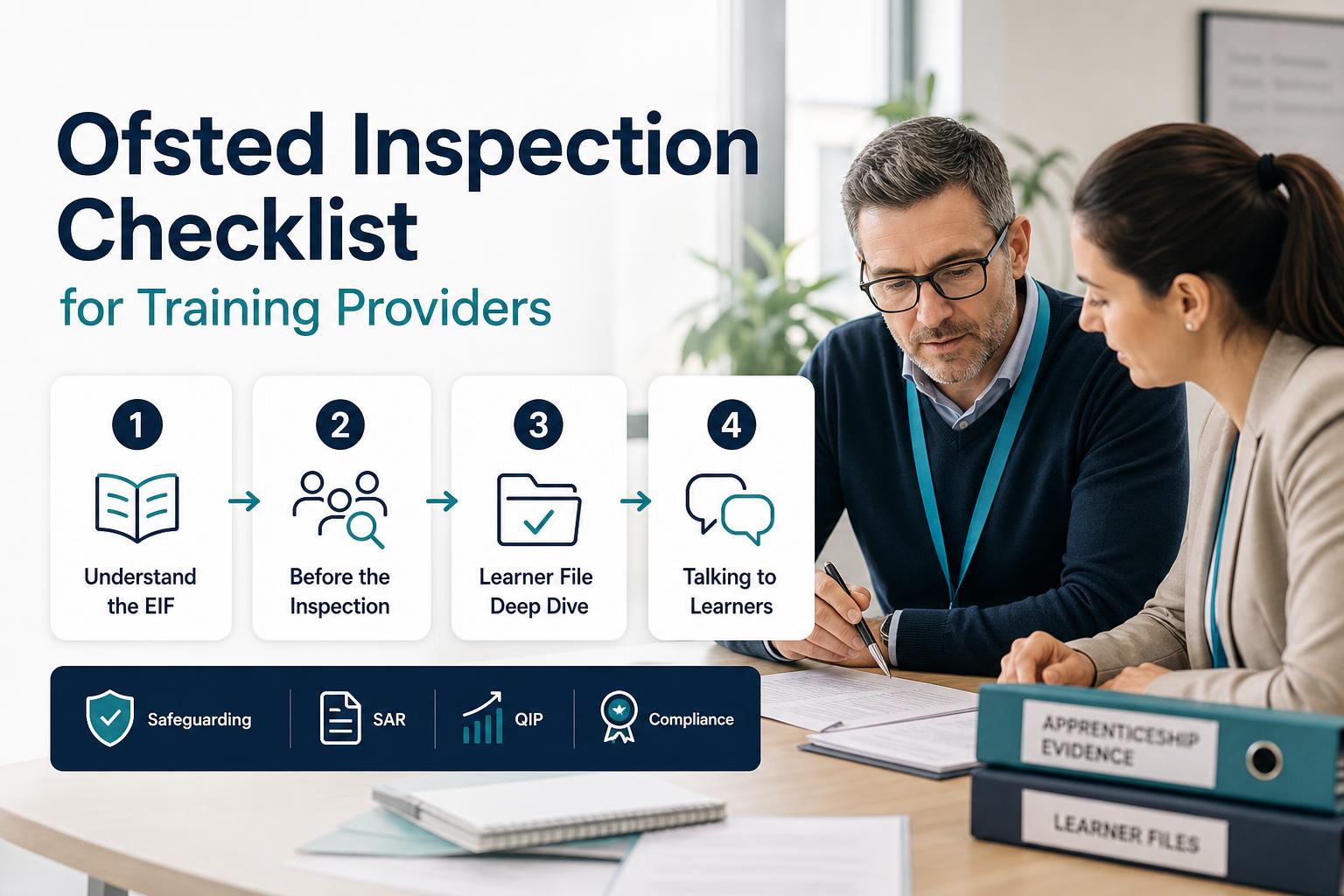
Understanding the Education Inspection Framework (EIF)
Ofsted inspects training providers using the Education Inspection Framework (EIF). Inspections produce one of four outcomes: Outstanding, Good, Requires Improvement, or Inadequate. There is also a separate safeguarding judgement that can result in automatic Inadequate regardless of other scores.
The four EIF judgements are weighted differently, and understanding their relative importance shapes how you should prioritise your preparation:
- Quality of Education — the most heavily weighted judgement
- Behaviour and Attitudes
- Personal Development
- Leadership and Management
For apprenticeship providers, Quality of Education is assessed through three lenses: curriculum intent (how well-designed is the programme?), implementation (how effectively is it delivered?), and impact (are learners achieving and progressing?). Inspectors will probe all three — through documentation, observations, and conversations with learners, tutors, and employers.
How Ofsted Selects Providers for Inspection
Ofsted does not inspect at random. Providers are prioritised based on a combination of data signals and intelligence:
- ILR data signals: low achievement rates, high withdrawal rates, sudden changes in learner numbers
- Learner and employer feedback: complaints raised directly with Ofsted
- Intelligence from ESFA: funding concerns or compliance issues
- Time since last inspection: providers who haven't been inspected recently
New providers typically receive a monitoring visit before their first full inspection. Ofsted gives 2 working days' notice for a full inspection — in some cases same-day for unannounced visits. This means all documentation must be maintained continuously, not assembled at short notice. Treating inspection preparation as a periodic exercise is one of the most common mistakes providers make.
2 working days' notice
This is the standard notice period for a full Ofsted inspection. In practice, this means your SAR, QIP, learner files, and safeguarding records must be inspection-ready at all times — not compiled in a panic when the call comes.
Before the Inspection
Your Self-Assessment Report (SAR)
Your SAR is your honest, evidence-based judgement of your own performance. Inspectors read it before the visit and will probe any claims you make. A SAR that overstates quality without evidence is a red flag. A strong SAR:
- References learner achievement, retention, and progress data with specifics — percentages, trends, cohort breakdowns
- Honestly identifies areas for development (vague positivity raises suspicion)
- Is written by practitioners who actually understand the provision, not assembled by a compliance team from a template
- Is updated at least annually and reviewed following any significant changes to the programme or learner base
Your Quality Improvement Plan (QIP)
The QIP should flow directly from the SAR's areas for development. If your SAR says English and maths achievement is below target, the QIP should have a specific action to address it — not a generic note about "improving outcomes". Each action needs:
- A specific, measurable outcome (not "improve quality")
- A named owner and target date
- RAG-rated progress
- An impact statement showing what changed as a result of each action
Inspectors will check whether actions in the QIP are genuinely connected to learner outcomes or whether they're box-ticking. A QIP full of completed actions that haven't changed anything is worse than a QIP that is honest about slow progress.
Programme Documentation
For each standard you deliver, have the following ready before the inspection call arrives:
- Curriculum intent document — the rationale for how you've structured the programme around the KSBs, and why in that sequence
- Scheme of work or programme plan showing how KSBs are built up over time from foundation to gateway
- Recent session and lesson plans demonstrating active planning and KSB alignment
- Training materials and learning resources used in delivery
- Initial assessment records and evidence of how results informed individual programme design
The Learner File Deep Dive
The deep dive is the most intensive part of an apprenticeship inspection. Inspectors select 8–12 learners across different standards, programmes, and progress stages. They examine files in detail and then interview those learners — often without the provider or assessor present. The quality of learner files frequently determines the Quality of Education grade.
Initial assessment
Was a baseline assessment completed before or at the start of the programme? Did it identify prior learning and experience (recognition of prior learning, or RPL)? Was English and maths need identified at this stage and addressed in the individual plan? Inspectors are looking for evidence that the programme was designed around the individual learner's starting point, not applied as a one-size-fits-all template.
Induction records
Was the learner properly inducted into the programme — including their rights and responsibilities, who the Designated Safeguarding Lead is, and the requirements of the apprenticeship standard? Induction records should be signed and dated. Missing induction documentation is a common finding in weaker providers.
Individual Learning Plan (ILP)
The ILP is the backbone of the learner file. Inspectors look for:
- Does it show progression from the learner's starting point?
- Are KSBs mapped to planned learning activities — not just listed?
- Is the plan updated at each review, or is it a static document from month one?
- Is it genuinely individualised or just a generic template with a name at the top?
Progress reviews
Progress reviews must happen at least every 12 weeks. But frequency is the floor, not the standard. Inspectors look for:
- Meaningful assessment of KSB progress — not just pastoral notes about how the learner is enjoying the programme
- SMART targets set at each review, with evidence they were followed up at the next review
- Employer attendance and sign-off on the review record
- Evidence the review discussed the apprenticeship standard, not just the learner's day-to-day work situation
OTJ hours records
Off-the-job training records are scrutinised carefully. Is the learner on track to meet the 20% requirement? Are activities described clearly and specifically — or are entries vague, such as "training" or "meeting"? Are both the apprentice and their employer supervisor signing off on the log? Are there unexplained gaps of several weeks with no recorded OTJ activity? Unexplained gaps suggest either poor record-keeping or that off-the-job training is not genuinely happening.
Portfolio and evidence
Is evidence authentic and specific to the individual learner? Is it clearly mapped to KSBs — or is the mapping vague and unverifiable? Are there KSB gaps visible in the portfolio, and if so, is there a documented plan to close them before gateway? A portfolio that is strong in some KSBs but silent on others without explanation is a risk.
English and maths
If the standard requires Level 2 English and maths, is the learner enrolled at an appropriate provider? Are they making progress? Is there evidence of additional support if they have struggled — referrals, additional sessions, adjusted plans? Inspectors expect to see that English and maths is actively managed, not left to chance.
Talking to Learners
Ofsted will interview learners — often without the provider present. This is deliberate. They want unfiltered answers. Common questions inspectors ask learners include:
- "What are you learning on your apprenticeship?"
- "How does your training connect to your day-to-day job?"
- "Do you know what KSBs are and which ones you're currently working on?"
- "Have you had a progress review recently? What did you talk about?"
- "Do you feel safe? Do you know who to contact if you had a concern?"
Red flags that inspectors listen for:
- Learners who don't know what KSBs are — or who give a vague, unconvincing answer when pressed
- Learners who describe progress reviews as "just signing forms"
- Learners who say their off-the-job training is "the same as my normal job"
- Learners who don't feel safe, or don't know how to raise a concern
Prepare learners — don't script them
Prepare learners by ensuring they genuinely understand the programme and their own progress. Do not script or rehearse their answers. Ofsted inspectors are trained to identify coached responses, and scripted answers raise more concerns than honest but imperfect ones.
Employer Evidence
Inspectors may also speak with employers directly. They want to understand: Does the employer understand their obligations under the apprenticeship? Are they genuinely releasing the apprentice for off-the-job training? Do they attend and contribute to progress reviews? Are they satisfied with the quality of training their apprentice is receiving?
Providers should maintain clear records of employer engagement throughout the programme. This includes review attendance records, employer sign-offs on OTJ logs, records of any employer concerns raised and how they were resolved, and any employer feedback formally collected. Sporadic or undocumented employer involvement is a quality risk and an inspection risk.
Safeguarding: The Non-Negotiable
A safeguarding failure results in an automatic Inadequate grade — regardless of how strong every other aspect of provision is. There are no partial credits on safeguarding. This checklist must be watertight before the inspection call arrives:
- Designated Safeguarding Lead (DSL) identified, trained, and known by name to all learners
- All staff have completed Prevent duty awareness training — with completion records held centrally
- Safer recruitment checks completed for all staff: DBS certificates logged, in-date, and accessible
- Safeguarding policy up to date, reviewed within the last 12 months, and accessible to both staff and learners
- Mental health first aid provision documented, with a named lead
- Lone working policy in place for visiting tutors and assessors
- All learners can name the DSL and know how to raise a concern
- Records of any safeguarding referrals and actions taken are held securely and can be produced if required
Leadership and Management Evidence
The Leadership and Management judgement looks beyond operational delivery at the governance, quality systems, and strategic oversight that underpin the provision. Inspectors expect senior leaders — not just coordinators — to be able to speak to the data.
- Senior leaders can discuss achievement and withdrawal data by standard, employer, and cohort — not just headline figures
- Board or governance body has documented oversight of apprenticeship quality data
- Staff CPD records are current and relevant to delivery — including assessor CPD and subject specialism updates
- All staff hold appropriate qualifications: assessor award, CERTA/PTLLS, and subject expertise as relevant
- IQA processes are documented, actively evidenced, and feeding back into quality improvement — not a paper exercise
- Equality, diversity and inclusion data is collected, reviewed against national benchmarks, and actioned where gaps exist
- A staff survey or formal feedback mechanism is in place and results are acted upon
On Inspection Day
When the inspection begins, the operational arrangements matter as much as the documentation. Disorganisation on the day creates a poor first impression and slows down the inspection process, which rarely helps providers.
- A dedicated quiet room is available for the inspection team with reliable Wi-Fi and power
- A single named lead contact is identified to liaise with the inspection team throughout the visit
- Learner files — or secure, well-organised digital access — are ready for the selected learner sample before the team asks
- SAR, QIP, and all programme documentation are available immediately and clearly organised
- All staff are informed the inspection is taking place — but they are not coached on what to say
- Logistics for learner interviews and employer contact are confirmed and communicated
After the Inspection
Inspectors share a verbal summary at the end of the final inspection day, giving the provider a first indication of likely grades. The formal report is published on Ofsted's website within 28 days of the inspection concluding. Providers have a short window to review the draft report for factual inaccuracies — but not to challenge grades at this stage.
Providers graded Requires Improvement receive a monitoring visit within 12 months to check whether sufficient progress has been made. Providers graded Inadequate lose their ESFA registration and access to public funding. Appeals are possible but are rarely successful on grading — appeals are only accepted on procedural grounds, such as evidence that the inspection was not conducted in line with published procedures.
If you receive a monitoring visit result rather than a full inspection — which is common for providers in their first two years — you will be graded as either "making sufficient progress" or "not making sufficient progress" across three areas: quality of education, safeguarding, and leadership and management. Sustained "not making sufficient progress" findings across multiple monitoring visits will trigger a full inspection with an elevated risk of an Inadequate outcome.
Continuous readiness is the only strategy
The providers that perform best in Ofsted inspections are those for whom the inspection itself changes very little about how they operate. Learner files are maintained as a matter of course. SAR and QIP are living documents. Safeguarding is embedded, not bolted on. If your preparation relies on a two-day scramble, the gaps will show.
Sources & further reading
- Education Inspection Framework (EIF) — Ofsted: the overarching framework used in all Ofsted inspections of training providers
- Further Education and Skills Inspection Handbook — Ofsted: how inspectors judge leadership, quality of education, and outcomes for learners
- ESFA Apprenticeship Funding Rules — GOV.UK: compliance requirements that underpin Ofsted judgements on management of apprenticeship programmes