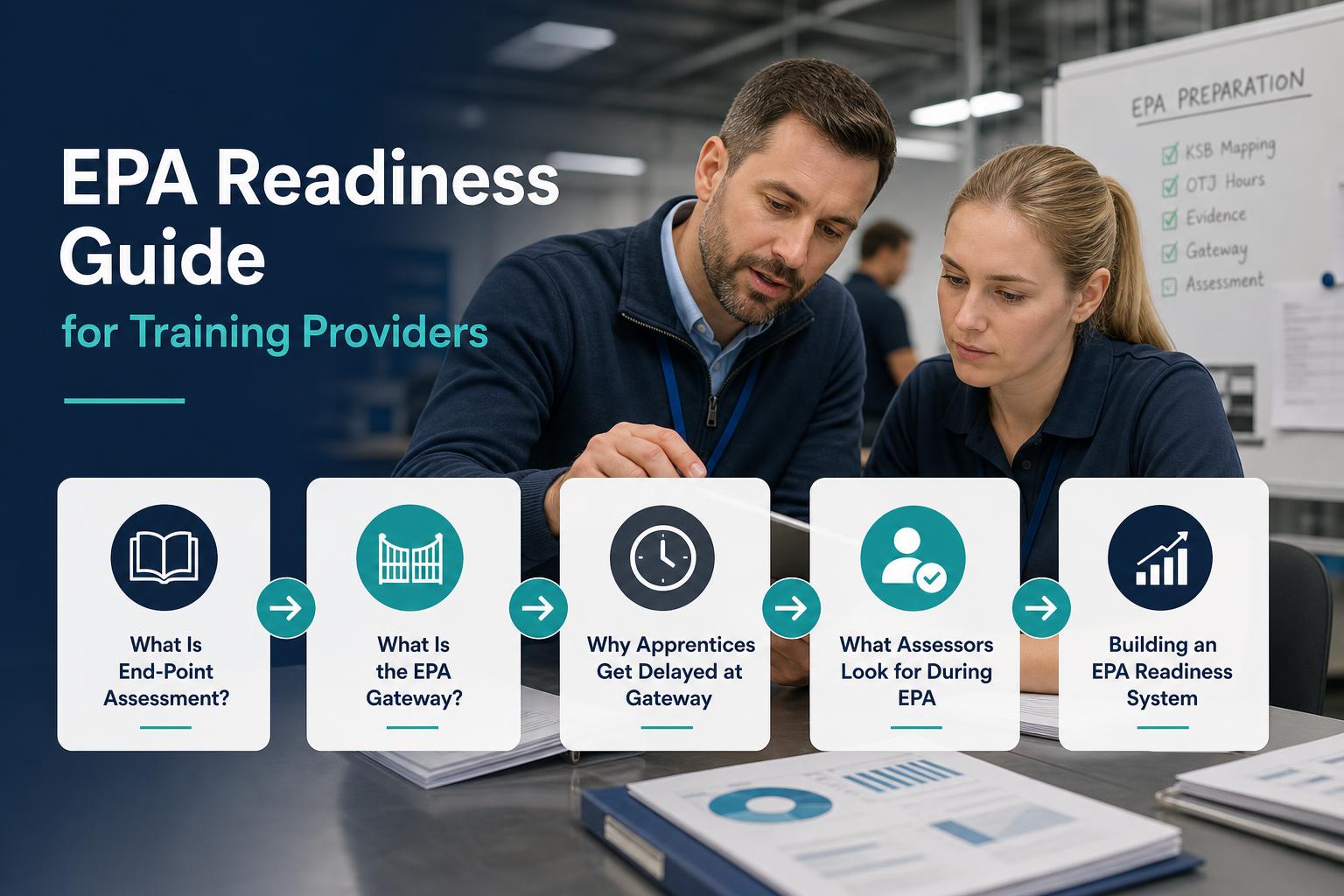
What Is End-Point Assessment (EPA)?
EPA is the independent assessment that every apprentice must pass to complete their apprenticeship and receive their certificate. It's conducted by an EPAO (End-Point Assessment Organisation) that is completely independent of the training provider — the provider cannot influence the outcome.
EPA structure varies significantly by standard: some require a professional discussion, others a project presentation, portfolio submission, multiple choice test, practical observation, or combinations of several methods. The specific EPA format is defined in each apprenticeship standard.
The critical distinction: providers control gateway readiness. They do not control the EPA itself. Their job is to ensure that every learner who reaches gateway is genuinely prepared — not just technically compliant.
What Is the EPA Gateway?
The EPA gateway is the formal readiness sign-off that must be completed before a learner can sit their EPA. It requires written confirmation from the employer, training provider, and (for some standards) the EPAO that the apprentice has met every gateway criterion.
Gateway requirements are defined in the apprenticeship standard — not by the provider. They typically include:
- All KSBs evidenced to the minimum threshold specified in the standard
- Minimum OTJ hours met (as calculated for the specific learner and standard)
- English and Maths qualifications achieved, or exemptions documented with evidence
- Portfolio or evidence file completed and verified by the provider
- Any mandated qualifications specified in the standard (first aid, sector licences, professional memberships)
- Employer confirmation of readiness
A learner who hasn't met every single one of these criteria cannot pass through gateway. There are no exceptions and no partial gateways.
Why Apprentices Get Delayed at Gateway
1. KSB gaps — uncovered or under-evidenced competencies
Even one KSB with insufficient evidence is grounds for the EPAO to reject gateway. "Sufficient" means tutor-assessed, specific, scenario-based evidence — not a generic claim that the competency has been demonstrated.
Behaviour KSBs (professionalism, initiative, adaptability, communication) are the most frequently under-evidenced because they're the hardest to demonstrate in a single piece of work and the easiest to overlook when tutors are managing large caseloads.
2. OTJ hours shortfall
The minimum OTJ hours requirement is calculated from the apprenticeship duration and must be 20% of employed contracted time (or the standard's specified minimum, whichever is greater). Providers often undercount because they don't track hours continuously — a shortfall discovered at week 50 is far harder to remedy than one spotted at week 20.
OTJ must be off-the-job learning that takes place in contracted working hours. Lunch breaks, voluntary overtime, and activities the learner would normally do as part of their job role don't qualify.
The Cost of a Gateway Delay
A learner held at gateway for 4–8 weeks waiting to make up a shortfall represents lost revenue for the provider, employer frustration, and a significant risk of learner dropout — particularly for those who have already mentally "completed" their apprenticeship. Proactive readiness tracking prevents this entirely.
3. English and Maths not achieved
Level 2 English and Maths (or equivalent) are required for Level 3 and above apprenticeships — unless the learner holds a prior exemption that has been formally documented and accepted. A learner who hasn't sat or passed their functional skills qualification is not eligible for gateway regardless of how strong their programme progress is.
This is one of the most frequently overlooked gateway blockers, often because English and Maths delivery is managed by a different team or sub-contracted provider. The apprenticeship provider is responsible for tracking it — even if someone else delivers it.
4. Mandated qualifications incomplete
Many apprenticeship standards require specific sector qualifications as gateway prerequisites — first aid certificates, CSCS cards, food hygiene certificates, SIA licences, professional body memberships. These are listed explicitly in the standard. If they expire before gateway, they must be renewed — achievement at programme start is not sufficient if the qualification has since expired.
What Assessors Look for During EPA
Understanding what makes EPA assessors confident — and what makes them uncomfortable — is essential context for building a readiness system that goes beyond compliance.
Portfolio reviews
Assessors check that evidence is specific, contemporaneous, and genuinely demonstrates the KSB at the required level — not generic, not retrofitted, and not repetitive. They look for evidence that was collected during normal programme delivery, not assembled in the weeks before gateway.
Red flag patterns: all KSBs evidenced in a short period close to gateway; all evidence using similar language and format (suggests a template rather than authentic activity); Behaviour KSBs supported only by generic professional statements.
Professional discussion
Assessors probe for depth. A learner who genuinely understands a KSB can discuss it from multiple angles — applying it to real scenarios, identifying edge cases, explaining the rationale behind a decision, connecting it to wider standards and regulation. A learner who has been given a script or a bullet-point list cannot sustain that depth under questioning.
Practical observation
Workplace or simulated observation assesses whether the learner can actually perform the competency in a realistic context — not recite it. Preparation must be genuine: practising the actual tasks in actual conditions, not rehearsing for the assessment specifically.
Building an EPA Readiness System
Start with a gateway checklist per standard
Build a specific gateway checklist for every standard you deliver. It should include: a list of all KSBs with the minimum evidence threshold defined; OTJ hours target broken down by month; English and Maths qualification milestones with target dates; all mandated qualifications with achievement and renewal dates; employer confirmation process and timeline.
The checklist must be a live document — reviewed and updated at every progress review, not created for the first time in the final review before gateway.
RAG rate every learner against every criterion
A simple RAG (Red, Amber, Green) status against each gateway criterion at each review makes cohort readiness visible at a glance. Green means on track. Amber means at risk but recoverable with specific action. Red means intervention required now.
Any red-rated learner should trigger an immediate documented action plan with specific milestones and a named responsible tutor. Not a note for the next review. Not "to be discussed." An action plan, written, with dates.
Early Warning at Scale
Prentice's AI detects at-risk learners 3 weeks earlier than manual tracking by monitoring OTJ accumulation rates, KSB coverage velocity, and evidence submission frequency across the cohort. Tutors receive proactive alerts — not lagging reports that show a problem after it's already critical.
Track readiness at every progress review
EPA readiness should appear as a standing agenda item at every progress review — not just the final review. At each review: is the learner on pace to evidence all KSBs by programme end? Is OTJ accumulation on schedule? Are English and Maths milestones on track?
The earlier a risk is identified, the more options exist to address it. A KSB gap identified at review 3 can be incorporated into the next 6 months of planned workplace activities. The same gap identified at the final review is a crisis.
Structure EPA preparation sessions properly
EPA prep is a legitimate OTJ activity when conducted in contracted time and genuinely focused on developing competency for the EPA format. Structure prep sessions around the specific assessment method: for professional discussion, run practice Q&A sessions against real KSBs, not generic interview practice; for project presentations, provide structured feedback on content and delivery against the EPA marking criteria; for portfolio review, work through the evidence checklist with the learner rather than adding evidence for them.
Assessors can tell the difference between a learner who has genuinely prepared and one who has been briefed the week before. The former can discuss their evidence and extend their thinking. The latter can recite their portfolio.
EPA Readiness by Apprenticeship Type
Degree apprenticeships
Additional gateway requirement: module completion as specified by the university partner. The coordination between the HEI and training provider on gateway sign-off is one of the most common failure points in degree apprenticeship delivery — communication between the two organisations breaks down, and learners sit in limbo while both sides clarify requirements. Establish a formal joint gateway process with the HEI at programme start, not at gateway.
Level 2 apprenticeships
English and Maths requirements may be at Entry 3 or Level 1 depending on the standard — always check the standard's specific gateway requirements rather than applying the general rule. Mandated qualifications at Level 2 are often sector-specific and some expire (first aid certificates, for example) — track renewal dates, not just initial achievement.
Level 6 and 7 professional standards
These are the longest and most complex programmes — often 3–5 years. KSB evidence must demonstrate sustained, deepening competency across the full programme, not just initial achievement. Gateway often requires a synoptic project or extended piece of work that takes months to produce — starting this late is a critical failure mode that is entirely avoidable with an early planning conversation.
The EPA Readiness Checklist
- All KSBs have a defined minimum evidence threshold documented in your gateway policy
- KSB coverage is tracked at every progress review, not just the final review before gateway
- OTJ hours are logged continuously and verified against the minimum threshold monthly
- English and Maths milestones are tracked separately and flagged if at risk
- All mandated qualifications are listed per standard with achievement dates and renewal deadlines
- Employer confirmation process is documented and initiated well in advance of gateway target date
- Every learner is RAG-rated against all gateway criteria at every progress review
- Red-rated learners have documented action plans with specific milestones and named owners
- EPA prep is structured around the specific assessment format — not generic interview coaching
- Gateway checklist is formally signed off by tutor, employer, and EPAO before submission
- Degree apprenticeship gateway process is coordinated with the HEI partner from programme start
Sources & further reading
- End-Point Assessment — IfATE: EPA organisation list, assessment plans, and gateway requirements by standard
- Apprenticeship Standards — IfATE: assessment plan documents specifying KSB coverage required for EPA gateway
- ESFA Apprenticeship Funding Rules — GOV.UK: gateway conditions and funding compliance requirements