Last updated: 19 March 2026
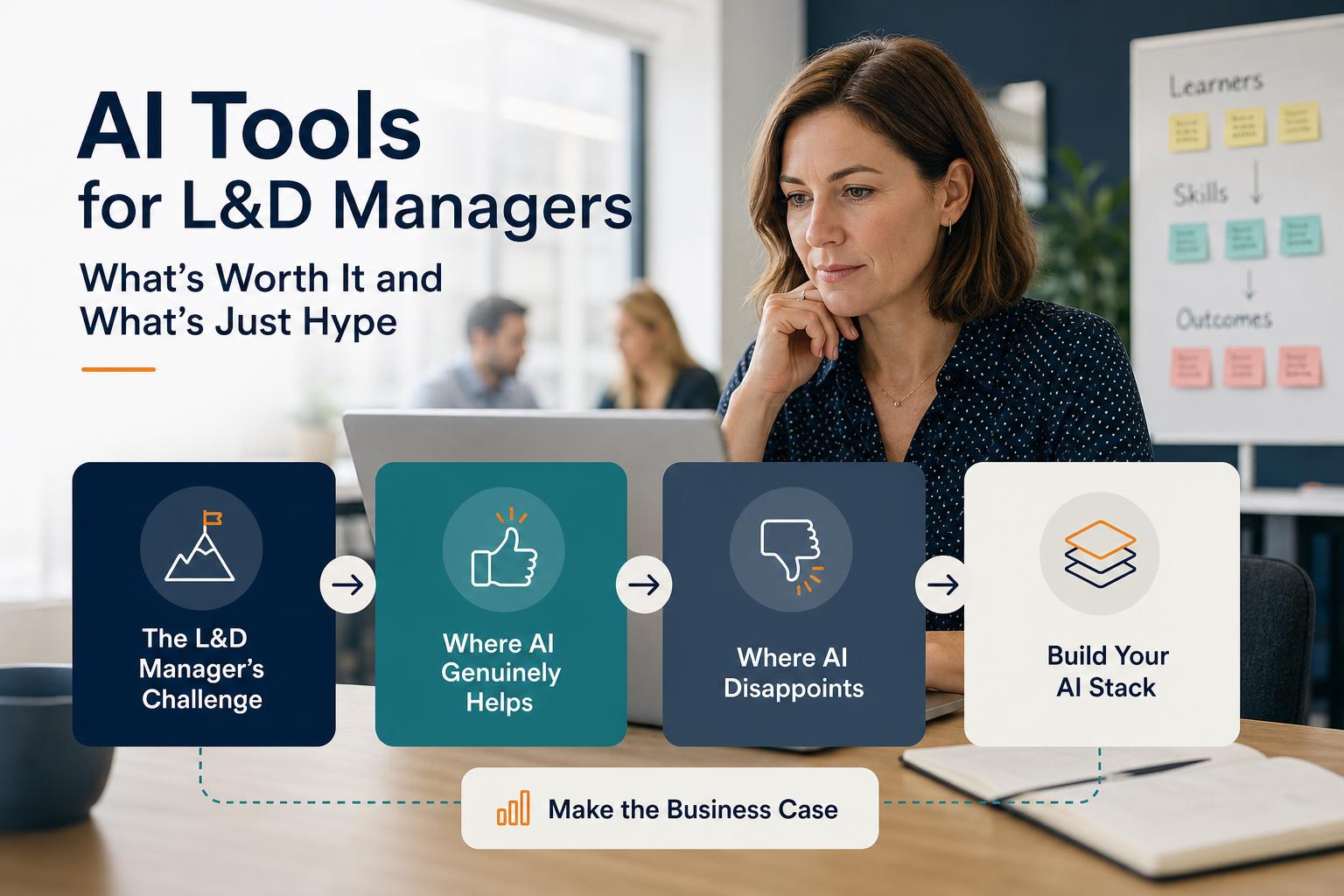
The L&D Manager’s Challenge in 2026
The workload landing on L&D managers in 2026 looks nothing like it did five years ago. Organisations are running AI adoption programmes that require new skills training at pace. Regulatory and compliance requirements have grown in scope. Leaders who previously treated training as a cost centre are now asking for data on learning impact — and expecting that data to look like business intelligence, not completion rate dashboards.
Meanwhile, L&D team size has not kept pace with these demands. CIPD data consistently shows that L&D budget and headcount growth has lagged behind the expansion of L&D scope. The gap between what L&D is asked to deliver and what the resource base can support is real — and it is widening.
The honest arithmetic of the situation is straightforward. If you cannot hire your way to capacity and you cannot reduce demand, the only remaining lever is increasing the output per hour of L&D effort. AI tools are the primary way to move that ratio in 2026. Not as a replacement for L&D expertise — the work that requires human judgment, relationship, and context has not diminished — but as a way to reduce the hours spent on administrative, repetitive, and data-processing tasks that currently consume a significant proportion of L&D manager time.
The challenge is identifying which tools actually deliver on this and which are expensive additions to an already stretched workflow.
Where AI Genuinely Helps L&D Managers
Based on practitioner feedback and implementation data, four areas stand out as delivering consistent, measurable productivity gains for L&D managers.
Automating administrative tasks
The single largest category of recoverable time for most L&D managers is administration: tracking learner progress, identifying who is behind schedule, chasing completion, compiling reports for leadership, and managing the scheduling and logistics of training delivery. These tasks are individually small but collectively consume 30–40% of a typical L&D manager’s working week in organisations without automation.
AI-powered platforms address this directly. Automated progress tracking identifies learners behind schedule without manual monitoring. At-risk flagging surfaces cohorts or individuals who are likely to disengage before they actually do. AI-generated narrative summaries of cohort data eliminate the weekly ritual of translating spreadsheet data into written progress reports for stakeholders.
The real-world impact, consistently reported by L&D teams using AI-native platforms, is 3–5 hours per week returned to strategic work — curriculum design, programme review, stakeholder engagement — rather than administrative process.
Accelerating content development
Content development is the second major time sink for L&D managers who also carry design responsibilities. The industry benchmark for developing one hour of instructor-led training content is 40–80 hours of designer time; for e-learning, research from Brandon Hall Group puts the range at 100–200 hours for fully interactive content.
AI content authoring tools — used correctly — reduce the time required for the structural and drafting phases of this work by 40–60% for standard content types. AI generates a first-draft module outline from a brief in seconds. AI drafts narration scripts and scenario text that require editing but not creation from scratch. AI generates quiz questions from source documents that require review but not authoring.
The practical result is a content development cycle measured in days for standard modules rather than weeks — which changes what is possible within a fixed L&D resource. Complex, technical, or emotionally sensitive content still requires significant SME investment; the gains are clearest for procedural, policy, and compliance content that follows predictable structures.
Smarter learner analytics
Traditional LMS analytics tell you what already happened: who completed what and when. For most organisations, this information arrives after the point at which intervention would have been useful. By the time a learner has failed to complete a module, disengaged, or fallen behind schedule, the report confirming this is of limited value.
AI analytics moves the information earlier. By learning patterns in learner behaviour — engagement velocity, session length, assessment score trajectories, response patterns — AI can identify which learners are likely to disengage before they do. This shifts L&D from reactive case management (someone flagged a problem) to proactive programme management (patterns suggest an intervention is needed).
For L&D managers reporting to leadership, the secondary benefit is also significant. AI-generated programme analytics produce narrative-quality reporting on training outcomes — not just completion tables but summaries that connect training activity to performance indicators where data integration permits. This is the kind of reporting that makes the case for L&D investment, and it was previously only achievable with dedicated data analyst time.
Personalisation at scale
The promise of personalised learning has existed for decades but remained impractical for most organisations. Differentiating curriculum by learner prior knowledge, role, and performance trajectory requires either very small cohorts or significant designer time — neither of which is available at most organisations.
AI adaptive learning systems change this calculus. By adjusting learning path based on demonstrated performance — surfacing additional practice material where a learner struggles, accelerating past content where a learner demonstrates existing competence, and recommending next learning based on role and skills gap data — AI-native platforms deliver a more relevant learning experience without requiring manual curriculum differentiation.
The impact on learner outcomes is not uniform across all content types. Adaptive learning delivers strongest results for skill-based and knowledge acquisition content; it is less relevant for cohort-based leadership development or programme content that requires shared experience. L&D managers should apply adaptive features selectively rather than assuming they improve all training contexts.
Where AI Disappoints L&D Managers
Equally important as knowing where AI helps is understanding where it consistently falls short or creates additional work rather than reducing it.
Generic chatbots as a substitute for structured learning. Deploying a general-purpose AI chatbot to answer training queries is not a learning intervention. Learners interacting with generic AI chatbots show poor retention outcomes compared to structured content, because the conversational format does not reliably produce the spaced repetition, retrieval practice, and deliberate challenge that learning science identifies as effective. Chatbots have a role in performance support; they are not a substitute for programme design.
AI-generated content without SME review. L&D teams that publish AI-generated content without subject matter expert review consistently encounter accuracy and tone problems. AI writes plausible content — it does not necessarily write correct content. In technical, regulated, or high-stakes training contexts, the difference between plausible and correct matters significantly. The time saved on drafting can be exceeded by the time required to correct errors that reach learners.
Tools with a high “integration tax.” Some AI tools require substantial manual configuration, data migration, or workflow adjustment before they begin saving time. A tool that takes three months of setup before it delivers productivity gains is a materially different proposition from one that delivers value in the first week. This integration cost is rarely prominent in vendor materials and must be investigated explicitly during evaluation.
AI analytics that only automate completion reporting. A common category of “AI analytics” tool in the training market delivers completion rates with a more sophisticated dashboard and calls it AI. Completion rate is not a measure of learning impact. Tools in this category are not adding meaningful analytical value — they are presenting the same inadequate metric with a more modern interface.
Many AI analytics tools surface completion rates with sophisticated dashboards. But completion rate is a lagging indicator of learner engagement, not a measure of learning impact. AI tools that help you measure skills application and behavioural change post-training are significantly more valuable than those that automate reporting on activity data. Before purchasing an AI analytics tool, ask the vendor: what does this tool measure that my existing LMS cannot? If the answer is primarily “better visualisation of completion data,” the tool is not delivering AI value.
Building Your AI Stack as an L&D Manager
The most common mistake L&D managers make when adopting AI tools is attempting to implement too many simultaneously. Enthusiasm following a conference or a compelling vendor demonstration leads to multiple tool evaluations running in parallel, each requiring time from an already stretched team, and none receiving the focused attention required to embed properly.
Start with one workflow. Identify the task in your current role that consumes the most time and delivers the least value relative to your strategic priorities. That is the first use case for AI. One specific use case, one tool, one pilot — before anything else.
Integration before capability. A tool that integrates with your existing LMS or HRIS is worth more than a tool with superior AI capability that requires manual data transfer. The friction of non-integrated tools is consistent and daily; the capability advantage is periodic. Integration quality should be a primary evaluation criterion, not a secondary one.
Change management is half the work. AI tools do not adopt themselves. Tutors, trainers, and L&D coordinators who are expected to work with AI outputs need to understand what the AI does, why they should trust it, and what to do when it is wrong. Adoption rates for AI tools without structured onboarding are consistently lower than adoption rates for tools with active change management — regardless of tool quality. Budget for this explicitly.
Run the ROI calculation before you commit. The business case for an AI tool is: hours saved per week × hourly cost of L&D resource × 52 — compared against licence cost, integration cost, and change management cost over 12 months. This calculation is not complicated, but it is frequently not done before purchase. Tools that cannot demonstrate a plausible payback period within 12 months should require stronger justification before budget is committed.
L&D managers who attempt to implement five AI tools simultaneously typically see poor adoption across all of them. The team’s capacity to absorb change, learn new workflows, and adapt existing processes is finite. Implement one tool at a time: build confidence with it, measure the impact against your baseline, and then introduce the next. Sequential implementation consistently produces better outcomes than parallel implementation, even if the total time to full AI stack adoption is longer.
Making the Business Case for AI L&D Tools
L&D managers seeking budget approval for AI tools frequently frame the case in terms of innovation, competitive positioning, or learning science. These arguments land poorly with CFOs and finance directors. The conversation that releases budget is a different one.
What finance stakeholders want to see: A clear statement of the current cost (hours spent on the task being automated, at a fully loaded hourly rate), a documented vendor estimate of time saved, a total cost of the tool over 12 months including implementation, and a projected payback period in months. That is the complete business case for most budget holders. “Innovation” does not appear in it.
Gathering the data you need: Before approaching finance, spend two weeks tracking actual time spent on the specific administrative tasks you intend to automate. The granularity of this data — “I spend 4.5 hours per week on cohort progress reporting” — is far more persuasive than a general claim about L&D inefficiency. It also gives you the baseline against which to measure actual post-implementation savings.
Framing for different stakeholders:
- IT and data teams: Security architecture, GDPR compliance documentation, integration requirements, and data residency. Have answers to these questions before the conversation, not during it.
- HR leadership: Data governance for learner data, implications for performance management processes, and whether the tool changes how training outcomes are recorded or reported.
- Finance: ROI calculation, payback period, total cost of ownership over 24 months, and the cost of not acting (the opportunity cost of L&D manager time continuing to be consumed by manual administration).
- Senior leadership: The competitive and talent angle — AI-enabled L&D teams can develop workforce skills faster, respond to skills gaps more quickly, and demonstrate training impact more clearly than teams working with legacy tools.
Quick Reference: AI Tool Selection Checklist for L&D Managers
Before committing to any AI tool, work through this checklist:
- Specific use case identified before evaluation — not “we need an AI tool”
- Current time spent on that task measured and documented as a baseline
- Tool demo focused on your use case with your content — not vendor-prepared scenarios only
- UK GDPR and data processing documentation requested and reviewed
- Integration with existing LMS/HRIS confirmed (not assumed)
- End-user (tutor/trainer) feedback on usability collected during the pilot period
- Adoption and change management plan documented before go-live
- Success metric and formal review date set before purchase — not retrospectively
Frequently asked questions
Which AI tools save L&D managers the most time?
The highest-impact AI tools for L&D managers are: AI-assisted reporting and analytics (reducing the time spent compiling training data for leadership reports), AI content authoring assistants (reducing course development time by 40–60% for standard content types), and AI-powered learner progress platforms (automating the monitoring, flagging, and reporting tasks that typically consume 3–5 hours per week). The tools that disappoint tend to be generic chatbots applied to training queries without sufficient domain knowledge.
Do I need a dedicated AI strategy to start using AI tools in L&D?
No — in fact, waiting for a formal AI strategy before acting is one of the most common ways L&D teams fall behind. Start with a single, specific use case where you know the current process wastes time. Pilot one tool, measure the impact, and build from there. A documented AI strategy is useful once you have 3–5 tools in use and need governance — not before you start.
How should L&D managers handle GDPR concerns around AI tools?
Before deploying any AI tool that processes learner data, confirm: (1) whether the AI vendor processes data under a data processing agreement that complies with UK GDPR; (2) whether learner data is used to train the vendor's models (and if so, whether opt-out is possible); (3) where data is stored and whether it leaves the UK/EEA. Most reputable AI training platforms will have this documentation available on request. Avoid tools that cannot answer these questions clearly.
Sources & further reading
- CIPD Learning at Work Survey — cipd.org/en/knowledge/reports/learning-work-survey
- McKinsey Global Institute: The economic potential of generative AI — mckinsey.com/capabilities/mckinsey-digital/our-insights
- GOV.UK AI Opportunities Action Plan — gov.uk/government/publications/ai-opportunities-action-plan