Last reviewed: 15 July 2026 against Skills England's June 2026 assessment requirements, July 2026 behaviour-verification guidance and the published 2026/27 funding rules.
England is in a standard-by-standard transition. Existing assessment plans can retain end-point assessment and gateway arrangements, while revised plans use apprenticeship assessment and gateway to completion. The learner's exact standard, version, start date and assessment plan decide which route applies.
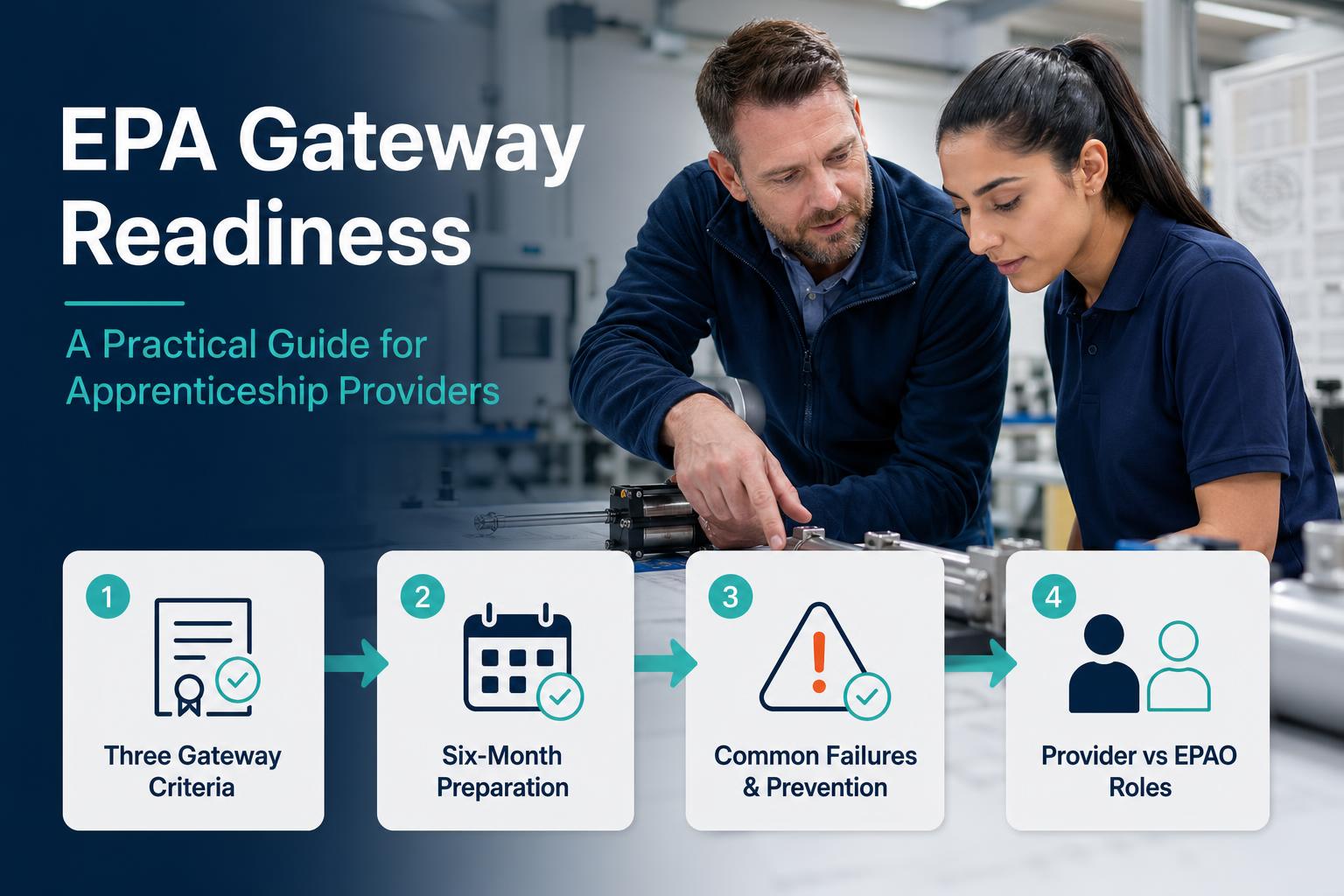
This guide is the final control: the short, evidence-led check before a provider declares readiness under a legacy plan or confirms completion conditions under a revised plan. It is deliberately different from a programme-long EPA preparation and readiness system. Teaching, practice and early intervention should already have happened. The question here is whether the final decision is based on the correct rules and complete evidence.
Start With the 2026 Assessment Transition
Official guidance now uses three terms for revised assessment plans:
- apprenticeship assessment instead of end-point assessment;
- assessment organisation instead of end-point assessment organisation; and
- gateway to completion instead of gateway or gateway to assessment.
The change is substantive, not cosmetic. Where a revised plan permits it, assessment can take place during the apprenticeship and may be delivered or marked by a provider under the plan and the assessment organisation's quality assurance. Gateway to completion remains the end-of-programme checkpoint before the certificate is requested; it is not necessarily a gate before every assessed activity.
At the same time, the 2026/27 funding rules explicitly retain the term end-point assessment for existing versions whose plans have not yet been revised. Skills England standard pages can also show a revised plan approved but still in a lead-in period, with the current EPA plan remaining in force until the stated implementation date.
| Control question | Existing plan | Revised plan |
|---|---|---|
| Terminology | EPA, EPAO and gateway may remain correct. | Apprenticeship assessment, assessment organisation and gateway to completion. |
| Assessment timing | Follow the gateway and assessment sequence in that plan. | Assessment may occur during the programme where the plan says so. |
| Final checkpoint | Confirm every gateway condition in the applicable plan. | Confirm all completion conditions before certification, including employer behaviour verification. |
Freeze a Learner-Specific Source Pack
The final reviewer should be able to see which official documents control the decision. Capture the following in the learner record rather than relying on a portfolio-level checklist that may have changed:
- Standard reference and version. Record the ST code, version and the learner's start date. Use Skills England's version log, not only the standard title.
- Assessment plan and effective status. Save or link the plan that applies. A revised plan marked for information during a lead-in period is not automatically the operative plan for current learners.
- Applicable funding rules. Funding rules differ by start date. Record the year and version used for the final checks.
- Assessment organisation and delivery route. Confirm who designs, delivers, marks, quality assures and records the relevant assessment under this plan.
- Any transfer, dispensation or version instruction. If the apprentice has moved version or a standard page carries a specific notice, retain the decision and evidence that the transfer conditions were met.
That source pack prevents a common transition error: using a newly published revised plan for an apprentice who remains on an earlier version, or continuing with a legacy EPA checklist after a valid move to the revised version.
The Final Control Checklist
Build the learner's checklist from the source pack. Use not applicable only when the applicable plan or rules show that the condition does not apply; do not use a blank cell.
1. Required assessment is complete and correctly recorded
For a legacy plan, confirm the gateway evidence and the required EPA sequence exactly as published. For a revised plan, check every assessment method, including any assessment carried out during the programme, and confirm the required outcomes are complete and available to the organisation responsible for certification.
Do not assume every revised plan has the same number of methods, that a provider can mark every method, or that an end-stage assessment has disappeared. Those are plan-level decisions.
2. The correct OTJ minimum has been met and evidenced
Use the funding rules for the apprentice's start date. For newer starts, use the minimum volume published for the exact standard and version on Skills England, with any reduction supported by the applicable recognition-of-prior-learning rules. Do not put “20% complete” on every learner's final checklist.
Check actual eligible delivery, not simply planned hours or learner-submitted logs. The provider remains responsible for evidencing required OTJ training even where another party delivered it. Keep the eligibility test, actual-hours evidence and final reporting aligned. The 2026/27 OTJ hours guide covers the calculation and exclusions in detail.
3. Mandatory qualifications and plan-specific requirements are achieved
List every additional qualification or other completion requirement mandated by the occupational standard and assessment plan. Verify the result against the awarding or authoritative record. A course attendance status is not evidence of qualification achievement.
Under some revised plans, mandatory qualifications cover all or most knowledge and skills and change who records the grade and requests certification. Treat that as a plan-specific route, not a portfolio-wide assumption.
4. English and maths are checked where applicable
Do not make Level 2 English and maths a universal gateway condition. Check the funding rules, assessment plan and mandatory qualification for this apprentice. Where English or maths is an essential component of a mandatory qualification, it must be completed as part of the apprenticeship. Where another requirement or exception applies, retain the evidence for that route.
The final control should say which requirement applies and why, not simply show a generic Functional Skills traffic light.
5. The employer has verified behaviours under a revised plan
For revised assessment plans, the employer must confirm that every behaviour in the occupational standard has been demonstrated sufficiently and consistently during the programme. Behaviours do not contribute to the grade, but a certificate cannot be issued without the employer confirmation.
Providers and assessment organisations do not assess those behaviours or quality assure the employer's judgement under the revised arrangements. The provider's control is to make responsibilities clear, support the ongoing process and confirm that the employer's report has reached the organisation requesting the certificate.
6. Employment, learning and review records tell one story
Reconcile the apprentice's start and end information, training plan, OTJ actuals, assessment outcomes, qualification records, employer confirmation and any change-of-circumstance evidence. The control should stop when two authoritative records disagree. Correct the source rather than adding a note that leaves the contradiction unresolved.
7. The certification route and owner are explicit
Record who will request the certificate, what result or confirmation they still need, the target date and the evidence that the request was made. Under many standards the assessment organisation continues to record the grade and initiate certification. For revised standards assessed solely through one or more mandatory qualifications, the plan may place that responsibility with the training provider.
“Complete” should link to the plan condition, result, employer confirmation or verified record that makes it true. If a reviewer cannot reproduce the decision without asking the original tutor, the control is not yet robust.
Make Employer Behaviour Verification Proportionate
Skills England's July 2026 employer guidance is deliberately designed to avoid a new paperwork industry. It focuses on naturally occurring examples from supervision, feedback, induction, regular check-ins and performance development.
A practical process is:
- Identify every behaviour from the occupational standard at induction or early onboarding.
- Agree who is close enough to the apprentice's work to observe each behaviour.
- Discuss development periodically and record concise examples from real work.
- Gather input across placements, teams or shifts where necessary.
- Have one authorised employer representative provide the final confirmation at gateway to completion.
The signatory is usually the line manager or equivalent and must understand the behaviours and have sufficient oversight. Several people can contribute observations, but the employer gives a single confirmation. For flexi-job apprenticeships, the lead employer or flexi-job apprenticeship agency retains overall responsibility and collates host-employer feedback.
Run a Two-Lane Transition Register
A cohort dashboard should identify the governing route before it shows readiness. Suggested fields are:
- ST reference and version;
- learner start date and applicable funding-rule year;
- assessment plan status: existing EPA or revised apprenticeship assessment;
- plan effective date and any lead-in or transfer note;
- assessment methods and status;
- published OTJ minimum, adjusted minimum and verified actual hours;
- mandatory qualifications and English or maths condition where applicable;
- employer behaviour verification status for revised plans;
- certificate-requesting organisation, owner and target date; and
- exception, evidence link and last review date.
Do not overwrite historic rows when a new version becomes available. A portfolio can legitimately contain learners on different versions and assessment routes at the same time.
Run the Final Sign-Off as a Control Meeting
The meeting is not a ceremonial signature exercise. Put the source pack and learner checklist on screen and resolve each condition with the employer, provider and other parties required by the applicable plan.
- Confirm the standard, version, plan and route first.
- Review evidence for each applicable condition.
- Ask the employer to make its own behaviour judgement under a revised plan.
- Record any missing or contradictory item as a stop condition with an owner and date.
- Confirm who records the result and requests the certificate.
- Save the dated decision and the document versions used.
A learner who is technically ready for a legacy gateway may still need help with assessment format and confidence. That is assessment preparation, not this control. Keep the two decisions visible so a compliance sign-off is not mistaken for a judgement that no further preparation is needed.
Assure the Control Across a Cohort
Quality teams should sample the decision, not merely the existence of a signed form. A useful monthly sample asks:
- Was the correct version and effective assessment plan used?
- Can every applicable green status be reproduced from evidence?
- Was the OTJ minimum taken from the correct source and start-date rules?
- Were English, maths and mandatory qualifications treated as learner-specific conditions?
- For revised plans, did the employer make and report the behaviour verification?
- Were assessment results and certification ownership recorded correctly?
- Did any tutor use a copied checklist containing conditions from another version?
Track failure themes by standard and version. If the same condition repeatedly stops completion, repair the earlier programme control rather than adding more activity to the final week.
Frequently Asked Questions
Should providers rename every EPA field now?
No. Retain EPA terminology where it describes an existing operative assessment plan. Add revised terminology and a route field so records remain accurate during the transition.
Can an employer ask the provider to decide whether behaviours are sufficient?
Under revised plans, the employer owns that verification. The provider can explain the occupational behaviours and facilitate regular discussions, but it should not make or quality assure the employer's final judgement.
Is gateway to completion just the old gateway with a new name?
No. It remains an end-of-programme checkpoint, but assessment under a revised plan may already have occurred during the programme. The checkpoint confirms the conditions needed before certification rather than always opening access to assessment.
What is the single most important field in the checklist?
The combination of standard reference, version and applicable plan. If that is wrong, every subsequent requirement can be checked against the wrong rules.
Sources & further reading
- Department for Work and Pensions: Changes to apprenticeship assessment, 2025 to 2026 — gov.uk/changes-to-apprenticeship-assessment
- Skills England: Requirements and guidance for apprenticeship assessment — gov.uk/requirements-for-apprenticeship-assessment
- Skills England: Apprenticeship behaviour verification guidance for employers — gov.uk/verifying-apprenticeship-behaviours
- Department for Work and Pensions: Apprenticeship funding rules and assessment plan guidance, 2026 to 2027 — gov.uk/apprenticeship-funding-rules-2026-to-2027
- Skills England: Search apprenticeship standards and versions — skillsengland.education.gov.uk/apprenticeships