Understanding the two models
Before comparing features, it is worth being clear on what each product actually is — because they are not direct substitutes.
Multiverse is a training provider: an employer selecting it is choosing the organisation that will deliver and manage the apprenticeship. Verify its current programmes, minimum cohort, inspection record and commercial terms directly, because these can change.
TIQ-plus, built by Training Intelligence (TIQ) Ltd, is AI-powered apprenticeship management software for independent UK training providers. TIQ-plus is not a training provider — it powers the independent providers who are. Employers working with a TIQ-plus-powered provider are choosing that provider; TIQ-plus handles the compliance, evidence, tracking, and reporting infrastructure that makes delivery possible at high quality.
The practical implication: when you choose Multiverse, you get one delivery model, one curriculum, and one set of accounts. When you choose an independent provider using TIQ-plus, you can select the specialist that best fits your sector, cohort size, and delivery requirements — and they bring the full capability of TIQ-plus’s platform to your programme.
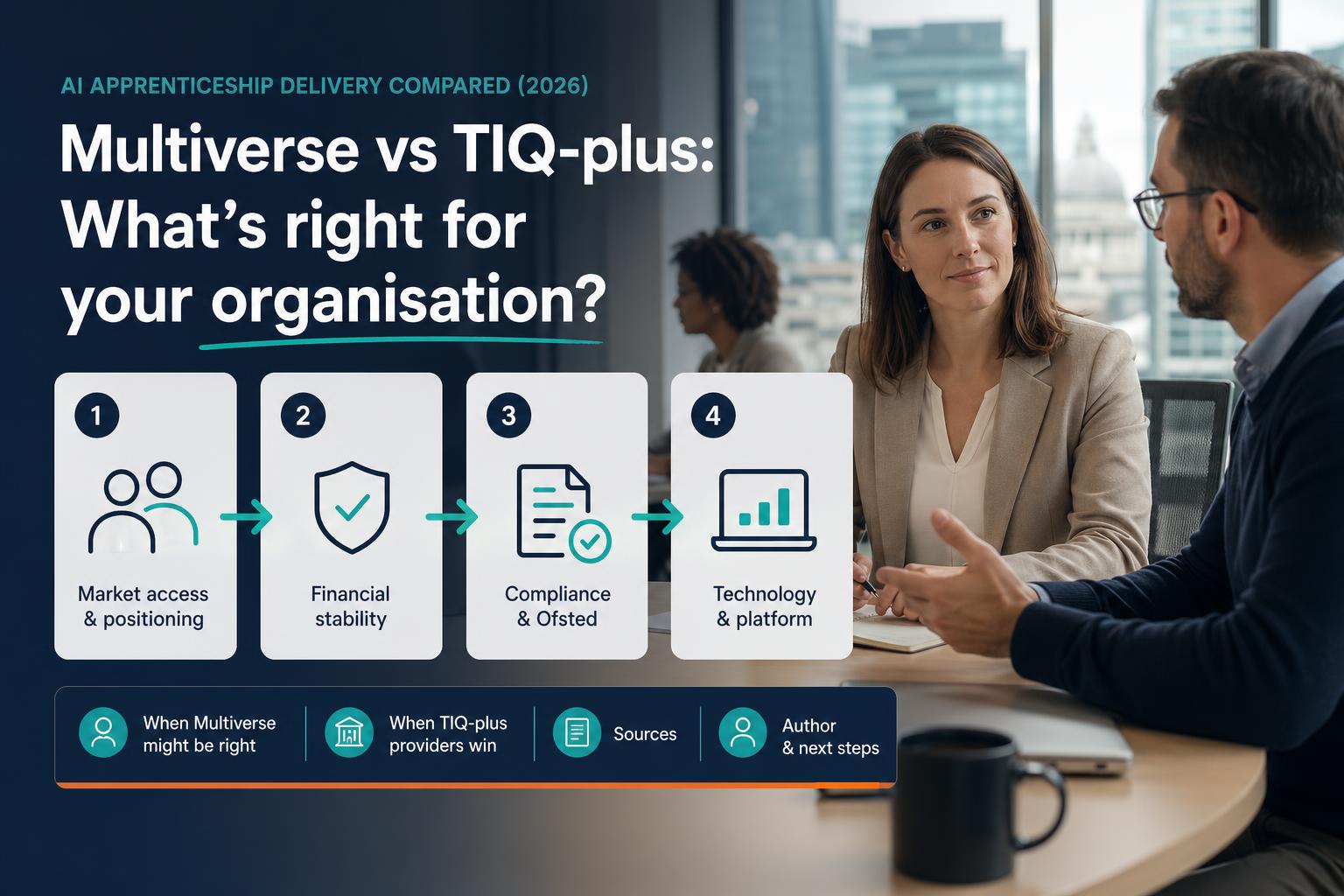
Factor 1: Market positioning and employer access
This is the most fundamental difference between the two models.
Multiverse publicly positions much of its offer around larger employers. That does not establish one universal cohort minimum or mean a smaller employer cannot be served. Ask for a written answer on minimum cohort, available start dates, delivery mode, support model and whether the exact standard is currently offered.
Some independent providers accept a single learner, while others set a cohort minimum. A smaller employer should confirm availability, job fit, prior learning, the exact standard version and the funding route before making a comparison. Funding depends on the learner’s start date and age as well as employer levy status; it is not a provider-wide 95% promise.
Factor 2: Financial stability and provider continuity
ST1512 has a published typical duration of 18 months, so continuity is a legitimate procurement question. Review the latest filed accounts and credit information, but do not treat profit, loss or venture funding alone as a verdict.
Ask every provider for a continuity plan covering tutor departure, platform outage, subcontractor failure, loss of approval and provider exit. Confirm who owns learner records, how data can be exported and how learners would be supported through a transfer. Apply the same test to a national provider and an independent specialist.
Factor 3: Regulatory compliance and Ofsted evidence
The delivery provider—not its software vendor—holds the regulatory relationship and inspection outcome. Check the exact legal entity, its latest Ofsted report, its approval to deliver the product and any subcontracting arrangement.
Multiverse manages compliance within its own platform. For large enterprise clients with standardised AI programmes, this works effectively. The compliance record is Multiverse’s, managed on Multiverse’s infrastructure, and visible to the employer through Multiverse’s portal.
TIQPlus is built around UK apprenticeship delivery workflows. It supports learner data, timestamped evidence, OTJ records, employer sign-off and assessment-readiness views. Buyers should test each claimed workflow against a real learner scenario and the exact standard version rather than relying on a feature list.
For regulated employers, request a demonstration of permissions, audit history, evidence export, retention controls and employer reporting. Portability and transparency must be tested in the contract and product, not assumed from either provider model.
Factor 4: Technology and platform capability
Multiverse has invested heavily in technology. Its AI capabilities include talent matching (enhanced through the April 2024 acquisition of US AI recruitment company SearchLight), learning platform delivery, and employer dashboard functionality. The platform is well-engineered and serves its enterprise market well.
TIQ-plus approaches AI differently. Rather than using AI primarily for talent matching, TIQ-plus applies AI to the operational challenge of apprenticeship delivery at scale:
- AI-assisted evidence tagging: Suggested classification of learner evidence against KSBs, with human review before it becomes part of the learner record
- KSB gap analysis: Real-time identification of coverage gaps against the standard, updated as evidence is submitted, so providers and learners always know what remains before EPA gateway
- Smart progress review generation: Automated drafting of progress review documentation from learner activity data, with mandatory fields pre-populated
- EPA readiness scoring: Live scoring against each standard’s gateway requirements, so both provider and employer can see programme-to-programme how gateway-ready a learner is
- OTJ controls: planned and actual eligible hours tracked against the minimum for the learner’s exact standard version, with evidence and employer release workflows
- ILR validation: Automated data checking before ESFA submission windows to catch errors that would otherwise trigger funding clawback
The distinction to test is workflow ownership. Ask who completes each learner-data, evidence, review and assessment handover task, what remains manual and how exceptions are surfaced. Run the same scripted demonstration with every shortlisted system.
Factor 5: Sector specificity
AI is not generic. An AI apprenticeship for an NHS data analyst has different KSB application requirements than one for a financial services risk manager or a manufacturing process engineer. The tools, the regulatory context, the practical project work, and the EPA evidence all need to reflect the sector.
A national provider and a sector specialist may make different trade-offs between standardisation and contextualisation. Ask to see how the proposed curriculum uses your systems, regulatory environment and workplace tasks; provider size alone does not answer that question.
Independent providers using TIQ-plus can specialise. Healthcare AI providers understand the NHS Digital landscape, NHSX AI governance frameworks, and clinical data handling requirements. Financial services providers understand FCA expectations on algorithmic accountability and SM&CR AI oversight obligations. Manufacturing providers understand Made Smarter and the industrial AI toolchain. This sector depth translates into better-quality EPA portfolios, stronger project work, and learners who can apply AI skills in the specific context their employer needs.
Factor 6: Cost structure and levy value
The Level 4 AI and Automation Practitioner standard (ST1512 version 2.1) has a published maximum funding band of £18,000. The band caps apprenticeship-service or government funding, not the commercial price: an employer pays any agreed amount above the band from other funds.
Multiverse’s pricing model reflects its brand positioning, enterprise-service infrastructure, and VC-backed investment costs. For large employers with negotiated commercial contracts, Multiverse may offer competitive pricing relative to the funding band. For smaller employers, the enterprise commercial model may not translate to value-for-money co-investment.
Ask every provider for the agreed training and assessment price, included services and any charges outside apprenticeship funding. For starts from 1 August 2026, a levy payer with insufficient account funds contributes 25% up to the band; a non-levy employer contributes 5% for an apprentice aged 25 or over; and an eligible non-levy start aged 16 to 24 is government-funded up to the band.
Factor 7: Programme quality and assessment outcomes
Compare achievement, retention and assessment outcomes for the exact standard version, alongside learner and employer feedback. Do not treat an organisation-wide headline pass rate as evidence for a new programme.
Request standard- and version-specific starts, retention, achievement and grade data, with the reporting period and cohort size. Ask how the provider handles small cohorts and whether results have been independently checked.
A delivery platform can make KSB coverage, evidence gaps and assessment actions visible, but it does not create achievement on its own. Tutor quality, employer support, valid assessment and timely intervention remain decisive.
Summary comparison
| Factor | Multiverse | TIQ-plus-powered independent provider |
|---|---|---|
| Model type | Direct training provider | Software powering independent providers |
| Minimum cohort | Confirm directly for the selected programme | Varies by independent provider |
| SME access | Check current SME availability | Single-learner access where offered; funding is start-date specific |
| Financial stability | Review current accounts and continuity plan | Review each provider's accounts and continuity plan |
| Ofsted inspection | Inspected as tech-company provider | Independent Ofsted Good/Outstanding ratings |
| ILR compliance | Internal system management | Automated ILR validation and audit trails |
| KSB mapping | Internal tracking | Real-time AI-powered gap analysis |
| OTJ tracking | Internal process | Automated tracking with employer sign-off |
| Sector expertise | Sector-agnostic delivery | Specialist providers by sector |
| EPA readiness | Gateway-stage focus | Live scoring throughout programme |
| Admin efficiency | Platform-managed | Measure with a workflow pilot |
| Evidence tagging | Manual/platform-assisted | AI suggestions with human review |
| Pricing transparency | Enterprise contract model | DfE funding band transparent pricing |
Verdict by audience
When Multiverse might be right
- You are a large enterprise (FTSE 250 scale) running 15+ AI apprentices simultaneously
- You want integrated AI talent acquisition and training from a single vendor
- Your internal positioning frames apprenticeships as a university alternative and Multiverse’s brand supports that narrative
- You have a dedicated L&D and HR team to manage an enterprise provider relationship
- You want AI-powered talent matching as part of the apprenticeship recruitment process
When a TIQPlus-powered independent provider may fit
- You are an SME or mid-market employer with 1–10 learners for an AI programme
- You need a regulated, Ofsted-inspected provider with independently published inspection outcomes
- You operate in a regulated sector (healthcare, financial services, public sector) where compliance depth matters
- You want sector-specialist delivery contextualised to your industry’s AI tools and regulatory environment
- You want to maximise levy or co-investment value against published DfE funding bands
- You are a training provider looking for platform capability to compete with or outperform Multiverse’s technology model
- Provider continuity and financial stability are due diligence requirements in your organisation
For training providers: competing with Multiverse
An independent provider can differentiate through an evidence-backed niche: a sector it understands, a delivery model it can staff, transparent cohort access and reliable employer service. Do not build the proposition on an unverified claim that another provider refuses a market segment.
TIQPlus supplies delivery and evidence infrastructure; the provider remains responsible for approval, quality, funding compliance, teaching, assessment relationships and learner outcomes. Demonstrate those controls and publish verifiable results rather than relying on comparison rhetoric.
How to evaluate any AI apprenticeship provider
Whether comparing Multiverse, TIQ-plus-powered providers, or any other option, use these questions to evaluate:
- What is your minimum cohort size for AI apprenticeship delivery, and how do you support employers with one to five learners?
- Can you show me your current Ofsted inspection outcome and most recent full inspection report?
- How do you track KSB coverage — can I see a live learner’s gap analysis right now?
- What achievement and assessment-outcome evidence can you show for this exact standard and version?
- How are OTJ hours recorded and what is the employer’s confirmation workflow?
- What sector experience do your assessors and coaches have in our specific industry?
- Can you provide your last three years of audited accounts to confirm financial stability?
- If you ceased delivery mid-programme, how would learner records and portfolio evidence be transferred?
Sources
- Multiverse company information and financial data: Companies House filings and published financial statements, year to March 2025
- Skills England: AI and Automation Practitioner apprenticeship (ST1512)
- ESFA apprenticeship funding rules and co-investment rates: GOV.UK Apprenticeship Funding Rules
Frequently asked questions
What is the difference between Multiverse and TIQ-plus?
Multiverse is a training provider that directly delivers AI apprenticeships to large enterprise employers. TIQ-plus is AI-powered apprenticeship management software that powers independent UK training providers to deliver apprenticeships to employers of any size. The key distinction: employers using Multiverse must use Multiverse as their provider. Employers using a TIQ-plus-powered provider can choose from a range of independent, Ofsted-inspected specialists suited to their sector and cohort size.
Is Multiverse financially stable?
No single revenue, profit or funding figure answers that question. An employer should review the latest filed accounts, Ofsted report, apprenticeship-service status, subcontracting position, learner-continuity plan and contractual protections for every shortlisted provider. Apply the same due-diligence test to Multiverse and to any independent provider.
Does TIQ-plus work for SMEs?
Potentially. Cohort minimums and commercial terms vary by provider. For new starts from 1 August 2026, an eligible non-levy employer is government-funded up to the band for an apprentice aged 16 to 24 and pays 5% for an apprentice aged 25 or over. Employers pay any price above the funding band. Earlier starts retain the funding rules that applied to them.
How does TIQ-plus handle compliance compared to Multiverse?
TIQPlus supports apprenticeship data, evidence, KSB coverage, off-the-job records and readiness workflows. The training provider remains responsible for funding compliance and quality. Compare the latest Ofsted report and approval status of the exact delivery provider, then test both systems for permissions, audit history, exports and employer visibility.
Sources & further reading
- Multiverse company information and financial data: Companies House filings and published financial statements, year to March 2025 Skills England: — AI and Automation Practitioner apprenticeship (ST1512)
- ESFA apprenticeship funding rules and co-investment rates: — GOV.UK Apprenticeship Funding Rules