Last updated: 25 March 2026
Why AI Upskilling Is Now a Strategic Priority
The framing of AI upskilling as a training programme — one item among many on the L&D plan — understates what is happening. AI is not another technology tool requiring an adoption curve. It is a general-purpose capability shift that is changing the productivity baseline for work across sectors, and the gap between organisations that have built workforce AI capability and those that have not is widening rapidly.
McKinsey’s research on AI adoption at scale finds that organisations with structured, systematic approaches to AI upskilling see 3–4 times the productivity gain from AI investments compared to organisations that treat AI adoption as a technical deployment question. The World Economic Forum’s Future of Jobs report identifies AI and big data skills as the fastest-growing skills priority globally — ahead of analytical thinking, and ahead of any other technology skill. CIPD research in the UK echoes this: AI literacy is now listed as a priority development need by a majority of L&D leaders surveyed.
The talent attraction dimension is also becoming significant. Organisations that are visibly investing in AI upskilling — communicating clearly to employees what support is available, what roles will change, and how the organisation is preparing people rather than simply deploying technology — are beginning to report a talent differentiation advantage, particularly in sectors where AI-capable candidates are in short supply.
The regulatory context is a third driver. The UK AI Opportunities Action Plan, the EU AI Act’s extraterritorial reach, and emerging sector-specific AI governance expectations (most immediately in financial services and healthcare) are building an expectation that organisations deploying AI tools have systematically addressed the skills and judgment required to use them appropriately. An AI upskilling programme is not just a performance investment — it is increasingly part of the due diligence an organisation needs to demonstrate around responsible AI use.
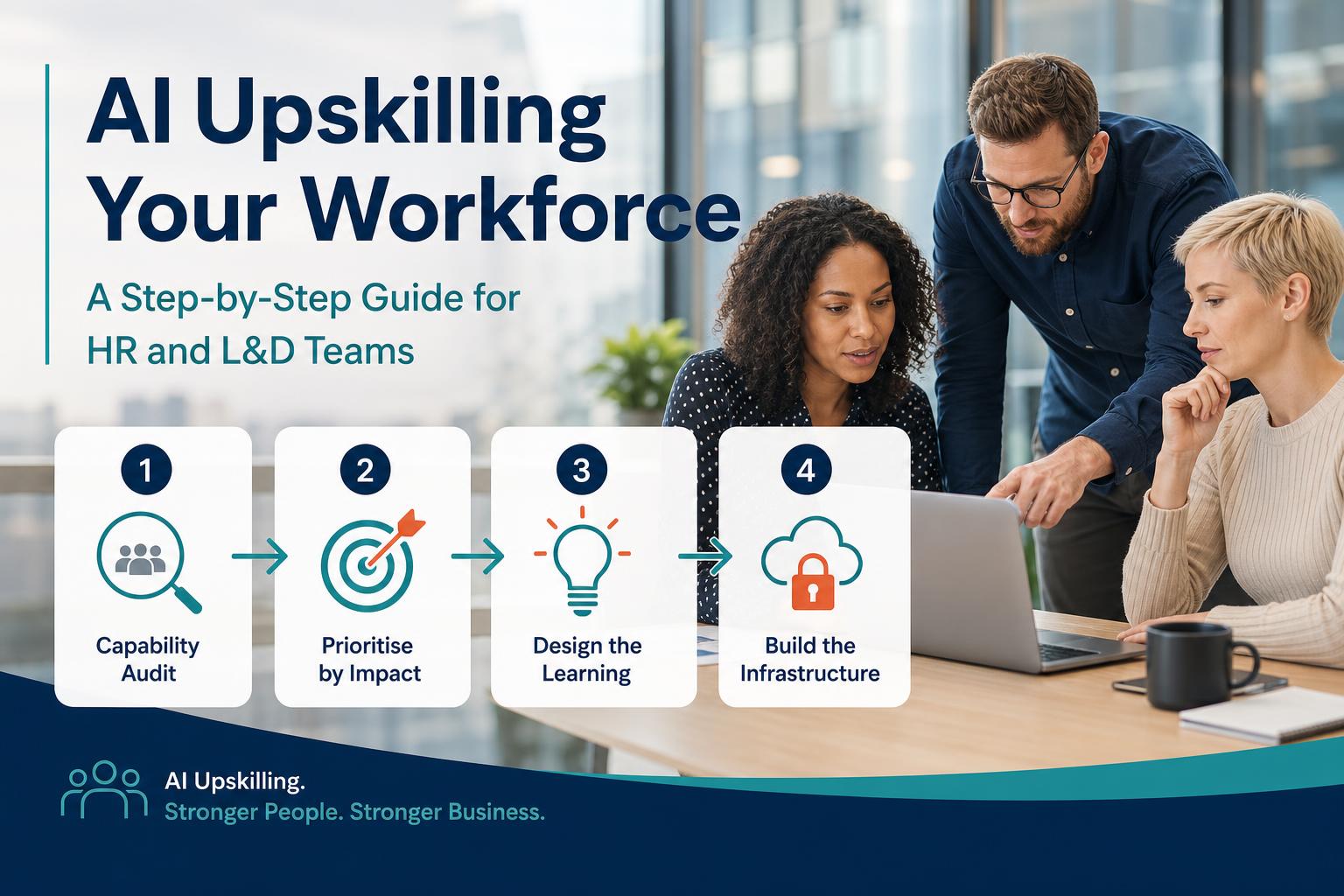
Step 1: Capability Audit
Before committing budget, check what is fundable: the AI training funding finder matches your organisation to the routes currently available, and the six-dimension readiness assessment covers the data, technology and governance conditions a capability audit alone will miss.
Every organisation that skips the capability assessment ends up training the wrong people on the wrong things. This is not an observation about the minority of organisations — it is the most common failure pattern in AI upskilling programmes. The organisations that jump straight to content design or platform selection are making an assumption about the shape of the gap. That assumption is almost always wrong in some material way.
Start with the audit. Every organisation that skips the capability assessment ends up training the wrong people on the wrong things. The capability audit is not a bureaucratic prerequisite — it is the analysis that makes every subsequent decision in the programme faster and more accurate.
Survey design
A capability audit survey for AI upskilling needs to capture three things: current AI tool use (what tools employees are already using, in what contexts, and with what frequency); self-assessed competence (how confident employees feel using AI tools for specific categories of task); and role-based AI exposure (which AI tools will be required for their role, and at what skill level).
The survey should be role-segmented rather than generic. A uniform survey that asks the same questions of a data analyst and a facilities manager will produce data that cannot be meaningfully analysed by role. Design role-specific question tracks, or use branching logic to route respondents to questions relevant to their role type.
Keep the survey to 10–15 questions maximum for broad deployment. Longer surveys produce lower completion rates and survey fatigue. If you need deeper diagnostic data for specific role groups — for example, your analytics team or your senior leadership population — supplement the organisation-wide survey with targeted focus groups or structured competency interviews.
Role-by-role analysis
The audit is most useful when it produces a role-by-role capability profile: for each major role type in the organisation, what is the current AI capability baseline and what is the AI-augmented capability requirement? The gap between these two produces the upskilling priority for that role group.
The AI-augmented capability requirement for each role should be defined before you analyse the survey data — not reverse-engineered from the survey results. Work with line managers and department heads to define what “AI-capable” means for each role in practical terms: which specific tools, which specific use cases, at what skill level. This prevents the common error of designing training to the current baseline rather than the future role requirement.
Benchmarking against AI-augmented role requirements
The external benchmark for AI capability requirements is moving quickly. Role profiles that were “AI-optional” in 2024 are “AI-expected” in 2026. Using job description data — look at how the AI-related requirements in job adverts for your key roles have changed over the past 12–24 months — and sector-specific skills frameworks provides an external calibration for your internal capability requirements. This prevents underspecifying the target: designing a programme for where AI was 18 months ago rather than where it is now.
Step 2: Prioritise by Impact
Not all upskilling is equally valuable. With finite training resource and finite employee time, a well-designed AI upskilling programme is explicit about where to invest first. The two-axis prioritisation model provides a practical framework.
The two-axis model: exposure and readiness
Plot each major role group on two axes: exposure to AI tools (how much of the role is expected to involve AI-augmented work now and in the near future) and readiness to use them (current capability level and motivational readiness based on audit data).
This produces four quadrants. High exposure, low readiness is the urgent priority: these are the role groups where AI tool adoption is required but capability is insufficient, creating both performance risk and compliance risk. High exposure, high readiness is the group to develop quickly as organisational champions and early adopters — they can accelerate programme adoption across the organisation. Low exposure, low readiness is a lower short-term priority but should not be ignored: these workers face the risk of being left behind as AI exposure increases over time. Low exposure, high readiness can largely self-direct their development with platform access and minimal structured support.
The prioritisation should translate directly into sequencing. The high exposure, low readiness cohort receives structured training first, with active change management support. The high exposure, high readiness cohort receives early platform access, advanced content, and is recruited as peer champions. The lower priority cohorts are served by foundation-level provision that does not require significant L&D intervention.
Step 3: Design the Learning
AI upskilling requires a tiered learning architecture. A single training programme that attempts to serve both a digitally anxious administrator and an analytically sophisticated data professional will serve neither well. Design three tiers and route learners to the appropriate starting tier based on audit data.
The tiered approach: foundation, application, mastery
Foundation tier is for employees who need to understand what AI is and is not, develop basic competence in using AI-assisted tools in common workplace contexts, and build the judgment to evaluate AI outputs critically. Foundation content should be accessible, jargon-free, and anchored in workplace scenarios relevant to the learner’s role. Duration: typically 4–8 hours of structured learning, designed for self-paced completion over 2–3 weeks.
Application tier is for employees who need to develop confident, productive use of specific AI tools in their live work context. Application content is role-specific rather than generic — it covers the AI tools actually in use for this role, in the specific task contexts where they apply. Duration: typically 8–16 hours of structured learning plus 4–6 weeks of supported practice in the role.
Mastery tier is for employees who will be expected to configure, evaluate, manage, or advise on AI tool use within their function. Mastery-level content covers AI system evaluation, prompt engineering, AI output quality assessment, and role-specific advanced use cases. Duration: 20–40 hours of structured learning, often combining formal training with project-based application. At mastery level, consider whether a formal qualification (AI or data apprenticeship standard, relevant digital qualification) is appropriate.
Content formats that work for AI skills
AI skills have some specific characteristics that influence which learning formats work best. Practice-based learning consistently outperforms passive instruction for AI skills: learners who complete a module about AI and then practice with the tool learn faster and retain better than learners who complete a longer module but do not practice. Design for short modules followed by structured practice tasks, not longer content blocks with no immediate application.
Scenario-led content — where learners work through realistic workplace scenarios using AI tools, including scenarios where the AI produces wrong or problematic outputs — is particularly effective for building the judgment layer. The ability to identify when an AI output needs verification, and to produce a better output through iteration, is a skill that requires exposure to AI error, not just AI success. Design some content scenarios specifically around AI failure modes.
Spaced repetition and retrieval practice are as applicable to AI skills as to any other skill domain. Rather than a single concentrated learning block, design for spaced encounters with AI concepts and tools — an initial module, a practice task, a review module two weeks later, a more complex scenario a month after that. Platforms that support spaced delivery and automated follow-up make this practical at scale.
Build versus buy content
Most organisations are better served by a combination of bought foundation content and internally developed application content. High-quality AI literacy foundation content is available from multiple providers — Google, Microsoft, LinkedIn Learning, and specialist providers all offer foundation-level AI skills content that is well-produced and regularly updated. Developing this from scratch is rarely the best use of L&D resource.
Where internal development adds value is in the application tier: role-specific content that covers the specific AI tools your organisation uses, in the specific workflow contexts of your roles. This contextualisation is the difference between generic AI awareness and practically useful AI skills development, and it cannot be bought off the shelf. The build investment should be focused here.
Step 4: Build the Infrastructure
An AI upskilling programme at scale requires a platform that can: manage learner assignment and routing across the tier structure; track completion and competence assessment across the programme; provide practice environments or integrate with the AI tools being trained on; generate the reporting that stakeholders need to see; and adapt content delivery based on learner progress data.
The infrastructure requirements for AI upskilling are more demanding than for standard compliance or onboarding training. The programme is longer, the tracking is more complex, the learning design requires practice task management that most basic LMS platforms do not support well, and the reporting needs to demonstrate behaviour change rather than just completion.
If your current LMS was built primarily for compliance training and tracks completion against a content catalogue, it may not be fit for purpose for an AI upskilling programme. Evaluate specifically: can the platform assign different content tracks by role segment? Can it track structured practice task completion, not just module completion? Can it generate evidence of competence for the mastery tier? Can it integrate with the AI tools learners will practice with?
The SCORM-based course library model works for foundation-tier content. It is insufficient for application- and mastery-tier learning, where the learning is embedded in work and requires evidence collection from live task performance rather than module completion.
Step 5: Launch with Change Management
The launch phase is where AI upskilling programmes most commonly fail — not because the training design is poor, but because the change management is absent. A well-designed programme that launches without addressing the fear profile of the employee population, without managers who are themselves ahead of their teams in AI adoption, and without a plan for the 90 days post-launch will produce adoption rates far below its potential.
For detailed guidance on change management for AI adoption, see our companion guide: AI Change Management: How to Train Employees to Adapt to AI-Augmented Work. The critical points for the launch phase are:
Manager readiness comes first. Managers must have completed at least the foundation tier and ideally the application tier for their own role before their team members begin. A manager who is simultaneously a learner in the same programme as their team cannot perform the coaching and reinforcement functions that the launch phase requires.
Address fear before training begins. The communication cadence before launch should acknowledge the concerns employees have about AI — specifically, job security and professional identity — and provide honest, role-specific context about what will and will not change. Launch communication that focuses entirely on capability and opportunity without acknowledging concern builds resistance rather than readiness.
AI upskilling is not a training programme. It is an organisational change initiative that happens to include training. Organisations that frame it as a training programme underinvest in change management, underestimate the timeline, and are surprised when completion rates do not translate into productivity improvement. The L&D function’s role is to lead the change initiative, not just to deliver the training content.
The 90-day post-launch plan
The most critical period for AI upskilling adoption is the 90 days after launch. In this window, new behaviours are forming or failing to form, manager coaching is either happening or not happening, and the programme is building or losing momentum.
Design the 90-day plan explicitly before launch. Week 1–2: foundation content completion and first practice tasks. Week 3–4: first manager coaching conversations on AI tool use in the role. Week 5–8: application-tier content and supported work tasks. Week 8–10: first adoption pulse survey — self-reported confidence and tool usage by role group. Week 10–12: targeted support for role groups with adoption below expected level; application of reinforcement content for those progressing well.
Step 6: Measure at Behaviour Level
The most common failure in AI upskilling measurement is treating training completion as the primary success metric. Completion tells you that employees attended. It does not tell you whether behaviour has changed. For a programme designed to change how people work, behaviour-level measurement is the only meaningful evidence of success.
Leading and lagging indicators
Leading indicators predict future behaviour change: self-reported confidence in AI tool use (measured at 30 and 60 days post-training); manager-reported observations of AI tool use in the role; frequency and depth of practice task completion during the programme; and AI tool usage data in the first 4 weeks post-training. These indicators are available quickly and can be acted on during the programme.
Lagging indicators confirm that behaviour change has occurred and is producing the intended outcomes: AI tool usage data at 3 and 6 months post-training (has usage stabilised at a productive level?); productivity indicators for the tasks the AI tools were adopted for (are those tasks taking less time, or producing better outputs?); manager assessment of AI competence at the 6-month mark; and, where measurable, business outcome indicators linked to AI-augmented work.
Manager observation frameworks
The missing measurement layer in most AI upskilling programmes is structured manager observation. Managers are closest to the work and best positioned to observe whether AI tools are being used, how well they are being used, and whether use is translating into performance improvement — but without a structured framework, manager observations are inconsistent and anecdotal.
Develop a simple manager observation guide: 4–6 questions that managers can use as a conversation framework in one-to-ones during the adoption period. Questions like “Which AI tasks are you most confident about now compared to before the programme?” and “Where are you still defaulting to manual approaches and why?” produce qualitative data about adoption depth and adoption barriers that usage metrics alone cannot provide. Aggregate manager observations across the team every 4–6 weeks to identify patterns.
Self-assessment versus demonstrated competence
Self-reported confidence is a useful leading indicator but should not be the only assessment approach. For application- and mastery-tier learners, design practical assessments that require demonstrated AI tool use — complete this task using the AI tool and submit the output, with a brief reflection on how you used the tool and what you verified or modified. This provides evidence of competence that self-assessment cannot, and it gives learners a meaningful learning activity that consolidates the skill.
Demonstrated competence assessments are also valuable for communicating programme outcomes to leadership. “92% of application-tier learners completed a practical assessment demonstrating productive AI tool use in their role” is a more credible programme outcome than “94% module completion rate.”
UK Funding for AI Upskilling
Several publicly funded routes are relevant to AI upskilling programmes for UK employers, reducing the direct cost of provision significantly.
Growth and Skills Levy. The current approved products are apprenticeships, foundation apprenticeships and exact apprenticeship units in the live Skills England catalogue. It is not a generic pot for an employer-designed AI course. The three AI leadership units are AU0009, AU0010 and AU0011 for eligible employed leaders; each is a separate Level 5 product with at least 30 delivery hours and maximum funding of £750.
Skills Bootcamps. These are separate, locally commissioned offers lasting up to 16 weeks. Subject, entry criteria and timetable vary. For an existing employee, the published contribution is normally 10% for an employer with 1–249 employees and 30% for one with 250 or more. Check the live provider offer before including it in a plan.
Apprenticeships for genuine occupations. Current examples include Data Analyst at Level 4 and AI and Automation Practitioner ST1512 v2.1 at Level 4. ST1512 typically lasts 18 months, lists 420 minimum compliance hours and has a maximum funding band of £18,000. Artificial Intelligence Data Specialist ST0763 is Level 7—not Level 4—and new-start government funding is restricted by age and status. Match duties and prior learning before considering price.
Free foundation learning. AI Skills Boost links to partner courses that can help individuals build baseline knowledge. Employers should add their own approved tools, policies, examples and escalation routes rather than treating a generic course as complete workforce governance.
Common Failure Modes
Four patterns cause AI upskilling programmes to stall with enough consistency that they are worth naming explicitly.
Starting without the audit. The most common and most costly failure. Designing and launching a programme without knowing where the actual gaps are produces misaligned content, wasted budget, and a programme that addresses the loudest needs rather than the highest-impact gaps. The audit is not optional.
Treating it as a one-time event. AI capabilities and tool landscapes are changing at pace. A programme designed in 2025 and not reviewed in 2026 will already be partially obsolete. AI upskilling needs a review cycle built into the programme design from the start — content reviewed against current tool capabilities at least annually, with the audit process repeated at 12–18 month intervals to track gap closure and identify new gaps.
Underinvesting in the mastery tier. Most AI upskilling programmes serve the foundation and application tiers adequately and neglect mastery-tier development. The mastery tier matters disproportionately: the employees who develop deep AI capability become the internal experts, advocates, and problem-solvers that enable the rest of the organisation’s adoption. Neglecting this tier means the programme never builds the internal capability that would make it self-sustaining.
Measuring the wrong things. Programmes that report success based on completion rates and learner satisfaction scores, without evidence of behaviour change or productivity improvement, cannot make an evidence-based case for continued investment. And when the inevitable question comes — “We spent significant budget on this programme. What changed?” — the inability to answer it is the primary cause of AI upskilling investment being cut before it matures.
AI Upskilling Programme Readiness Checklist
Before launching your AI upskilling programme, work through this checklist:
- Capability audit completed — current AI capability baseline documented by role group
- AI-augmented capability requirements defined for each major role type
- Two-axis prioritisation completed — high-exposure, low-readiness cohorts identified as first priority
- Tiered learning architecture designed — foundation, application, and mastery tracks with clear routing criteria
- Practice tasks designed for application-tier content — not just module completion
- Platform capabilities confirmed — can track practice task completion, not just module completion
- Manager programme running ahead of team rollout — managers at application-tier level before team foundation launch
- Fear inventory completed and change management communication designed for specific fear profile
- 90-day post-launch plan documented with manager coaching cadence and adoption pulse schedule
- Behaviour-level measurement framework in place — leading indicators at 30 and 60 days, lagging indicators at 3 and 6 months
Frequently asked questions
How do you start an AI upskilling programme?
The starting point for any AI upskilling programme is a capability audit — a structured assessment of current AI capability across your workforce, mapped against the AI-augmented requirements of each role. Without this, you risk training the wrong people on the wrong things. The audit should use a combination of self-assessment surveys, line manager input, and role-by-role analysis of where AI tools are already in use or will be introduced. The audit results then drive the prioritisation in Step 2: identifying which role groups have the highest-impact gaps and which should receive training first. Starting with the audit is the single most important decision an HR or L&D team can make when building an AI upskilling programme.
How long does AI upskilling take?
Timelines depend on the role, existing capability, system risk and the behaviour being developed. A short awareness session may establish shared language, but application competence needs role-specific practice and observation. Define the task and success measure first, pilot the learning, then set the duration from evidence rather than treating a generic number of hours as proof of competence.
What does AI upskilling cost?
Cost depends on learner volume, content depth, facilitation, tools, release time and measurement. AI Skills Boost lists free partner courses. A locally commissioned Skills Bootcamp may require an existing-employee contribution of 10% for an organisation with 1–249 employees or 30% for one with 250 or more. Apprenticeship funding depends on the exact product, learner age, employer levy status, start date, negotiated price and band; it is not automatically free for a smaller employer.
Sources & further reading
- GOV.UK AI Opportunities Action Plan — gov.uk/government/publications/ai-opportunities-action-plan
- GOV.UK AI Skills Boost explainer — gov.uk/government/publications/ai-skills-boost-explainer
- Skills England: AI and Automation Practitioner ST1512 — skillsengland.education.gov.uk/apprenticeships/st1512
- World Economic Forum: Future of Jobs Report 2025 — weforum.org/publications/the-future-of-jobs-report-2025
- CIPD Learning at Work Survey — cipd.org/en/knowledge/reports/learning-work-survey