Last updated: 25 March 2026
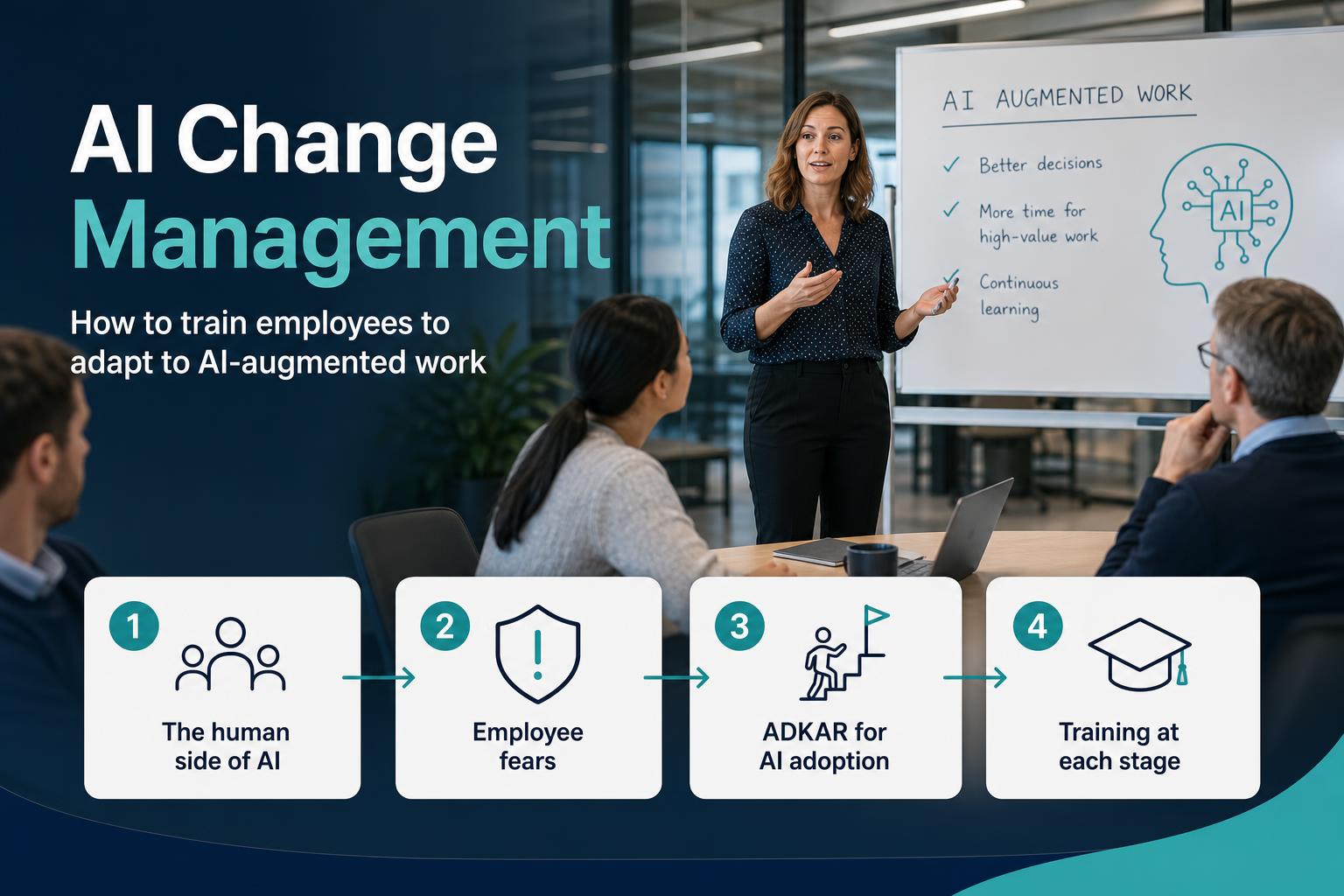
The Human Side of AI Adoption
When organisations plan an AI tool rollout, the planning conversation is almost always dominated by the technology. Which vendor? Which features? What does the integration architecture look like? What does the IT security review require? These are legitimate questions and they deserve attention — but they are not where most AI adoption initiatives fail.
The consistent finding across large-scale AI adoption research is that technology is rarely the binding constraint. McKinsey’s research on AI adoption at scale finds that organisational and human factors — change resistance, insufficient skills development, lack of leadership support — account for the majority of underperforming AI implementations. The technology works. The people don’t use it.
This is not a new problem. The same dynamic played out with ERP implementations in the 1990s, with digital transformation programmes in the 2010s, and with remote working tool rollouts in 2020. New technology without managed human transition produces the same outcome in each generation: adoption rates far below potential, with the gap filled by workarounds, shadow processes, and quiet non-compliance.
AI adoption in 2026 has some features that make the change management challenge more acute than previous technology waves. AI tools are not just automating tasks — they are changing the nature of judgment, expertise, and professional identity. An employee whose skill and status derived from being the person who knew the answer now works alongside a system that also produces answers. Managing that transition requires more than a how-to guide and a login.
What AI Change Management Actually Is
AI change management is not telling people a new tool is coming and providing a training session on how to use it. That is tool launch communication, and it is necessary but far from sufficient.
Genuine AI change management involves three distinct but related tasks:
Shifting mental models. Most employees have mental models of AI shaped by news coverage — which tends toward either utopian capability or dystopian displacement. Neither is accurate for workplace AI tools in 2026. Changing the mental model to a practical, accurate understanding of what the specific AI tool does and does not do is the prerequisite for everything else. Employees who believe AI is about to make them redundant are not going to adopt it enthusiastically.
Building psychological safety around uncertainty. Working with AI tools involves uncertainty that most professional roles are structured to minimise. AI outputs are sometimes wrong. The right prompt for a task isn’t always obvious. Best practices are still evolving. Employees who work in cultures where admitting uncertainty or making mistakes carries professional risk will not experiment openly with AI — and without experimentation, adoption is shallow and fragile.
Creating conditions for sustained behaviour change. New tools require new habits. Habits form through repetition in context, not through training events. AI change management needs to be present in the workflow — through prompts, practice opportunities, manager coaching, and reinforcement mechanisms — not just in a classroom or e-learning module.
The Specific Fears Employees Have
Understanding which fears are most common and most significant allows L&D and HR teams to design targeted interventions rather than generic reassurance. The research on employee attitudes toward AI adoption consistently surfaces four primary fear categories.
Job displacement. This is the most widely discussed fear and also, for many roles, the most overstated. Concerns about AI replacing jobs at scale are real and legitimate for certain roles — particularly those involving repetitive, predictable information processing. But for most knowledge worker and service roles in 2026, AI is augmenting rather than replacing, and the evidence base does not support a near-term displacement narrative for complex roles. The failure mode in change management is either dismissing this fear entirely (which reduces trust) or validating it without context (which escalates anxiety). The right approach is transparent, role-specific discussion of what AI will and will not change.
Looking incompetent. Employees who are highly skilled at current ways of working face a specific challenge when AI tools arrive: they are temporarily less competent at AI-augmented work than at current work, and they know it. The status cost of being visibly less capable — of asking basic questions, making obvious mistakes, or producing worse outputs than a junior colleague who has adopted the tool more quickly — is a real deterrent to adoption. This fear is particularly acute among senior employees and subject matter experts.
Making consequential mistakes with AI outputs. AI tools produce plausible outputs that are not always correct. Employees in regulated, compliance-sensitive, or high-stakes roles have legitimate concerns about acting on AI outputs that turn out to be wrong — and about their accountability for those outcomes. This fear requires a specific organisational response: clear guidance on when AI outputs require human verification, explicit role accountability for review decisions, and a track record of organisational support for employees who catch and correct AI errors rather than passing them through.
Loss of autonomy and professional identity. For employees who define their professional identity through craft, expertise, or judgment, the introduction of AI tools that produce outputs in their domain can feel like a diminishment of what makes their work meaningful. This is not primarily a rational concern — it is an emotional response to a perceived threat to identity. Change programmes that address only the practical and ignore the emotional consistently produce slower adoption among this group.
The ADKAR Model Applied to AI Adoption
Prosci’s ADKAR model is one of the most widely used frameworks in change management practice. Applied to AI adoption, it provides a useful structure for diagnosing where an individual or team is in the change process and what interventions are needed at each stage.
Awareness: Why are we doing this?
Awareness is not just informing employees that AI tools are being introduced. It is building a clear, credible answer to the question employees will ask first: “Why?” — and particularly, “Why now, and what does this mean for me?”
In an AI adoption context, effective awareness communication addresses: the specific business problem the AI tool is solving; the rationale for this tool over alternatives; what will change for employees in affected roles; what will not change; and the timeline for rollout. Communication that is vague, evasive about role impact, or framed entirely in terms of organisational benefit without acknowledgement of employee experience consistently produces resistance rather than readiness.
Desire: Do employees want to change?
Desire is the most commonly under-invested ADKAR stage in AI adoption programmes. Awareness without Desire produces employees who understand the change intellectually but are not motivated to make it. The training events run, the licenses are distributed, and the tool sits unused.
Building Desire requires addressing the specific fear profile of the employee group (see above) and connecting AI adoption to things employees already care about — typically: reducing the tedious parts of the job, having more time for the parts of the work they find meaningful, or demonstrating capability and adaptability that is visible to management. Early adopters and peer champions are particularly powerful for building Desire; seeing a respected colleague use the tool effectively and report genuine benefit is more persuasive than any formal communication.
Knowledge: Do employees know how to change?
Knowledge is the stage most change programmes focus on almost exclusively. This is the formal training: how the tool works, how to use key features, what good use looks like. Knowledge-stage interventions include e-learning modules, live demonstrations, job aids, and quick reference guides.
For AI tools, Knowledge stage content needs to cover not just the mechanics of the tool but the judgment layer — when to trust AI outputs and when to verify, how to interpret AI recommendations, how to give feedback to improve AI outputs, and how to identify when the AI is producing confidently wrong results. This judgment layer is specific to AI adoption and is frequently absent from standard how-to training.
Ability: Can employees perform the new behaviours?
Knowledge does not equal Ability. An employee who has completed a training module on an AI tool and can describe how it works is not necessarily able to use it fluently in their live work context. Ability requires practice — repeated use in realistic scenarios, with feedback, until the new workflow becomes habitual.
For AI tools, the Ability stage is where most adoption programmes stall. The training event ends, employees return to their desks with a new tool they understand theoretically but have not practiced sufficiently to use confidently, and the path of least resistance is to revert to the old way of working. Addressing this requires structured practice opportunities in the workflow itself — not additional training sessions, but embedded prompts, supported work, and manager coaching in the live work context.
Reinforcement: What sustains the change?
Reinforcement is the stage that determines whether adoption is permanent or temporary. Without active reinforcement, new behaviours decay. The research on habit formation suggests that without environmental support, new behaviours return to baseline within weeks for the majority of people — regardless of the quality of the initial training.
Reinforcement mechanisms for AI adoption include: manager coaching conversations that explicitly discuss AI tool use; team forums for sharing effective prompts and approaches; performance conversations that include AI adoption as a relevant dimension; recognition of effective AI use; and regular updates on new features or improved practices that keep the tool visible and evolving.
The biggest predictor of AI adoption failure is not poor technology. It’s insufficient attention to the human transition. Organisations that invest heavily in tool selection and implementation but treat change management as an afterthought consistently see adoption rates 30–50% below the rates achieved by organisations that invest equally in change management and technology. The technology budget and the change management budget should be proportional.
Training Design at Each ADKAR Stage
Different ADKAR stages require different training and communication interventions. A common failure is applying Knowledge-stage interventions (formal training) to Awareness- or Desire-stage problems — the result is training that is technically well-designed but lands in an environment where employees are not ready to receive it.
Awareness-stage interventions: Town halls and team briefings led by senior leaders (not L&D or IT); clear, jargon-free communication about role impact; FAQ documents that answer the questions employees are already asking privately; honest acknowledgement of what is uncertain rather than overselling certainty.
Desire-stage interventions: Early adopter communities and peer champions; pilot groups with visible, positive reported outcomes; manager conversations that connect AI adoption to employee development and career; removing practical barriers to trying the tool (access, time, permission to experiment).
Knowledge-stage interventions: Role-specific training modules rather than generic tool training; scenario-based content that reflects employees’ actual work tasks; job aids and quick reference guides for common use cases; guidance on the judgment layer — verifying, checking, and overriding AI outputs.
Ability-stage interventions: Structured practice tasks with realistic scenarios; coaching from peers or managers on live work; action learning sets where teams share and develop AI practices together; low-stakes opportunities to use the tool before it is embedded in critical workflows.
Reinforcement-stage interventions: Regular manager check-ins on AI tool use; team sharing forums; updated job aids as practices evolve; performance conversations that reference AI adoption; recognition for effective use and for catching AI errors before they cause problems.
The Manager’s Crucial Role
Prosci’s research consistently finds that an employee’s direct line manager is the most influential factor in whether that employee successfully adopts a change — more influential than senior leadership communication, formal training, or peer pressure. This holds for AI adoption: managers who do not model AI adoption actively undermine team adoption, regardless of what the organisation’s formal change programme says.
The implication is straightforward: manager training and adoption must come before team rollout, not simultaneously. A manager who has not yet adopted the AI tool themselves cannot coach their team through the Ability stage, will not ask reinforcing questions in one-to-ones, and will signal through behaviour that AI tool use is optional rather than expected.
Manager training for AI adoption needs to cover more than tool use. It needs to cover: how to have conversations with employees who are resistant; how to create psychological safety for experimentation and mistakes; how to coach through the Ability stage in live work; and how to recognise and respond to adoption problems before they become entrenched. These are change management skills, not technology skills, and they are rarely provided as part of standard AI rollout programmes.
Common Failure Patterns
The same failure patterns recur across AI adoption programmes with enough consistency that they can be identified and anticipated.
Big-bang launch without preparation. Announcing a tool, providing training on day one, and expecting adoption from week two. The ADKAR framework predicts exactly why this fails: employees arrive at Knowledge-stage training having skipped Awareness and Desire stages, and leave with knowledge they are not motivated to apply.
Technical training without addressing fear. A comprehensive how-to training programme that never acknowledges the concerns employees have about AI. Employees complete the training and go back to their desks with their fears unaddressed and their resistance intact. Technical knowledge does not dissolve emotional resistance.
No ongoing reinforcement. A well-designed launch programme followed by silence. The change management effort concentrated in weeks one and two, with nothing to sustain the behaviours beyond the initial momentum. Adoption rates peak at launch and decay to below potential within six weeks without active reinforcement.
No psychological safety to admit uncertainty. Cultures where admitting you don’t know how to use a tool well, or where an AI output looks wrong to you, carries professional cost. Employees in these cultures develop a pattern of performing adoption — appearing to use the tool while continuing to work in familiar ways. This produces adoption data (tool logins, activity metrics) that overstates real adoption and delays the surfacing of problems until they are entrenched.
Measuring Adoption Beyond Training Completion
Training completion rates tell you that employees attended. They do not tell you whether employees changed their behaviour. Genuine AI adoption measurement requires indicators from further along the behaviour change chain.
Tool usage data: Are employees using the AI tool in live work, not just in training contexts? Frequency, session depth, and feature usage patterns are better adoption indicators than login count. Most AI tools produce usage analytics that L&D and line managers can review.
Manager observations: Are managers seeing AI tool outputs in work products? Are team members referencing AI tools in work conversations? Manager observation frameworks — structured conversation guides for one-to-ones — capture qualitative adoption evidence that usage data misses.
Self-reported confidence: Pulse surveys asking employees to rate their confidence using the tool for specific tasks, and to indicate which tasks they are still avoiding. Self-reported confidence is a leading indicator — it predicts future behaviour change better than current usage data.
Outcome indicators: Are the outputs the AI tool was intended to improve actually improving? If the AI tool was adopted to accelerate report drafting, is report drafting time decreasing? Outcome indicators are the hardest to measure and the most meaningful.
Adoption metrics, from least to most meaningful: (1) training completion rate; (2) tool login frequency; (3) feature usage depth; (4) self-reported confidence; (5) manager-observed behaviour change; (6) outcome improvement on the specific tasks the tool was adopted for. Most organisations measure only (1) and (2). Aim for at least (3), (4), and (5) before concluding that adoption is on track.
5 Practical Actions for L&D This Quarter
If your organisation has an AI tool rollout in progress or planned, these are the highest-leverage actions available to L&D teams right now.
- Run a fear inventory before the launch. Before formal training begins, conduct brief focus groups or pulse surveys to surface the specific fears your employee population holds about the AI tool. Design your Awareness and Desire interventions around the actual fears, not assumed ones.
- Train managers first and separately. Run a manager-specific programme that covers both tool adoption and change management skills before rolling out to teams. Managers who are not ahead of their teams in adoption cannot support team adoption.
- Design practice tasks, not just training content. For each key use case, design a structured practice task that employees can complete in their live work context within the first week after training. Practice in context converts Knowledge into Ability.
- Build reinforcement into manager one-to-ones. Create a set of coaching questions for managers to use in one-to-ones during the 90 days post-launch. Questions like “What AI task have you tried this week?” and “Where are you still finding it quicker to do manually?” make adoption a regular conversation rather than a launch event.
- Measure behaviour, not just completion. Set up a 30-day and 60-day adoption review that captures usage data, manager observation reports, and a brief self-assessment of confidence. Use the data to identify where employees are stuck and design targeted interventions, not additional generic training.
AI Change Management Checklist
Use this checklist to assess your AI adoption programme’s readiness across the ADKAR stages:
- Fear inventory completed before formal training begins — specific fears documented by employee group
- Awareness communications address role-specific impact, not just tool features
- Manager programme runs ahead of team rollout — managers have adopted and can model the tool
- Desire-stage interventions in place: peer champions identified, early adopter outcomes visible
- Training content includes the judgment layer: when to trust, verify, and override AI outputs
- Structured practice tasks designed for each key use case — not just training module completion
- Psychological safety explicitly addressed: leadership signals that mistakes are learning, not failure
- Reinforcement plan documented: manager coaching cadence, forums, performance conversation integration
Frequently asked questions
What is AI change management?
AI change management is the structured process of helping employees understand, accept, and adopt AI tools and AI-augmented ways of working. It goes beyond technical training to address the psychological, behavioural, and cultural dimensions of AI adoption, including managing fear of job displacement, building confidence in using AI outputs, and creating the conditions where employees are willing to experiment with new approaches. AI change management typically follows established frameworks like Prosci ADKAR, applied specifically to the unique challenges AI adoption presents.
How do you overcome resistance to AI tools in the workplace?
Overcoming resistance to AI tools requires addressing the specific fears employees hold, most commonly fear of job displacement, fear of looking incompetent, and fear of making consequential mistakes with AI outputs. Effective approaches include being transparent about what AI will and will not change about roles, involving employees in the selection and piloting of AI tools rather than imposing them, ensuring managers actively model AI use and speak positively about it, creating psychological safety for employees to admit uncertainty, and providing structured opportunities to practice with AI tools in low-stakes environments before using them in live work contexts.
How long does AI adoption take in an organisation?
Research from Prosci suggests that significant behavioural change in organisations typically takes 6 to 18 months to reach sustainable adoption. AI adoption timelines vary by the complexity of the tools involved, the degree of role change required, and the quality of change management support. Simple AI tool adoption can achieve stable adoption in 3 to 6 months with active change management, while more transformative AI adoption typically requires 12 to 18 months of sustained change management effort.
Sources & further reading
- Prosci Change Management Research and Best Practices — prosci.com/resources/articles/adkar-model
- McKinsey & Company - The state of AI in 2024 — mckinsey.com/capabilities/quantumblack/our-insights/the-state-of-ai
- GOV.UK AI Opportunities Action Plan — gov.uk/government/publications/ai-opportunities-action-plan