Last updated: 19 March 2026
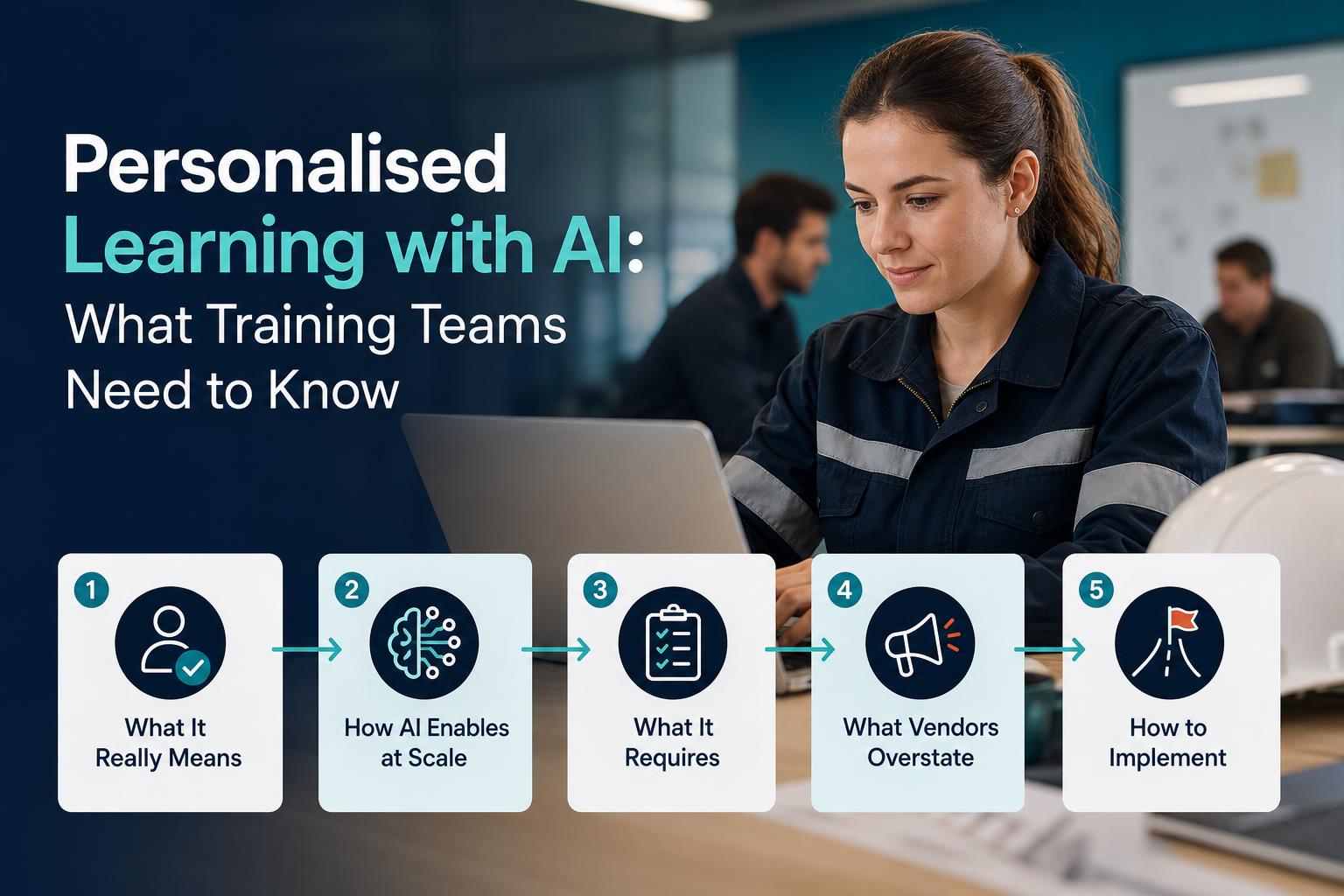
What Personalised Learning Really Means (and What It Doesn’t)
Personalised learning is one of the most overloaded terms in the L&D technology market. Vendors use it to describe everything from role-based content segmentation (basic) to fully adaptive AI-driven pathways (advanced) — and buyers often assume they are getting the latter when they are receiving the former.
Understanding the spectrum is the starting point for any honest evaluation. At the simplest end: different roles receive different content. A compliance training programme that shows customer-facing staff different modules to back-office staff is, technically, personalised — but it requires no AI and no learner data beyond role assignment. At the sophisticated end: an AI system that monitors every interaction a learner has with content, dynamically adjusts the sequence, difficulty, and format of what comes next, and provides specific feedback on each response. This exists in research settings and some specialist technical training contexts; it is not typical of enterprise workplace learning.
Most organisations do not need the sophisticated end of this spectrum to see meaningful improvement in learning outcomes. The three most impactful personalisation interventions — ranked by typical ROI — are: removing irrelevant content (not showing learners material they already know or that is not relevant to their role); differentiating by prior knowledge (routing learners past content they have already demonstrated competence in); and providing personalised feedback on practice tasks (replacing generic “correct/incorrect” with specific, actionable feedback). All three are achievable with current AI tools at realistic implementation cost.
How AI Enables Personalisation at Scale
Skills inference from existing data
Traditionally, personalised learning started with a diagnostic assessment — a test that took 20–40 minutes and asked learners to demonstrate prior knowledge before a programme began. Learners found these assessments tedious; completion rates were poor; and the data was only as current as the last time the assessment was run.
AI inference changes this. By analysing data already available — job role, performance history, prior learning completion records, assessment results from other programmes — AI can build a probabilistic skills profile for a learner before they begin a new programme. This is not perfectly accurate, but it is significantly better than treating every learner as a blank slate, and it requires no additional effort from the learner themselves.
Adaptive learning pathways
Adaptive pathways adjust the sequence and content of learning modules based on how a learner is performing. Get a knowledge check right, and the next module moves on. Struggle with a concept, and the system provides additional explanation or a different approach before proceeding.
The evidence for adaptive pathways is well-established for knowledge-based and procedural learning — the kind of learning that involves acquiring and applying structured information or repeatable processes. The evidence for complex cognitive skills (strategic thinking, ethical decision-making, creative problem-solving) is less clear, partly because these skills are harder to assess and partly because the learning pathways are less linear.
Personalised feedback at scale
Providing specific, individual feedback to every learner on every practice task has always been resource-prohibitive at scale. A tutor with 50 learners cannot write meaningful feedback on 50 written responses in anything less than several hours. AI changes this equation entirely.
Modern AI feedback tools can analyse a written response, a scenario decision, or a simulated conversation and return feedback that is specific to what the learner actually said or wrote — not generic. The quality of this feedback depends on the quality of the prompt design and the rubric the AI is working from, but well-implemented AI feedback is consistently rated by learners as more useful than generic completion feedback and broadly comparable to human tutor feedback for structured tasks.
Learning recommendations
AI-powered recommendation engines suggest next learning based on a learner’s current skills profile, role requirements, and learning history. The analogy is streaming service recommendations — not “here is the full content catalogue”, but “here is what would be most useful to you next, given what you have already done and what your role requires”.
Recommendation quality is directly dependent on two upstream factors: the quality of the skills taxonomy (does the system know what skills exist?) and the currency of role profiles (does the system know what skills a given role requires?). AI recommendations built on outdated role profiles will recommend irrelevant content with great confidence.
What Genuine Personalisation Requires
Personalisation is often described as a technology problem. It is not — or rather, it is only partly one. The more common blockers are organisational and content-related.
A skills model. You cannot personalise without knowing what skills are required for each role. A skills model does not need to be exhaustive — a focused list of the 15–20 skills that most determine performance in a role is more useful than a comprehensive taxonomy with 200 entries that nobody maintains. But it needs to exist, be agreed across L&D and line management, and be kept current as roles evolve.
Prior knowledge assessment. Even a short diagnostic — five to ten questions assessing foundational knowledge at programme start — significantly improves pathway relevance. Learners who demonstrate prior competence should be routed past material they already know. Without this mechanism, personalisation cannot remove irrelevant content because the system has no basis for distinguishing what a learner already knows from what they need to learn.
Quality content at multiple levels. This is the most commonly overlooked requirement. Personalisation routes learners to content — but if content only exists at one level, there is nowhere to route them. Before investing in personalisation technology, audit whether your content library can actually support differentiated pathways. If you have a single version of every module with no variation by skill level or role context, personalisation will produce a system that confidently routes learners to content that is not right for them.
The most common reason AI personalisation fails to deliver is insufficient content coverage. An AI that identifies a learner needs Level 1 content but only Level 3 content exists cannot personalise effectively. Before investing in personalisation technology, audit whether your content library can actually support differentiated pathways.
What Vendors Often Overstate About AI Personalisation
Honest evaluation of AI personalisation tools requires looking past a category of claims that appear regularly in vendor materials but do not reflect typical implementation reality.
“Our AI creates a unique learning path for every learner.” In practice, this typically means assigning one of three to five predefined pathways based on a role code or an initial assessment result. That is a useful feature — but it is not what “unique learning path” implies. Understanding what the system is actually doing behind the personalisation claim is essential before signing a contract.
“Our AI knows what a learner needs before they start.” This requires substantial prior data about the learner that most platforms simply do not have on day one of an implementation. Unless the platform has been running in your organisation for at least 6–12 months and has accumulated meaningful learner data, claims about AI-driven prior knowledge inference should be treated with scepticism.
“Personalisation improves outcomes by X%.” These statistics are typically from controlled studies conducted under ideal conditions with well-prepared content and technically sophisticated learner populations. Real-world enterprise implementations rarely replicate the conditions of the study being cited. Ask vendors for case studies from organisations comparable to yours, not from research papers or pilot programmes with curated learner groups.
When a vendor says their personalisation improves learning outcomes by 40%, ask: in which study, with which population, measured how, over what time period? Genuine evidence exists for targeted personalisation; inflated claims typically describe controlled experiments that bear little resemblance to typical enterprise deployments.
How to Implement Personalised Learning Practically
The most effective implementation approach starts simple and adds sophistication only where it creates measurable value.
Start with role-based differentiation. Assign different content to different roles based on what is relevant to each. This requires no AI, no diagnostic assessment, and no sophisticated platform. It does require maintained role profiles and an honest content audit. For most organisations, this single step — removing irrelevant content from training pathways — produces more improvement in engagement and completion than any AI personalisation feature.
Add prior knowledge assessment. A short diagnostic at programme start allows the system to route learners past content they can already demonstrate competence in. Even a five-question knowledge check creates a meaningful split between learners who need the full programme and those who can skip foundational modules. This is the point at which AI can add value — by automating the routing decision based on assessment results.
Introduce AI feedback on practice tasks. Where learners produce outputs — written responses, scenario decisions, reflective statements — AI feedback adds personalisation at relatively low implementation cost. This is the intervention with the strongest evidence base for improving learning quality and learner satisfaction.
Evaluate and iterate. Measure whether learners on personalised pathways complete faster, score higher on knowledge checks, and demonstrate competence earlier than those on standard pathways. Use this data to refine pathway design, improve diagnostic accuracy, and identify content gaps. Personalisation is not a configuration you set once — it improves with ongoing iteration as real learner data accumulates.
Quick Reference Checklist
Before investing in AI personalisation technology, confirm the following are in place:
- Skills model defined for target roles
- Prior knowledge assessment designed (even a short diagnostic)
- Content library audited for coverage at multiple levels
- Platform capability for differentiated path assignment confirmed
- AI feedback tool identified for practice tasks if applicable
- Measurement plan for personalisation impact defined
- Vendor personalisation claims tested in demo with your actual content and learner profiles
Frequently asked questions
What does personalised learning actually mean?
Personalised learning adjusts the learning experience based on characteristics of the individual learner. At minimum, this means different content for different roles or skill levels (differentiation). At its most sophisticated, it means dynamically adjusting content, sequence, pacing, and feedback in real time based on learner behaviour and performance (true adaptive learning). Most AI personalisation tools sit somewhere between these two points: they adapt pathways based on prior assessment results or role profiles, but do not adjust dynamically within a session.
Is there evidence that personalised learning improves outcomes?
Yes — but the evidence is more nuanced than vendors claim. Studies consistently show that reducing irrelevant content (removing material the learner already knows) improves engagement and reduces time-to-competence. Adaptive practice (adjusting difficulty based on performance) improves skill acquisition for procedural and knowledge-based skills. The evidence for more complex adaptive approaches in workplace learning is less established. The honest answer is: targeted differentiation (right content for the right person) consistently works; fully dynamic adaptive systems add cost and complexity for unclear marginal benefit in most workplace contexts.
What do I need in my platform to deliver personalised learning?
The platform requirements for personalised learning are: (1) a skills or competence model that defines what good looks like for each role; (2) a prior knowledge assessment mechanism (even a short diagnostic quiz); (3) the ability to assign different content pathways to different learners based on assessment results; (4) tracking that reports on individual progress against the personalised path (not just aggregate completion). If your current LMS cannot do items 3 and 4, you are delivering differentiated content assignment, not personalised learning — which is still valuable, but is not the same thing.
Sources & further reading
- Learning and Performance Institute - thelpi.org — Learning and Performance Institute - thelpi.org
- CIPD Learning at Work Survey - cipd.org — CIPD Learning at Work Survey - cipd.org
- Education Endowment Foundation: Personalised Learning Review - educationendowmentfoundation.org.uk — Education Endowment Foundation: Personalised Learning Review - educationendowmentfoundation.org.uk