Last updated: 19 March 2026
What Is Skills Gap Analysis — and Why Does It Matter?
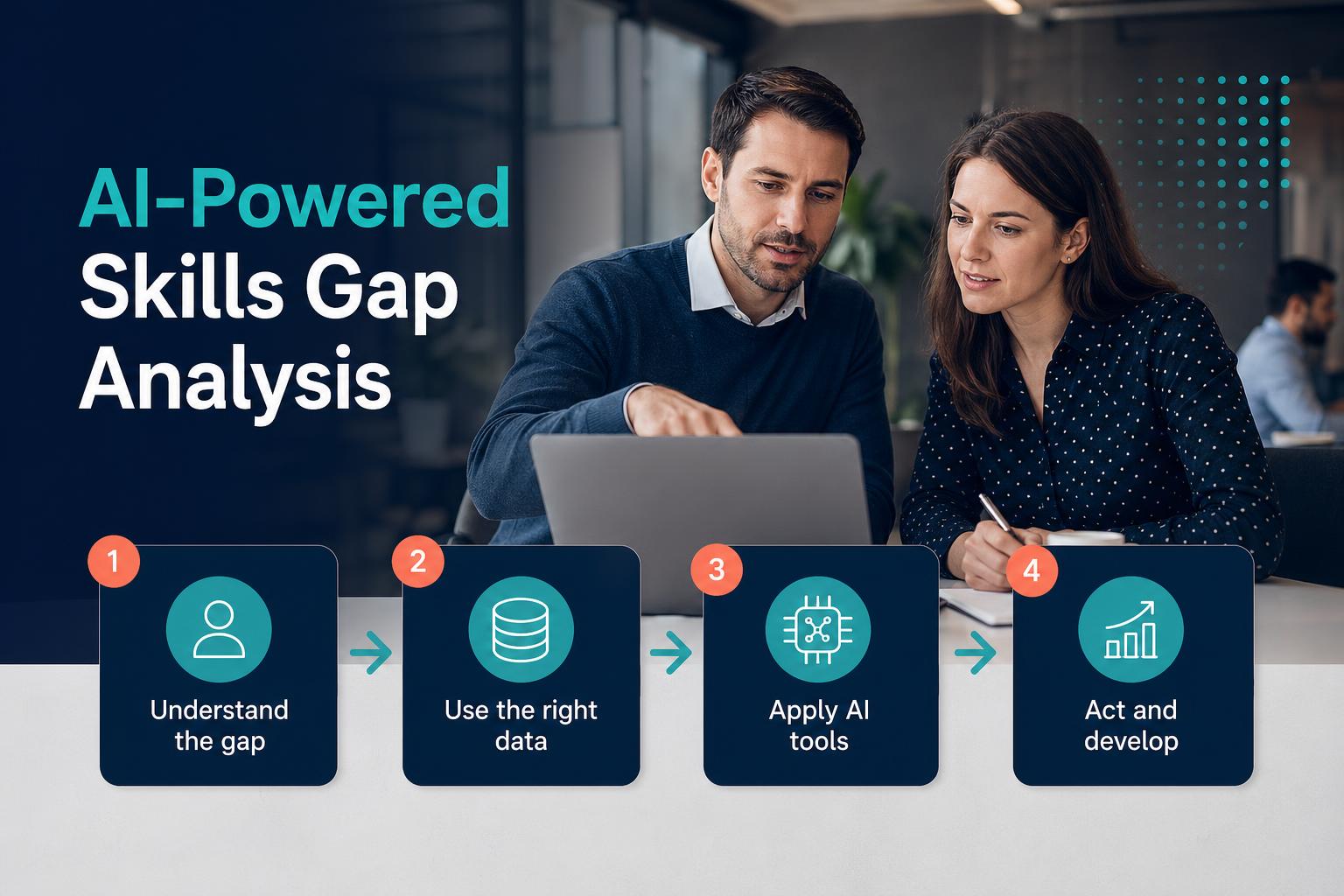
Skills gap analysis is the process of comparing the skills an organisation currently has against the skills it needs — now and in the near future. The output is a structured view of where capability is strong, where it is adequate, and where it is deficient relative to role requirements and strategic objectives.
The question “what skills do we have, and what skills do we need?” has always mattered. What has changed is the pace at which the answer shifts. Technology adoption, regulatory change, and evolving business models mean that skills requirements in many roles are changing on a 12–24 month cycle. An organisation that assessed its workforce capability in 2024 may already be working from outdated data.
The cost of unaddressed skills gaps compounds over time. In the short term, gaps show up as performance problems, compliance failures, and slower delivery. In the medium term, they produce talent attrition — capable people leave organisations where they cannot develop. In the long term, an organisation that does not systematically close skills gaps falls behind competitors that do.
Manual methods for skills gap analysis have never scaled well. Structured interviews and assessment centres are expensive and slow. Skills surveys suffer from self-assessment bias and low completion rates. Analysing the results of either across a workforce of hundreds or thousands requires significant resource. The output is typically a static report that is already partially outdated by the time it is circulated.
How AI Improves Skills Gap Analysis
AI does not change what skills gap analysis is. It changes what is feasible — in terms of scale, speed, consistency, and continuity.
Scale. AI can process thousands of job descriptions, CV or profile data sets, performance records, and assessment results simultaneously. A skills gap analysis that previously required a team of analysts working for several months can be produced in days.
Consistency. Human-led skills assessment introduces variability — different assessors apply different standards, different interviewers probe different areas, and different managers write performance reviews in incomparable ways. AI applies consistent criteria across all inputs, making comparisons across roles, teams, and locations meaningful.
Speed. Gap maps that previously took three to six months to produce can be generated in weeks. This matters not just for efficiency, but for relevance — a faster analysis is more likely to reflect current reality.
Continuity. Perhaps the most significant advantage: AI-powered systems can update gap maps in near-real-time as roles change, people change, and training is completed. This moves skills gap analysis from a periodic exercise to a continuous function.
A skills gap analysis done once is a snapshot. Organisations that reassess annually are working from data that may already be 12 months out of date. AI-powered systems that continuously update gap maps as roles and people change give L&D a live view of skills health, not a historical one.
What Data You Need for AI Skills Gap Analysis
The quality of an AI skills gap analysis is determined almost entirely by the quality of its inputs. Before selecting a tool, organisations need to understand what data they can actually provide.
Skills taxonomy. This is the foundation. A skills taxonomy is a structured list of the skills relevant to your organisation — what they are called, how they are defined, and how they relate to each other. Many AI tools provide pre-built taxonomies (often based on frameworks like the ESCO skills classification or O*NET); others require custom development. Without an agreed taxonomy, AI cannot produce consistent gap maps because different parts of the organisation are describing the same skills with different language.
Role profiles. Current, accurate job descriptions that specify required skills at a granular level. “Communication skills” is not a useful role profile entry; “ability to present financial analysis to non-finance stakeholders” is. Role profiles that have not been updated in two or more years are unlikely to reflect current requirements.
Current skills evidence. The options, from richest to weakest data quality:
- Structured assessments — work samples, skills tests, or competence-based observations. Highest validity, highest cost to collect.
- Performance review data — if reviews are structured around skills or competencies, they provide useful signal. Unstructured narrative reviews are harder for AI to interpret consistently.
- Self-assessment surveys — fast to collect, but subject to well-documented overestimation bias. Useful as one input among several; unreliable as the sole data source.
- CV or profile inference — AI infers skills from job history and credentials. Lowest cost, but also lowest precision — inference is probabilistic, not verified.
A critical caveat: AI amplifies data quality problems rather than correcting them. Outdated job descriptions, inconsistent skills language, and biased self-assessment data will produce misleading gap maps that appear authoritative because they are AI-generated. The rigour of the data preparation phase determines the utility of the analysis output.
AI Tools Available for Skills Gap Analysis
The market for skills intelligence tools has grown significantly since 2023. The main categories are:
Enterprise HR platform modules. Workday Skills Cloud, SAP SuccessFactors Skills, and Microsoft Viva Skills are built into existing HR infrastructure. For large enterprises already on these platforms, the integration advantage is significant — skills data connects directly to performance management, succession planning, and learning assignment. The trade-off is that skills inference capability is typically less sophisticated than purpose-built tools.
Standalone skills intelligence platforms. Beamery, Eightfold.ai, and Gloat are purpose-built skills graph tools. They typically offer stronger AI inference capability — building skills profiles from multiple data sources including job history, training records, and external signals. Best suited to organisations that want deep skills intelligence and are prepared to manage a separate tool alongside their HRIS.
L&D-integrated platforms. A growing category: platforms that combine skills assessment with learning recommendation. The advantage is a closed loop — the gap analysis directly populates the training plan, and completed training updates the gap map. AI-native LMS platforms such as TIQPlus track competence progression alongside delivery, meaning the skills picture updates as learners develop rather than requiring a separate periodic analysis.
Budget option: structured self-assessment with AI analysis. For smaller organisations, well-designed skills surveys fed into an LLM for structured analysis represent a viable entry point. The output is less sophisticated than purpose-built tools, but significantly better than unanalysed survey data. This approach requires careful survey design and should be treated as a starting point rather than a long-term solution.
Acting on Skills Gap Analysis Results
The output of a skills gap analysis is only valuable in proportion to the quality of the action it generates. A gap map that sits in a report and is not translated into training plans has zero return on the investment made to produce it.
Prioritise by business impact, not gap size. The most common mistake in acting on gap analysis results is treating all gaps as equally important. A large gap in a low-priority skill (say, a legacy software system being deprecated in six months) is far less important than a small gap in a business-critical competency (say, data interpretation skills in a team responsible for client reporting). Prioritisation should be driven by: what is the business consequence if this gap is not closed, and how quickly?
Connect gaps to learning. For each prioritised gap, the question is: does existing training address this gap, or does new content need to be developed? Many organisations discover at this stage that their training library has significant coverage gaps of its own. This is useful intelligence, but it lengthens the timeline to closing critical gaps.
Set realistic timelines. Closing a complex technical skills gap typically takes 6–18 months of structured training and practice. Planning cycles that expect skills gaps to close within a quarter are likely to produce disappointment. L&D leaders who set realistic expectations with business stakeholders about timelines are better positioned than those who over-promise.
Track progress. Reassess targeted gaps after training has been delivered to determine whether the intervention worked. Without a post-training assessment, there is no way to distinguish between training that closed the gap and training that was completed but did not change behaviour.
Common Mistakes in AI Skills Gap Analysis
The following failures are consistent across organisations that report poor results from AI skills gap analysis projects:
Running analysis before having a skills taxonomy. AI cannot identify gaps without a clear, agreed definition of what skills should exist. Organisations that skip taxonomy development and attempt to run AI analysis on raw job descriptions and survey data typically receive outputs that are inconsistent, incomplete, or simply inaccurate.
Trusting self-assessment data without validation. Research consistently shows that people overestimate their competence in self-assessment, particularly in areas where they lack the expertise to recognise their own limitations (the Dunning–Kruger effect is a real phenomenon in skills data). Self-assessment is a useful input but should be triangulated with at least one other data source before driving investment decisions.
Using gap analysis as a one-off exercise. A skills gap analysis completed in January and acted on in March is already several months out of date by the time training is assigned. Organisations that treat gap analysis as a continuous process — integrated into performance management cycles and updated as roles and people change — get significantly more value than those that run it annually.
Failing to connect results to action. This is the most costly failure mode. Gap maps that are not translated into specific training assignments, with named individuals, timelines, and review dates, produce no improvement. The quality of the action plan matters more than the sophistication of the analysis.
The most common reason AI skills gap analysis produces unhelpful results is an inadequate or inconsistent skills taxonomy. Before investing in AI tools, invest in agreeing what ‘skills’ means in your organisation — which skills exist, what they are called, and how they are defined. This groundwork takes time but it determines whether your AI gap analysis is useful or misleading.
Quick Reference Checklist
Use this checklist before committing resource to an AI skills gap analysis project:
- Skills taxonomy defined and agreed across HR and L&D
- Role profiles current and skills-specific
- Skills evidence collection method chosen (assessment / performance data / self-assessment / inference)
- AI tool selection matched to organisation size and existing HR tech stack
- Data quality validated before AI analysis runs
- Gap prioritisation by business impact (not gap size)
- Learning plan connected to prioritised gaps
- Reassessment date set post-training
- Progress reporting to leadership planned
Frequently asked questions
What is AI-powered skills gap analysis?
AI-powered skills gap analysis uses machine learning and natural language processing to assess the skills an organisation currently has — from job descriptions, performance data, CV/profile data, and assessment results — and compare them against the skills required for current and future roles. The output is a gap map showing which skills are present, which are missing, and at what severity. AI makes this feasible at scale: what would take months of manual surveys and interviews can be completed in days using AI-driven tools.
What data does AI need to run a skills gap analysis?
The minimum viable data set includes: (1) a current skills taxonomy (what skills exist in your organisation); (2) role profiles or job descriptions (what skills each role requires); (3) some form of current skills evidence — this could be self-assessment surveys, performance review data, CV/LinkedIn profile data, or training completion records. Better quality inputs produce better quality outputs. Organisations that have never systematically captured skills data may need to run a baseline assessment before AI can produce reliable gap maps.
How do I turn skills gap analysis results into a training plan?
The output of a skills gap analysis is only valuable if it connects to action. A practical process: (1) prioritise gaps by business impact — which gaps, if closed, would most improve performance or reduce risk; (2) map prioritised gaps to available training — does existing content address the gap, or does new content need to be developed; (3) assign training to individuals or teams based on gap severity; (4) set a review date to reassess the gap after training has been delivered. AI tools that integrate gap analysis with a learning platform can automate steps 2 and 3.
Sources & further reading
- CIPD Skills and Training Report - cipd.org — CIPD Skills and Training Report - cipd.org
- World Economic Forum: Future of Jobs Report 2025 - weforum.org — World Economic Forum: Future of Jobs Report 2025 - weforum.org
- Skills England - GOV.UK — Skills England - GOV.UK