Last updated: 15 July 2026
First, these are not four equivalent workforce plans
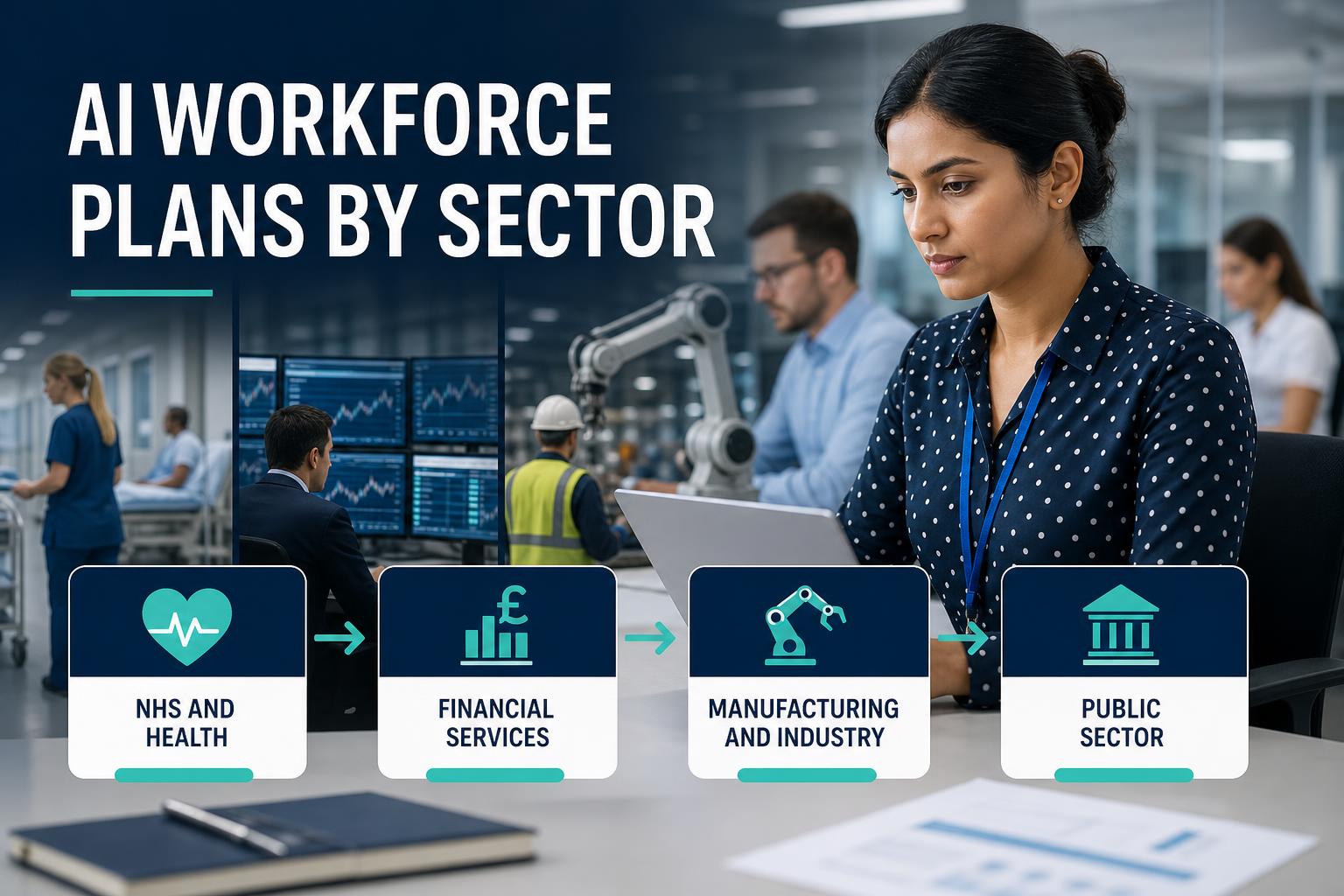
Sector context matters, but the official documents do not all have the same status. The NHS has national health and workforce plans. Financial services now has an independent AI Adoption Plan published on 14 July 2026. Advanced manufacturing has an independent AI Champion adoption plan published on 8 June 2026. Central government has an AI Playbook and learning resources, while councils make their own workforce and adoption decisions.
A recommendation, operating guidance, an employer learning service and a funded qualification are different. Employers and providers should record which document creates the need, which body owns implementation and which funding rules make training eligible.
NHS and health sector
Current policy direction
The 2023 NHS Long Term Workforce Plan discusses digital and AI capability. The more recent 10 Year Health Plan for England says the ambition is for staff to be AI trained and digitally confident. It proposes comprehensive AI and digital-tool content in education and training curricula, new workforce upskilling programmes and a phased rollout of validated diagnostic and administrative tools.
Delivery is still staged. For example, NHS England announced in June 2026 that Microsoft 365 Copilot access would be extended to 505,000 clinicians and support staff, with rollout expected by October 2026. That is an announced deployment, not proof that every trust, role or use case has completed training.
Priority capabilities
- safe use of the specific clinical or administrative system;
- critical interpretation of outputs and appropriate human oversight;
- patient-data protection, information governance and cyber security;
- medical-device and clinical-safety responsibilities where applicable;
- workflow redesign, evaluation and escalation of incidents or uncertain outputs.
Training routes
The NHS Digital Academy is a current NHS England service offering digital learning and leadership products. Access, cohort status and funding vary by product, so “NHS funded” should not be used as a blanket description. Apprenticeships can support an employed worker only where the job, duties and training need match the current standard and the start-date funding rules.
Financial services
The new July 2026 plan
The Financial Services AI Adoption Plan was published by HM Treasury on 14 July 2026. It contains ten recommendations spanning regulatory clarity, AI-enabled advice, resilience, skills and talent, and agentic payments. Government welcomed the plan and accepted the recommendations directed to government.
The skills section calls for industry participation in the Financial Services Skills Compact and recommends that HM Treasury and industry explore development of a sector-wide AI skills plan. The wording matters: the July document is an adoption plan recommending a future skills plan, not evidence that one unified training offer already exists.
Regulatory and workforce priorities
The FCA continues to monitor AI through its existing wider regulatory framework and AI Lab. Its 2026 activity includes AI Live Testing, the Supercharged Sandbox and an AI Input Zone whose responses will inform examples of good and poor practice later in 2026. Firms remain responsible for outcomes under the rules that apply to them; participation in a sandbox or completion of a course does not transfer that accountability.
- board and senior-leader understanding of AI strategy, risk and accountability;
- model-risk management, assurance, explainability and monitoring;
- Consumer Duty, fairness, data protection and vulnerable-customer considerations;
- operational resilience, cyber security and third-party concentration risk;
- role-specific capability for frontline, legal, risk, compliance and technical teams.
Advanced manufacturing
The June 2026 adoption plan
The Advanced Manufacturing AI Adoption Plan proposes a “Scan-Pilot-Scale” pathway. It identifies workforce capability and confidence, legacy systems, fragmented data, uncertainty over returns, safety and assurance as barriers to moving from pilots into production.
Its workforce proposal is explicitly pro-worker: build practical skills for leaders, engineers, operators and managers; embed learning in operations; and align existing support such as Made Smarter, AI Skills Boost, apprenticeship products and innovation programmes. The plan is independent and its phased interventions are proposals, some subject to evidence and co-investment.
Priority capabilities
- industrial data quality, connectivity and operational-technology integration;
- use and assurance of predictive maintenance, quality and optimisation systems;
- human factors, safety and worker consultation in workflow redesign;
- business cases, pilot evaluation and evidence needed to scale;
- cyber security, supplier risk and ongoing performance monitoring.
Training and adoption support
Made Smarter can provide digital roadmapping, advice, leadership development and, in some programmes, match-funded support. The exact offer and eligibility are regional and time-limited; the national brand is not a guarantee of a grant. Apprenticeship selection should start with the occupation. ST1512 v2.1 may suit an operational AI and automation role, while current engineering standards may suit engineering duties, but a provider should not claim that every engineering standard contains an AI pathway.
Central and local government
Guidance rather than one workforce plan
The AI Playbook for the UK Government gives ten principles for civil servants and people working in government organisations. It covers lawful, ethical and secure use, meaningful human control, life-cycle management, procurement, appropriate expertise and assurance. It is supported by AI learning on Civil Service Learning and Government Campus.
These resources do not create a single training entitlement across every council, arm's-length body or public service. Local government employers must combine national guidance with their own data, procurement, equality, safeguarding, cyber-security and service-accountability requirements.
Priority capabilities
- deciding whether AI is appropriate for a public-service problem;
- procurement, commercial due diligence and supplier management;
- meaningful human control and routes for review or challenge;
- data protection, equality, accessibility, security and record keeping;
- testing, assurance and transparent communication with the public.
What is common across sectors
Foundation literacy. People need to understand what AI is, where it is used, its limitations and risks, and the organisation's rules. Skills England's foundation benchmark offers a current baseline for simple workplace tools.
System-specific competence. General literacy does not qualify a clinician to rely on a diagnostic tool, a risk manager to approve a model or an engineer to deploy AI into production.
Human and organisational capability. The current plans repeatedly emphasise leadership, worker confidence, consultation, workflow design and oversight. These are not optional “soft skills”; they determine whether technical adoption works safely.
Assurance over time. Staff need to test, monitor, document and challenge systems after deployment, not merely complete training before launch.
Funding guardrails for every sector
AI Skills Boost offers free benchmarked foundation courses to UK adults. It is not bespoke occupational training or a general provider subsidy.
Skills Bootcamps are locally commissioned in England, last up to 16 weeks and include an interview opportunity for learners seeking a new job, not a job guarantee. Existing-employee contributions are normally 10% for employers with 1 to 249 staff and 30% for larger employers.
Apprenticeships require a genuine job and occupational fit. Current examples include ST1512 v2.1 at Level 4, Data Analyst ST0118 v1.1 at Level 4 and Data Scientist (integrated degree) ST0585 v1.1 at Level 6. “AI Data Specialist Level 4” does not exist: ST0763 is Level 7, is under revision and has restricted government funding for new starts from 1 January 2026.
Apprenticeship units fund only approved products under their own rules. The three current AI leadership units are Level 5 products for employed learners aged 19 and over; they are not a generic fund for any short AI course.
Provider action checklist
- Record whether the source is policy, independent advice, regulatory guidance or a funded product
- Use the most recent document, including the 14 July 2026 Financial Services AI Adoption Plan
- Map learning to actual roles, systems, decisions and affected people
- Separate foundation literacy from system-specific occupational competence
- Check every apprenticeship reference, level, version and funding restriction on Skills England
- Verify Bootcamp availability and eligibility with the relevant local commissioner
- Describe Made Smarter and NHS learning access at programme level, not as universal funding
- Build sector regulation, safety, governance and assurance into practical assessment
- Involve workers and managers in workflow design and evaluation
- Measure safe workplace application and service outcomes, not attendance alone
Frequently asked questions
Does the NHS have an AI workforce plan?
The NHS Long Term Workforce Plan from 2023 covers AI and digital capability, while the 10 Year Health Plan for England published in July 2025 gives the current policy direction: NHS staff should be AI trained and digitally confident, curricula should include AI and digital tools, and new upskilling programmes are planned. These documents are not a guarantee that every NHS employee already has a funded AI course. The NHS Digital Academy remains a current source of learning products, with access and commissioning determined by the relevant programme and employer.
What is the current financial-services AI workforce plan?
The independent Financial Services AI Adoption Plan was published on 14 July 2026. It recommends industry participation in the Financial Services Skills Compact and asks HM Treasury and industry to explore a sector-wide AI skills plan. It therefore identifies a need and proposes next steps; it does not show that a single sector-wide training plan is already operating. The FCA continues to supervise AI through its existing wider regulatory framework and AI Lab activity.
How is manufacturing planning for AI skills?
The independent Advanced Manufacturing AI Adoption Plan, published on 8 June 2026, proposes a Scan-Pilot-Scale pathway and makes workforce capability and adoption one of five priority interventions. It builds on programmes such as Made Smarter but does not itself create an automatic grant or training entitlement. Manufacturers must check the support available in their region and the conditions attached to each programme.
Which AI apprenticeships are current in July 2026?
Relevant live examples include Artificial Intelligence and Automation Practitioner ST1512 v2.1 at Level 4, Data Analyst ST0118 v1.1 at Level 4, and Data Scientist (integrated degree) ST0585 v1.1 at Level 6. Artificial Intelligence Data Specialist ST0763 is Level 7, not Level 4, is being revised and has restricted government funding for new starts from 1 January 2026. Always check the live Skills England page and funding rules before enrolment.
Sources & further reading
- GOV.UK: 10 Year Health Plan for England — GOV.UK: 10 Year Health Plan for England
- HM Treasury: Financial Services AI Adoption Plan — HM Treasury: Financial Services AI Adoption Plan
- FCA: AI Lab and current approach — FCA: AI Lab and current approach
- GOV.UK: Advanced Manufacturing AI Adoption Plan — GOV.UK: Advanced Manufacturing AI Adoption Plan
- GOV.UK: AI Playbook for the UK Government — GOV.UK: AI Playbook for the UK Government
- Skills England: AI skills for the UK workforce — Skills England: AI skills for the UK workforce
- Skills England: ST1512 v2.1 — Skills England: ST1512 v2.1