Last updated: 15 July 2026
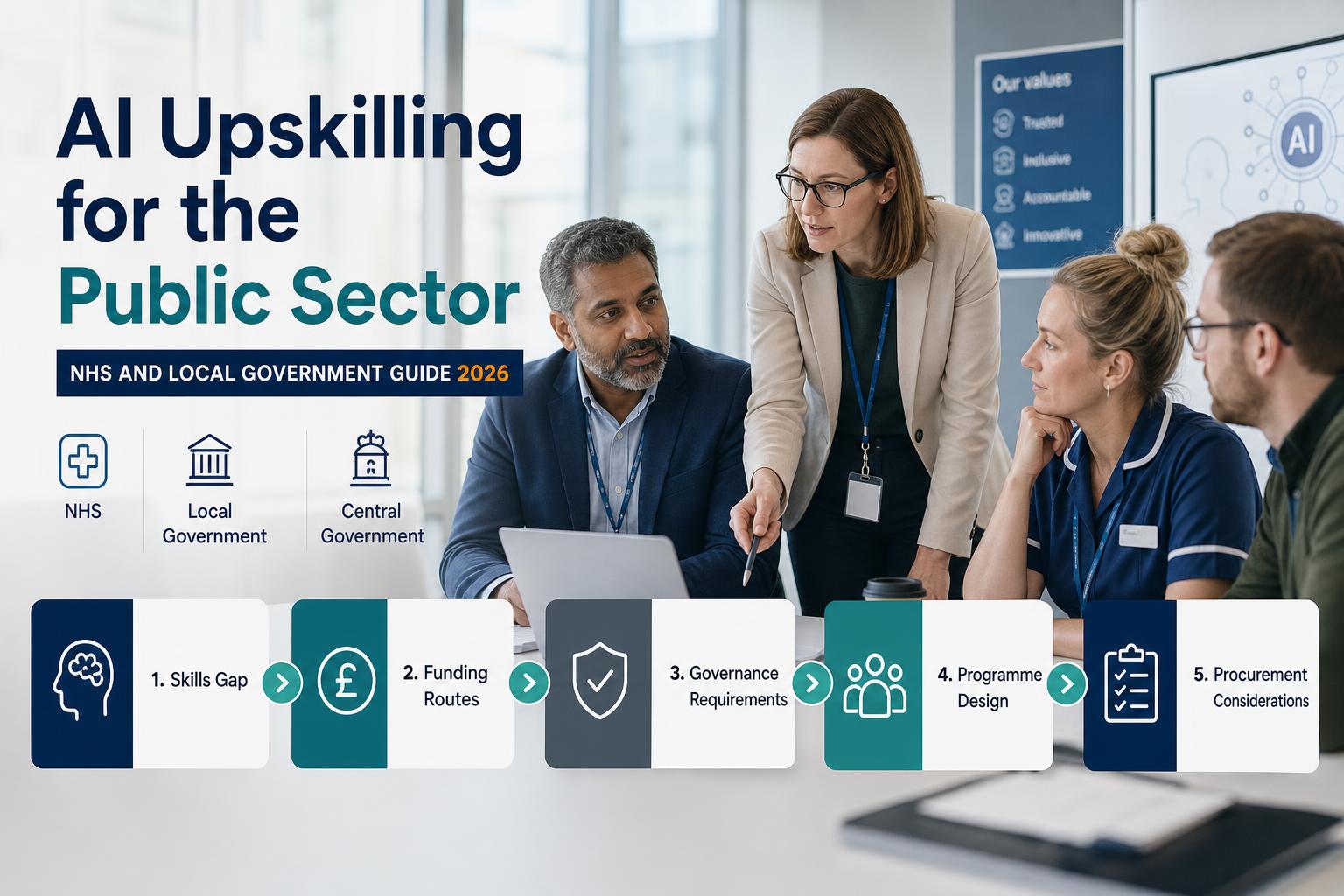
The Public Sector AI Skills Gap
Public sector organisations face a more complex AI skills challenge than many private sector employers. They are simultaneously under pressure to adopt AI tools to improve service delivery and reduce costs, subject to specific governance and accountability obligations that make AI deployment higher-risk than in commercial settings, and constrained by workforce structures, pay scales, and procurement rules that make accessing private sector AI talent and training difficult.
The DSIT AI Labour Market Survey 2025 found that public sector organisations report AI skills gaps at broadly similar rates to the private sector — but with a distinctive pattern. The gap is particularly acute at the management and leadership layer: frontline workers are increasingly using AI tools in their daily work, but their managers lack the knowledge to supervise AI use appropriately, assess AI-related risks, or make informed decisions about AI adoption. This management AI literacy gap is the primary risk factor for poor AI outcomes in public services.
The January 2026 AI Skills Boost announcement, which named the NHS as Britain’s largest employer partner, signals that the government sees public sector workforce AI capability as a national priority rather than just an employer responsibility. This creates both a mandate for public sector L&D teams to invest in AI upskilling and an expanded range of funded routes to do so.
Funding Routes for Public Sector AI Upskilling
Public sector organisations have access to several funded routes for AI upskilling in 2026, each with different eligibility criteria and appropriate use cases.
AI Skills Boost. The government’s free AI foundation training programme is open to all UK adults including public sector employees. For NHS trusts and local authorities with large workforces, the AI Skills Boost provides a cost-effective route to baseline AI literacy for all staff — frontline workers, administrators, and managers. Training under the programme must be from an accredited provider and must meet the Skills England AI Foundation Skills benchmark. Large public sector organisations should approach accredited providers directly to arrange organisation-wide or departmental cohort delivery rather than relying on individual learner enrolment through public channels.
Apprenticeship Levy / Growth and Skills Levy. NHS trusts and local authorities may use apprenticeship service funds for eligible apprenticeship units and full standards. The current AI leadership units are AU0009, AU0010 and AU0011; each is Level 5, has a 30-hour delivery minimum and carries up to £750 funding. They are intended for employed learners aged 19 or over in leadership positions with autonomy to deliver technological change and inform investment decisions, not as general AI training for all clinical or operational staff. ST1512 is a separate Level 4 occupational apprenticeship route.
Skills Bootcamps. Public sector organisations can access Skills Bootcamp provision for their staff through DfE-funded programmes. As employers, NHS trusts and councils contribute 30% of the Bootcamp fee with DfE covering 70%. AI-focused Skills Bootcamps that target the management layer — equipping supervisors and middle managers to govern and support AI use — are a good fit for public sector organisations that need to upskill large numbers of managers without the constraints of a full qualification programme.
Shared Services and Integrated Care Systems. NHS organisations operating within Integrated Care Systems (ICS) have the option to coordinate AI upskilling across multiple trusts and primary care providers within the ICS footprint — sharing the cost and complexity of programme commissioning and potentially qualifying for volume-based pricing from providers. ICS-level AI training commissioning is an emerging model that several systems are piloting in 2026.
Public Sector AI Governance Requirements
Public sector AI upskilling must address the specific governance obligations that apply to public bodies — which go beyond the standard corporate responsible AI requirements. These obligations are not optional; they are embedded in the legal and regulatory framework that governs public service delivery.
Public sector equality duty. Section 149 of the Equality Act 2010 requires public bodies to have due regard to equality in their functions. This applies to AI systems: when AI is used to support decisions that affect individuals (allocation of services, assessment, prioritisation), the public body must be able to demonstrate that it has assessed the AI system for equality impacts and has appropriate oversight in place. Staff who use AI in these contexts need training that specifically addresses their equality duty obligations — not just generic responsible AI awareness.
ICO accountability framework. The ICO’s guidance on AI and data protection creates specific obligations for public bodies processing personal data through AI. Data Protection Impact Assessments (DPIAs) are required for high-risk AI processing, and public bodies must be able to respond to subject access requests and individual rights requests that involve AI systems. L&D teams responsible for public sector AI training should ensure these obligations are translated into specific training content rather than relying on employees to find and read the ICO guidance themselves.
NHS-specific obligations. NHS organisations deploying clinical AI must comply with the MHRA’s software as a medical device framework (where applicable), the NHS AI Lab’s responsible AI principles, and CQC expectations for clinical governance of AI-assisted care. Clinical staff using AI diagnostic support tools, AI-assisted documentation, or AI care pathway tools need training that addresses these specific obligations — not just the general AI literacy benchmark.
Programme Design for Public Sector Contexts
Generic AI upskilling programmes — designed for private sector employers and repurposed for public bodies — consistently produce poor outcomes in the public sector. The core problem is relevance: public sector employees who are trained on AI tools they do not use, in scenarios drawn from commercial contexts that do not reflect their work, disengage quickly and do not apply the training.
Effective public sector AI training is built around the AI tools that employees actually use or are being asked to adopt — which in the NHS means clinical AI tools (diagnostic support, documentation, discharge planning), administrative AI (patient scheduling, communications), and operational AI (workforce management, supply chain). For local government, this means AI in planning support, housing assessment, benefits processing, and community services. The training content must be grounded in these actual use cases, with examples and scenarios drawn from the specific public service context.
Tiered delivery is essential for large public sector workforces. All-staff AI awareness — covering what AI is, what the organisation’s AI policy is, and what employees must do to comply — can be delivered as a short blended module. Role-specific application training for staff who use specific AI tools must be designed for those tools and those roles. Governance-level training for managers, team leaders, and AI decision-makers requires the most substantive investment and should include the specific legal and regulatory obligations relevant to public service contexts.
CQC inspections, internal audit, and PHSO investigations are increasingly likely to surface AI governance questions. Staff who have completed generic commercial AI awareness training but cannot articulate their specific obligations under the public sector equality duty, UK GDPR, or their sector regulator’s AI guidance are a governance liability. Build sector-specific governance content into your programme from the start.
Procurement Considerations
Public sector organisations must procure AI training through compliant routes — most commonly the Crown Commercial Service’s Learning & Training Services framework, the Education and Skills Funding Agency’s registers for apprenticeship provision, or their own managed service or preferred supplier list. Training providers working with public sector organisations need to be aware of these procurement requirements and should be able to confirm their framework lot status and relevant experience.
For NHS organisations, the NHS eLearning Repository and Health Education England (now NHS England) frameworks provide pre-approved routes for certain types of training. AI literacy content that has been accredited through Skills England’s AI Skills Boost benchmark may qualify for procurement via frameworks that recognise the accreditation. NHS L&D teams should engage with their regional workforce team and NHS England AI strategy leads to understand current commissioning guidance for AI upskilling before approaching the open market.
Frequently asked questions
Can NHS trusts access the AI Skills Boost for staff training?
Yes. NHS England joined the AI Skills Boost programme as Britain’s largest employer partner in January 2026. NHS trusts can access AI Skills Boost accredited training for their staff through approved training providers, with the government covering the cost for the foundational AI literacy component. NHS-specific AI upskilling programmes that address clinical AI tools, data governance in healthcare, and responsible AI in patient care contexts are increasingly available from providers accredited under the scheme.
How are local authorities funding AI upskilling for staff in 2026?
Local authorities have several potential funded routes for AI upskilling. For eligible employed leaders, the approved apprenticeship units are AU0009 for strategy and opportunity, AU0010 for adoption, procurement and governance, and AU0011 for delivery and organisational transformation. Each is Level 5, requires at least 30 delivery hours and carries maximum funding of £750. The Level 4 AI and Automation Practitioner standard (ST1512) serves a different, occupational route. Employers should check the current funding rules and regional programmes for each learner and need.
What AI governance training do public sector organisations need?
Public sector organisations deploying AI are subject to specific governance expectations from the Cabinet Office, ICO, and sector regulators. Staff who make or inform decisions using AI outputs need training on: the AI regulatory framework relevant to public services, transparency obligations when using AI in public-facing services, data protection requirements under UK GDPR for AI processing of personal data, and the public sector equality duty as it applies to AI-assisted decisions. NHS organisations additionally need training on CQC expectations for clinical AI use and NHS AI Lab governance frameworks.
Sources & further reading
- GOV.UK: Free AI training for all - NHS as Britain's largest employer partner — gov.uk
- NHS AI Lab: Responsible AI principles — nhsx.nhs.uk/ai-lab
- ICO: AI and data protection guidance — ico.org.uk