Last reviewed: 15 July 2026 against the DSIT explainer, Skills England benchmark and live AI Skills Hub.
The public programme routes learners to free courses on the AI Skills Hub. Courses selected for the programme have been checked against Skills England's benchmark. That does not create an open accredited-provider register, guarantee public funding, or make every benchmark-informed course an official AI Skills Boost course.
What AI Skills Boost is in July 2026
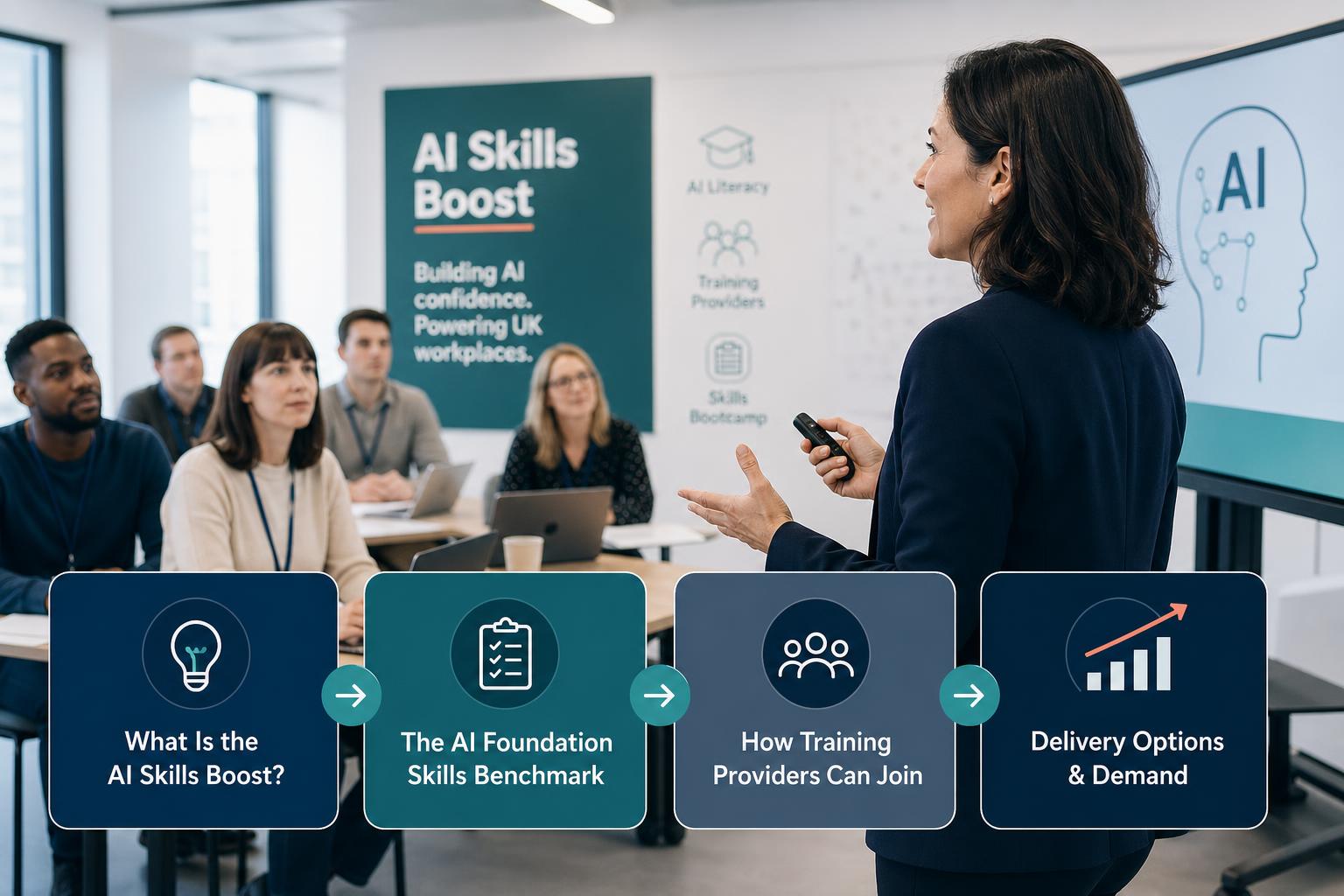
AI Skills Boost is a government-industry initiative led by the Department for Science, Innovation and Technology with support from Skills England and industry partners. The partnership began in June 2025; in January 2026 government expanded the ambition to upskill 10 million UK workers by 2030.
The initiative uses partner reach and training provision rather than a new national provider contract. Government's explainer describes outcomes such as helping workers adapt to AI, targeting cohorts that need support and encouraging AI uptake across the economy. Those are programme ambitions, not guaranteed outcomes for an individual course or learner.
In June 2026, government reported 1.7 million AI upskilling course completions and announced additional partners. Treat that as a government-reported programme total, not as 1.7 million unique workers, foundation badges or job outcomes. The January explainer says the earlier 1,001,147 completion count included internal and external partner learners and courses ranging from introductory literacy to advanced data science and machine-learning engineering.
The learner offer is a free partner-course catalogue
The AI Skills Hub describes AI Skills Boost as a free training offer built by industry partners and backed by DSIT and Skills England. It says the highlighted courses take from around 20 minutes to a day and are intended to fit around working life. Learners browse the catalogue and follow the terms for the selected partner course.
A training provider should therefore verify each listed course separately. Provider, delivery platform, duration, access period, prerequisites, accessibility, use of learner data, tool licences and support can vary. “Free” on the campaign page does not justify inventing a payment rate to the provider or promising a particular level of tutor support.
The AI foundation skills for work benchmark
Skills England's public benchmark sets out six foundation skills across three domains:
| Domain | Published foundation skills |
|---|---|
| Technical | Write clear instructions for AI tools; use AI tools to support routine processes and tasks |
| Non-technical | Use simple software that automates work tasks; adjust how an AI tool works to get better results |
| Responsible and ethical | Understand the risks and consequences of AI use; analyse information using AI tools |
The benchmark helps industry and training providers design good-quality foundation training. It is not a prescribed timetable, qualification specification or licence to use AI Skills Boost branding. A provider can use it as a curriculum reference without claiming that Skills England has approved the provider or course.
What the virtual badge means
Skills England states that someone who completes an AI Skills Boost course covering all six foundation skills receives a virtual badge showing that they met the benchmark. The badge belongs to the defined learner and course process; it is not blanket accreditation of every product sold by the course author.
Before advertising a badge, confirm in writing:
- that the exact course is part of the current AI Skills Boost offer;
- that it covers all six published skills;
- who issues the badge and what completion data must be supplied;
- the assessment or completion trigger; and
- the permitted wording, logos and expiry or version terms.
A self-declared mapping to the benchmark does not by itself entitle learners to the programme badge.
How a training organisation can express interest
The live AI Skills Hub page invites organisations interested in becoming a strategic partner, and with training material that could be displayed on the hub, to contact the programme using the address shown on that page. This is the only public provider-facing route described there.
It should not be rewritten as two accreditation routes, a Skills England accreditation team, a fixed review period or priority access for Skills Bootcamp operators. The public page does not publish those mechanisms.
- Review the live hub, benchmark and existing course catalogue.
- Prepare evidence for the exact course, audience, accessibility, completion model and all-six-skills mapping.
- Use the strategic-partner contact route shown on the hub.
- Ask for written terms covering course review, listing, brand use, learner badge and completion reporting.
- Do not market official programme status until it has been confirmed.
AI Skills Boost is not a guaranteed provider funding stream
The current public sources describe free courses contributed through government and industry partners. They do not publish an open per-learner funding rate, guaranteed referral volume or reimbursement contract for any training provider that maps a course to the benchmark.
| Route | What it provides | What it does not prove |
|---|---|---|
| AI Skills Boost | Free partner-course discovery; benchmarked-course badge where conditions are met | An open per-learner provider payment or guaranteed leads |
| Skills Bootcamp | Separately commissioned, place- and cohort-specific adult training | That an AI Skills Boost listing has won a Bootcamp contract |
| Apprenticeship unit or full apprenticeship | Funding only under the relevant apprenticeship rules and approved route | That a short AI course can be charged to an apprenticeship account |
| Employer-paid training | A commercial contract between customer and provider | Government endorsement or programme badge rights |
A course can potentially be used in more than one context, but each claim must stand on its own documentation. Directory listing, benchmark alignment, public funding eligibility and commercial purchase are not interchangeable statuses.
Audit the course and marketing claims
For every course promoted through or alongside AI Skills Boost, record:
- the course owner and current catalogue URL;
- whether it is an official listed course or only independently benchmark-informed;
- the six-skill mapping and version reviewed;
- actual duration, format, prerequisites and access window;
- which AI tools learners use and who pays for any licence;
- privacy, intellectual-property and acceptable-use terms;
- accessibility and reasonable-adjustment arrangements;
- the completion definition and any badge entitlement; and
- the evidence behind employment, productivity or capability claims.
Safe descriptions distinguish “listed on the AI Skills Hub”, “selected for AI Skills Boost”, “checked against the Skills England benchmark” and “informed by the public benchmark”. Avoid “AI Skills Boost accredited provider”, “government funded”, “levy funded” or “guaranteed badge” unless the exact written programme or funding terms support that phrase.
Measure the right outcome
A course completion or virtual badge records completion of the defined learning route. It does not, by itself, prove job progression, sustained behaviour change, responsible workplace deployment or productivity gain.
Providers and employers can measure those separately: pre- and post-course confidence, task demonstrations, output checking, policy compliance, use-case adoption, manager observation and follow-up application. Keep programme-reported national completion totals out of an individual provider's sales case unless the provider can evidence its own contribution and avoid double-counting.
Training-provider checklist
- Read the current DSIT explainer and AI Skills Hub page
- Map the exact course against all six published foundation skills
- Distinguish an independent mapping from an official programme listing
- Use the hub's strategic-partner contact if seeking inclusion
- Obtain written brand, badge, reporting and course-listing terms
- Publish the actual course duration, format, access and prerequisite terms
- Do not invent a provider accreditation, application deadline or review team
- Do not promise per-learner funding, employer leads or learner volumes
- Test Skills Bootcamp or apprenticeship eligibility under those separate rules
- Measure learner completion separately from workplace and employment outcomes
- Recheck the hub and official announcements before every campaign
The partner list and course catalogue can change. Recheck the live AI Skills Boost hub and the Skills England benchmark before making programme, badge or funding claims.
Frequently asked questions
What is the AI Skills Boost programme?
AI Skills Boost is a government-industry initiative targeting 10 million UK workers with AI skills by 2030. Its public learner offer is a catalogue of free, industry-developed short courses on the AI Skills Hub. Selected courses have been checked against Skills England's AI foundation skills for work benchmark.
Is AI Skills Boost an accreditation for training providers?
No general provider-accreditation scheme is described in the current public guidance. Skills England says courses chosen for the programme were assessed against its benchmark, and the AI Skills Hub invites organisations with training material to express interest in strategic partnership. A public benchmark, course assessment, hub listing and learner badge are different things; none creates blanket accredited-provider status.
Can a training provider apply to join AI Skills Boost?
The current AI Skills Hub page invites organisations interested in becoming strategic partners, and with training material that could be displayed, to use the contact address on that page. This is an expression-of-interest route, not a published grant or automatic accreditation process. Obtain written confirmation of any partnership, listing, badge and brand terms before marketing a course as part of AI Skills Boost.
What does the AI foundation skills for work benchmark cover?
Skills England publishes six skills across technical, non-technical, and responsible or ethical domains: writing clear instructions for AI tools; using AI for routine processes and tasks; using simple software that automates tasks; adjusting an AI tool for better results; understanding AI risks and consequences; and analysing information using AI tools.
Does AI Skills Boost fund training providers per learner?
The current public programme pages do not announce an open per-learner reimbursement stream for providers. They describe free partner courses and a course catalogue. AI Skills Boost listing does not automatically make a course eligible for Skills Bootcamp, apprenticeship-unit, apprenticeship-service or other public funding; each route must independently meet its own rules and contract.
Sources & further reading
- GOV.UK / DSIT — AI Skills Boost: explainer
- GOV.UK / DSIT and Skills England — Free AI training and 10 million worker target
- GOV.UK / Skills England — AI foundation skills for work benchmark
- AI Skills Hub — AI Skills Boost course catalogue and strategic-partner contact
- GOV.UK / DSIT and DWP — June 2026 AI Skills Boost partner and completion update