Last updated: 26 March 2026
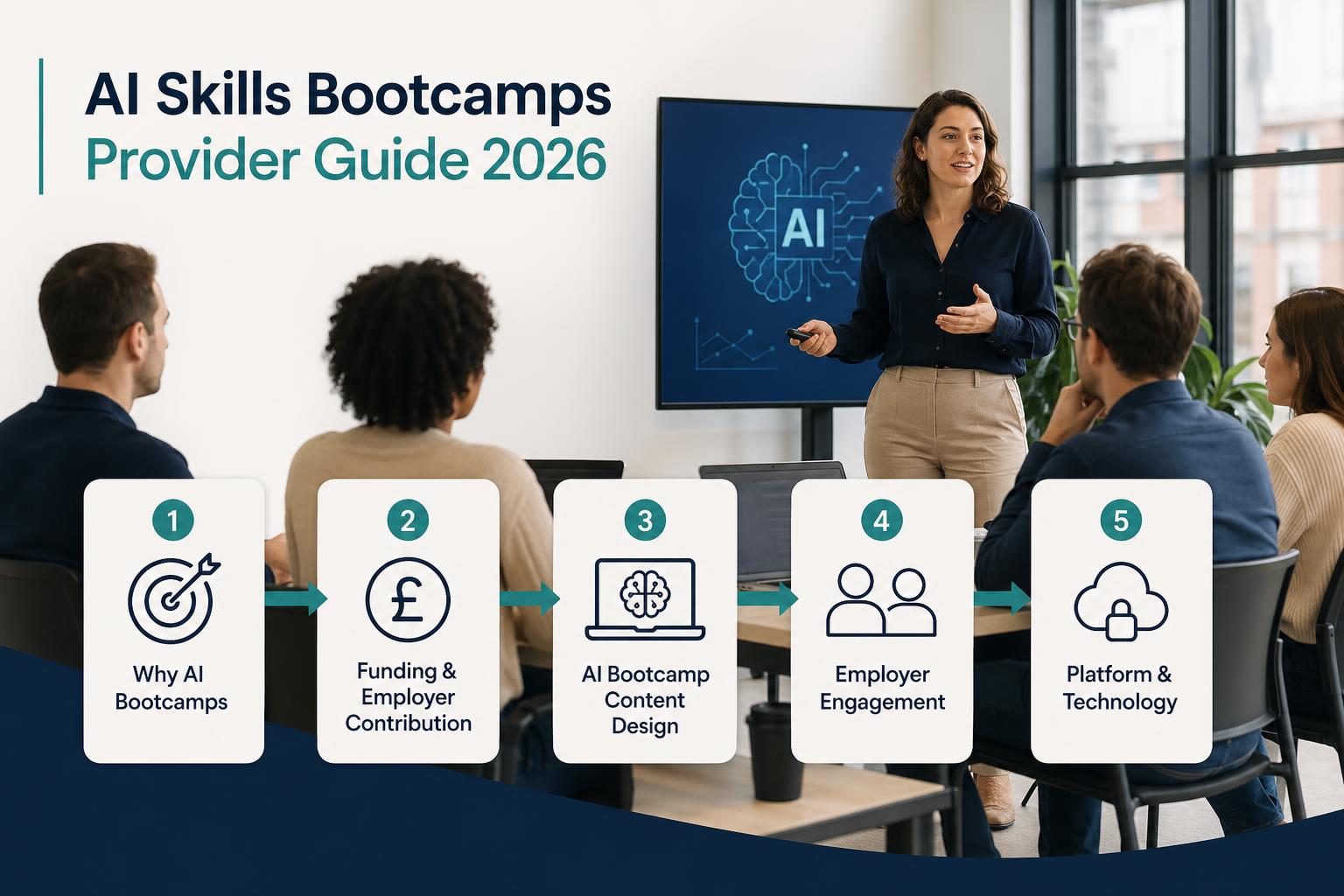
Why AI Skills Bootcamps, and Why Now
Skills Bootcamps have been running since 2020, initially focused on digital and technical skills for unemployed adults. The programme has expanded significantly since then — in 2025–26, Bootcamps cover digital, green skills, construction, healthcare, and several other priority sectors, with in-work learners (employed adults seeking to upskill) now the majority of the funded cohort. AI has been added as an explicit priority sector, reflecting the government’s AI skills agenda and the volume of employer demand that has outrun the capacity of existing funded provision.
For training providers, the AI Bootcamp opportunity is substantial for two reasons. First, demand is employer-driven rather than learner-driven — employers are approaching providers with funded AI training needs that exceed what can be delivered through apprenticeship standards alone. Second, the competition among accredited AI Bootcamp providers is currently limited: the pool of providers with approved AI-specific Bootcamp programmes is small relative to the volume of employer enquiries, and the market is growing faster than new providers are entering it.
Funding Structure and Employer Contribution
Skills Bootcamp funding operates on a co-investment model. For employed adults, the DfE covers 70% of the course fee and the employer pays 30%. For SMEs with fewer than 250 employees, the employer contribution is reduced to 10%, with the DfE covering 90%. For unemployed adults, the government funds 100% of the course fee. These rates apply to the agreed DfE funding rate for the provision, not to any fee the provider might charge above that rate.
The 2025–26 funding cycle has moved allocation responsibility from central DfE to mayoral strategic authorities and combined authorities in most regions. This means providers now apply to their regional authority rather than directly to DfE, and funding rates and application processes vary by region. Providers operating across multiple regions need to manage separate applications and potentially separate contracts with multiple regional authorities — a more complex operational model than the previous centralised approach.
Funding is paid on a learner start basis with a retention element — providers receive a portion of the funding when a learner starts the Bootcamp and the remainder on completion. This cashflow model has operational implications for programme design: cohorts that do not achieve strong completion rates affect provider cash flow. AI Bootcamp content must be genuinely engaging and practically relevant to the employed adults who make up the primary cohort, or completion rates will suffer.
AI Bootcamp Content Design
DfE requires Skills Bootcamp content to be employer-endorsed, outcome-focused, and genuinely skills-developing — not just awareness-raising. For AI Bootcamps specifically, this means the programme must produce demonstrable competence with AI tools, not just familiarity with AI concepts. The distinction matters: a 10-week Bootcamp that covers AI history, terminology, and general principles but does not produce learners who can apply AI tools in their job roles will struggle to meet DfE quality standards and will generate poor employer satisfaction scores.
Effective AI Bootcamp content design starts with employer co-design. DfE expects to see evidence of employer involvement in developing the programme — not just employer endorsement letters, but genuine input into the skill requirements, the tools covered, and the real-world application scenarios. The AI skills landscape changes quickly; employer input ensures the content reflects current tool use rather than what was relevant 18 months ago when the curriculum was written.
A well-designed 10–12 week AI Bootcamp typically covers: AI fundamentals and the current landscape (weeks 1–2), practical generative AI and productivity tools (weeks 2–4), data literacy and AI tools for data analysis (weeks 4–6), AI in specific industry or function contexts (weeks 6–8), responsible AI, governance, and compliance (weeks 8–9), and a practical project applying AI to a real workplace problem (weeks 9–12). The practical project component is increasingly important as DfE and employers focus on demonstrated capability rather than knowledge assessment.
Employer Engagement Requirements
Skills Bootcamp funding requires providers to demonstrate strong employer engagement before and during delivery — not just at the point of learner recruitment. DfE expects evidence that employers are actively involved in: shaping the programme content, committing to in-work practice opportunities for employed learners, supporting managers to enable learner time for training, and providing meaningful feedback on learner outcomes. Providers who treat employer engagement as a box-ticking exercise — collecting endorsement letters but not building genuine employer involvement — consistently underperform on DfE quality reviews.
For AI Bootcamps specifically, employer engagement has an additional operational dimension: employed learners need access to AI tools in their workplace to complete the practical application components of the programme. Providers should confirm at the point of employer agreement that learners will have access to approved AI tools during the Bootcamp — and should identify alternatives (sandbox environments, provider-provided tool access) for employers who have not yet approved AI tool use internally.
For AI Bootcamps, the employer agreement should specify: learner time allocation (how many hours per week the employer will release the learner for training and practice), AI tool access confirmation, manager briefing obligations, and the employer’s commitment to apply AI skills after completion. This level of specificity protects completion rates and learner outcomes — and produces better employer satisfaction scores that support future funding applications.
Platform and Technology Requirements
Delivering an AI Bootcamp requires a delivery platform that can support the blended, project-based model that achieves good outcomes for employed adult learners. The platform needs to handle asynchronous content delivery (employed learners cannot always attend synchronous sessions), cohort-level progress tracking, practical project evidence submission and feedback, employer progress visibility, and DfE-required reporting outputs. Generic LMS platforms not designed for funded provision often lack the DfE reporting capabilities that compliance requires — providers should audit their platform against Bootcamp reporting requirements before their first funded cohort starts.
Frequently asked questions
How are AI Skills Bootcamps funded?
AI-focused Skills Bootcamps are funded by the DfE through Skills England, with funding allocations made to providers via mayoral strategic authorities and combined authorities from 2025–26 onwards. For employed adults (in-work learners), employers contribute 30% of the course fee and the government funds 70%. For unemployed adults seeking work, the government covers 100%. Funding rates vary by region and provider; providers should confirm current rates with their relevant regional authority or DfE Skills Bootcamp lead.
Does AI count as a Skills Bootcamp eligible topic?
Yes. Digital and AI skills are among the priority sectors listed by DfE for Skills Bootcamp funding. AI-focused Bootcamps that equip learners with practical AI skills applicable to work — whether for employed or unemployed adults — are eligible for funding applications. Content must be employer-endorsed and outcome-focused, with a clear employment or skills improvement outcome for learners.
How long does a Skills Bootcamp need to be?
Skills Bootcamps are typically 6–16 weeks in duration. There is no fixed minimum or maximum, but programmes must be substantial enough to deliver meaningful skill development — generally a minimum of 60–70 guided learning hours for funded provision. Very short programmes (under 6 weeks) are less likely to be approved for Bootcamp funding and may be better suited to the apprenticeship units funding route.
Sources & further reading
- GOV.UK: Skills Bootcamps funding allocations 2025-2026 — gov.uk/government/publications/skills-bootcamps-funding-allocations
- GOV.UK: Skills Bootcamps guidance for providers — gov.uk/guidance/skills-bootcamps
- GOV.UK: Help for businesses to fill AI skills gap — gov.uk