Last updated: 15 July 2026
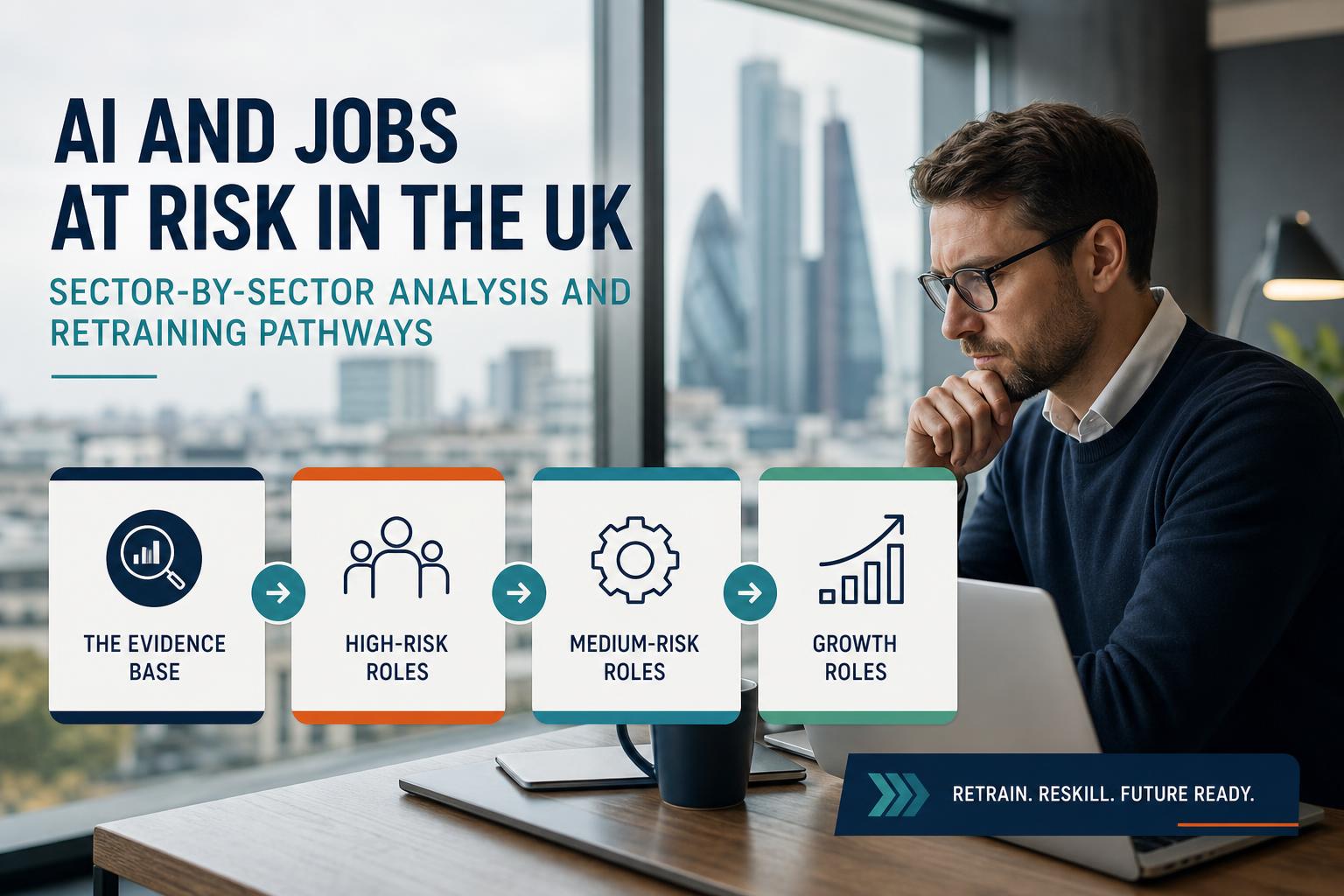
Which jobs are at risk from AI is an urgent workforce question, but a percentage labelled “jobs lost” is usually the wrong starting point. The strongest UK evidence measures whether AI could affect tasks inside an occupation. It does not tell us that the technology will work reliably, be adopted economically, or remove the whole job.
That distinction matters. The same system could substitute for routine document processing, help a professional investigate a complex case, or create additional checking and governance work. Employers need a task-level assessment tied to real deployment plans, followed by upskilling, job redesign, redeployment, or career transition where the evidence supports it.
The ONS did not find that 10–30% of UK jobs will be lost to AI. Its 2019 study estimated that 7.4% of jobs in England in 2017 were at high risk of automation. That study covered automation broadly and pre-dated today's generative-AI systems. This guide uses it as historical context, not a current forecast.
What the UK Evidence Says in 2026
Three UK government sources are especially useful, provided their limits remain visible: the Department for Science, Innovation and Technology's 2026 labour-market assessment, the Department for Education's 2023 occupational exposure analysis, and the ONS's earlier automation study.
The 2026 DSIT Assessment: Exposure Is Not Displacement
DSIT's January 2026 assessment is unusually explicit about uncertainty. Using an IMF-derived measure, its chart grouped 35% of UK employment as highly exposed with high potential for AI to complement workers, 32% as highly exposed with lower complementarity, and 33% as less exposed. Those figures describe potential exposure. They are not percentages of jobs expected to disappear.
The assessment also reviews early signs of weaker hiring in more-exposed occupations, but says the available evidence cannot establish that AI caused the change. Exposure does not prove adoption, and changing interest rates, demand, vacancies, and other labour-market conditions can produce similar patterns.
A June 2026 government snapshot reached a similarly careful conclusion about entry-level hiring. Recruitment has weakened, but broadly alongside the wider labour market, with substantial variation by occupation and no clean causal test that isolates AI.
The DfE Occupational Analysis: Professional Work Can Be Highly Exposed
The Department for Education's 2023 analysis scores occupations by how closely their tasks align with AI capabilities. It found greater exposure in professional and clerical work, including finance, law, business management, administration, writing, and teaching. Finance and insurance was the most exposed industry in that analysis, followed by information and communication, professional and technical services, property, public administration, and education.
This challenges a simple story in which only low-skilled routine jobs are affected. People with higher qualifications can work in highly exposed occupations because language models and other AI systems operate on information-rich tasks. High exposure may still mean augmentation rather than substitution: a teacher, accountant, lawyer, or analyst may use AI while retaining responsibility for context, judgment, relationships, and quality.
What the ONS Automation Figure Does and Does Not Mean
The ONS estimated that around 1.5 million jobs in England, or 7.4% of jobs analysed in 2017, were at high risk of automation. Waiters and waitresses, shelf fillers, and elementary sales occupations appeared among the most exposed. Women, younger workers, and part-time workers were overrepresented in high-risk roles.
The study is still useful for understanding uneven exposure, but it should not be relabelled as a generative-AI forecast. It estimated automation risk using the technology and occupational structure available at the time. Technical feasibility, investment, regulation, demand, organisational design, and customer preference all affect what happens next.
How to Read Global Forecasts
The World Economic Forum's 2025 employer survey projected 170 million roles created and 92 million displaced globally by 2030, a net increase of 78 million. Those figures cover the combined effect of technology, demographic, economic, and green-transition trends. They are neither a UK forecast nor an AI-only forecast, but they do reinforce the need to prepare for substantial job change as well as job creation.
Which Tasks and Roles Are Most Exposed?
A responsible assessment separates tasks from job titles. Current AI is strongest where work can be represented as text, images, code, structured records, or repeatable digital decisions. Exposure is often higher where outputs are standardised and easy to check, and lower where the work depends on unpredictable physical settings, deep relationships, tacit organisational knowledge, or accountable high-stakes judgment.
Routine Information Processing
Examples in the DfE analysis include bank and post-office clerks, bookkeeping and payroll work, finance administration, customer-service occupations, telephone sales, typists, and some HR administration. Activities such as classifying documents, transferring data, drafting standard correspondence, reconciling records, and answering repeat queries are plausible candidates for partial automation.
This does not mean every role with one of those titles will disappear. A customer-service worker handling vulnerable customers and complex exceptions has a different task profile from an agent answering predictable queries. Local workflow evidence matters more than a generic risk score.
Professional Knowledge Work
Authors, writers and translators, legal and financial professionals, analysts, consultants, and educators can all have high exposure to generative AI. Drafting, summarising, searching, coding, and initial analysis may change quickly. Responsibility for the result, domain judgment, negotiation, teaching, client trust, and regulated decisions may remain human and can become more important as output volume rises.
Physical, Interpersonal, and High-Stakes Work
Care, skilled trades, field maintenance, hospitality, and other work in changing physical environments may have less direct exposure to current language-based AI. They are not immune to technology: scheduling, diagnostics, documentation, customer contact, and parts of workflow management can still change. Lower technical exposure also does not automatically mean growing demand, good job quality, or an easy retraining destination.
There is no robust official basis for claiming that a named occupation will disappear in two, three, or five years. Plan against your organisation's approved use cases and investment timetable, then update the assessment as system performance and adoption evidence change.
Sector-by-Sector Analysis
Financial Services
Finance and insurance was the most AI-exposed industry in the DfE analysis. Document review, transaction processing, customer contact, fraud investigation, compliance support, and analytical work all contain tasks that AI may affect. The likely impact differs by task: some processing can be automated, while complex decisions may be accelerated but still require accountable review.
Priority development areas include AI literacy, data quality, model limitations, escalation, customer communication, and redesigned workflows. Employers should connect training to the controls and responsibilities attached to the actual system being deployed.
Professional Services and Information Industries
Information and communication and professional, scientific and technical services also rank highly in the DfE analysis. Generative AI can change research, drafting, coding, design exploration, and routine analysis. It can also reshape entry routes if employers reduce the junior tasks through which people traditionally learn.
A sound response preserves structured practice, supervision, and progression. Giving junior staff an AI tool without redesigning how they acquire judgment risks creating a capability gap later.
Public Administration and Education
Public administration and education appear among the more-exposed industries because they contain substantial information-processing and language work. Potential uses include correspondence, case summaries, lesson preparation, search, and administrative support. Public-service context, data protection, accessibility, procurement, equality, and accountable decision-making can constrain or shape adoption.
Teaching should not be described as simply low risk. Many teaching tasks are exposed, while the full occupation also relies on safeguarding, motivation, classroom relationships, subject judgment, and responsibility for learners.
Manufacturing, Retail, Health, and Care
In manufacturing, generative AI may affect planning, design, documentation, maintenance support, and quality analysis, while robotics and other automation technologies affect physical production. These are related but different changes. Training should follow the specific equipment, data, and operating model at each site.
In retail, standard customer queries, product content, forecasting, and administrative work may be exposed. In health and care, documentation, scheduling, coding, and clinical support may change, but regulated decisions and direct care require context, safety, and human accountability. Sector labels alone are too broad to determine who needs retraining.
How to Assess Your Own Workforce
- Inventory tasks, not only job titles. Ask role holders and managers what people actually do, how often, and which exceptions consume time.
- Name the proposed system and use case. “AI” is too broad. Assess a real tool against real inputs, outputs, users, and decisions.
- Test performance and reliability. Measure error patterns, human review effort, accessibility, security, and the effect on service quality.
- Assess complementarity. Identify which tasks could be supported, which could be substituted, and which new tasks the system creates.
- Add adoption constraints. Consider cost, integration, law and regulation, customer expectations, industrial relations, and operational readiness.
- Examine distributional effects. Check who gains higher-value work, who loses developmental tasks, and whether particular groups bear disproportionate risk.
- Review regularly. Treat the assessment as a living workforce record, not a one-off score.
Choose Between Augmentation, Redeployment, and Transition
The AI reskilling ROI calculator compares the cost of retraining an existing employee against recruiting for the same capability, which is usually the number that decides between these three options.
Augmentation is appropriate when AI changes tasks but the occupation and its human responsibilities remain. Training should combine tool use with verification, domain judgment, escalation, and practice in the actual workflow.
Redeployment is appropriate when workload moves between teams or a role loses enough tasks to require redesign. Map adjacent roles using demonstrated skills, then provide supported practice rather than assuming a course alone creates readiness.
Career transition may be needed when there is credible evidence that a role population will shrink. Involve affected workers early, define realistic destination roles, protect learning time, and connect training to vacancies or work experience. Do not advertise a programme as retraining if no plausible destination exists.
Funded Training Routes Available in July 2026
Use the AI training funding finder to narrow these routes to the ones an individual employer is actually eligible for before building a retraining plan around them.
Public support can reduce training cost, but each programme has its own purpose and eligibility. It is not a single pot that can fund any AI course.
AI Skills Boost
AI Skills Boost is a government-industry initiative aiming to help 10 million workers develop AI skills by 2030. UK adults can access selected free courses through the AI Skills Hub. Courses that meet the foundation benchmark can lead to a government-backed virtual AI foundations badge.
It is not a three-tier entitlement to free, subsidised, and advanced training, and it does not guarantee occupational competence. Use it for an accessible foundation, then add role-specific practice, policy, and assessment.
Skills Bootcamps
Skills Bootcamps in England are flexible courses for adults aged 19 and over and can last up to 16 weeks. Subjects and availability vary by area and commissioning round. For a learner seeking a new job, completion comes with an interview opportunity; it is not a guaranteed job offer or progression outcome.
Where an employer uses a Bootcamp to train an existing employee, the published employer contribution is 10% for organisations with 1–249 employees and 30% for those with 250 or more. Employers do not pay the course cost when recruiting someone who has completed a Bootcamp. Confirm the current local offer and learner eligibility before building a workforce plan around it.
Growth and Skills Levy: Apprenticeships and Approved Units
An apprenticeship is a paid job with approved training and assessment against an occupational standard. Levy funds cannot be treated as a general-purpose course account. The learner's role, off-the-job training, programme duration, and assessment must meet the applicable rules.
Relevant current standards include:
- Artificial Intelligence and Automation Practitioner, level 4 (ST1512 v2.1) — available for starts, with a typical duration of 18 months.
- Data Analyst, level 4 (ST0118 v1.1) — available for starts, with a typical duration of 24 months.
- Data Scientist (integrated degree), level 6 (ST0585 v1.1) — a deeper occupational route, typically 36 months.
- Artificial Intelligence (AI) Data Specialist, level 7 (ST0763 v1.0) — not level 4, currently under revision, and typically 24 months.
For level 7 apprenticeship starts from 1 January 2026, government funding is generally limited to people aged 16–21 at the start, plus eligible people under 25 with an education, health and care plan and/or care experience. Earlier starts can continue under the rules that applied to them.
Funding rules also depend on the start date and employer. For starts from 1 August 2026, the published rules provide full government funding for non-levy employers taking on eligible 16–24-year-olds; non-levy employers generally contribute 5% for learners aged 25 and over. Where a levy-paying employer has insufficient funds, the new-start co-investment rate is 25% employer and 75% government. Costs above the funding-band maximum remain with the employer. Starts on or before 31 July 2026 follow the applicable 2025–26 rules.
Approved apprenticeship units have also been available since 28 April 2026 for employed adults aged 19 and over where an employer identifies a rapid upskilling need. The catalogue includes approved AI leadership units. These products have their own content, price, and funding rules; they do not make every short AI course levy-funded.
Essential Digital Skills and Other Adult Funding
Under the Adult Skills Fund rules in England, eligible adults aged 19 and over who are assessed below level 1 can receive fully funded essential digital skills or Digital Functional Skills qualifications up to and including level 1. This entitlement establishes a digital foundation; it is not a free AI qualification for every adult.
Free Courses for Jobs can fund eligible level 3 qualifications and selected level 2 routes for qualifying adults, subject to earnings, unemployment, prior attainment, residency, local devolution, and course rules. Check the current national or devolved-authority offer against the target occupation rather than assuming eligibility.
Choose the target role and capability first. Then test which funding route fits the person, employer, location, start date, approved product, and intended outcome.
Set Realistic Retraining Timelines
A programme's advertised length is not a universal transition time. An AI Skills Boost course can introduce foundation concepts, and a Skills Bootcamp can run for up to 16 weeks. Current level 4 apprenticeship standards listed above typically run for 18 or 24 months. None of those durations guarantees independent performance in a new role.
Build the timeline from four variables: the worker's starting skills, the distance to the target occupation, protected learning and practice time, and the availability of real work in which competence can be demonstrated. Track capability and destination outcomes, not just enrolment or completion.
Building a Retraining Programme
1. Establish the Workforce Evidence
Document affected tasks, planned systems, deployment dates, workforce numbers, locations, and confidence levels. Separate current change from speculative future use.
2. Design Roles Before Courses
Define what work will remain, what will change, who will be accountable, and which new or adjacent roles genuinely exist. Include career progression and the developmental tasks junior workers still need.
3. Match People to Plausible Pathways
Assess prior experience, interests, access needs, and transferable skills. Offer more than one destination where possible and be honest about entry requirements.
4. Select Training and Funding
Compare the curriculum and assessment with the role specification. Verify current eligibility directly with the provider, funder, and official rules before committing places.
5. Provide Practice and Manager Support
Allocate protected learning time, supervised work, feedback, and access to the systems people will use. Train managers to support the transition and identify when additional help is required.
6. Measure Workforce Outcomes
Measure verified capability, quality, time to proficiency, redeployment, progression, retention, learner experience, and equality of outcomes. A completion certificate is an input, not proof that the transition succeeded.
L&D Leader Checklist for 2026
- Replaced occupation-level “job loss” labels with a task-level exposure assessment
- Linked every high-priority workforce segment to a named AI use case and realistic deployment date
- Recorded where AI is expected to complement people, substitute tasks, or create new work
- Tested system reliability, human review effort, accessibility, and service impact
- Reviewed effects on entry-level learning, career progression, and different workforce groups
- Defined augmentation, redeployment, and transition populations separately
- Specified real destination roles before buying retraining
- Checked Skills Bootcamp location, eligibility, contribution, and interview terms
- Checked the current apprenticeship standard version and funding rules for the learner's start date
- Removed references to a nonexistent AI Data Specialist level 4 standard
- Used the essential digital skills entitlement only for eligible foundation-level learners
- Protected time for learning, supervised practice, and manager feedback
- Measured capability and workforce outcomes rather than completion alone
- Scheduled a review as AI capability, adoption evidence, and public funding change
Frequently Asked Questions
Which UK jobs are most exposed to AI?
The DfE analysis found high exposure in professional and clerical work, including finance, law, business management, administration, writing, customer service, and some teaching tasks. Finance and insurance was its most exposed industry. Exposure is not a prediction of job loss: assess the tasks, system, and deployment context.
Does ONS say that 10–30% of UK jobs will be lost to AI?
No. The ONS estimated that 7.4% of jobs in England in 2017 were at high risk of automation, equivalent to around 1.5 million jobs. The research covered automation broadly, pre-dated the current generative-AI wave, and did not predict that those jobs would be lost.
What funded training is available for workers in AI-exposed roles?
Depending on eligibility and location, options in England include selected free AI Skills Boost courses, Skills Bootcamps of up to 16 weeks, approved apprenticeships and apprenticeship units, essential digital skills provision, and qualifying Free Courses for Jobs. Contributions and outcomes differ. Skills Bootcamps provide an interview opportunity for learners seeking a new job, not a general job guarantee.
Is there an AI Data Specialist Level 4 apprenticeship?
No. Artificial Intelligence (AI) Data Specialist is a level 7 standard and government funding for new level 7 starts is now age-restricted. Current level 4 options include Artificial Intelligence and Automation Practitioner and Data Analyst, where the learner's paid job and training meet the relevant standard.
How long does workforce retraining for AI take?
There is no single evidence-based duration. A selected foundation course may be short, a Skills Bootcamp can last up to 16 weeks, and current level 4 apprenticeships typically last around 18–24 months. Set the transition timetable from the person's starting point, the target role, protected practice time, and evidence of competence.
Sources & further reading
- Department for Science, Innovation and Technology - Assessment of AI Capabilities and the Impact on the UK Labour Market (January 2026) — Department for Science, Innovation and Technology - Assessment of AI Capabilities and the Impact on the UK Labour Market (January 2026)
- Department for Education - The Impact of AI on UK Jobs and Training (2023) — Department for Education - The Impact of AI on UK Jobs and Training (2023)
- Office for National Statistics - Which Occupations Are at Highest Risk of Being Automated? (2019) — Office for National Statistics - Which Occupations Are at Highest Risk of Being Automated? (2019)
- Department for Science, Innovation and Technology - Entry-level Hiring in the UK: A Snapshot (June 2026) — Department for Science, Innovation and Technology - Entry-level Hiring in the UK: A Snapshot (June 2026)
- World Economic Forum - Future of Jobs Report 2025 — World Economic Forum - Future of Jobs Report 2025
- UK Government - AI Skills Boost Explainer — UK Government - AI Skills Boost Explainer
- Department for Education - Skills Bootcamps for Employers — Department for Education - Skills Bootcamps for Employers
- Department for Education - Apprenticeship Funding Rules Summary of Changes, 2026 to 2027 — Department for Education - Apprenticeship Funding Rules Summary of Changes, 2026 to 2027
- Skills England - Artificial Intelligence and Automation Practitioner, Level 4 — Skills England - Artificial Intelligence and Automation Practitioner, Level 4
- Skills England - Data Analyst, Level 4 — Skills England - Data Analyst, Level 4
- Skills England - Artificial Intelligence (AI) Data Specialist, Level 7 — Skills England - Artificial Intelligence (AI) Data Specialist, Level 7
- Department for Education - Adult Skills Fund Rules, 2026 to 2027 — Department for Education - Adult Skills Fund Rules, 2026 to 2027