Last updated: 20 March 2026

What Is the SME Apprenticeship Incentive?

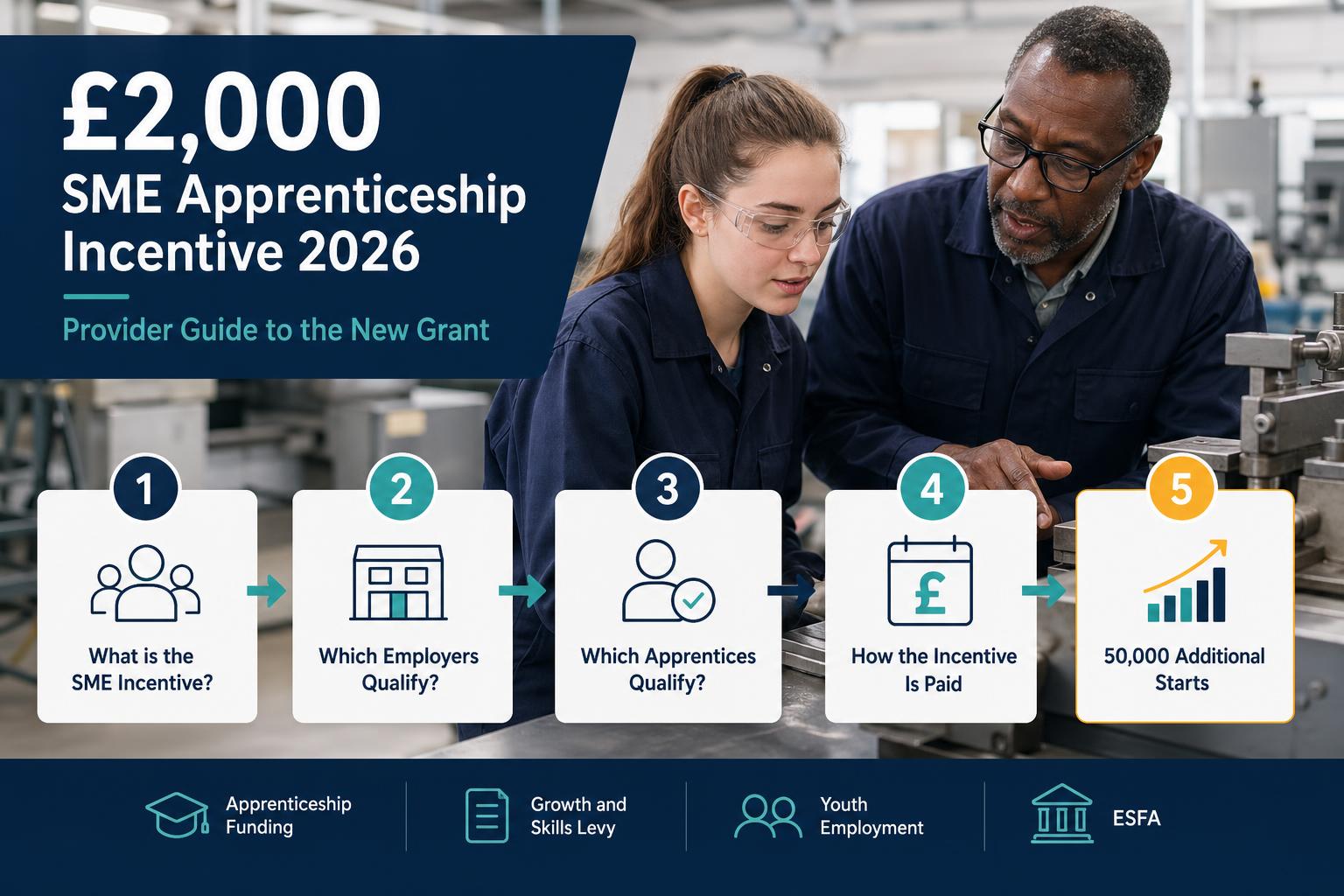
The SME Apprenticeship Incentive is a £2,000 payment per apprentice, available to small and medium-sized employers that hire apprentices aged 16–24. It was announced on 16 March 2026 as part of the Government’s £2.5bn youth employment package — one of the largest interventions in youth employment in a generation.

The incentive is designed to drive 50,000 additional apprenticeship starts over three years, targeting a sustained reversal of the 40% decline in apprenticeship starts recorded over the past decade. With almost one million young people classified as NEET (not in education, employment, or training), the Government has identified apprenticeships as a primary route for bringing that cohort into structured employment and training.

The scheme is SME-only. Larger employers — those with 250 or more employees — are not eligible for this specific incentive payment. It sits within the apprenticeship service framework and is delivered through ESFA, not DWP. This distinguishes it from the separate Youth Jobs Grant (a £3,000 payment for employing 18–24-year-olds who have been on Universal Credit for six months or more), which is a DWP scheme and applies to employment generally, not exclusively to apprenticeships.

The incentive forms part of a broader package of reforms that includes the Growth and Skills Levy — a reprioritisation of apprenticeship funding to support younger apprentices and flexible training units — and the introduction of Foundation Apprenticeships launching in April 2026. Providers need to understand where the incentive sits within this wider landscape to advise employers accurately and plan their delivery capacity.

Which Employers Qualify?

Eligibility for the SME Apprenticeship Incentive is restricted to small and medium-sized employers. The standard UK definition applies: fewer than 250 employees. The employer must be based in England and must employ the apprentice in England.

To access the incentive, the employer must use the Apprenticeship Service (DAS) to manage the apprenticeship. Non-levy payers — employers with an annual pay bill under £3m — already benefit from 95% government co-investment on apprenticeship training costs. The £2,000 incentive is on top of this existing arrangement, not a replacement for it.

Levy-paying SMEs are unusual — a business with a payroll above £3m but fewer than 250 employees is a relatively narrow category — but such employers may also be eligible. Providers with levy-paying SME partners should check ESFA guidance when it is published rather than assuming ineligibility.

Two important caveats apply at this stage. First, ESFA implementation guidance — including the precise eligibility criteria — has not yet been published as of 20 March 2026. The policy commitment was confirmed in the March announcement; the operational detail is pending. Second, the relationship between the new incentive and previous incentive payments (such as the existing £1,000 payment for hiring 16–18-year-olds, care leavers, or apprentices with EHCPs) has not been confirmed. Providers should not advise employers on combined eligibility until ESFA guidance is available.

Which Apprentices Qualify?

The incentive applies to apprentices aged 16–24 at the start of the apprenticeship. This age range is materially wider than the existing £1,000 incentive payment, which focused on 16–18-year-olds and specific groups such as care leavers and those with Education, Health and Care Plans (EHCPs).

Extending the threshold to age 24 captures a significantly larger portion of the working-age population. Employers who previously calculated that the administrative overhead of an apprenticeship was not justified for a 22-year-old hire now have a direct financial case to consider.

The incentive is not restricted to specific apprenticeship standards or sectors. The March 2026 announcement applied it across all apprenticeship standards, consistent with the policy aim of driving volume across the board rather than channelling starts into priority sectors. Providers should confirm this in ESFA implementation guidance when published, but the broad application is the stated intent.

There is no requirement for the apprentice to have a particular employment history or benefit status — that condition applies to the separate Youth Jobs Grant (DWP), not to this incentive. A 16-year-old school leaver and a 23-year-old career changer are both in scope, provided the employer is an eligible SME.

How the Incentive Is Paid

The £2,000 incentive is paid to the employer, not to the training provider. Payment flows through the Apprenticeship Service (DAS), and providers do not receive or administer this payment directly. The provider’s role is to help the employer understand eligibility, ensure the apprenticeship start is set up correctly on DAS, and report compliantly via the ILR — all of which are prerequisites for the employer’s claim to be processed.

The precise payment schedule has not been confirmed in the March 2026 announcement. Previous incentive payments have typically been paid in staged instalments — for example, at 90 days and at 365 days from the start date — to reduce the risk of payments being made for starts that do not progress. Providers should assume a similar staged model is likely, but should not confirm any specific dates or thresholds to employers before ESFA publishes the implementation schedule.

The incentive payment is taxable income for the employer. This is consistent with how previous ESFA incentive payments have been treated and should be flagged to employers who ask about the net financial benefit.

Await ESFA Implementation Guidance

The March 2026 announcement confirmed the policy commitment. ESFA implementation guidance — including exact eligibility criteria, payment schedule, and the interaction with existing incentive payments — has not yet been published. Providers should not confirm eligibility to employers or build claiming processes until that guidance is available.

50,000 Additional Starts: Planning for Delivery Capacity

If the incentive achieves its stated aim, providers should expect a material increase in employer enquiries and new start volumes from SME partners — particularly for 19–24-year-old apprentices who were outside the scope of previous incentives. SME employers who previously could not justify the cost and management overhead of taking on a younger apprentice now have a direct financial case to reconsider.

For providers, the critical planning questions are not about whether enquiries will increase — they will — but about whether delivery infrastructure can absorb additional starts compliantly:

  • Onboarding capacity: can your team process a significant increase in new starts without extending timelines or creating ILR compliance gaps from late data entry?
  • Tutor availability: additional starts require additional caseload capacity. A surge in SME apprenticeship starts without a corresponding increase in tutor resource creates delivery quality risk and Ofsted risk.
  • ILR reporting at volume: each new start generates ongoing reporting obligations. Manual ILR processes that are manageable at current volumes can break down quickly when starts increase materially.
  • Employer engagement quality at scale: SME employers are resource-constrained. A provider taking on 30 new SME starts needs to be able to support each employer effectively without diluting the quality of engagement across the cohort.

The risk is not that providers will receive too many enquiries — it is that providers will accept starts they cannot deliver to standard. Providers who take on volume without the systems and staff to support it create compliance risk, Ofsted risk, and reputational risk. The right response to an incentive-driven volume increase is not to cap enquiries, but to ensure the platform, processes, and people can absorb additional starts without losing delivery quality.

A training management platform that handles multi-employer onboarding, automated ILR data capture, and compliant evidence workflows at volume is not a premium feature for larger providers — it is a prerequisite for any provider planning to grow starts when an incentive of this scale is in the market.

How This Compares to Previous Incentive Payments

The existing incentive arrangement — a £1,000 payment for SME employers hiring apprentices aged 16–18, care leavers, or those with EHCPs — has been in place in various forms since the apprenticeship reforms of 2017. The new £2,000 SME Apprenticeship Incentive is a significant upgrade in both value and scope.

Payment value

The new incentive is double the previous £1,000 payment for 16–18-year-old hires. For an SME considering the overhead of taking on a younger apprentice, the difference between £1,000 and £2,000 is meaningful — particularly when combined with the 95% government co-investment on training costs that non-levy payers already receive.

Age range

The previous incentive was primarily targeted at the 16–18 age group (plus care leavers and EHCPs at any age). The new incentive extends to age 24, capturing a much larger working-age cohort. This is the single most significant structural change: providers who previously focused SME employer conversations on school leavers can now make the financial case for 19–24-year-old apprentice hires as well.

Interaction between old and new schemes

This is the area of greatest uncertainty as of March 2026. ESFA guidance will clarify whether the existing £1,000 payment for 16–18-year-olds is replaced by the new £2,000 incentive, stacked alongside it, or superseded entirely. Providers should not assume that the previous arrangement automatically continues alongside the new payment, and should not advise employers on how the two interact until the ESFA guidance is published. The new scheme is substantially more generous for eligible hires in any scenario, but the exact mechanics matter for employer conversations about specific cohorts.

How to Use This in Employer Conversations

Most SME employers will not have seen the March 2026 announcement in detail. The news cycle around a £2.5bn youth employment package is broad; the specific implications for apprenticeship hiring decisions at an individual SME level require interpretation that most employers will not do themselves. Providers who brief employers proactively — clearly, accurately, and early — position themselves as a valued strategic partner rather than a delivery vehicle that processes starts after the employer has already decided to act.

Key points for employer briefings

  • £2,000 per hire for 16–24-year-olds: this is not just for school leavers. An SME hiring a 22-year-old career changer as an apprentice is potentially eligible.
  • Payment through DAS, not extra paperwork: the incentive flows through the apprenticeship service, the system the employer already uses to manage the apprenticeship. It is not a separate grant application with its own bureaucracy — though exact processes are to be confirmed in ESFA guidance.
  • Combined with 95% co-investment: for non-levy employers, the government already pays 95% of the apprenticeship training cost. The £2,000 incentive is on top of this existing arrangement. The net cost of taking on an eligible apprentice is lower than many SME decision-makers realise.
  • Youth Jobs Grant may also apply: for an SME hiring an 18–24-year-old who has been on Universal Credit for six months or more, both the SME Apprenticeship Incentive and the Youth Jobs Grant may be accessible — see the section on combining grants below.

What to avoid in employer conversations

Do not confirm specific payment dates, exact eligibility criteria for edge cases, or whether the new incentive stacks with the previous £1,000 payment until ESFA guidance is published. Overpromising on grant combinations or timelines before the implementation detail is confirmed creates trust problems when the guidance clarifies differently. Brief employers on the policy commitment and the broad parameters — and be explicit that the operational detail is pending.

Combining the SME Incentive With Other March 2026 Grants

The March 2026 youth employment package included multiple schemes. For training providers advising SME employers, understanding the potential combinations is important — but so is understanding what has not yet been confirmed.

£5,000 Total for Eligible Hires?

An SME employer hiring a 18–24-year-old apprentice who has been on Universal Credit for 6 months or more may be able to access both the SME Apprenticeship Incentive (£2,000, through ESFA) and the Youth Jobs Grant (£3,000, through DWP) — a combined total of £5,000. This interaction has not been confirmed or ruled out in the initial announcement. Providers should flag this possibility to employer partners and take advice once full implementation guidance is published.

Youth Jobs Grant and SME Apprenticeship Incentive

The Youth Jobs Grant is a £3,000 payment from DWP for employers (of any size, not SME-only) who hire 18–24-year-olds who have been on Universal Credit for six months or more. Unlike the SME Apprenticeship Incentive, it applies to employment generally — not exclusively to apprenticeships. For an SME hiring an eligible candidate as an apprentice, both schemes could potentially apply: the Youth Jobs Grant (DWP) for meeting the employment eligibility criteria, and the SME Apprenticeship Incentive (ESFA) for the apprenticeship arrangement itself. This potential £5,000 combination has not been explicitly ruled out in the announcement, but has not been confirmed either. Providers should flag it to relevant employer partners and take advice once DWP and ESFA publish their respective implementation guidance.

Foundation Apprenticeships

Foundation Apprenticeships are launching in April 2026, initially in hospitality and retail. These are shorter, entry-level pathways with their own funding bands and compliance structure. The relationship between the £2,000 SME Apprenticeship Incentive and foundation apprenticeship starts — specifically, whether foundation starts are incentive-eligible — has not been confirmed in the March 2026 announcement. Providers planning to offer foundation apprenticeships to SME employers should seek ESFA confirmation before including the incentive in any commercial discussions about foundation delivery.

Quick Reference Checklist

  • Await ESFA implementation guidance before confirming eligibility with employers
  • Identify your SME employer partners who regularly hire 16–24-year-olds
  • Prepare a briefing for SME employers explaining the incentive, eligibility, and approximate timeline
  • Check whether your platform can support increased start volumes without additional manual overhead
  • Understand the distinction: incentive goes to employer (DAS), not provider (ESFA directly)
  • Flag the potential Youth Jobs Grant + SME Apprenticeship Incentive combination to eligible employers
  • Do not advise employers to change hiring processes before ESFA and DWP implementation guidance is published

Managing a surge in SME apprenticeship starts?

When the incentive launches, SME employers will be asking providers to onboard more 16–24-year-old apprentices than before. TIQPlus is built to handle high-volume, multi-employer cohorts without manual overhead.

Book a demo

Sources & further reading

Share this guide