Last updated: 15 July 2026
How to start an apprenticeship: step-by-step guide for training providers
This guide applies the final 2026/27 funding rules to the apprenticeship starts workflow: eligibility, initial assessment, separate statutory documents, the first evidenced learning activity, ILR submission, employer approval and progress review.
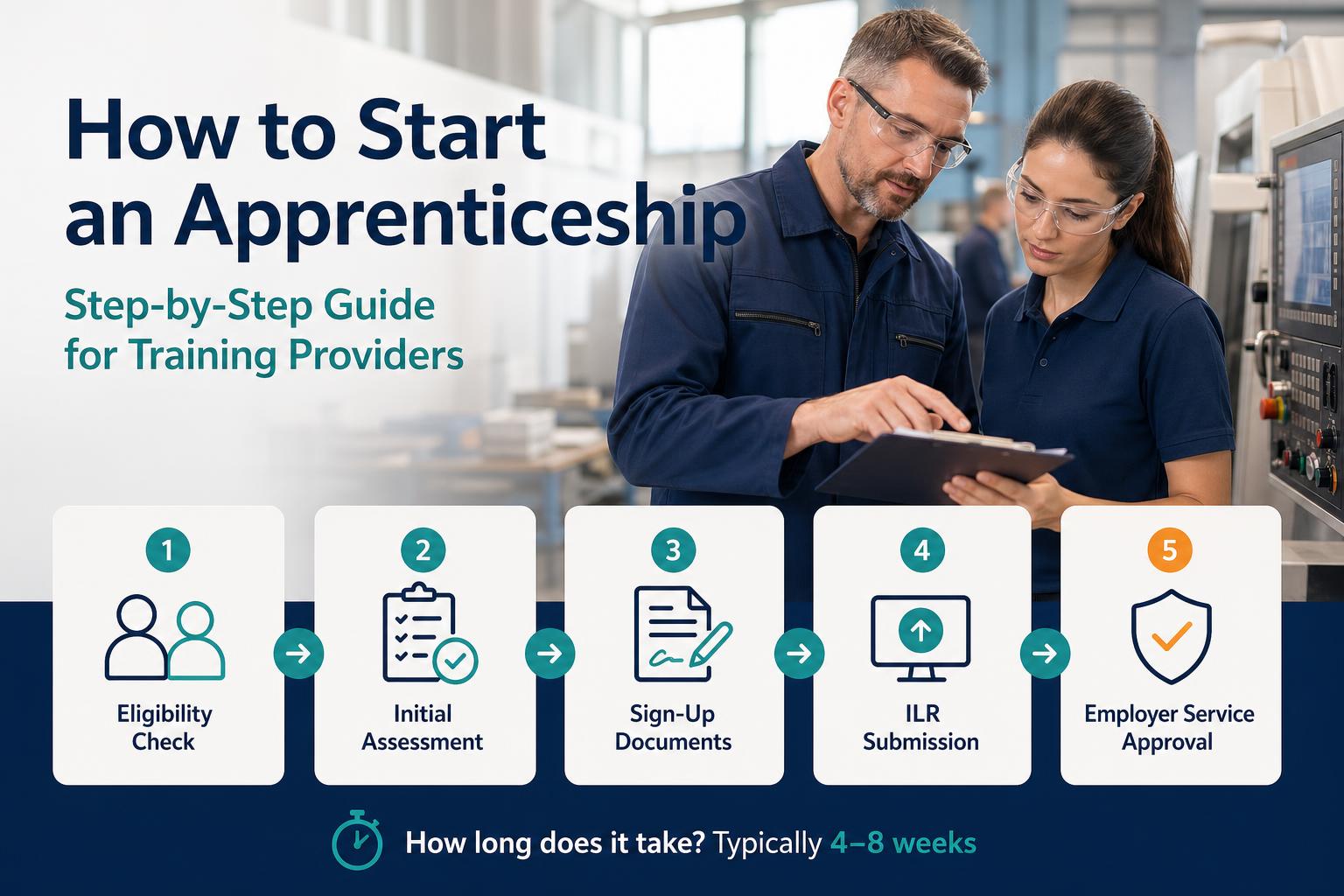
Stage 1: Employer and learner eligibility
Before apprenticeship training starts, confirm the provider, employer, learner and programme are eligible under the rules for the learner's start date.
Employer eligibility
- The provider must be eligible to receive government funding on the Apprenticeship Provider and Assessment Register (APAR).
- The apprentice must have a real job with a clear, substantial link to the selected standard and enough time to complete the programme.
- The PAYE scheme that pays the apprentice must be declared in the employer's apprenticeship service account. The employer controls that account; the provider must not access it unless it is also the employer.
- The employer must release the apprentice for the agreed, standard-specific off-the-job training during normal working hours.
Learner eligibility
- Check age, residency, employment and right-to-work evidence against the rule set that applies on the learning start date.
- A same- or higher-level qualification is not an automatic exclusion. The provider must establish that the apprentice still needs significant new knowledge, skills and behaviours for occupational competence.
- Assess relevant prior learning and experience. Remove duplicated content and make corresponding reductions to price, duration and off-the-job training where required.
Stage 2: Initial assessment
Complete and document the initial assessment before apprenticeship training. It must cover learner eligibility, programme eligibility and learning-support needs, and establish the apprentice's starting point against the standard.
The record should show:
- The assessment date
- The methods and evidence used, including a skills scan mapped to the standard or training-plan outcomes
- Relevant prior learning and experience, including learning gained through work
- The resulting changes to content, price, practical-period duration and planned off-the-job hours
- The English and maths decision. For 16–18-year-olds at the start who lack a suitable equivalent, funded study and achievement are required; for apprentices aged 19+ at the start, standalone study is optional where the employer agrees
- Any learning-support need and agreed reasonable adjustments
Where a funded standalone English or maths qualification is included and the apprentice cannot present acceptable prior-attainment evidence, assess their current level and record the delivery in the signed training plan. Standalone English and maths does not count as apprenticeship off-the-job training.
Stage 3: Apprenticeship agreement and training plan
These are separate documents with different purposes and signature requirements.
Apprenticeship agreement
The employer and apprentice sign the apprenticeship agreement. The provider is not a signatory. It records the employment-based apprenticeship terms and must be kept with any revisions.
Training plan (formerly called the commitment statement)
The provider develops the training plan with the apprentice and employer and signs it with them. Its broad content must be agreed before any apprenticeship training is delivered. Obtain the signed plan before delivery where possible.
If the initial broad-content agreement is virtual or by email and a signed version cannot be put in place first, retain evidence of that agreement — for example, an employer email — and obtain the fully signed plan by the end of the 42-day qualifying period. This is a controlled evidence route, not permission to start without agreement.
The plan must show the adjusted practical period and total planned off-the-job hours. For starts from 1 August 2025, use the minimum published on the relevant Skills England standard page. After valid recognition of prior learning, enough content must remain for at least eight months and 187 off-the-job hours.
Stage 4: ILR submission
Create and submit the Individualised Learner Record through the current DfE Submit learner data timetable. Funding can begin only from the first evidenced apprenticeship learning activity documented in the training plan; do not force that date to match the employment or agreement date.
Key fields to validate before submission:
- ULN — unique learner number, validated against the Learner Registration Service
- Learning start — the first evidenced apprenticeship learning activity
- Standard code and version — checked against the current Skills England record
- Employer identifier and employment status — not an employer UKPRN
- Funding model and ACT record — consistent with the contract and apprenticeship service route
- Planned off-the-job hours — consistent with the training plan and any evidenced prior-learning adjustment
- Age at start — affects funding rules; verify before submission
Use the ILR data audit template to validate records before submission.
Stage 5: Employer apprenticeship service approval
For 2026/27 starts, provider ILR data is shown to the employer in the apprenticeship service. The employer reviews and approves that learner record before funding is released. Explain this workflow in advance, identify the person with account permission and monitor the record without taking control of the employer's account.
There is no universal same-day or 48-hour compliance deadline. The practical control is to submit accurate data in the relevant return, tell the employer when the record is available and resolve any discrepancy before approval.
Stage 6: Learner induction
The induction must cover at minimum:
- Safeguarding — who to contact, how to report concerns, and the provider's safeguarding policy
- Prevent — awareness of radicalisation and extremism; required for all apprentices
- British Values — democracy, rule of law, individual liberty, tolerance and respect for others
- E-safety — online learning expectations and appropriate use policies
- Programme orientation — how reviews work, how OTJ is recorded, what EPA involves
The safeguarding and Prevent elements must be evidenced in the learner's record — a signed induction record or completion log is usually sufficient.
Stage 7: Platform and system setup
Complete system setup before the learner needs access, then anchor activity records to what actually happens:
- Create the learner's account on your e-portfolio platform
- Set up role-appropriate employer portal access for training-plan updates and review records
- Record actual off-the-job training from the first eligible, evidenced learning activity — not from an assumed “day 1”
- Schedule progress reviews at least every three calendar months, unless an evidenced delivery reason supports an alternative timetable agreed with the employer in advance; reviews must never be more than six months apart
Delaying any of these steps creates a backlog that compounds quickly across a cohort.
Stage 8: First progress review
Under the default timetable, complete the first review within three calendar months of the learning start. The apprentice and provider take part, and the employer should attend the majority of reviews. Record and share the review summary for signature.
- Whether the learner is settling in and has the support they need
- OTJ pace — are hours being recorded correctly?
- English and maths — where study is mandatory or the apprentice has opted in, is active learning taking place in line with the signed training plan?
- First SMART targets for the next review period
Use the progress review meeting template to ensure all mandatory fields are completed and the employer is genuinely involved — not just invited as an afterthought.
Common starts mistakes and how to avoid them
- No evidence of pre-delivery training-plan agreement — obtain signatures where possible; for a virtual or email start, retain broad-agreement evidence and monitor the end-of-day-42 signature deadline.
- Apprenticeship agreement has the wrong signatories — it is signed by employer and apprentice; the provider signs the separate training plan.
- ILR learning start forced to another document date — record the first evidenced apprenticeship learning activity documented in the plan.
- Employer approval missed — monitor the ILR-generated record in the apprenticeship service and help the employer resolve discrepancies without accessing its account.
- Blanket English and maths enrolment — determine the requirement from age at the apprenticeship start, suitable prior attainment, employer opt-in for 19+ apprentices and any mandatory-qualification exception.
- Generic off-the-job target — for starts since August 2025, use the standard-specific minimum and a valid prior-learning calculation, subject to the eight-month and 187-hour remaining-content floors.
Frequently asked questions
How long does it take to start an apprenticeship?
The lead time depends on employer service setup, eligibility evidence and initial assessment. Do not let an internal target override the rules: broad training-plan content must be agreed before apprenticeship training, and the learning start is the first evidenced apprenticeship learning activity documented in that plan.
When must the training plan be signed?
Obtain a signed training plan before delivery where possible. If the initial broad-content agreement is virtual or by email and signing first is not possible, retain evidence of that agreement and secure a fully signed plan by the end of the 42-day qualifying period. Broad content must always be agreed before training is delivered.
When must the ILR be submitted after a learner starts?
Submit the learner through the current DfE ILR collection timetable and validation rules. For 2026/27 starts, the learner data then appears in the employer's apprenticeship service account for review and approval; funding is not released until the employer approves it.
Sources
Sources & further reading
- DWP Apprenticeship Funding Rules 2026 to 2027 — GOV.UK — DWP Apprenticeship Funding Rules 2026 to 2027 — GOV.UK
- Apprenticeship Agreements — GOV.UK — Apprenticeship Agreements — GOV.UK
- Apprenticeship Standards and Off-the-Job Minimums — Skills England — Apprenticeship Standards and Off-the-Job Minimums — Skills England
- Submit Learner Data Guidance — DfE — Submit Learner Data Guidance — DfE
- Apprenticeship Provider and Assessment Register (APAR) — Apprenticeship Provider and Assessment Register (APAR)