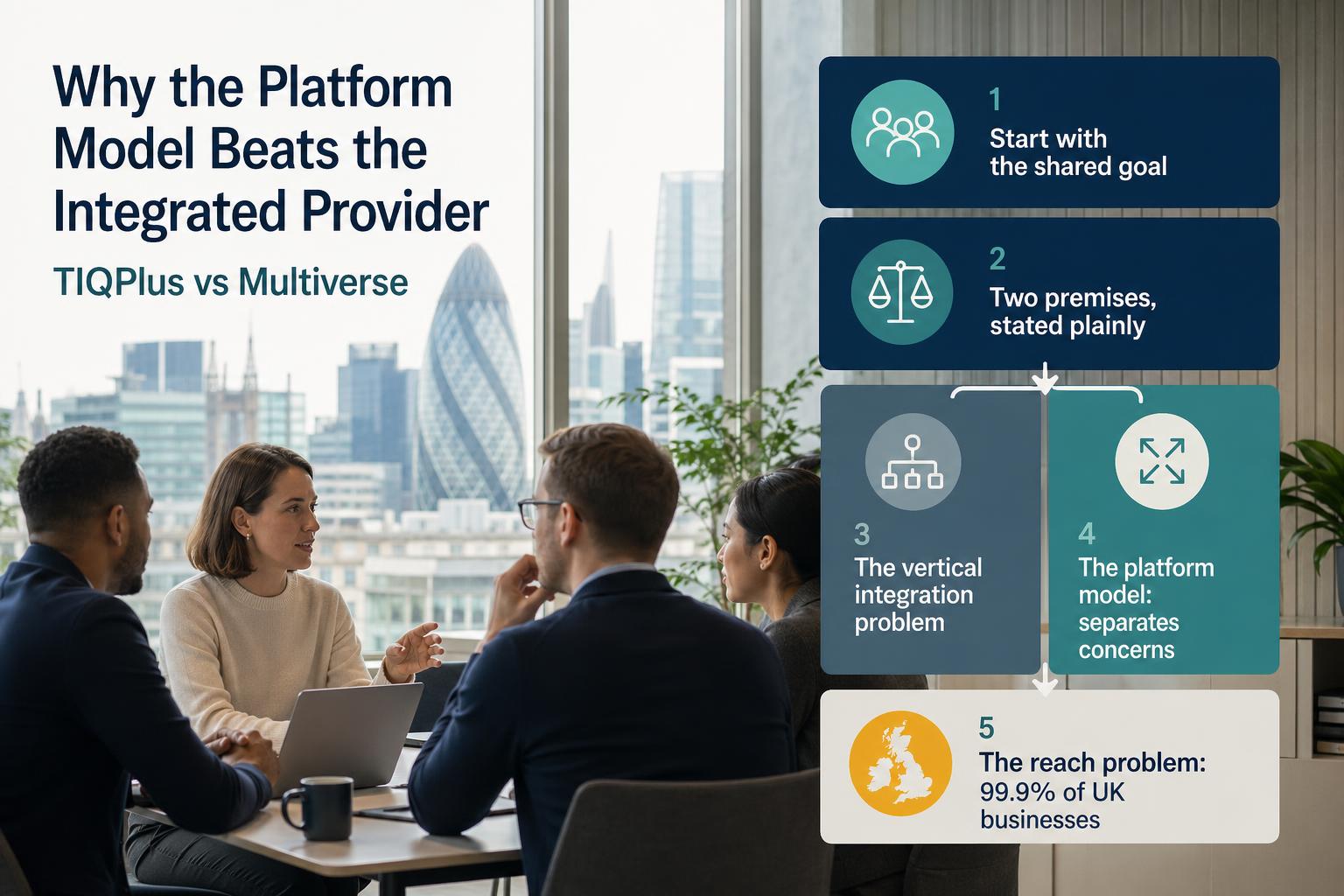
Start with the shared goal
Both Multiverse and TIQPlus exist to solve the same problem: UK employers need workers with real AI skills, and the current training system is not delivering those skills fast enough, accessibly enough, or reliably enough.
This is a genuine and urgent problem. The UK government’s AI Opportunities Action Plan identifies AI skills as a critical national priority. Skills England is restructuring the entire training landscape around AI readiness. The EU AI Act’s Article 4 creates legal obligations for AI literacy. Across every sector — NHS, financial services, manufacturing, public sector — organisations that cannot develop AI-capable workers will fall behind.
The question is not whether this problem needs solving. The question is: which approach is structurally better positioned to solve it?
Multiverse’s answer is vertical integration: become the training provider, build the technology, do everything in-house. TIQPlus’s answer is focused infrastructure: build the best possible platform so that the specialist providers who already know how to teach can serve every employer in the country.
These are not equivalent approaches. One of them scales efficiently. The other requires raising hundreds of millions of pounds and still runs at a loss.
The two premises, stated plainly
Multiverse’s premise
“We will close the UK AI skills gap by being the training provider.”
Recruit learners, design curriculum, employ coaches, manage compliance, build technology, sign employer contracts — all in one vertically integrated company. Own every stage of the value chain. Scale by hiring more coaches, signing more enterprise contracts, and raising more capital to fund the losses while the model matures.
TIQPlus’s premise
“We will close the UK AI skills gap by being the platform that makes every training provider excellent.”
Build the compliance infrastructure, evidence management, KSB mapping, and AI tooling that specialist providers need to deliver great programmes. Let providers focus entirely on teaching quality and learner relationships. Scale by powering more providers — each of whom serves more employers, at lower marginal cost per learner.
Both premises are coherent. But they have very different economics, very different reach, and very different quality profiles as they scale.
The vertical integration problem
Multiverse’s integrated model requires the company to be simultaneously excellent at five completely different things:
What Multiverse must do simultaneously to deliver one AI apprenticeship
- Employer acquisition: Sales team, account management, enterprise contracting, commercial negotiation, and retention of 1,500+ employer relationships across multiple sectors and geographies.
- Learner recruitment: Talent sourcing, screening, matching, and onboarding — the core capability acquired through the purchase of SearchLight in April 2024 for AI-powered matching.
- Curriculum design: Developing and maintaining AI apprenticeship content that stays current as AI tools, techniques, and regulatory requirements evolve — and doing this at generic scale across many sectors simultaneously.
- Teaching and coaching: Employing, training, managing quality-assuring, and retaining a workforce of coaches and assessors whose quality directly determines learner outcomes and EPA pass rates.
- Technology and compliance: Building and maintaining the platform, ILR reporting, KSB mapping, OTJ tracking, EPA readiness tools, and the entire ESFA compliance infrastructure that UK apprenticeship delivery requires.
813 employees. £79.6M revenue. £63.3M losses. That is what trying to do all five of these things at the same time, at enterprise scale, actually costs.
The issue is not that Multiverse is incompetent. It is that vertical integration in a regulated, skills-intensive service business is genuinely expensive. The quality of teaching depends on coaches — and coaches do not scale like software. Every new learner cohort requires proportional investment in human expertise. The fixed costs compound. This is why Multiverse’s losses are not shrinking as revenue grows — the model’s unit economics are structurally difficult.
The platform model: how TIQPlus separates the concerns
TIQPlus does not compete with Multiverse on teaching. TIQPlus competes with Multiverse on the premise that teaching quality and technology infrastructure are two separate problems that should be solved by two different types of organisations.
Independent training providers — the hundreds of Ofsted-inspected, ESFA-registered specialists across the UK — already know how to teach. Many of them have been delivering apprenticeships for 10, 15, 20 years. They have deep sector expertise, established employer relationships in their specific industries, and highly skilled coaching staff. What they often lack is the technology infrastructure to deliver at the quality, compliance depth, and efficiency that the modern apprenticeship market demands.
TIQPlus provides exactly that infrastructure:
- AI-powered evidence tagging that classifies learner portfolio submissions against KSBs with 89% accuracy — turning a task that takes assessors hours per learner per week into seconds
- Real-time KSB gap analysis that shows providers, learners, and employers exactly what coverage remains before EPA gateway — eliminating the last-minute gateway scramble
- OTJ hours tracking with employer sign-off workflow — ESFA-compliant, audit-ready, and visible to all parties
- EPA readiness scoring that updates live throughout the programme — so tutors get early warning signals instead of gateway surprises
- At-risk learner detection three weeks earlier than manual tracking methods identify problems — the difference between a timely intervention and a late withdrawal
- Automated progress review generation from learner activity data — so tutors prepare for conversations, not paperwork
- Ofsted-aligned reporting generated from structured programme data — a full learner file in minutes, not hours
- ILR data validation before submission windows — catching errors that would otherwise trigger ESFA funding clawback
The result: providers using TIQPlus report 60% reductions in administrative time on learner record management. That time goes back to teaching. The quality of the teaching improves because the compliance burden has been removed from it.
How the platform model creates scale
The reach problem: 99.9% of UK businesses
Of the approximately 5.5 million private sector businesses in the UK, 99.9% have fewer than 250 employees. Multiverse’s enterprise-minimum model — designed for FTSE 250 companies running cohorts of 10 or more learners simultaneously — cannot serve this market.
This is not a niche. This is almost the entire UK economy.
The AI skills gap is not concentrated in large enterprises. It runs through every SME trying to automate administrative work, every medium-sized manufacturer trying to implement predictive maintenance, every public sector team trying to use AI for data analysis. These organisations cannot get AI apprenticeship delivery from Multiverse. They are not Multiverse’s customer.
Through TIQPlus-powered independent providers, a single learner at a 15-person accounting firm can access the same quality of Level 4 AI and Automation Practitioner apprenticeship delivery as any enterprise programme — with full KSB tracking, OTJ compliance, EPA readiness scoring, and employer portal visibility. Non-levy employers pay just 5% co-investment (approximately £450 against the £9,000 funding band maximum) with the government covering 95%.
The platform model does not just compete with Multiverse on quality. It serves an entirely different and vastly larger market that Multiverse structurally cannot reach.
The sector expertise problem
AI is not generic. The specific AI skills a junior doctor needs to work with clinical decision support systems are different from the skills a financial analyst needs to use AI for fraud detection models, which are different again from what a manufacturing engineer needs to implement predictive maintenance using computer vision.
Multiverse’s integrated model, designed for scale across 1,500+ employers in many sectors, necessarily produces a curriculum that is broader than any individual sector’s AI context. The physics of serving many sectors simultaneously means some standardisation. That standardisation is a reasonable trade-off for the enterprise employers Multiverse serves, who have the internal L&D resource to contextualise generic AI training for their specific environment.
For every other employer — the NHS trust whose data scientists need to understand IG frameworks and clinical AI governance, the financial services firm whose employees need to understand FCA expectations on algorithmic accountability, the local authority whose analysts need to work within the ICO’s AI guidance — sector context is not optional. It is the difference between a learner who can apply skills in their actual job and one who can describe AI concepts in the abstract.
TIQPlus-powered providers include healthcare AI specialists, financial services training experts, manufacturing sector providers, and public sector specialists. Each delivers AI apprenticeships contextualised to their sector’s specific tools, regulations, and workflows. The platform provides the compliance infrastructure that makes all of them excellent. The provider brings the sector knowledge that makes the training relevant.
The quality problem at scale
Teaching quality does not scale like software. It scales like people. As Multiverse grows, it needs more coaches — and coach quality directly determines learner outcomes, EPA pass rates, and the value employers actually receive from the programme.
There is no algorithmic solution to this. You can use AI to help coaches work more efficiently — which is exactly what TIQPlus does for independent providers — but you cannot replace the quality of a skilled coach who knows their sector and genuinely invests in their learners. This is a fixed cost that scales linearly with learner volume. It is why Multiverse’s losses do not compress as revenue grows: more learners means proportionally more coaching cost.
The platform model handles this differently. The coaching expertise is distributed across the provider network — providers that have already made that hiring, training, and quality-assurance investment as their core business. TIQPlus’s job is to make those coaches more effective by removing administrative burden and giving them better data to work with. A coach who spends 60% less time on paperwork spends 60% more time on what they do best: helping learners grow.
The quality improvement that TIQPlus enables is structural, not additive. It does not make an average coach great. It removes the friction that stops a great coach from doing their best work.
The compliance depth problem
UK apprenticeship compliance is genuinely complex. ESFA funding rules run to hundreds of pages. ILR submissions have thousands of fields and dozens of validation rules. Ofsted inspectors examine evidence quality, curriculum mapping, progress review consistency, and OTJ evidence at a granular level. EPA organisations require specific evidence structures aligned to each standard’s gateway requirements. The Growth and Skills Levy is introducing new funding types with their own compliance requirements.
For Multiverse, compliance tooling is one of five things the engineering team must build. It competes for resources with the learner platform, the employer portal, the AI matching engine, and the curriculum tools.
For TIQPlus, compliance tooling is the entire product. Every engineering decision, every feature prioritisation, every AI model improvement is in service of making compliance easier and outcomes better. The ILR validation, the KSB gap analysis, the OTJ tracking, the EPA readiness scoring, the Ofsted report generation — these are not features of a general learning platform. They are the core product, built from the ground up by a team that thinks about UK apprenticeship compliance every day.
This depth of compliance focus is visible in specific ways: automated ILR data population that catches errors before submission windows rather than after, KSB tagging accuracy at 89% compared to the inconsistency of manual classification, at-risk learner detection three weeks before human review cycles would catch the same signals. These are not incremental improvements over what Multiverse’s platform does. They are the product of a team whose entire remit is solving these specific problems.
The AI evolution problem
AI is moving fast. The tools, techniques, and models that are standard practice in professional AI work today are substantially different from those of two years ago. The regulatory landscape — the EU AI Act, Ofqual’s assessment integrity guidance, the ICO’s AI and data protection frameworks — is evolving continuously.
A standardised curriculum maintained centrally by an integrated provider has an inherent lag. Updating curriculum across 22,000 active learners in multiple cohorts at different stages requires careful version management, retraining of coaches, and commercial negotiation with employers about scope changes. Multiverse can do this — but it requires significant internal coordination that slows the pace of adaptation.
The platform model handles currency differently. TIQPlus supports any IfATE standard: upload a standard document and the AI extracts KSBs, assessment criteria, and gateway requirements automatically. When a new AI standard launches — or an existing one is updated — providers can build or update their programme structure immediately, without waiting for a central content team to revise a shared curriculum. The platform’s AI programme builder generates updated content from the new standard in minutes.
In a domain that changes as fast as AI, the ability to adapt quickly at the curriculum level is a genuine competitive advantage for providers using TIQPlus — and a structural advantage for learners, who receive training aligned to current practice rather than a curriculum developed at the last major content refresh.
What the numbers actually mean
These are not marketing metrics. They are the product of a platform that does one thing — makes training delivery excellent — rather than five things at once. The 89% evidence tagging accuracy comes from a model trained exclusively on UK apprenticeship evidence classification. The 60% admin reduction comes from automating the specific compliance tasks that the UK apprenticeship system generates. The 3-week earlier at-risk detection comes from monitoring the specific signals that predict programme failure in the ESFA-funded delivery model.
Multiverse’s metrics are different because its focus is different. It measures learners placed, employer partnerships signed, and funding rounds closed. These matter for an integrated provider. They do not tell you whether a specific learner in a specific sector at a specific employer got the AI skills they needed to do their job better.
Why this matters for UK AI skills delivery
The UK government’s AI skills agenda cannot be delivered by one company. Multiverse, at its current scale and trajectory, reaches fewer than 2% of UK employers and places tens of thousands of learners against a workforce of tens of millions. The scale of the challenge requires many excellent providers, each serving their segment of the market with deep expertise, supported by infrastructure that makes all of them excellent.
This is exactly what the platform model enables. Every independent, Ofsted-inspected provider that joins the TIQPlus network becomes a higher-quality delivery vehicle for AI skills. Their coaches spend more time teaching and less time filing. Their learners arrive at EPA better-prepared. Their employers get real-time visibility without chasing progress updates. Their programmes are compliant by default, not by effort.
Multiply that across hundreds of providers, thousands of employers, and hundreds of thousands of learners — including the SMEs and mid-market companies that Multiverse cannot serve — and the platform model is not just better positioned than Multiverse to deliver the same results. It is the only model that can deliver those results at the scale the UK AI skills agenda actually requires.
Sources
- Multiverse financial data: Companies House filings, year to March 2025; funding history from public announcements
- UK business population statistics: BEIS Business Population Estimates 2025 — approximately 5.5M private sector businesses, 99.9% with fewer than 250 employees
- UK AI Opportunities Action Plan: GOV.UK, January 2026
- ESFA apprenticeship funding rules and co-investment rates: GOV.UK Apprenticeship Funding Rules
Sources & further reading
- Multiverse financial data: Companies House filings, year to March 2025; funding history from public announcements UK business population statistics: BEIS Business Population Estimates 2025 - approximately 5.5M private sector businesses, 99.9% with fewer than 250 employees UK AI Opportunities Action Plan: — GOV.UK, January 2026
- ESFA apprenticeship funding rules and co-investment rates: — GOV.UK Apprenticeship Funding Rules