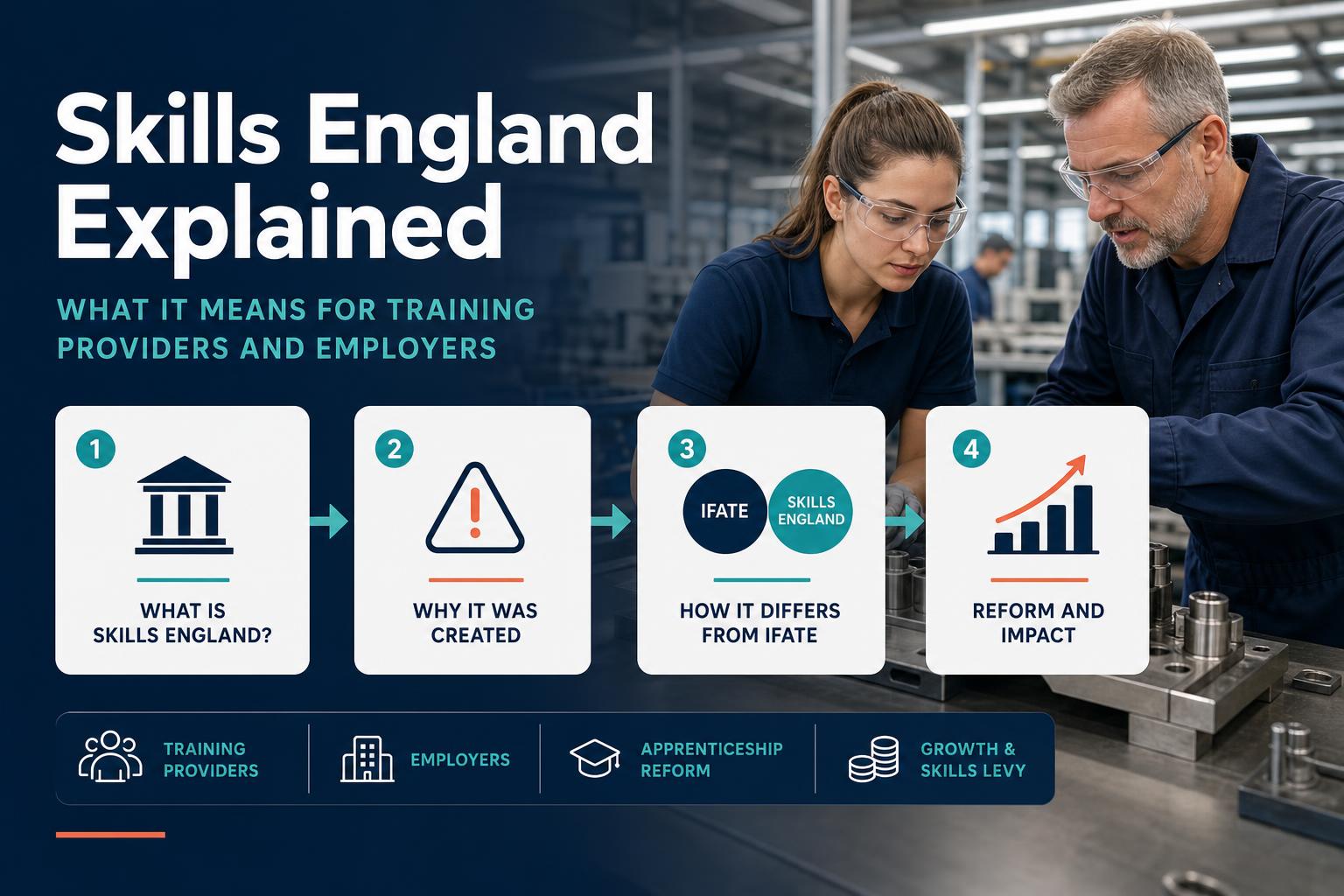
Last updated: 15 July 2026
Skills England in one sentence
Skills England is a DWP-sponsored executive agency that exercises most former IfATE apprenticeship functions on behalf of the Secretary of State and adds a wider role in national, sector and local skills intelligence.
What Is Skills England?
Skills England is the national skills body for England. It publishes labour-market and sector evidence, works with employers and local partners, maintains occupational standards and apprenticeship assessment plans, and supports government decisions about skills priorities. As of July 2026 it is an executive agency sponsored by the Department for Work and Pensions.
The legal detail matters. The Institute for Apprenticeships and Technical Education (Transfer of Functions etc) Act 2025 transferred IfATE's statutory functions to the Secretary of State and abolished IfATE. Most relevant apprenticeship functions are now exercised through Skills England on the Secretary of State's behalf. Skills England is therefore not simply IfATE under a new name, and the legislation is not called the “Skills England Act”.
Correct transition timeline
- July 2024: government announced Skills England and it began developing in shadow form.
- 15 May 2025: the transfer-of-functions Act received Royal Assent.
- 31 May 2025: IfATE closed.
- 1 June 2025: the formal transfer took effect and Skills England became fully operational.
- 2025 to 2026: Skills England's sponsorship moved to DWP following machinery-of-government changes; specified technical-qualification responsibilities remain with or move to DfE.
Old programme documents may still contain “IfATE”, “ESFA” or DfE links because a learner started under an earlier version or because an archived source retains its original URL. Do not mechanically alter historical evidence. Update current policies, templates and new-start guidance while retaining an audit trail for earlier cohorts.
Why Skills England Was Created
The policy aim is to connect the skills offer more directly with current and future employer demand. Government asked Skills England to become an authoritative voice on skills needs, simplify access to skills, mobilise employers and local partners, maintain occupational standards and help focus public and private investment.
This is broader than maintaining apprenticeship specifications. The agency combines national evidence with sector assessments, local intelligence and employer engagement. That evidence can inform policy, but it does not itself create an entitlement to funding. A published skills shortage is a planning signal; it is not a substitute for a funding rule, contract or approved product.
How Skills England Differs From IfATE
IfATE's core statutory work centred on occupational standards, apprenticeship assessment plans, occupational maps and technical education. Skills England continues most of the apprenticeship-related functions but operates within a wider skills-planning remit.
The November 2025 report to Parliament confirms that Skills England exercises functions concerning occupational categories and maps, standards, apprenticeship assessment plans, assessment quality, revisions, withdrawals and publication. It also records an important boundary: specified T Level and technical-qualification functions are exercised by DfE or are intended to move there.
Several other boundaries are equally important:
- DWP and published funding rules set the conditions for government apprenticeship funding.
- The apprenticeship service manages employer accounts, reservations, transfers and learner approvals.
- Ofsted inspects education and training quality.
- Ofqual regulates relevant qualifications and assessment organisations within its remit.
- Providers and employers remain responsible for applying the correct standard, version, training plan and start-date rules to each learner.
A Skills England publication can influence all of these actors, but it does not collapse their legal responsibilities into one body.
What Skills England Does in 2026
National and sector skills intelligence
Skills England published its first annual skills report in 2026 alongside Sectoral Skills Needs Assessments. These sources help providers and employers compare occupational demand, supply constraints and cross-cutting skills across priority sectors. They are better evidence for portfolio planning than an isolated vacancy count or a vendor forecast, but they should still be combined with employer commitments, local data and delivery economics.
Occupational standards and apprenticeship products
The agency publishes apprenticeship standards, versions, funding bands, typical durations, standard-specific off-the-job minimums and assessment plans. It also publishes foundation apprenticeships and approved apprenticeship units. These product pages are the first place to verify what an employer is buying and what a provider must deliver.
Assessment plans and quality
Skills England prepares, publishes, revises and withdraws apprenticeship assessment plans and evaluates assessment quality. Revised plans are being introduced progressively. That means two learners on the same named occupation can legitimately follow different versions and assessment arrangements.
Local and employer engagement
Skills England works with employers, strategic authorities, Employer Representative Bodies and Local Skills Improvement Plans. Providers can use the July 2026 LSIP publications and their area's plan to test whether a proposed programme is supported by local demand. Employers can contribute evidence through sector and local channels rather than waiting for a national standard review.
Skills England's Role in the Growth and Skills Levy
Skills England helps identify priorities and maintains the apprenticeship products that sit within the Growth and Skills Levy offer. It does not give employers a blank training budget, and a Skills England research report does not make a course fundable.
In July 2026 the confirmed product types employers should work from are:
- full apprenticeships, using the applicable standard and funding rules;
- foundation apprenticeships, for eligible young people and published occupations; and
- approved apprenticeship units, initially including the three Level 5 AI leadership units AU0009, AU0010 and AU0011.
Generic short courses, Bootcamps and micro-credentials are not automatically paid from an employer's levy account. Skills Bootcamps use separate commissioned funding and employer-contribution rules. Before describing anything as levy-funded, record the exact product code, provider eligibility, learner eligibility, maximum rate and the rules for the start date.
For new full-apprenticeship funds entering accounts from 1 August 2026, the employer guidance introduces a 12-month expiry period and removes the former 10% top-up; existing earlier funds keep their earlier expiry treatment. Other 2026/27 changes include age-based full government funding for non-levy employers and revised co-investment where a levy payer's account is insufficient. Those are funding-rule changes, not decisions a provider should infer from Skills England's wider strategy.
Standards and Assessment Reform
Apprenticeship assessment reform is being implemented standard by standard through revised assessment plans. Providers should avoid treating an announced reform wave as if every affected standard changed on one date. The published standard page and assessment plan determine what applies.
Revised plans may change who assesses particular content, the method mix, grading, behaviour verification and the point described as “gateway to completion”. Some assessment can take place during the programme under the new principles, while an assessment organisation remains responsible for independent elements and the overall result as specified. This is not permission for providers to rewrite an existing plan locally.
A safe version-control workflow
- Record the standard code and version at initial assessment.
- Save the applicable occupational standard, assessment plan and funding-band evidence.
- Check the earliest start date and any transition notice before enrolling.
- Map the curriculum and evidence model to that version only.
- When a revision appears, separate new starts from existing cohorts.
- Move a learner only where official guidance permits and every required party agrees.
- Keep the superseded mapping and decision record for audit.
Assessment organisations, professional bodies and employers are useful planning partners, but verbal expectations are not a substitute for the published plan.
What It Means for Training Providers
The practical impact is better portfolio discipline. Providers need a reliable way to distinguish policy signals, approved products, published versions and funded starts.
- Portfolio planning: use the annual and sector skills reports, LSIP evidence and real employer pipeline together. Do not launch solely because a sector appears on a national priority list.
- Product assurance: verify codes, versions, provider permissions and start dates before marketing or contracting.
- Curriculum control: version mappings, training plans, delivery-hour requirements and assessment preparation.
- Change control: nominate an owner to review Skills England notices and decide which cohorts are affected.
- Claims control: distinguish apprenticeship units from generic modular courses and Bootcamps.
- Evidence: retain the source and date behind each funding, duration and assessment statement used by sales and delivery teams.
APAR status, funding compliance and inspection outcomes remain separate controls. Skills England's product page can confirm a standard, but it does not by itself confirm that a provider is permitted to start learners or that a proposed learner is eligible.
What It Means for Employers
Employers gain better public evidence for workforce planning and a wider set of defined apprenticeship products. They also need stronger buying discipline because “aligned to Skills England priorities” is an easy phrase to use imprecisely.
For each purchase, ask:
- Which published occupation, standard or unit addresses the role need?
- Is this a full apprenticeship, foundation apprenticeship, apprenticeship unit, Bootcamp or commercial course?
- Who is eligible, and which rule version applies on the planned start date?
- Is the provider currently authorised for this product?
- What working time, manager input, assessment and employer validation are required?
- Which result will show that the skills gap has closed?
Use Skills England's evidence to frame the workforce problem, then use official product and funding pages to validate the buying route.
What Providers Should Do Now
- Correct the transition date. Current materials should say IfATE closed on 31 May 2025 and Skills England became fully operational on 1 June 2025.
- Replace the invented Act name. Cite the full 2025 transfer-of-functions Act where the legal basis matters.
- Update sponsorship. Describe Skills England as a DWP-sponsored executive agency in current corporate materials.
- Build a product register. Track code, version, source URL, funding band, OTJ or delivery-hour minimum, approval status and earliest start.
- Review revised assessment plans. Separate new starts from existing cohorts and record every migration decision.
- Map national to local demand. Connect the 2026 annual report and sector assessments to the current LSIP and signed employer demand.
- Audit marketing language. Remove claims that generic short courses or micro-credentials are levy-funded without an approved route.
- Subscribe to official updates. Monitor Skills England, DWP funding rules, the apprenticeship service, Ofsted and Ofqual separately.
Skills England Readiness Checklist
- Current documents use the correct 1 June 2025 transition date
- Legal references name the 2025 IfATE transfer-of-functions Act correctly
- Governance documents reflect current DWP sponsorship
- Every live apprenticeship cohort has a recorded standard and assessment-plan version
- New-start checks include earliest start date and transition instructions
- Marketing distinguishes full apprenticeships, foundation apprenticeships, units and Bootcamps
- No generic short course is described as levy-funded without an approved product code
- Portfolio decisions combine national, sector, LSIP and employer evidence
- One owner reviews standards, assessment plans and withdrawal notices
- Curriculum and evidence mappings are version-controlled
- Funding, inspection and qualification-regulation responsibilities remain clearly separated
- Official source links and last-checked dates are recorded in the compliance register
Frequently asked questions
What is Skills England?
Skills England is an executive agency sponsored by the Department for Work and Pensions. It became fully operational on 1 June 2025, when IfATE closed and most of its relevant apprenticeship functions transferred to the Secretary of State and began being exercised through Skills England. Its wider role includes national and sector skills intelligence, occupational standards, apprenticeship assessment plans and work with employers and local partners.
Will Skills England change apprenticeship funding?
Skills England informs priorities and maintains apprenticeship products, but the funding rules and apprenticeship service determine what can actually be paid for. In July 2026 the confirmed Growth and Skills Levy product types are full apprenticeships, foundation apprenticeships and approved apprenticeship units. Generic short courses and industry micro-credentials are not automatically levy-funded. Always check the exact product, version, start date and current funding rules.
How does Skills England affect existing apprenticeship standards?
A published standard and assessment plan remain valid until a revised version or withdrawal takes effect. Skills England publishes each version, funding band and earliest start information. Providers should not redesign delivery from a policy announcement alone: identify the version for each learner, read the applicable assessment plan, follow transition instructions and keep existing cohorts on the correct rules unless an authorised move is available.
How does Skills England differ from IfATE?
Skills England exercises most former IfATE apprenticeship functions on behalf of the Secretary of State, while adding a broader skills-intelligence and employer-mobilisation role. Not every former IfATE function sits with Skills England: the Department for Education exercises specified T Level and technical-qualification functions. Skills England is also not Ofsted, Ofqual or the apprenticeship funding authority; those responsibilities remain distinct.
Sources & further reading
- UK Government - Skills England official page — UK Government - Skills England official page
- Government report on transferred IfATE functions — Government report on transferred IfATE functions
- Skills England annual skills report and sector assessments 2026 — Skills England annual skills report and sector assessments 2026
- Requirements for apprenticeship assessment — Requirements for apprenticeship assessment