Last updated: 25 March 2026
What Is Changing and Why It Matters
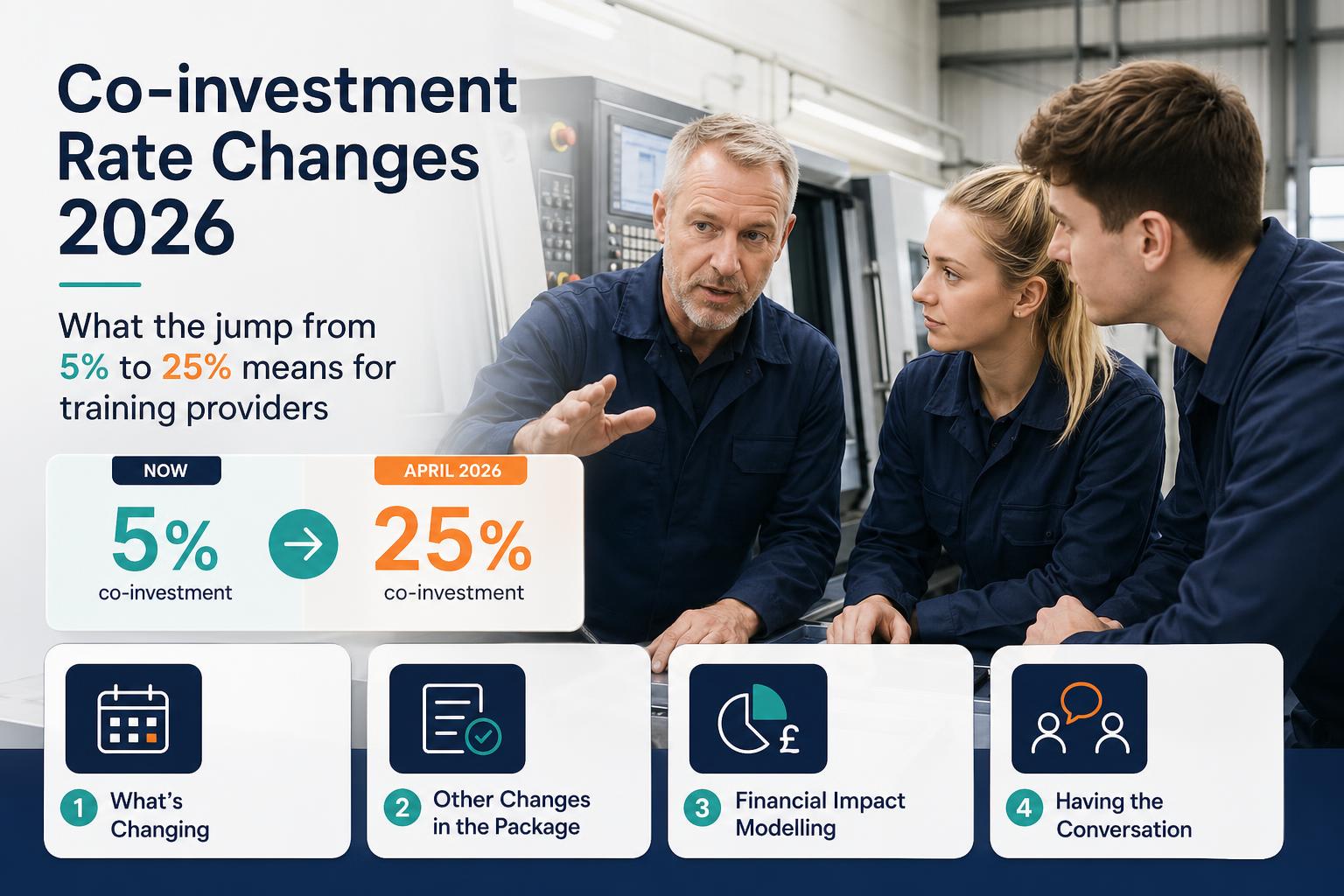
Co-investment is the arrangement by which employers contribute to the cost of apprenticeship training when they do not have sufficient levy funds to cover it. Under the system in place since 2017, the government contributed 95% of training costs and the employer contributed 5%. From April 2026, the split changes to 75% government, 25% employer.
This change affects two groups of employers. The first are non-levy employers: businesses with a total annual UK payroll bill below £3 million who do not pay the apprenticeship levy and therefore have no digital account balance to draw on. The second are levy-paying employers who have exhausted their levy account balance — a situation that is becoming more common as the separate change reducing levy fund expiry from 24 months to 12 months takes effect.
For training providers, the commercial risk is straightforward: employers who were previously comfortable committing to apprenticeship training at a 5% contribution may reconsider at 25%. At the same time, the levy account expiry change means that even levy employers who previously self-funded entirely now face a potential cliff edge when their 12-month rolling balance runs dry. The commercial conversations you need to have with your employer base are more complex than at any point in the last decade.
Other Changes in the Same Package
The co-investment rate increase is one element of a broader set of changes to apprenticeship funding. Two further changes are worth flagging for providers:
Removal of the 10% government uplift on levy accounts. Previously, when levy employers transferred funds to their digital account, the government added a 10% top-up. That top-up is being removed. Levy employers will now receive only what they paid in. This reduces the total funding available in the system and makes levy transfers slightly less generous for receiving employers.
100% government funding for under-25s with small employers. There is one meaningful positive change in the package. The government will now cover 100% of apprenticeship training costs for apprentices under the age of 25 employed by small businesses (fewer than 50 employees). Previously, this 100% coverage applied only to apprentices under 22. This is a genuinely useful lever for providers working with small employer partners, particularly in sectors that recruit younger cohorts.
Financial Impact Modelling: Real Numbers
The most useful thing a provider can do before April 2026 is model the cost change for each employer in their pipeline, using the actual funding band for the relevant standard. The table below illustrates the shift across common funding bands:
| Funding band | Old employer cost (5%) | New employer cost (25%) | Increase per apprentice |
|---|---|---|---|
| £5,000 | £250 | £1,250 | +£1,000 |
| £7,000 | £350 | £1,750 | +£1,400 |
| £9,000 | £450 | £2,250 | +£1,800 |
| £14,000 | £700 | £3,500 | +£2,800 |
| £27,000 | £1,350 | £6,750 | +£5,400 |
For a non-levy employer running a cohort of 10 apprentices on a £9,000 standard, the total annual contribution increases from £4,500 to £22,500. That is a meaningful budget line for a small business. For employers running larger cohorts across multiple standards, the aggregate increase is likely to trigger a budget review and potentially a reduction in planned starts.
Who Is Affected: Auditing Your Employer Base
Before the April 2026 changes take effect, providers should run a structured audit of their employer accounts to identify which are currently in co-investment or at risk of moving into it. Key segments to review:
- Current co-investment employers: Any employer who is currently contributing 5% will move to 25%. Contact them before April to discuss the change, model the cost impact, and agree a plan.
- Levy employers with low balances: Check which levy employers have account balances that may not cover their planned starts through the programme year. The 12-month expiry change makes it harder to carry a balance forward, so employers who previously relied on accumulated levy funds may be caught out sooner than they expect.
- Small employers with under-25 apprentices: Identify any small employer partners with current or planned apprentices under 25 — these are fully funded by the government and unaffected by the co-investment change. This is a strong positive message to lead with in those accounts.
- Pipeline starts planned for after April 2026: Any employer expecting to start apprentices after April needs to be briefed on the new rate now, not after they have already budgeted at the old rate.
How to Have the Conversation With Employers
The co-investment rate change is an uncomfortable conversation, but providers who frame it well will retain more employers than those who avoid it. Several principles are worth following:
Lead with Facts, Early
Do not wait for employers to find out from a GOV.UK notification or a competitor's email. Contact affected employers now, in March, so they have time to budget for April. An employer who feels they were not warned will lose confidence in you as a provider. An employer who hears the news from you, with a clear explanation and a plan, is much more likely to remain committed.
Frame the Conversation Around ROI
The cost increase is real, but so is the return on investment from apprenticeship training. Providers who can demonstrate the productivity and retention value of their programmes — with data from completed cohorts, completion rates, and learner progression — are better placed to justify the higher contribution. If you have case study data showing outcomes for employers similar to the one you are speaking to, use it. See our case studies for examples of how to structure these conversations.
Lead With Under-25 Funding for Small Employers
For small employer partners (fewer than 50 employees), the extension of 100% government funding to under-25 apprentices is a genuine benefit that partially offsets the co-investment increase. If the employer has any apprentices or planned starts under 25, open the conversation with this news before moving to the co-investment change. It reframes the overall message positively before addressing the harder part.
Timing: Use the Window Before April
Employers who start apprentices before April 2026 will be contracted at the existing 5% co-investment rate for those starts. Where an employer has planned cohorts that could reasonably start before April, it is worth modelling whether a slightly earlier start date is feasible. Be careful not to create enrolments that are not genuinely ready — incomplete paperwork or premature starts create bigger problems than co-investment — but for employers who are close to ready, a March start may save them significant cost.
Strategies for Providers: Protecting Pipeline
Beyond individual employer conversations, there are structural strategies providers can use to reduce the pipeline risk from the co-investment change.
Levy Transfer Brokerage
Large levy-paying employers can transfer up to 50% of their annual levy payment to other employers to fund apprenticeship starts. Non-levy employers who receive a levy transfer pay nothing — the transfer fully covers the training cost. Providers who can facilitate levy transfer arrangements between large and small employers in their network effectively eliminate the co-investment problem for the receiving employer. This requires relationship management with both the transferring and receiving employers, but it is the single most powerful mitigation tool available. See our levy account management guide for more on how transfers work operationally.
Target Under-25 Starts with Small Employers
The 100% government funding for under-25 apprentices with small employers is not widely understood by employers. Providers who actively help small employer partners identify and recruit apprentices under 25 are providing a tangible service that completely avoids the co-investment issue. This is particularly effective in sectors where younger entry-level hires are common.
Cohort Timing Strategy
Review your planned start dates across all employer accounts in your pipeline for April and May 2026. For cohorts that could reasonably start in March 2026, the cost saving to the employer is material — and a provider that proactively helps an employer save money is demonstrating real partnership value. Build a simple one-page cost comparison for each affected employer account and have that ready for account manager conversations in March.
What to Do Before April 2026: A Checklist
- Audit your employer base and segment accounts by co-investment status, levy balance, and planned starts.
- Prepare a one-page cost impact summary for each affected employer, using the actual funding band for their standard.
- Brief your employer engagement and account management teams on all the changes — not just the rate increase, but also the 12-month levy expiry, the removal of the 10% uplift, and the positive under-25 news for small employers.
- Identify levy transfer opportunities in your employer network and start those conversations now.
- For small employer partners: map which planned apprentices are under 25 and confirm they qualify for 100% funding.
- Where employers have viable cohorts ready to start, model the cost of a March 2026 start vs. a post-April start and present the case to the employer.
- Update your enrolment and pricing documentation to reflect the new 25% rate from April — do not let account managers quote the old rate after April by mistake.