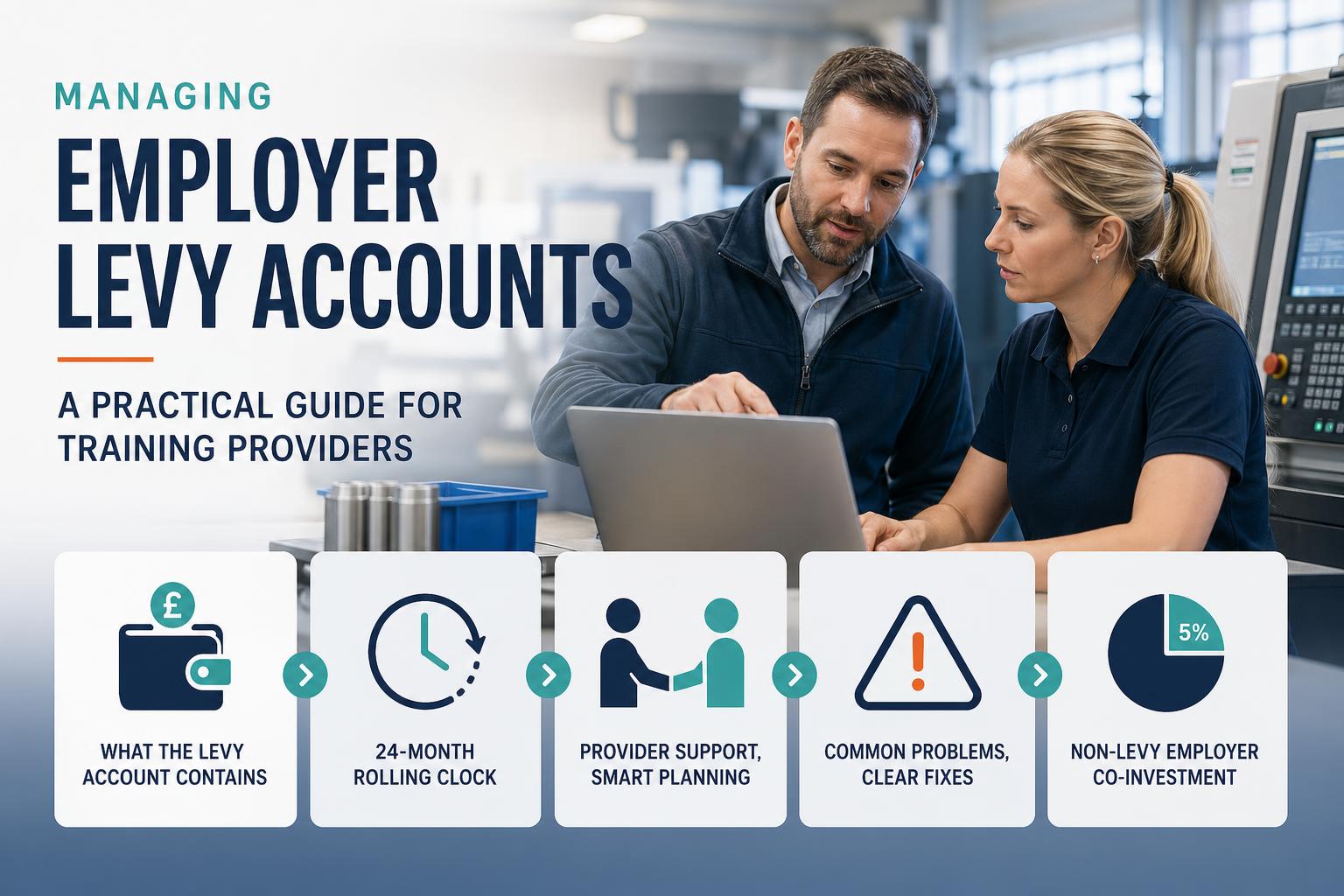
What the Levy Account Contains and How Employers Access It

The apprenticeship levy is paid by UK employers with an annual pay bill above £3 million. It is calculated at 0.5% of the pay bill above that threshold, collected monthly through PAYE. The government adds a 10% top-up to every pound paid in, so an employer paying £10,000 in levy each month has £11,000 available to spend on apprenticeship training and assessment.

Funds accumulate in the employer's apprenticeship service account, accessed via manage-apprenticeships.service.gov.uk. The account balance is visible in real time and shows the employer exactly how much is available, how much is committed to existing programmes, and — critically — how much is at risk of expiry.

To use funds, the employer must:

  • Be set up on the apprenticeship service with a verified PAYE reference
  • Accept the employer agreement on the service
  • Add the training provider to their account as an approved provider
  • Approve the cohort and individual learner records submitted by the provider
  • Confirm payment details and funding band allocation per apprentice

Each apprenticeship start requires an approved commitment — a signed agreement between employer and provider — before any funds are drawn down. Funds are then paid to the provider by the ESFA monthly in arrears based on the negotiated price and the learner's active status on the ILR.

How Levy Funds Expire: The 24-Month Rolling Clock

This is the aspect of levy management that catches employers most frequently. Funds do not accumulate indefinitely. Each monthly contribution expires exactly 24 months after it was paid into the account, unless it has already been committed to an active programme.

An employer who started paying the levy in April 2023 and has not yet started any apprenticeships will see April 2023's contribution expire in April 2025. May 2023 expires in May 2025, and so on. For a large levy payer, this means tens of thousands of pounds leaving the account every month — silently, without a direct notification that prompts urgent action.

The practical consequence for training providers: employers sometimes contact you about starting a cohort believing they have a large balance available, only to discover a significant proportion has already expired. This discovery — mid-sales process — can derail relationships and delay starts. Providers who help employers check and understand their expiry position before this point are far better positioned.

The expiry clock starts on contribution, not account opening

A common misconception is that the 24-month expiry window starts from when the employer first opened their apprenticeship service account. It starts from when each individual monthly contribution was paid. An employer who has been levy-paying for three years with no apprenticeship starts has already lost 12 months of contributions — and is losing more each month.

How Providers Can Help Employers Plan Their Levy Spend

The most effective providers treat levy planning as a consultative service offered to employer partners — not as a reactive conversation after a problem has emerged. This means three practical activities.

Cohort planning sessions

A structured annual meeting with the employer's HR or finance team to map current headcount, likely growth areas, suitable roles for apprenticeship standards, and the realistic pipeline of starts over the next 12 months. The output should be a simple plan: how many starts, to which standards, starting when, at which funding band, and what that totals against the employer's available balance.

For large employers with complex workforce structures, this may involve multiple divisional conversations before a single plan is agreed. The effort is justified: an employer with a clear plan is far more likely to run a cohort to completion than one who starts programmes reactively.

Standard selection support

Employers frequently don't know which apprenticeship standards are available for their sector, or which funding band applies to roles they're considering. Helping an employer select the right standard — one that matches the actual job role and that the employer can realistically support in terms of off-the-job time and workplace experience — prevents programme failures later.

A mismatch between the standard and the actual job role is one of the most common reasons apprentices fail at gateway or perform poorly at EPA. Providers who do this well upfront reduce their EPA pass rate risks downstream.

Timing and start scheduling

Employers often don't understand the implications of timing on their levy balance. A planned cohort that starts three months later than intended may mean additional levy expiry for employers with large uncommitted balances. Helping employers understand this — and structuring programme starts to optimise levy utilisation — is a straightforward value-add that can accelerate decisions.

Common Employer Account Problems and How to Resolve Them

Employer not set up or approved on the apprenticeship service

This is a surprisingly common blocker, particularly for employers who are new to apprenticeships. Setting up an apprenticeship service account requires a Government Gateway account, a PAYE reference, and completion of the employer agreement. The process is not complex but it takes time — often a week or more — and must be done before any cohort can be submitted.

Providers should build apprenticeship service setup into their onboarding process with new employers, rather than discovering mid-start that the account is not in place. A simple checklist sent to the employer at the point of agreement, with clear instructions and a named contact for questions, removes most of this delay.

Wrong or unverified PAYE reference

For multi-entity employers — large groups, franchises, or organisations with multiple payrolls — it is common for levy funds to be paid under a different PAYE reference than the one set up on the apprenticeship service account. This means the account shows zero or an incorrect balance despite the employer genuinely paying the levy.

Resolution requires the employer to contact HMRC to verify the PAYE reference and ensure the correct entity is linked to the apprenticeship service account. This can take several weeks. Providers who spot this problem early — by asking employers to log in and confirm their balance before a cohort is finalised — avoid a last-minute delay to start dates.

Expired funds — the balance is lower than expected

When an employer discovers that funds have expired, the immediate question is whether the remaining balance is sufficient to cover the planned cohort. If it is, no further action is needed beyond agreeing the commitment. If it is not, the employer either needs to co-invest the shortfall or reduce the cohort size to match available funds.

Providers should encourage employers to log into their apprenticeship service account periodically to monitor their balance and expiry position — and consider offering a simple levy health check as part of account management conversations.

Co-investment confusion

Non-levy employers and levy-paying employers with insufficient funds both require co-investment, but the mechanism and rate are different. Many employers — particularly those who have recently become liable for the levy — are confused about what co-investment means and whether it makes apprenticeships unaffordable.

The short answer is that co-investment is rarely a significant barrier. The government funds 95% of the negotiated price beyond the employer's levy contribution, with the employer paying 5%. On a £6,000 programme, the employer co-investment is £300. Providers who explain this clearly — rather than allowing employer confusion to become a deal-breaker — convert significantly more employer enquiries into confirmed starts.

Non-Levy Employer Co-Investment: The 5% Rule

Employers who do not pay the apprenticeship levy — those with a pay bill below £3 million — can still access government funding for apprenticeship training. This is done through co-investment: the employer pays 5% of the agreed training and assessment price, and the government funds the remaining 95%.

The 5% co-investment is paid directly to the training provider by the employer — it does not flow through the apprenticeship service or any ESFA account. Providers must collect it and are responsible for ensuring it is received; the ESFA will not chase it on the provider's behalf.

Key points for providers managing co-investment:

  • Co-investment invoices should be issued per learner per month (or in agreed instalments), matching the payment schedule for the government funding
  • If an employer fails to pay co-investment, the provider is still required to maintain the apprenticeship — but non-payment is grounds for withdrawing from the programme after due process
  • Co-investment payments must be documented in the provider's financial records for ESFA audit purposes
  • The 5% rate applies to the negotiated price, which must be within the funding band maximum for the relevant standard — it cannot exceed the band cap

Additional employer incentive payments

Employers who take on apprentices aged 16–18, or apprentices who have been in care or have an Education, Health and Care Plan, are eligible for an additional incentive payment from the ESFA. This payment goes to the employer — not the provider — but providers who help employers claim it build goodwill. Check current incentive payment rates and eligibility on GOV.UK, as amounts are subject to policy change.

The Growth and Skills Levy Transition: What Changes for Employer Accounts

The Growth and Skills Levy is replacing the Apprenticeship Levy as the UK government's primary employer-funded training mechanism. For employer accounts, the transition introduces several changes that providers should understand and be ready to explain to employer partners.

Under the Growth and Skills Levy framework, employer accounts will eventually be able to direct funds to a wider range of training types beyond apprenticeships — including Skills Bootcamps and other Skills England-approved programmes. This means the account balance that an employer currently views as exclusively apprenticeship money will become available for a broader training menu.

The implications for providers:

  • Employers with large balances may, in time, choose to direct some funds to shorter, non-apprenticeship provision — reducing the balance available for apprenticeship starts
  • Providers who can offer both apprenticeship and Skills Bootcamp provision from a single employer account relationship will have a competitive advantage
  • The 24-month expiry mechanism is expected to continue under the new levy framework, so the urgency argument for levy utilisation remains valid
  • The transition is being phased, and full employer account access to non-apprenticeship funding streams is not yet fully live — providers should monitor DfE and Skills England guidance for implementation dates

How Providers Can Position Levy Planning as a Value-Add Service

The providers who grow employer relationships most effectively don't just deliver training — they act as a guide through the levy system. Employers, particularly those in HR or L&D teams without dedicated apprenticeship expertise, are often navigating levy accounts, funding bands, and co-investment rules for the first time. Providers who make this easier build durable commercial relationships.

Practical ways to do this:

  • Offer a levy utilisation review at the point of employer onboarding and annually thereafter — a simple summary of their account balance, expiry position, committed funds, and remaining capacity, with a recommended cohort plan for the next 12 months
  • Provide a named employer relationship contact who can answer apprenticeship service questions directly — not just a generic enquiries inbox
  • Produce a simple one-page summary of the relevant funding band, co-investment rate, and incentive payments for each standard the employer is considering — before the employer has to ask
  • Flag expiry risk proactively — if you can see from your account management conversations that an employer has significant uncommitted funds approaching expiry, raise it before it becomes a problem
  • Offer cohort planning workshops for employers with multiple business units or HR teams who are managing apprenticeship programmes across different parts of the organisation

Providers that treat levy planning as an account management function — rather than a compliance hurdle to clear before a start — retain employers for longer and generate significantly higher starts per employer relationship.

Frequently Asked Questions

Do levy funds roll over if they are not used?

No. Funds expire on a rolling 24-month basis from the date each monthly contribution was paid. An employer who has not committed funds within 24 months of payment will lose them, with no mechanism to recover or reinstate expired amounts. This makes proactive cohort planning essential for any employer who has been levy-paying for more than 18 months without starting programmes.

What if the employer's levy is insufficient to cover the full training cost?

If a levy-paying employer's account balance is insufficient to cover the full negotiated price of a programme, co-investment applies to the shortfall at a rate of 5% employer / 95% government. The employer pays the 5% directly to the provider. For non-levy-paying employers, the same 5/95 split applies to the full cost of the programme from the first pound.

Can employers transfer levy funds to other employers?

Yes. Levy-paying employers can transfer up to 25% of their annual levy funds to other employers via the apprenticeship service. This mechanism is commonly used by large levy payers to support supply chain SMEs, sector partners, or charitable organisations who could not otherwise access levy-funded training. Both the transferring and receiving employer must be set up on the apprenticeship service, and transferred funds can only be spent on apprenticeship training and assessment by the receiving employer.

Help employers make the most of their levy

Prentice gives providers real-time visibility of employer levy positions, committed funding per cohort, and at-risk expiry dates — so you can have the right conversation before funds disappear.

Book a demo

Sources & further reading

  • Manage apprenticeships: employer guidance — GOV.UK: how employers access and manage their apprenticeship service account, including funding, co-investment, and transfers
  • Apprenticeship Funding Rules — ESFA / GOV.UK: the statutory rules governing levy contributions, co-investment rates, funding band maximums, and employer incentive payments
  • Growth and Skills Levy — GOV.UK: government guidance on the transition from the Apprenticeship Levy, including employer account changes and new eligible training types
Share this guide