Last updated: 4 August 2026
Employer engagement materially affects whether an apprentice gets protected time for off-the-job training, whether progress reviews are meaningful, and whether the programme survives a difficult period in the learner's employment. It works alongside curriculum quality, tutor capacity and learner support rather than replacing them.
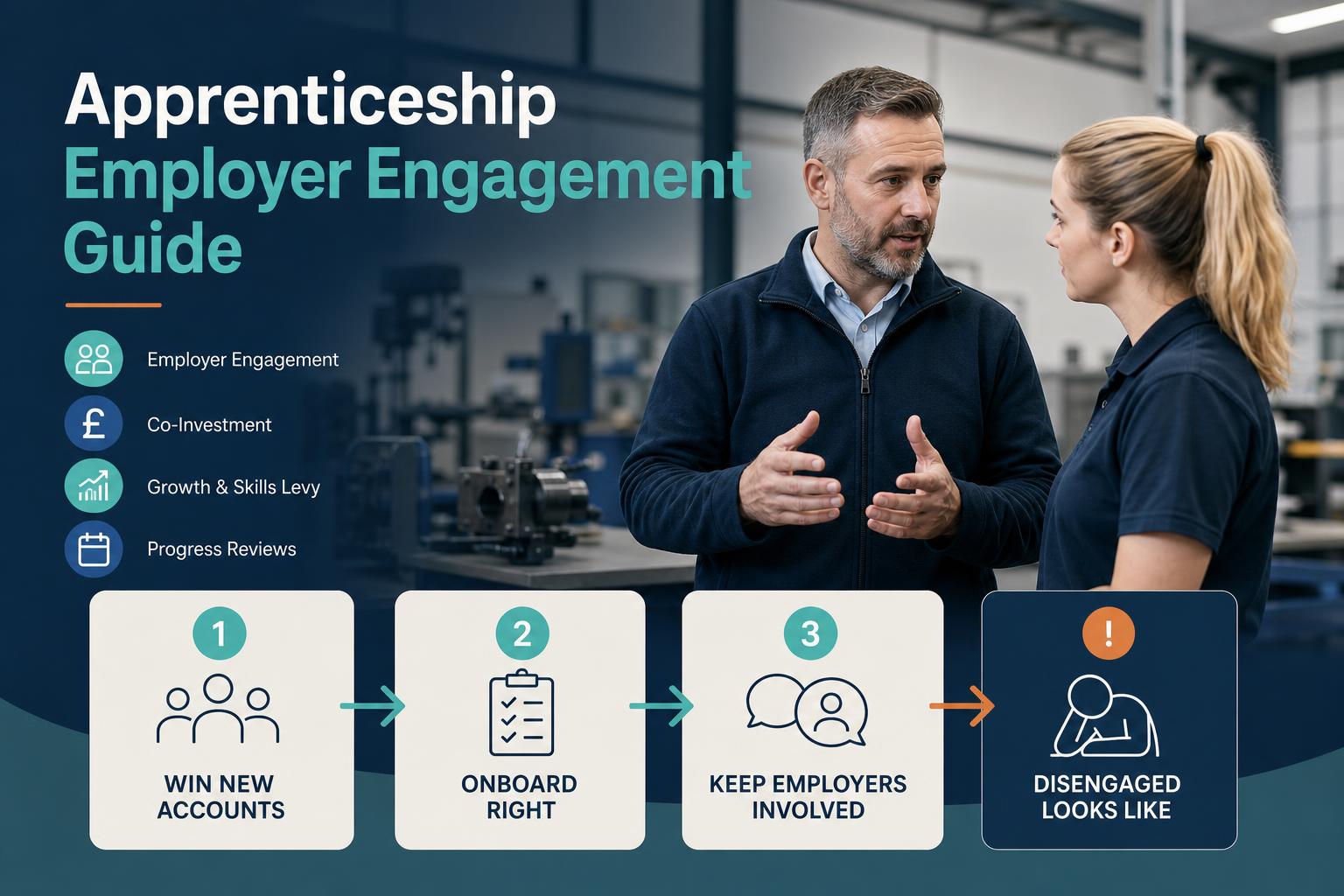
This guide covers the full employer engagement lifecycle — from winning a new account through to keeping employers actively involved throughout delivery — and explains the start-date funding and review rules applying in 2026/27.
Why employer engagement is your biggest differentiator
The AELP and Bud Systems State of the Skills Sector 2026 survey found that 56% of responding providers planned further investment in employer engagement and growth. It also identified employer responsiveness and timely feedback as influences on learner progress, evidence collection and successful completion. Providers planning that investment can use the companion employer engagement operating model to define ownership, response standards and intervention signals.
Completion rates and EPA outcomes are downstream effects of employer engagement quality. An engaged employer gives the apprentice protected time, confirms OTJ hours promptly, attends progress reviews, and responds quickly when a problem emerges. A disengaged employer does none of these things — and every lapse creates a compliance risk, a retention risk, or an Ofsted risk.
Provider-level data should be used to test the connection between employer participation, attendance, progress and withdrawals. Achievement and retention performance can affect regulatory and commercial confidence, so employer engagement is an operational control rather than a soft extra. Avoid quoting a causal uplift unless your own evidence supports it.
For a new start from 1 August 2026, an underfunded levy payer contributes 25% of the eligible shortfall. A non-levy employer receives full government funding to the band for an eligible apprentice aged 16–24, while a non-levy start aged 25 or over normally uses 5% employer and 95% government co-investment. Above-band costs remain with the employer. Earlier starts keep their applicable rules.
Stage 1: Acquisition — winning new employer accounts
Most providers approach employer acquisition by leading with the programme: the standard, the duration, the qualification outcome. This is the wrong frame. Employers — particularly SMEs who have never used apprenticeships before — do not think in terms of frameworks. They think in terms of business problems: how do I fill this skills gap? How do I retain my best junior staff? How do I build succession without paying senior salaries?
An effective acquisition conversation starts with those questions and maps the apprenticeship to the answers. If a hospitality employer is struggling with high turnover among supervisory staff, the conversation is about how a Team Leader or Operations/Departmental Manager apprenticeship creates a retention mechanism. The funding model is an enabler, not the headline.
Framing ROI under the 2026/27 funding routes
The employer contribution varies, but every employer should understand the value case before signing. Use measured cohort data where you have it: observed productivity changes, retention, progression and time to competence. Label small samples and estimates honestly; do not present generic sector figures as a guaranteed outcome for one employer.
Framing the conversation around succession is particularly effective with SMEs. Many business owners in the 50–200 employee range have not thought explicitly about succession risk. An apprenticeship, positioned correctly, becomes a talent pipeline conversation rather than a training purchase — and that is a much stickier commercial relationship.
Stage 2: Onboarding — setting up the programme correctly
The most common failure point in employer onboarding is treating it as a paperwork exercise rather than a relationship-building one. The provider, employer and apprentice need to agree the training plan, including the planned off-the-job training and each party's responsibilities. Who takes part in that agreement tells you a great deal about how engaged the employer will be during delivery.
Training plan agreement and sign-off
The training plan records the three-way agreement between provider, employer and apprentice. Its broad content should be agreed before training begins and it should be signed before the practical period starts wherever possible. If signatures are not available at that point, retain evidence of the parties' agreement and complete the fully signed plan within the first 42 days. It is frequently a bottleneck: providers send it digitally, it gets routed to someone without authority to agree the employer's commitments, and it sits in an inbox for three weeks. The solution is to identify who in the employer organisation is accountable for the programme and include that person in the planning conversation.
Where the training plan is signed by a junior HR administrator who was not in the original sales conversation and cannot commit the organisation to protected training time, you have a structural engagement problem from day one. Escalate early, not late. Keep the training plan distinct from the employer and apprentice's apprenticeship agreement, which has its own legal requirements.
Line manager induction
The apprentice's direct line manager is, in most programmes, the most important person in the employer organisation. They control the apprentice's day-to-day workload, they decide whether protected OTJ time is honoured or quietly squeezed out, and they are the first person the apprentice will go to with a problem. Yet most provider onboarding focuses entirely on the apprentice.
A structured line manager induction — even a 45-minute call covering programme structure, OTJ obligations, the review process, and who to contact — significantly improves the subsequent engagement quality. It also creates a named relationship between the provider and the employer's delivery chain, not just the HR function.
Employer portal access
Set up employer portal access at induction, not three months in. Employers who cannot see their apprentice's progress data from the start develop a perception that the programme is a black box — and that perception is hard to reverse. Early portal access, even when the learner has only completed their initial assessment, signals transparency and builds trust.
Every programme should have a named employer contact — one person at the employer organisation who is accountable for the apprenticeship relationship. This should be agreed at onboarding and recorded in your management information system. When this is left ambiguous, communications fragment, reviews get cancelled, and OTJ confirmation falls through the cracks.
Stage 3: Ongoing engagement — keeping employers involved through delivery
The progress review is the primary formal touchpoint with the employer during delivery. Under the 2026/27 rules, reviews normally take place at least every three calendar months. An alternative cadence can be agreed in advance for an evidenced delivery reason, but reviews must be no more than six months apart. Reviews are three-way discussions; the employer must be given the opportunity to contribute and should attend the majority.
Using reviews as a relationship tool, not just a compliance exercise
Providers who treat the 12-weekly review purely as a compliance requirement miss its value as an engagement mechanism. A well-run review gives the employer a structured view of their apprentice's development — progress against KSBs, OTJ hours to date, any concerns flagged. It is, for many employers, the only time they receive a formal report on the value their training spend is producing.
The quality of target-setting matters here. SMART targets connected to the apprentice's actual job role — rather than generic learning objectives — demonstrate that the provider understands the employer's context. That connection builds confidence regardless of which funding route applies.
Maintaining contact between reviews
Twelve weeks is a long time. Learners who are struggling often show early warning signs — missed sessions, flagging engagement scores, declining coursework submissions — that the employer does not know about because no one has told them. A brief update email or portal notification at the midpoint between reviews costs little but significantly improves the employer's sense of involvement.
This is particularly important in the early months of the programme, where the learner is most at risk of withdrawal. If an employer knows a learner has missed two sessions, they can have a supportive conversation at work. If they find out at the 12-week review, the window for early intervention has closed.
OTJ hours confirmation
The signed training plan must include the employer's confirmation that the apprentice will be released for off-the-job training within normal working hours. The provider is responsible for evidence of all eligible delivery and for accurate planned and actual hours. Providers who wait until an audit to reconcile release, delivery evidence and ILR data create a structural compliance risk.
Build OTJ confirmation into your regular workflow: monthly confirmation requests to the employer contact, automated reminders through the portal, and an escalation pathway for non-response. An employer who repeatedly fails to confirm OTJ hours may also be failing to provide that time — which is a programme issue, not an administrative one.
What disengaged employers look like in practice
Disengagement rarely arrives as a formal withdrawal. It builds gradually through a pattern of small signals:
- Progress reviews repeatedly rescheduled or cancelled without explanation
- OTJ hours confirmations consistently late or incomplete
- The employer contact changes without notification to the provider
- The apprentice reports not receiving protected OTJ time
- Review sign-offs completed by someone who was not present at the review
- No engagement with the employer portal despite access being set up
Each of these individually is manageable. Several of them together, sustained over more than one review cycle, indicate a relationship that needs active intervention — not additional reminders.
Re-engaging a disengaged employer
The instinct when an employer disengages is to escalate via email. This rarely works. Emails can be ignored, forwarded to someone without context, or simply lost. Effective re-engagement requires a named senior contact at the provider — someone with commercial authority — making a direct call to the employer's decision-maker.
The framing of that call matters enormously. Do not open with compliance language. Do not tell the employer what they are failing to do. Open with outcomes: "We want to make sure [apprentice name] gets the most from this programme, and we've noticed a few gaps in how we've been working together. Can we take 20 minutes to reset the relationship?" Outcome-focused conversation keeps the employer on your side. Compliance lectures push them away.
If re-engagement fails despite a direct senior conversation, document the attempts carefully. If the employer is not providing protected OTJ time, you may be heading towards a withdrawal — and a clearly documented re-engagement attempt is essential evidence if the withdrawal is subsequently reviewed.
What Ofsted looks for
Inspectors conduct employer interviews as a standard part of an inspection. They ask employers whether they understand the programme their apprentice is on, whether they have seen progress review records, whether they know their OTJ obligations, and whether they know who to contact if they have a concern.
Common findings from inspections where employer engagement is weak include: employers who cannot describe the standard their apprentice is working towards; employers who have never seen a progress review record despite signing off on reviews; and employers who are unaware that the apprentice is supposed to receive protected time for off-the-job learning.
These findings do not just damage your Ofsted grade. They damage your commercial relationships with those employers once the inspection report is published.
In the months before a known inspection window, consider running a brief employer survey asking the key questions inspectors are likely to ask. The gaps this reveals are fixable. The same gaps identified during an inspection are not.
Employer engagement under the Growth & Skills Levy
The approved Growth and Skills Levy products are product-specific: apprenticeships, foundation apprenticeships and the apprenticeship units listed by Skills England. Skills Bootcamps are a separate commissioned programme and should not be marketed as automatically payable from an employer's levy account. Providers face broader competition for employer attention, but eligibility must be checked before flexibility becomes a sales claim.
Providers who treat employer engagement as a business relationship — with active account management, regular outcome reporting, and genuine responsiveness to employer needs — will retain accounts in this environment. Providers who treat employers as funding vehicles for learner starts will find those employers exercising their new flexibility elsewhere.
Frequently asked questions
What is the biggest cause of employer disengagement in apprenticeships?
The most common cause is poor communication between reviews. When employers only hear from the provider during the 12-weekly progress review, they disengage between touchpoints. Providers who send brief update summaries between reviews report significantly higher employer retention.
When does the 25% apprenticeship contribution apply from August 2026?
For a new start from 1 August 2026, a levy-paying employer whose account has insufficient funds pays 25% of the eligible shortfall and government pays 75%, up to the funding-band maximum. A non-levy employer is fully funded to the band for an eligible apprentice aged 16 to 24, while a non-levy apprentice aged 25 or over normally uses 5% employer and 95% government co-investment. Employers pay above-band prices.
What do Ofsted inspectors ask employers during an inspection?
Inspectors typically ask employers whether they understand the programme their apprentice is on, whether they have seen progress review records, whether they understand off-the-job training requirements, and whether they know how to raise a concern. A common finding is employers who are unaware of their programme obligations.
Is employer confirmation of OTJ hours a compliance requirement?
The employer must confirm in the signed training plan that the apprentice will be allowed to undertake planned off-the-job training during normal working hours. The provider remains responsible for evidencing all eligible delivery, including learning delivered by another party, and for recording planned and actual hours under the applicable funding rules.
Sources & further reading
- Apprenticeship funding rules 2026 to 2027 — three-way review, training-plan and OTJ requirements (GOV.UK) — Apprenticeship funding rules 2026 to 2027 — three-way review, training-plan and OTJ requirements (GOV.UK)
- AELP and Bud Systems State of the Skills Sector 2026 findings — employer responsiveness, provider investment and delivery impact — AELP and Bud Systems State of the Skills Sector 2026 findings — employer responsiveness, provider investment and delivery impact
- Ofsted Further Education and Skills Inspection Handbook — employer interview criteria (GOV.UK) — Ofsted Further Education and Skills Inspection Handbook — employer interview criteria (GOV.UK)
- Apprenticeships in 2026: Making employer-led programmes viable, not just visible (Blueberry MS) — Apprenticeships in 2026: Making employer-led programmes viable, not just visible (Blueberry MS)