Last updated: 19 March 2026

What Is Apprenticeship Levy Transfer?

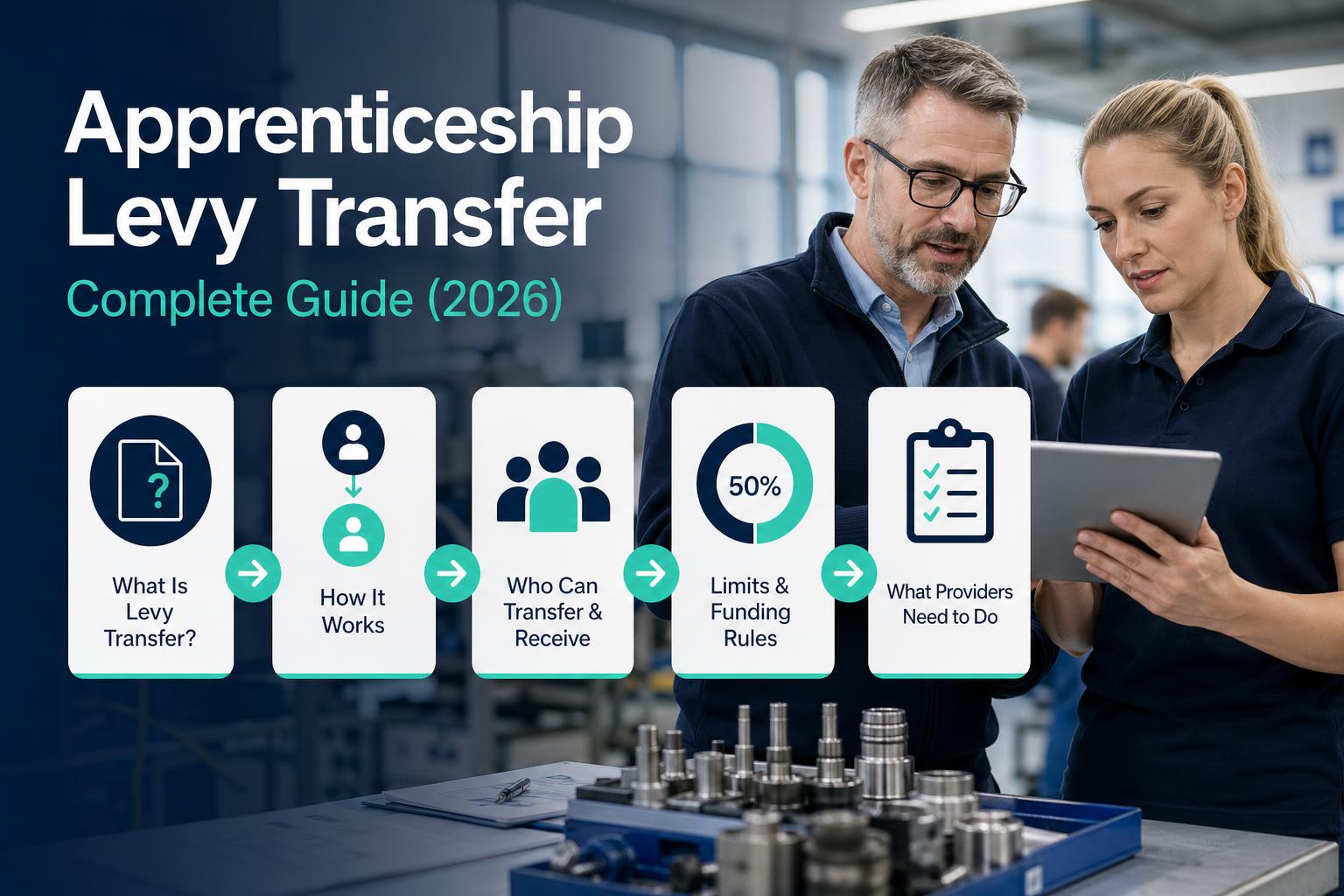
The apprenticeship levy transfer mechanism allows large employers — those who pay the levy — to direct up to 50% of their unused annual levy funds to other employers to pay for apprenticeship training and assessment costs.

The mechanism was introduced to address a structural problem: large levy-paying employers often accumulate more levy funds than they can spend on their own workforce, while smaller employers — who do not pay the levy — struggle to fund apprenticeship training. Levy transfer creates a channel between surplus levy and unmet training need.

Key structural points:

  • The transferring employer must be a levy-paying employer (annual payroll above £3 million)
  • Up to 50% of the transferring employer’s annual levy pot can be transferred
  • Transferred funds can only be used for apprenticeship training and assessment — not wages, equipment, or other costs
  • The transfer is made via the Digital Apprenticeship Service (DAS); both employers must have DAS accounts
  • The receiving employer can be of any size — including a non-levy SME

For training providers, levy transfer is not just a funding mechanism to understand in the abstract — it directly affects how you enrol learners on DAS, what funding source you record in the ILR, and how you communicate with employers about their levy position.

How the Transfer Mechanism Works

The levy transfer process follows a defined sequence through DAS:

  1. Sending employer sets up a transfer connection — the levy-paying employer logs into their DAS account and creates a transfer connection with the receiving employer, specifying the maximum transfer amount
  2. Receiving employer adds apprentice starts — the receiving employer uses the transferred funds in their own DAS account to pay for apprenticeship starts, selecting the approved training provider and standard
  3. Provider approves the cohort — the training provider confirms the apprentice details and training costs in DAS, matching the enrolment to the relevant standard and funding band
  4. Funds are drawn down monthly — the apprenticeship funding is drawn down from the transfer pot on a monthly basis as the apprenticeship progresses

It is important to note that the training provider deals primarily with the receiving employer in the day-to-day relationship — the receiving employer is the apprentice’s employer of record and the provider’s contractual employer partner. The sending employer’s role is funding, not delivery.

Transfer vs Standard Levy Funding

From a provider’s delivery perspective, a transfer-funded apprentice goes through exactly the same programme as a directly levy-funded apprentice. The difference is entirely in how the funding is sourced and recorded — not in what the learner experiences.

Who Can Transfer and Who Can Receive

Who can transfer

Only levy-paying employers can transfer — those with annual payrolls above £3 million who already contribute to the apprenticeship levy via PAYE. Transfer is only possible from funds held in the employer’s DAS account; they cannot transfer funds they have not yet accumulated.

Who can receive

Any employer can receive a levy transfer, regardless of size or levy-paying status. This is the mechanism’s primary purpose: enabling SMEs and micro-employers to fund apprenticeships without needing to pay the levy themselves.

Common transfer relationships include:

  • Large corporates funding SME supply chain partners — a retailer, manufacturer, or logistics firm transferring levy to small suppliers to develop skills in the supply chain
  • Group company structures — a parent company transferring levy to subsidiaries or associated entities that do not meet the levy threshold independently
  • Sector body and levy share schemes — industry associations or sector bodies facilitating transfer connections between member organisations; common in construction, hospitality, and care sectors
  • Local authority and public sector networks — NHS trusts or combined authorities coordinating transfer to smaller partner organisations

Transfer Limits and Funding Rules

The 50% transfer cap applies to the sending employer’s total annual levy funds — not just the unspent balance. If an employer pays £500,000 in levy annually, they can transfer up to £250,000 per year, regardless of how much they spend on their own apprenticeships.

Additional rules that affect transfer-funded starts:

  • Funding band caps apply to the receiving employer: transferred funds are subject to the same funding band maximum as any other levy-funded start. A provider cannot charge above the funding band cap simply because the funds come from a transfer.
  • Co-investment rules still apply: if the receiving employer is a non-levy payer and the apprentice is aged 22 or over, the standard co-investment rules apply — the receiving employer pays 5% of training costs, and the government (via the transfer pot) pays 95%.
  • Transfer commitments expire if not used: if a transfer connection is set up but no starts are made against it within the commitment period, the committed funds return to the sending employer’s pot.
  • Transfers are for training and assessment only: providers cannot use transfer funds to pay for anything outside the agreed training and assessment price — no additional payments, no admin fees.

What Training Providers Need to Do

DAS Enrolment for Transfer-Funded Starts

When enrolling a transfer-funded apprentice, the provider must ensure that the DAS enrolment correctly reflects the receiving employer — not the sending employer — as the employer of record. The receiving employer is who you have a contract with, who employs the apprentice, and who signs the commitment statement.

The funding source in DAS will show as “transfer” — providers do not need to take additional action to reflect this, but they should verify it is recorded correctly before confirming the enrolment.

ILR Reporting for Transfer-Funded Learners

In the ILR, transfer-funded starts are recorded using the standard learner fields, but the funding source indicator must accurately reflect that the funds come from a levy transfer. The relevant ILR fields are:

  • Apprenticeship Financial Record (AFR): must reflect the correct employer contribution and government contribution split, including whether co-investment applies
  • Employer identifier: must reference the receiving employer — the learner’s actual employer — not the sending employer
  • Funding source: correctly coded to reflect levy transfer rather than direct levy or government co-investment

Errors in these fields are one of the most common causes of ESFA audit queries on transfer-funded cohorts. A platform that tracks funding source at the learner level — and validates ILR output against DAS enrolment records — significantly reduces this risk.

Common ILR Error: Wrong Employer on Transfer Starts

Some providers record the sending employer (the large corporate transferring funds) as the employer of record in the ILR. This is incorrect. The ILR must reference the receiving employer — the one who employs the apprentice and has the training contract.

Common Errors Providers Make with Levy Transfer

Beyond the employer identifier error above, the most frequently seen transfer-related compliance issues are:

  • Co-investment rules misapplied: failing to collect the 5% employer contribution from receiving employers who are non-levy payers with learners aged 22+
  • Charging above the funding band: the funding band maximum applies equally to transfer-funded starts — providers who invoice the employer (rather than the DAS system) for top-up amounts risk a funding breach
  • DAS not updated when transfer ends: if a sending employer stops the transfer mid-programme, the funding source changes — providers must ensure DAS and ILR records are updated promptly to reflect the new funding arrangement
  • Transfer commitment not in place before start: providers should confirm the transfer connection is active in DAS before enrolling learners against it — starting learners before funds are committed creates reconciliation problems
  • Treating all transfer starts identically: transfer-funded SME employers often have different onboarding needs, levy account familiarity, and capacity for DAS administration — providers who assume SME employers understand DAS as well as large corporates tend to encounter more errors

How to Build a Levy Transfer Pipeline

For providers looking to grow through levy transfer, the opportunity is significant — particularly in sectors where large employers have strong supply chain relationships with SMEs who cannot independently fund apprenticeships.

Practical steps for building a transfer pipeline:

  • Identify employers in your existing network with surplus levy: large employers often have more levy than they can spend. Conversations about unused levy can open transfer conversations.
  • Understand sector-specific transfer networks: some sectors have established levy share schemes — retail, logistics, construction. Making contact with sector bodies in your delivery area is a faster route to transfer relationships than approaching individual employers.
  • Support receiving employers through DAS setup: SMEs that have never used DAS before need guidance. Providers who offer employer onboarding support — helping set up DAS accounts and connect to a transfer — convert more transfer-funded starts and build stronger employer relationships.
  • Be clear on the timeline: transfer connections take time to set up in DAS. Build a four-to-six week lead time into your transfer-funded start pipeline to avoid rushed enrolments.

Levy Transfer Under the Growth and Skills Levy

The Growth and Skills Levy — the planned replacement for the Apprenticeship Levy — is expected to retain the levy transfer mechanism. DfE has indicated that the ability for large employers to share levy funds with smaller employers in their supply chain is a valued feature of the current system, and the policy intent is to maintain it under the new framework.

What may change under the Growth and Skills Levy is the range of training types that transferred funds can support. If Skills Bootcamps and shorter qualifications become levy-eligible, it is possible that transfer funds could eventually be directed to those training types — not just apprenticeships. Providers should monitor DfE and Skills England guidance as the new framework takes shape.

What Your Platform Needs to Support Transfer Management

Training providers managing transfer-funded cohorts need their TMS or apprenticeship management platform to handle several transfer-specific requirements:

  • Funding source tracking at learner level: the platform must record whether each learner is levy-funded, transfer-funded, or government co-invested — and surface this in both operational dashboards and ILR exports
  • Co-investment calculation: automatically applying the correct employer contribution based on learner age and employer levy status — so invoices and ILR data are always consistent
  • DAS status visibility: if the platform integrates with DAS, showing the live enrolment status for transfer-funded learners reduces the risk of starts proceeding without a valid transfer commitment
  • Employer portal differentiation: receiving SME employers typically have less DAS experience than large levy-paying employers — your employer portal needs to be accessible and clear for lower-experience users

Quick Reference: Levy Transfer Checklist for Providers

  • Confirm transfer connection is active in DAS before enrolling learners
  • Record receiving employer — not sending employer — as employer of record in ILR
  • Apply co-investment rules correctly for non-levy receiving employers with learners aged 22+
  • Do not charge above the funding band maximum for transfer-funded starts
  • Update DAS and ILR records if the transfer arrangement changes mid-programme
  • Support SME receiving employers through DAS account setup and transfer acceptance
  • Build a 4–6 week lead time into transfer-funded start planning
  • Track transfer-funded cohort separately in your reporting to monitor compliance risk

Track every funding source, automatically

TIQPlus tracks levy-funded, transfer-funded, and co-invested learners in one platform — with ILR exports that reflect the correct funding source for every start.

Book a demo

Sources & further reading

Share this guide