Last updated: 19 March 2026
What Are Green Skills Apprenticeships?
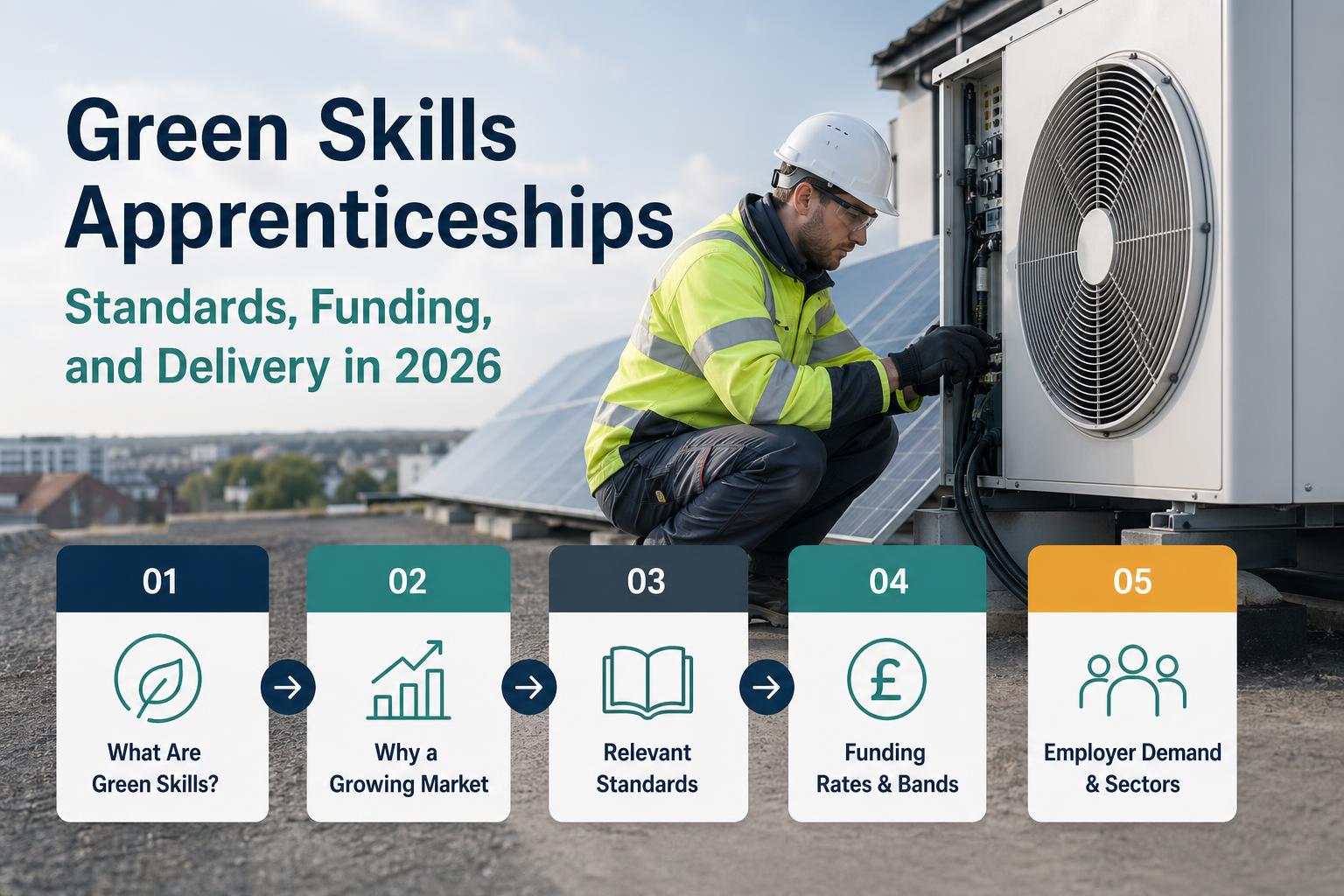
Green skills apprenticeships are not a separate funding category or a distinct qualification type. They are standard apprenticeship standards that develop knowledge, skills, and behaviours directly relevant to the low-carbon economy — retrofit, clean energy, sustainable construction, and the technologies that underpin the UK’s net zero transition.
Skills England identifies green skills as a national priority sector under the Growth and Skills Levy agenda, placing them alongside digital and health and care as the areas where employer demand most urgently exceeds current workforce capacity.
The green skills agenda spans multiple occupational sectors:
- Construction and the built environment — retrofit, insulation, and low-carbon building techniques
- Engineering and manufacturing — clean energy equipment, wind turbine technology, and EV infrastructure
- Energy supply and distribution — heat pump installation, solar PV, and battery storage
- Transport — EV maintenance and charging infrastructure
- Agriculture and land management — sustainable land use and carbon sequestration
The fundamental driver is the UK’s legally binding net zero target for 2050, the Climate Change Committee’s workforce projections, and the growing regulatory and commercial pressure on employers to demonstrate green skills competence in their teams.
Why Green Skills Are a Growing Market
The demand side for green skills apprenticeships is growing from multiple directions simultaneously:
- The UK government has committed to net zero by 2050 — this requires a fundamental transformation of the built environment, energy infrastructure, and transport systems, all of which are workforce-intensive
- The Climate Change Committee estimates that around 725,000 workers will need to be trained or retrained in green skills by 2030 — a target that current provider capacity cannot meet without significant expansion
- The UK Green Building Council (UKGBC) and other sector bodies have highlighted a substantial gap between current assessor and installer capacity and what the retrofit programme requires to meet government housing decarbonisation targets
- Employer demand is growing across construction firms, energy suppliers, local authorities, housing associations, and social housing providers — many of whom face contractual and regulatory obligations to demonstrate green skills in their workforce
- SME construction firms in particular are facing regulatory pressure — Part L building regulations, PAS 2035/2030 retrofit standards — that requires new competences in their workforce, creating demand for funded training that apprenticeships can meet
For training providers, this represents a significant and durable market opportunity — not a short-term policy initiative. The structural need for green skills persists across the entire 2030–2050 period regardless of short-term policy changes.
Which Apprenticeship Standards Are Relevant
The following standards are currently among the most relevant for green skills delivery. Providers should check the IfATE register and current ESFA funding band tables for the most up-to-date information, as new standards are being developed and approved:
- Heat Pump Installer (Level 3): high demand, high funding band, specialist equipment requirements. Growing from near-zero volume to significant starts as the Heat Pump Association and government push installation targets ahead of the 2030 boiler phase-out.
- Retrofit Assessor (Level 3): assesses properties to determine appropriate energy efficiency improvements; required under PAS 2035. Demand linked directly to the Great British Insulation Scheme and related government programmes.
- Retrofit Coordinator (Level 3): oversees retrofit projects to PAS 2030/2035 standards; a relatively new standard with growing take-up as the social housing sector accelerates decarbonisation programmes.
- Electrical Installation (Level 3): a long-established standard with significant green skills relevance due to EV charging, solar PV, and battery storage installation components — one of the highest funding bands at Level 3.
- Construction and Built Environment standards: various Level 2 and Level 3 standards for bricklaying, insulation, plastering, and roofing — all relevant to the large-scale building retrofit programme required to meet housing decarbonisation targets.
- Engineering Manufacturing Technician (Level 3): relevant to wind turbine, solar energy, and other clean energy manufacturing occupations, particularly in the offshore wind supply chain.
Skills England is actively developing new standards in offshore wind, hydrogen, and EV maintenance sectors. Providers should monitor the IfATE register for approvals and consider early registration with relevant Employer Route Panels to position for new standards as they are approved.
Funding Rates and Bands
Green skills standards typically attract higher-than-average funding bands — reflecting the specialist delivery requirements, equipment costs, and assessor expertise involved. Current indicative funding band information:
- Heat Pump Installer: currently funded at £12,000 per learner (funding band maximum). Actual delivery costs can be high given equipment and specialist workshop requirements.
- Retrofit Assessor and Retrofit Coordinator: funded in the £7,000–£9,000 range per learner.
- Electrical Installation: funded at £15,000 — one of the highest funding bands for a Level 3 standard — reflecting the extensive practical delivery requirements.
Providers should check the current ESFA funding band tables before planning delivery — rates are periodically reviewed and the figures above may have changed. Some green skills delivery also attracts additional support through DfE and UK Shared Prosperity Fund (UKSPF) programmes — regional growth funding opportunities are worth investigating, particularly in areas with active retrofit programmes or industrial cluster investment.
High Funding Band = High Delivery Cost
Green skills standards typically attract high funding bands because they are expensive to deliver. Specialist workshop space, equipment maintenance, refrigerant handling certification, and qualified assessors represent significant and ongoing costs. Providers should model delivery costs carefully before committing to volume — the funding band maximum does not guarantee margin without disciplined cost management.
Employer Demand and Sector Context
Understanding which employer types are driving green skills demand helps providers prioritise their business development and delivery planning:
- Housing associations and local authorities are among the highest-volume employers for retrofit-related standards — driven by social housing decarbonisation obligations under the Social Housing Decarbonisation Fund and related programmes. Many have explicit targets for EPC rating improvements across their housing stock.
- Energy companies and their sub-contractors are growing users of heat pump and electrical standards — as they expand installation capacity ahead of government phase-out targets for gas boilers.
- SME construction firms increasingly need green skills to remain competitive and compliant with building regulations — creating demand for funded training that apprenticeships can directly meet.
- The supply chain challenge: many employers need green skills training but lack the procurement infrastructure for apprenticeship management. Providers who can support employers through DAS setup, commitment statement processes, and levy account management will win more business than those who assume employers can manage this independently.
- Regional variation: demand is higher in areas with large social housing stock, active retrofit programmes, and specific industrial clusters — offshore wind in the North East and Humber, for example, or heat pump installation in urban areas with dense housing association stock.
Delivery Challenges for Providers
Green skills apprenticeships present delivery challenges that are distinct from mainstream standards. Providers entering this market should plan for:
- Specialist facilities: many green skills standards require workshop space and equipment that general FE providers do not have — heat pump rigs, electrical installation boards, retrofit assessment tools. The capital investment required before the first learner starts is substantial.
- Qualified tutors and assessors: the pool of practitioners with both occupational competence in green technologies and a teaching qualification is small. Providers must develop internal capability, recruit from industry, or establish delivery partnerships — each of which takes time and carries risk.
- Rapidly evolving technical content: green technology changes quickly. Heat pump efficiency standards, PAS specifications, and electrical installation requirements are regularly updated. Curriculum must keep pace with industry standards — outdated content creates both learner risk and Ofsted scrutiny.
- Health and safety requirements: many green skills standards involve live electrical systems, refrigerant handling under F-Gas regulations, or working at height. Robust health and safety management is essential and will be scrutinised closely by Ofsted under the Further Education and Skills inspection framework.
- Small cohort sizes: some green skills standards currently have low starts volumes as the market develops. Providers need to plan carefully for smaller cohorts with higher per-learner delivery cost — and avoid over-investing in capacity before the employer pipeline is confirmed.
EPA Considerations for Green Standards
End-Point Assessment for green skills standards has specific characteristics that providers should plan for from the start of delivery:
- EPAO choice is critical: green standards often have specialist End-Point Assessment Organisations with specific assessment methodologies. Not all EPAOs have the technical facilities to assess heat pump installation or retrofit assessment in a realistic working environment — check EPAO capacity and methodology before committing your cohort.
- Practical demonstration components are common: EPA for green standards often requires the apprentice to demonstrate competence in a realistic work environment — installing a heat pump to specification, conducting a retrofit assessment on a real or simulated property. These components require careful planning and early gateway preparation.
- Gateway requirements may differ from mainstream expectations: providers should register with their chosen EPAO early and obtain the full gateway requirements in writing — some green standards have specific certification requirements (F-Gas, 18th Edition wiring regulations) that must be completed before gateway is submitted.
- EPAO capacity constraints: some green EPAOs have limited assessment capacity during peak periods as volumes grow. Build longer lead times into gateway planning than you would for mainstream Level 3 standards — a six to eight week lead time for EPA booking is not uncommon.
How to Build Green Skills into Your Provision
Providers who enter the green skills market successfully tend to follow a disciplined development sequence rather than attempting to launch multiple standards simultaneously:
- Start with standards where you have existing sector knowledge and employer relationships. A provider already delivering electrical standards is better positioned to add Heat Pump Installer than to start from scratch in retrofit assessment — the occupational knowledge, assessor pool, and employer network have some overlap.
- Conduct employer conversations in your current network before investing in infrastructure. Energy companies, housing associations, and construction contractors in your area are likely to have unmet green skills demand — but you need confirmed starts pipeline, not projected demand, before committing to workshop investment.
- Use specialist subcontracting only where it genuinely improves the learner offer. Under the 2026/27 apprenticeship rules, the main provider must still directly deliver substantive training within each employer's programme, retain the employer relationship and meet APAR, declaration, threshold and quality-assurance requirements. Subcontracting does not transfer delivery risk away from the main provider.
- Track green learners separately in your training management system to build a clear picture of provision size, funding, and outcomes as the portfolio grows. Mixing green and mainstream standards in a single reporting view makes it difficult to monitor performance or make delivery investment decisions.
- Apply for Skills England and DfE sector-specific funding calls when they open. Capital funding for specialist equipment and facility development is periodically available — providers who have existing delivery credibility in related sectors are better positioned to secure it.
Confirm Your Starts Pipeline Before Investing
The green skills market is growing — but employer conversations about intent are not the same as confirmed apprenticeship starts. Invest in facilities and equipment only once you have signed commitment statements and DAS enrolments in place. Green skills infrastructure is expensive to build and expensive to maintain without sufficient learner volume.
Quick Reference Checklist
- Identify which green skills standards align to your existing sector expertise and employer relationships
- Check ESFA funding band tables for each target standard — and model full delivery costs before committing to infrastructure investment
- Register with the relevant EPAO early and confirm gateway requirements — including any pre-gateway certification requirements
- Assess your facility and equipment needs — and map the capital investment required against your confirmed starts pipeline
- Identify qualified tutors and assessors with occupational competence in your target green standards, or develop a recruitment and development plan
- Engage employer partners before launch — confirm starts pipeline before investing in infrastructure
- Set up separate tracking for green learners in your TMS to monitor performance and inform delivery investment decisions
- Monitor Skills England and IfATE for new green standards approvals in offshore wind, hydrogen, and EV maintenance sectors
Frequently asked questions
Which apprenticeship standards are considered green skills standards?
Green skills apprenticeships include standards directly relevant to the low-carbon economy. Key examples include: Heat Pump Installer (Level 3), Retrofit Assessor (Level 3), Retrofit Coordinator (Level 3), Electrical Installation and Maintenance (Level 3), various Construction and Built Environment standards, and Engineering Manufacturing pathways relevant to clean energy. Skills England is developing additional standards aligned to net zero priorities — providers should monitor the Institute for Apprenticeships and Technical Education (IfATE) register for new approvals.
Do green skills apprenticeships attract higher funding rates?
Some green skills standards attract maximum or near-maximum funding bands due to the specialist equipment, facilities, and assessor expertise required to deliver them well. Heat pump installation, for example, is a high-cost standard given the technical delivery requirements. Providers should check the current ESFA funding bands for each specific standard before planning delivery, as funding rates vary significantly.
How is Skills England prioritising green skills?
Skills England has identified clean energy and the net zero transition as one of its priority sectors for the Growth and Skills Levy era. This means green skills standards are expected to receive continued and increased funding under the new levy framework, and Skills England is actively working with employers and sector bodies to develop new standards and upskill the existing assessor and tutor workforce to support delivery.
Sources & further reading
- Skills England — Skills England
- Net Zero Strategy — Net Zero Strategy
- Apprenticeship Funding Bands — Apprenticeship Funding Bands