Last updated: 15 July 2026
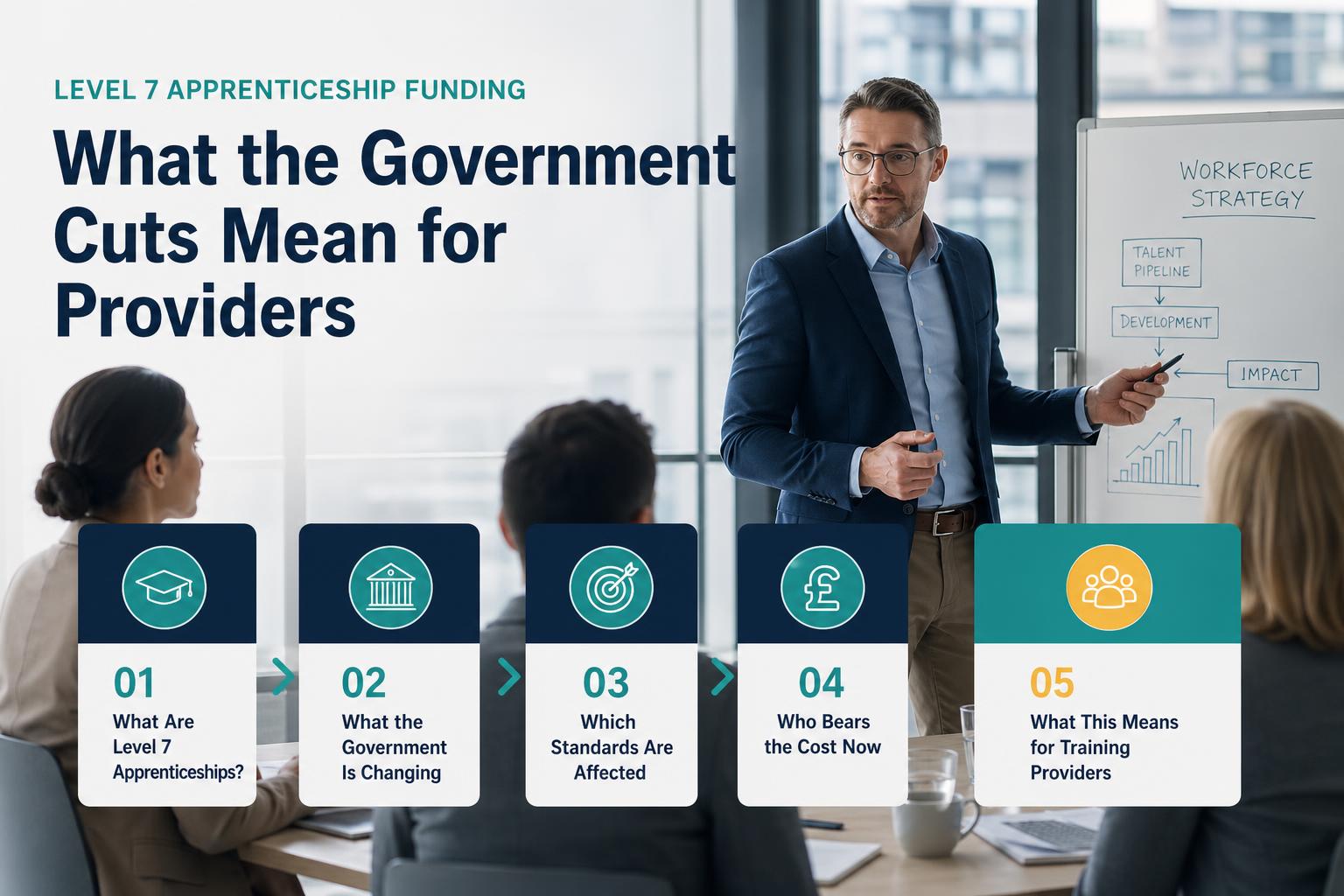
What Are Level 7 Apprenticeships?
Level 7 apprenticeships are set at master’s-degree level in England, although not every standard includes a master’s qualification. They remain employment-based programmes: the apprentice must have a genuine job, receive the training needed for occupational competence, and complete the assessment requirements for the version on which they start.
Current examples include Senior leader (ST0480), Solicitor (ST0246), Accountancy or taxation professional, and Senior people professional. Check the live Skills England catalogue for the current version, level, latest-start date and maximum funding for any standard; do not reuse old funding-band tables or assume a related occupation has the same level.
What the Government Changed
For Level 7 apprenticeships starting on or after 1 January 2026, government funding is normally available only where, at the start of apprenticeship training, the apprentice is:
- aged 16 to 21; or
- aged under 25 and has an Education, Health and Care (EHC) plan and/or has been, or is, in the care of their local authority.
An individual who started a Level 7 apprenticeship before 1 January 2026 continues to be funded through completion under the rules that apply to that start. The policy is therefore a learner-eligibility restriction for new starts, not the withdrawal of selected standards from the catalogue.
Approved for delivery does not mean every learner is funded
A Level 7 standard may remain available for starts while an older learner is ineligible for levy-account or government co-investment funding. Check three things separately: the live standard version on Skills England, the learner eligibility rule for the actual start date, and the employer’s funding route.
Which Standards Are Affected?
The age rule applies to all Level 7 apprenticeship standards. It does not distinguish management programmes from regulated professional or technical occupations.
The Same Rule Applies Across the Level
- Senior leader: a new start aged 22 or over is not automatically fundable; only the stated under-25 exceptions can apply.
- Solicitor: the occupational and regulatory importance of the route does not create a separate funding exemption.
- Accountancy or taxation professional and Senior people professional: the same start-date, age and exception test applies.
There Is No “Retained Standard” Carve-out
Terms such as “retained” or “protected profession” can be misleading here. A standard’s delivery status and a learner’s funding eligibility are different questions. Providers should record the evidence for the learner’s age and any EHC-plan or care-status exception before confirming a funded start.
Who Bears the Cost Now?
For an age-ineligible new starter, the employer must decide whether to buy a privately funded apprenticeship, buy different training outside the apprenticeship programme, or not proceed. The public funding shortfall does not convert automatically into ordinary co-investment.
Private Funding Is Not Co-Investment
- Privately funded apprenticeship: the employer pays the full negotiated training and assessment price. The programme must still satisfy the statutory and apprenticeship requirements in the official privately funded apprenticeships guidance.
- Government-funded apprenticeship: this is available only if the apprentice is eligible. The normal levy-account, reservation and co-investment rules then apply for that start date.
- Non-apprenticeship course: an employer may purchase a master’s, professional qualification or leadership programme commercially, but it must not be recorded or marketed as a funded apprenticeship.
For eligible starts from 1 August 2026, non-levy employers receive government funding up to the funding-band maximum for eligible apprentices aged 16 to 24. A levy payer first uses available account funds; where those funds are insufficient, the employer normally contributes 25% of the eligible shortfall and government contributes 75%. Employers always pay costs above the funding-band maximum. Earlier starts follow the rules for their own start date.
Where the Operational Impact Is Greatest
The largest impact is likely wherever Level 7 recruitment historically included adults aged 22 and over: senior leadership and people roles, experienced entrants to legal and accountancy routes, public-sector professional development, and career changers. Providers should analyse their own age profile rather than assume an entire sector or standard is funded or unfunded.
What This Means for Training Providers
The immediate task is to stop treating a standard-level funding band as proof that every planned learner can be funded. The core risks are:
Pipeline Risk
A pipeline built around adults aged 22 and over may now contain privately funded opportunities rather than levy-funded starts. Reclassify the pipeline before forecasting income: protected pre-2026 learners, eligible new starts, exception-dependent new starts, fully private starts, and undecided employer demand should be reported separately.
Revenue Concentration
Model revenue using the current maximum funding for the live standard version and the actual eligibility of each learner. Then model employer conversion to a fully private price. This makes the risk visible without assuming that a whole standard has been withdrawn or that every employer will accept private funding.
Reputation and Quality Risk
Do not move a learner to a lower-level standard solely to preserve public funding. The replacement must match the job, prior learning and substantive training need. Clear employer communication and accurate marketing are especially important where a proposed private apprenticeship or commercial course has different price, assessment and reporting arrangements.
Learner Protection Obligations Remain
Earlier funded starts are protected through completion. If a provider exits delivery, it must manage continuity or transfer in line with the current DWP funding rules, provider agreements and APAR conditions. The funding change is not permission to abandon an active cohort.
How to Adapt Your Delivery Portfolio
Audit Your Level 7 Dependence
For every current learner and planned start, record:
- the standard reference and live version, planned start date and latest-start date;
- the learner’s age at start and evidence for any under-25 EHC-plan or care-status exception;
- whether the start is government-funded, privately funded or still awaiting an employer decision;
- the applicable maximum funding, negotiated price, employer contribution and any amount above the maximum; and
- the current assessment plan and continuity arrangements for active learners.
Keep the eligibility evidence with the learner record and apply the rules for the actual start date; do not overwrite older cohorts with the newest co-investment rate.
Develop Level 3–5 Alternatives
A lower-level apprenticeship may be suitable where it reflects the employee’s occupation and the training will deliver new occupational competence. Use the Skills England apprenticeship search to confirm current products and versions, then complete initial assessment and recognition of prior learning. A programme is not a compliant alternative merely because its subject is similar or its funding is available.
Check Apprenticeship Units and Skills Bootcamps Separately
Apprenticeship units are named, approved Growth and Skills Levy products for employed learners aged 19 and over who need upskilling for their role. The initial units last 30 to 140 delivery hours over 1 to 16 weeks, and only eligible APAR providers can deliver a unit with public funding. Check the live Skills England catalogue and the apprenticeship unit funding rules.
Skills Bootcamps are a separately commissioned programme, not an apprenticeship-service-account product. The official employer guidance says an existing employee’s Bootcamp normally requires a 10% employer contribution for organisations with 1 to 249 employees or 30% for organisations with 250 or more; availability and subjects depend on the commissioned offer. Use the current employer guidance and course finder. Neither route should be presented as an automatic replacement for a Level 7 apprenticeship.
What a Platform Needs to Support Mixed-Level Provision
A mixed public/private portfolio creates operational complexity and exposes systems that assume every learner on a standard has the same funding status.
- Start-date rules: retain the funding and assessment rules that apply to each cohort rather than applying the newest settings retrospectively.
- Learner eligibility: record age-at-start and exception evidence separately from standard availability.
- Funding route: distinguish levy funds, government co-investment, fully private apprenticeships and commercial non-apprenticeship courses.
- Product rules: keep full apprenticeships, apprenticeship units and separately commissioned Skills Bootcamps in distinct workflows.
The platform should also preserve approvals, evidence history and audit trails when a learner or funding route changes.
Quick Reference Checklist
- Check every Level 7 standard and version in the live Skills England catalogue.
- Apply the start-date funding rules and record the learner’s age at the start of training.
- Collect evidence for an under-25 EHC-plan or local-authority care exception where applicable.
- Do not describe an age-ineligible learner as co-invested; agree a fully private price and follow the private-apprenticeship rules.
- Protect pre-1 January 2026 funded starts through completion and maintain continuity plans.
- Only propose a lower-level apprenticeship after confirming the job, training need and prior learning.
- Keep approved apprenticeship units and separately commissioned Skills Bootcamps in distinct funding workflows.
- Monitor DWP funding rules and Skills England product pages; use the rules for each learner’s actual start date.
Frequently asked questions
Which Level 7 apprenticeship standards are losing levy funding?
The rule is not based on a list of selected standards. For starts from 1 January 2026, government funding for any Level 7 apprenticeship is normally available only where the apprentice is aged 16 to 21 at the start, or is under 25 and has an Education, Health and Care plan and/or has been, or is, in local-authority care. A standard can remain approved for delivery while a particular learner is ineligible for public funding.
Can employers still fund Level 7 apprenticeships after the levy restriction?
Yes. An employer can pay the full negotiated training and assessment price for a privately funded Level 7 apprenticeship, provided the apprenticeship still meets the statutory and programme requirements. Government co-investment is not a way around the age rule: an otherwise ineligible learner is privately funded, rather than 5% or 25% co-invested. An employer can also buy a non-apprenticeship course, but that is a different product and must not be presented as an apprenticeship.
What should training providers do if Level 7 is a large part of their portfolio?
Providers should segment every planned start by start date, age and exception evidence; separate protected existing learners from new starts; model fully private prices for ineligible learners; and discuss alternatives with employers. Any lower-level apprenticeship must fit the employee’s real job and training need. Approved apprenticeship units and separately commissioned Skills Bootcamps may be relevant in some cases, but they are distinct products with their own eligibility and delivery rules.
Sources & further reading
- Apprenticeship funding rules, 2025 to 2026 — Apprenticeship funding rules, 2025 to 2026
- DWP apprenticeship funding rules, 2026 to 2027 — DWP apprenticeship funding rules, 2026 to 2027
- Privately funded apprenticeships: rules and guidance — Privately funded apprenticeships: rules and guidance
- Skills England apprenticeship search — Skills England apprenticeship search
- Skills Bootcamps for employers — Skills Bootcamps for employers