Last updated: 19 March 2026
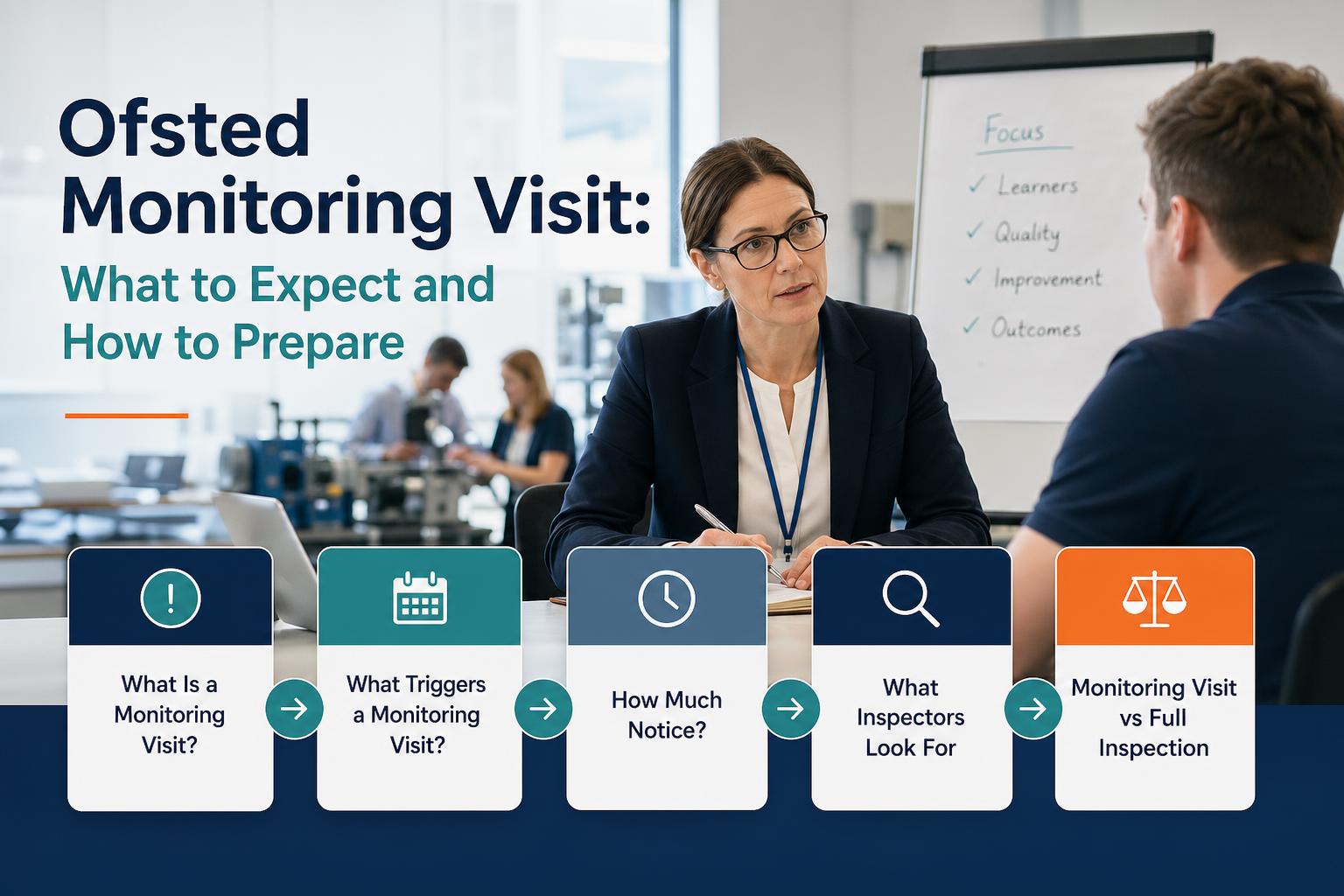
What Is an Ofsted Monitoring Visit?
An Ofsted monitoring visit is a targeted inspection activity triggered after a provider receives a Requires Improvement (grade 3) or inadequate (grade 4) outcome at a full inspection. Its purpose is narrow and specific: to assess whether the provider has made sufficient progress against the areas for improvement set out in the inspection report.
A monitoring visit is not a full re-inspection. No new overall effectiveness grade is awarded. The outcome is a monitoring letter — published on Ofsted’s website — that describes the provider’s progress against each area for improvement as one of three ratings: insufficient progress, reasonable progress, or significant progress.
Inspectors attending a monitoring visit focus exclusively on what has changed since the last inspection. They are not conducting a comprehensive quality review of the provider’s entire operation. If an area of delivery was not cited as an area for improvement, it is not the primary focus of the monitoring visit — though safeguarding is always assessed regardless of whether it appeared as a specific finding.
The distinction matters practically: providers who treat a monitoring visit as a mini version of a full inspection, and attempt to demonstrate overall quality across all themes, often distract from what inspectors are actually looking for. The monitoring visit is about the specific areas for improvement — nothing else.
What Triggers a Monitoring Visit
The standard trigger for a monitoring visit is a Requires Improvement or inadequate grade at full inspection. Following this outcome, providers can expect at least one monitoring visit — and potentially more — before their next full inspection. However, a Requires Improvement grade is not the only trigger.
- Safeguarding concerns: a serious safeguarding concern, complaint, or whistleblowing referral to Ofsted can trigger an unannounced monitoring visit regardless of a provider’s current inspection grade.
- DfE referral: the Department for Education can request a monitoring visit for funded providers outside the standard inspection cycle, particularly where there are concerns about financial health, significant management changes, or compliance with funding conditions.
- Significant change in provision: rapid growth in learner numbers, a new subcontracting arrangement, a major change in leadership or ownership, or a substantial shift in the type of provision delivered can prompt Ofsted to visit outside the normal cycle.
- Unsatisfactory progress at a previous monitoring visit: a provider that receives an insufficient progress finding at a monitoring visit is at high risk of an accelerated full re-inspection, but may also receive further monitoring visits in the interim.
How Much Notice Do Providers Get?
The standard notice period for an Ofsted monitoring visit is one to two working days, given by telephone. This is not a long window — and it is the most important practical feature of monitoring visits for providers to understand.
Providers cannot meaningfully “prepare” for a monitoring visit in the one-to-two-day window between notification and the visit. The evidence that inspectors will examine — learner outcome data, review records, improvement plan progress, self-assessment — must already exist in a current, complete state before the phone call comes.
In cases where Ofsted has serious concerns — particularly relating to safeguarding — visits may be unannounced. Providers should not assume that notification will always come.
The practical implication is significant: monitoring visit readiness is an ongoing operational state, not a preparation project. The evidence that will determine the monitoring letter outcome is accumulating (or failing to accumulate) every week between inspections. Providers who begin preparing after they receive notification are, in effect, already too late.
What Inspectors Look For
The areas for improvement identified in the previous full inspection report define the entire scope of a monitoring visit. Inspectors arrive with those findings in hand and assess progress against each one specifically. Everything they examine — every data set, learner file, and leadership conversation — is framed by those findings.
The most important distinction inspectors make is between process and impact. A provider that has created new procedures, updated policies, and written an improvement plan has demonstrated process. A provider that can show those changes have produced measurably better outcomes for learners has demonstrated impact. Monitoring visits are assessed on impact.
Learner outcomes data
Achievement rates, progression data, and destinations are primary evidence of impact. Inspectors will want to see current data, compared with the position at the time of the previous inspection, and a clear trend line showing direction of travel. Data that has not improved since the inspection — or that has moved only marginally — is a difficult position from which to demonstrate significant progress.
Quality of teaching, learning, and assessment
If teaching quality was an area for improvement, inspectors will observe teaching sessions and speak to learners and tutors. They want to see that tutor practice has genuinely improved — not that a new observation schedule has been introduced. Improved tutor quality is evidenced by improved learner outcomes, stronger learner knowledge, and tutors who can articulate curriculum intent and sequencing clearly.
Leadership understanding
Can leaders and managers articulate the improvement story? This is a specific inspector activity at monitoring visits. The principal, CEO, or quality director should be able to describe clearly: what the area for improvement was, what specific actions were taken, what the evidence of impact is, and what the current position is. If senior leaders cannot do this fluently, it is itself a monitoring visit finding — it suggests that improvement has been managed at operational level without genuine leadership ownership.
Employer engagement quality
Where employer engagement was an area for improvement, inspectors will look for evidence that employers are now more meaningfully involved in programme delivery — not just that provider staff have had more contact with them. Genuine employer engagement is evidenced by employer contributions to review records, employer involvement in assessment, and employers who can describe what their apprentices are learning and why.
Safeguarding effectiveness
Safeguarding is assessed at every monitoring visit, regardless of whether it was a specific area for improvement in the previous inspection. Inspectors will check that the designated safeguarding lead is in post and trained, that safeguarding records are current, that staff have received recent safeguarding training, and that governors or trustees are sighted on safeguarding effectiveness.
How It Differs from a Full Inspection
Understanding the structural differences between a monitoring visit and a full inspection helps providers focus their preparation appropriately and avoid investing effort in areas that are not the focus of the visit.
- Scope: a monitoring visit is focused solely on the specific areas for improvement from the previous inspection. A full inspection covers all quality themes under the EIF — quality of education, behaviour and attitudes, personal development, leadership and management, and overall effectiveness.
- Duration: monitoring visits typically last one to two days. Full inspections for larger providers can run two to five days or longer.
- Inspector team size: monitoring visits typically involve one or two inspectors. Full inspections involve a larger team, with inspectors assigned to specific themes or curriculum areas.
- Outcome: a monitoring visit produces a monitoring letter with a progress rating (insufficient, reasonable, or significant) for each area for improvement. A full inspection produces a new overall effectiveness grade across all EIF themes.
- Frequency and timing: monitoring visits are triggered by grade and progress findings. Full inspections operate on a rolling cycle determined by the provider’s current grade and the inspection schedule.
Preparing Your Evidence Pack
The evidence pack for a monitoring visit is not a document you assemble after notification — it is the live state of your provision. What follows describes what should be in a current, ready state at all times during the post-inspection improvement period.
Know your areas for improvement by heart
Every leader and senior manager in the organisation should be able to recite the areas for improvement from the previous inspection report, describe what has been done in response to each one, and provide evidence of the impact of those actions. If a head of department is unaware of an area for improvement that relates to their area, that is itself a monitoring visit risk.
Live outcome data
Current achievement rates by standard and level, compared with the position at the time of the previous inspection, with trend data showing direction of travel. This data should be updated monthly and available for immediate presentation. Data that has to be pulled together after notification will appear — and often is — incomplete or recently assembled.
Learner case files
Inspectors will select specific learners and conduct a deep dive into their records. Files must be complete, accurate, and demonstrate the quality of teaching, assessment, and review. A file that is current and reflects high-quality practice is the strongest possible evidence. A file with gaps, generic review content, or missing signatures is a direct risk.
Self-assessment report
The self-assessment report (SAR) presented to inspectors at a monitoring visit must be current. Not the SAR written immediately after the last inspection — a current SAR that reflects the position today, references the areas for improvement explicitly, and provides evidence-referenced judgements on progress against each one. A SAR that has not been updated since the inspection signals that self-assessment is a compliance exercise rather than a genuine management tool.
Improvement plan
The improvement plan must show actions completed, not just planned. Each completed action should be accompanied by evidence of its impact on learner outcomes or quality. An improvement plan that is a list of planned activities — with no record of what was done, by whom, when, and with what result — will not support a significant progress finding.
What Inspectors Mean by Impact
Saying “we updated our tutorial process” is not evidence of impact. “Tutorial quality has improved: learner satisfaction scores are up 22%, and the proportion of at-risk learners who successfully progress to gateway has increased from 45% to 61%” is evidence of impact. Every action on your improvement plan should have a corresponding measurable outcome statement.
Common Mistakes Providers Make in Monitoring Visits
The same patterns of underperformance appear repeatedly in published monitoring letters. Understanding them helps providers avoid the most common failure modes.
Presenting plans as outcomes
The most frequent error is describing what a provider is going to do, or what it has started doing, rather than demonstrating what it has done and evidencing the impact. Inspectors are not evaluating intent — they are evaluating improvement. “We are implementing a new review framework” is not a monitoring visit answer. “We implemented a new review framework in October; review quality scores have improved from 54% meeting the standard to 81%; here is the evidence from the last three months of review records” is a monitoring visit answer.
Showing process, not impact
A related error: describing new procedures without demonstrating that they have changed learner outcomes. A new policy document, a new template, a new training session for staff — these are processes. They are not improvements unless you can show that learner outcomes have changed as a result. Inspectors will push past process descriptions to ask: and what changed for learners?
Leaders unable to articulate the improvement story
Where senior leaders — including the principal or chief executive — cannot clearly describe the improvement story for each area for improvement, that is a monitoring visit finding in its own right. It suggests that improvement has happened at operational level without genuine strategic ownership, which raises questions about sustainability. Leaders should rehearse their improvement narrative before the visit — not for the first time during it.
Evidence that is too recent
Creating evidence in the week before a monitoring visit — new review records updated to show better quality, a SAR written or substantially rewritten after notification, an improvement plan with actions backdated — is both a credibility risk and, in some cases, an integrity risk. Inspectors are experienced at identifying recently created evidence and will specifically note if evidence quality appears inconsistent with the programme timeline. Evidence assembled in a pre-visit scramble rarely demonstrates the sustained improvement that a significant progress finding requires.
A “front of house” presentation that does not match underlying reality
Providers sometimes present senior leaders and hand-picked learner files to monitoring visit inspectors, while the broader picture of delivery does not match the narrative. Inspectors select their own learner file sample and speak to learners and employers without provider supervision. If the files they select and the conversations they have do not match the improvement story presented by senior leaders, the monitoring letter will reflect that gap.
Building a Monitoring Visit Readiness Culture
The providers who perform well at monitoring visits are not those who prepare most intensively in the two-day window — they are those who have built a culture in which monitoring visit readiness is a natural consequence of high-quality daily operations.
Treat the improvement plan as a live operational document
The improvement plan should be reviewed and updated at senior leadership team meetings — not pulled out of a folder when a monitoring visit is approaching. Every completed action should be recorded with evidence of impact at the time it is completed, not retrospectively assembled.
Conduct quarterly self-assessment against the areas for improvement
Formal, evidence-referenced self-assessment against the specific areas for improvement should happen at minimum every term. Not a narrative review — a structured assessment with data, file evidence, and judgements about current position. This gives senior leaders a current, credible self-assessment to present at a monitoring visit, regardless of when notification arrives.
Involve tutors and curriculum leads in evidence collection
Tutors and curriculum leads need to understand what the previous inspection found and what their role is in the improvement journey. A tutor who is unaware that review quality was an area for improvement — and who therefore has not changed their review practice — will be visible to inspectors when they examine learner files. Improvement plans that are owned only at senior leadership level do not produce the quality of evidence that monitoring visits require.
Hold regular leadership reviews on monitoring readiness
Assign evidence leads for each area for improvement within the senior or middle leadership team. Each lead is responsible for maintaining current, impact-evidenced records of progress in their area. Regular reviews — monthly or half-termly — ensure that the evidence base is accumulating rather than being assembled under pressure.
Use your TMS data proactively
If your areas for improvement included review quality, learner outcomes, or employer engagement, your Training Management System should be generating the evidence you need as a natural byproduct of high-quality daily delivery. Review completion rates, SMART target quality indicators, OTJ tracking, and cohort outcome data should be visible and current in your platform at all times — not extracted for inspection purposes.
Start Now, Not Two Days Before
Providers who wait for monitoring visit notification to begin compiling evidence rarely demonstrate sufficient progress. The evidence that impresses inspectors is organic — it accumulated naturally from high-quality daily delivery, not from a pre-inspection scramble. If you would not be comfortable with an unannounced visit today, your monitoring readiness is not where it needs to be.
Quick Reference: Monitoring Visit Readiness Checklist
- Know your areas for improvement by memory — every leader and senior manager
- Maintain a live improvement tracker with evidence of impact, not just actions
- Keep current achievement rate data updated monthly
- Ensure learner case files are complete and reflect high-quality provision
- Conduct a mock monitoring visit quarterly with a critical friend or external consultant
- Update your SAR regularly — at minimum every term
- Prepare two or three learner impact stories for each area for improvement
- Ensure safeguarding records are current and governors are sighted on safeguarding effectiveness
- Have your TMS data ready to demonstrate learner outcomes at a cohort and individual level
Frequently asked questions
How much notice do providers get for an Ofsted monitoring visit?
Providers typically receive one to two working days’ notice before an Ofsted monitoring visit. In cases where Ofsted has serious concerns about a provider — for example, following a safeguarding referral or a complaint — visits may be unannounced. Providers should maintain monitoring visit readiness at all times following a Requires Improvement grade, not just in the period immediately after an inspection.
What is the outcome of an Ofsted monitoring visit?
A monitoring visit results in a monitoring letter, not a new inspection grade. The letter describes whether the provider has made insufficient progress, reasonable progress, or significant progress against each area for improvement. The letter is published on Ofsted’s website. Providers who receive insufficient progress findings may face further monitoring visits or a full re-inspection sooner than scheduled.
How does a monitoring visit differ from a full inspection?
A monitoring visit is narrower in scope than a full inspection. It focuses specifically on the areas for improvement identified at the previous full inspection — not a comprehensive assessment of the provider’s overall quality. Fewer inspectors attend (typically one or two), and the visit lasts one to two days. No new overall effectiveness grade is awarded.
Sources & further reading
- Further Education and Skills Inspection Handbook — Further Education and Skills Inspection Handbook
- Ofsted inspections of further education and skills providers — Ofsted inspections of further education and skills providers
- Education Inspection Framework — Education Inspection Framework