Last updated: 15 July 2026
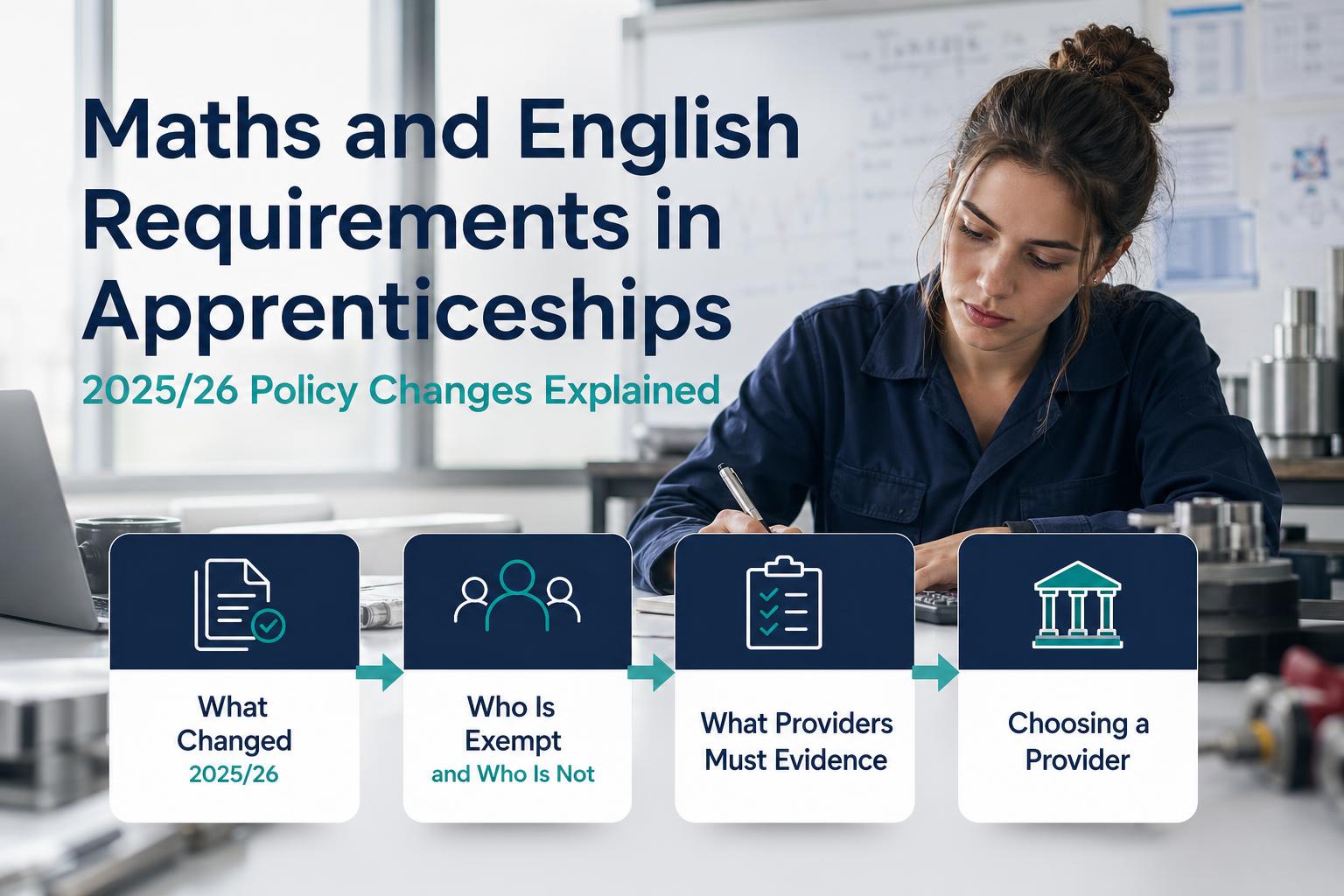
The Maths and English Requirement in Apprenticeships
The final 2026/27 rules use the apprentice's age on the day apprenticeship training starts. Apply the rule to English and maths separately.
- Aged 16–18 at the start: an apprentice without a suitable equivalent must study and achieve the applicable approved English or maths qualification before completing the apprenticeship.
- Aged 19+ at the start: standalone English or maths study is optional. It may be funded up to an approved level 2 where the apprentice lacks a suitable equivalent and the employer agrees that it should be included in the training plan.
- Mandatory qualification: if English or maths is an essential component of a mandatory qualification in the standard, it must be completed. The awarding organisation can confirm the requirement.
For a 19+ opt-in, the provider must deliver enough training for assessment and retain written evidence at gateway that the apprentice attempted the assessment. The apprentice does not have to pass English or maths to achieve the apprenticeship unless the mandatory-qualification exception applies.
Current 2026/27 Position
The adult flexibility has applied since 11 February 2025 and is not limited to a particular apprenticeship level. The final 2026/27 DWP rules clarify the operational controls:
- Decide during initial assessment whether standalone English or maths will form part of the apprenticeship.
- Where funded study is included and acceptable prior evidence is unavailable, assess the current level with a current tool.
- Record active delivery in the signed training plan with accurate learning start and end dates.
- Do not deliver the qualification entirely through self-directed distance learning.
- If a 19+ apprentice withdraws after opting in, close the aim on the last day of learning and update the plan and ILR.
Who Is Exempt and Who Is Not
Operational teams often call prior attainment an exemption, but the rule is whether the apprentice holds a qualification or evidence on DfE's current suitable-equivalent list for that subject and apprenticeship level.
Learners with prior Level 2 attainment
Do not rely on a short generic list. DfE publishes separate current English and maths tables covering qualification type, subject, grade and jurisdiction. For each subject:
- Match the exact award and grade to the current table.
- Retain acceptable evidence such as a certificate, verified awarding-organisation result or permitted personal-learning-record evidence.
- Record the evidence source and the resulting English or maths decision.
A learner self-declaration or internal diagnostic is not proof of a suitable equivalent. International and legacy qualifications must be verified through the route set out in the DfE guidance.
Learners who have attempted and failed
For a 16–18 apprentice who needs the qualification, a failed attempt does not remove the achievement requirement. Review support, reasonable adjustments and the delivery plan. For a 19+ opt-in, an evidenced assessment attempt meets the apprenticeship exit condition even where the qualification is not achieved, unless it forms an essential part of a mandatory qualification.
Learners with disabilities or learning difficulties
A separate flexibility may allow an apprentice with a learning difficulty or disability to study and achieve at a lower level. It is not automatic. Follow the current DfE guidance and retain:
- The formal evidence-based assessment by an appropriate professional
- The link between the disability or difficulty and the standard English or maths requirement
- The reasonable adjustments and support considered or provided
- The agreed lower-level delivery and achievement evidence
Do not treat repeated failure by itself as evidence that the flexibility applies.
Employer-provider cases
Employer-providers on the Apprenticeship Provider and Assessment Register (APAR) apply the same age-at-start, prior-attainment, opt-in and evidence rules. In-house delivery does not change the English and maths exit condition.
What Providers Must Evidence
The evidence pack should connect the initial decision, training plan, delivery record, assessment result and ILR.
Broad training-plan content must be agreed before apprenticeship training. Obtain a signed plan before delivery where possible. Where the initial broad agreement is virtual or by email and signing first is not possible, retain that agreement and obtain a fully signed plan by the end of the 42-day qualifying period. The training plan is signed by provider, employer and apprentice; it is separate from the apprenticeship agreement signed by employer and apprentice.
ILR recording requirements
Use the current DfE ILR specification and reference data. Controls should cover:
- Decision: suitable equivalent, mandatory 16–18 study, 19+ employer opt-in, not opted in, mandatory-qualification exception or learning-difficulty/disability flexibility.
- Learning aim: where funded standalone study is included, use the correct current learning aim and actual English or maths learning start.
- Active learning: retain delivery evidence against the signed training plan; standalone English and maths cannot be wholly self-directed distance learning.
- End and outcome: record achievement, attempt or withdrawal accurately. If a 19+ apprentice withdraws after opting in, close the aim on the last day of learning.
Standalone English and maths qualifications are funded separately and do not count towards the standard-specific apprenticeship off-the-job training minimum.
Common ILR errors around maths and English
Common control failures include:
- Creating aims for every adult without employer agreement
- Claiming funding before active English or maths learning starts
- Using planned programme dates instead of the actual English or maths learning dates
- Leaving a 19+ opt-in aim open after withdrawal
- Treating an assessment attempt as an achievement, or requiring a 19+ apprentice to pass when the rules only require an attempt
Choosing a Functional Skills Provider
Where delivery is outsourced, the main provider remains accountable for the funding-rule decision, active learning, data and evidence.
Awarding Organisation requirements
Check that the centre and qualification are approved through the relevant awarding organisation and that the delivery arrangement complies with the final 2026/27 subcontracting rules, including any APAR requirement or permitted exception.
The contract and operating process should cover:
- Centre and qualification approval
- Active-learning and attendance evidence
- Assessment bookings, attempts and results
- Data-sharing timescales and ILR responsibility
- Reasonable adjustments, quality oversight and escalation
Tracking achievement alongside the apprenticeship programme
Track English and maths at progress reviews where it forms part of the plan. For adults, separate “attempted” from “achieved”; for 16–18 apprentices, track progress to the achievement required for completion.
What Happens if Learners Don’t Achieve Functional Skills
The consequence depends on the applicable rule, not on a blanket Level 2 gateway policy.
Impact on gateway
A 16–18 apprentice who needed English or maths must achieve the applicable qualification before completion. A 19+ apprentice who opted in must have attempted the assessment but need not pass it to achieve the apprenticeship, unless the subject is essential to a mandatory qualification. Retain the evidence required by the applicable revised or legacy assessment-plan route.
Ofsted scrutiny on functional skills delivery quality
Quality assurance should show that English and maths decisions and delivery meet individual needs:
- An accurate starting-point assessment where funded study is included
- An individualised active-learning plan to the applicable assessment or achievement
- Occupational English and maths development even where no standalone qualification is funded
- Reasonable adjustments and timely intervention where progress is weak
Do not misclassify a valid adult opt-in non-achievement as an automatic gateway failure. Test whether active learning, assessment preparation, attempt evidence and learner support met the rule and the signed plan.
Implications for achievement rate data
English and maths learning aims and outcomes feed provider performance and accountability data. The final rules specifically note that unusual retention and withdrawal patterns for 19+ opt-in provision may be considered context in Apprenticeship Accountability Framework reviews.
Common Compliance Mistakes Providers Make
Correct these recurrent control failures:
- Applying one rule to every age. Record age at the apprenticeship start and decide each subject separately.
- Enrolling every adult automatically. A funded 19+ standalone aim needs employer agreement and a training-plan entry.
- Accepting self-declaration as prior-attainment evidence. Verify against DfE's current suitable-equivalent lists.
- Counting standalone English and maths as off-the-job training. It is expressly excluded from apprenticeship OTJT.
- Requiring a 19+ opt-in apprentice to pass for gateway. The normal rule requires an evidenced attempt, not achievement.
- Leaving delivery dates or withdrawal outcomes inaccurate. Align active-learning evidence, training plan and ILR.
Quick Reference Checklist
- Age on apprenticeship learning start confirmed
- English and maths suitable-equivalent evidence checked separately against current DfE lists
- 16–18 mandatory study and achievement recorded where needed
- 19+ employer opt-in or decision not to opt in recorded
- Mandatory-qualification and learning-difficulty/disability exceptions checked
- Broad training-plan agreement evidenced before apprenticeship training and full signature deadline monitored
- English and maths active-learning dates, delivery and ILR aims aligned
- Standalone English and maths excluded from off-the-job training hours
- Gateway evidence distinguishes achievement from adult assessment attempt
- Subcontracting and APAR requirements checked where another organisation delivers
Frequently asked questions
Do apprentices need Level 2 maths and English before they can go to EPA gateway?
Not universally. Apprentices aged 16–18 at the start who lack a suitable equivalent must achieve the applicable approved English and maths qualification. Apprentices aged 19+ at the start may opt into funded standalone study with employer agreement and must attempt the assessment, but do not need to pass it to achieve the apprenticeship unless English or maths is essential to a mandatory qualification.
What do the final 2026/27 rules require for maths and English?
Providers decide the requirement during initial assessment using age at the apprenticeship start, suitable prior attainment, employer agreement for a 19+ opt-in and any mandatory-qualification exception. Funded delivery must be active, recorded in the signed training plan and not fully self-directed distance learning.
What counts as evidence of prior Level 2 attainment in maths and English?
Check the exact award, subject and grade against DfE’s current English and maths suitable-equivalent lists. Retain acceptable evidence such as a certificate, verified awarding-organisation result or permitted personal-learning-record evidence. A learner self-declaration is not enough.
Sources & further reading
- DWP Apprenticeship Funding Rules 2026 to 2027 — DWP Apprenticeship Funding Rules 2026 to 2027
- English and Maths Requirements in Apprenticeships — English and Maths Requirements in Apprenticeships
- English and Maths Flexibilities for Apprentices with Learning Difficulties and Disabilities — English and Maths Flexibilities for Apprentices with Learning Difficulties and Disabilities
- Apprenticeship Standards — Apprenticeship Standards
- Submit Learner Data Guidance — Submit Learner Data Guidance