Last updated: 15 July 2026
Functional skills requirements for apprenticeships: a compliance guide
The final 2026/27 rules do not impose one English and maths outcome on every apprentice. The requirement depends mainly on age at the apprenticeship start, suitable prior attainment, employer opt-in for adults and any mandatory-qualification exception.
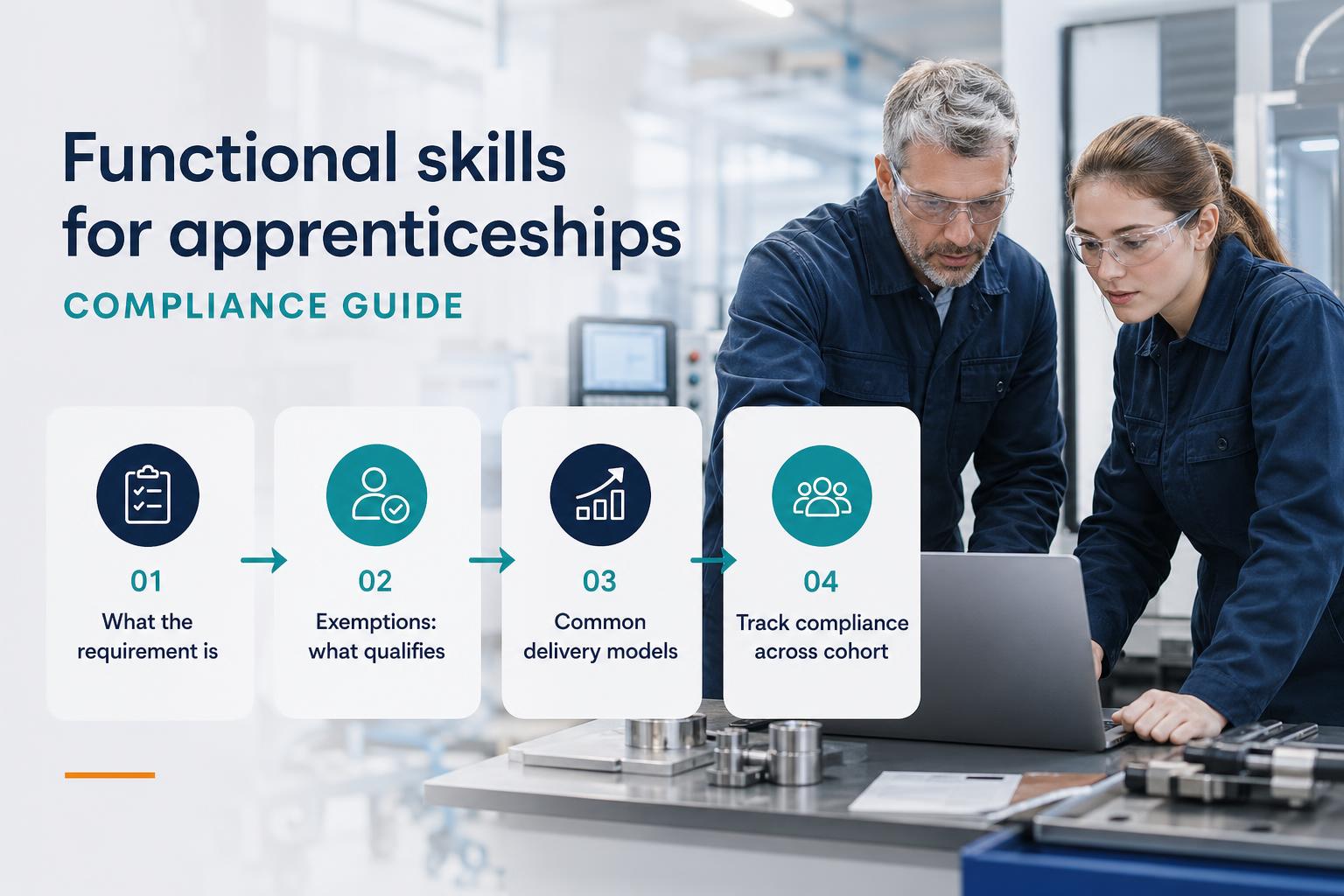
What the requirement is
Use the apprentice's age on the day they start apprenticeship training and check each subject separately.
- Aged 16–18 at the start: if the apprentice lacks a suitable equivalent in English or maths, the applicable approved qualification must be included, funded and achieved before apprenticeship completion.
- Aged 19+ at the start: standalone English and maths is optional. It can be funded up to an approved level 2 where the apprentice lacks a suitable equivalent and the employer agrees it should form part of the training plan.
- Mandatory-qualification exception: if English or maths is an essential component of a mandatory qualification in the standard, it must be completed regardless of the adult opt-in policy. Confirm the position with the awarding organisation.
For revised assessment plans the end checkpoint is called gateway to completion; legacy end-point assessment plans continue to use EPA gateway. In both cases, apply the English and maths requirement that actually applies to that apprentice.
Exemptions: what qualifies
“Exempt” is often used operationally, but the compliance question is whether the apprentice holds a qualification or evidence on DfE's current suitable-equivalent list for that subject and apprenticeship level.
- Check English and maths separately against the official current lists.
- Match the exact qualification type, subject, level or grade and jurisdiction; similar-sounding vocational units are not automatically equivalent.
- Use acceptable evidence such as a certificate, verified awarding-organisation result or permitted personal-learning-record evidence.
- Record the evidence source and retain it in the evidence pack.
A learner statement or internal diagnostic is not evidence of a suitable equivalent. International qualifications and legacy awards must be checked through the route specified in the current DfE guidance rather than accepted by analogy.
Functional skills Level 1 — what it means
Where funded standalone English or maths is included and acceptable prior-attainment evidence is unavailable, assess the apprentice's current level using a current tool. Tuition starts at the level immediately above the assessed level, or at level 2 where the apprentice is already assessed at level 2.
- Record the qualification decision and active-learning schedule in the signed training plan.
- Use accurate English or maths learning start and end dates.
- Do not deliver the qualification entirely through self-directed distance learning.
- For an apprentice aged 19+ who opts in, deliver enough training for the assessment and retain written evidence at gateway that the assessment was attempted. A pass is not required to achieve the apprenticeship.
For a 16–18 apprentice who needs English or maths, achievement remains required. Separate flexibilities exist for apprentices with evidenced learning difficulties or disabilities; these are evidence-based adjustments, not a general waiver.
Common delivery models
Once English or maths is mandatory or agreed as a 19+ opt-in, record the qualification and delivery pattern in the training plan. Broad training-plan content must be agreed before apprenticeship training. Obtain signatures before delivery where possible; if the initial broad agreement is virtual or by email and signing first is not possible, retain that evidence and obtain the fully signed plan by the end of the 42-day qualifying period.
The training plan is signed by provider, employer and apprentice. It is separate from the apprenticeship agreement, which is signed by the employer and apprentice only.
Providers typically deliver standalone English and maths through one of three models:
In-house delivery
The provider employs or contracts functional skills tutors and delivers maths and English directly to learners. This gives control over scheduling and integration with the main programme but requires awarding organisation centre approval and quality assurance processes.
Sub-contracted delivery
The provider subcontracts delivery to a specialist centre. The main provider remains accountable for compliance, data, quality and evidence and must follow the current subcontracting rules, including any APAR requirement or permitted exception that applies.
Employer-arranged delivery
Some employers arrange delivery through their own training teams or another provider. The main provider must still see delivery, attempt and achievement evidence and update the ILR accurately.
Regardless of delivery model, standalone English and maths qualifications are excluded from apprenticeship off-the-job training hours. They have their own funding and evidence rules.
Tracking compliance across a cohort
Track each subject separately and distinguish the requirement from the learner's delivery status:
- Suitable equivalent — exact qualification and evidence source verified
- Mandatory 16–18 — active learning, planned assessment and achievement status tracked
- 19+ opt-in — employer agreement, signed training-plan entry, active learning and assessment attempt tracked
- Not opted in — employer decision recorded; no funded standalone aim created
- Mandatory-qualification exception or LDD flexibility — applicable evidence and completion requirement recorded
If a 19+ apprentice withdraws after opting in, close the English or maths aim on their last day of learning and update the training plan and ILR. Do not turn a withdrawal into an unsupported achievement or leave an aim open indefinitely.
Gateway implications
The gateway check is age- and requirement-specific:
In practice this means:
- For a 16–18 apprentice who needed English or maths, retain evidence of achievement before completion.
- For a 19+ apprentice who opted in, retain written evidence that the assessment was attempted. They do not have to pass it to achieve the apprenticeship.
- Where English or maths is essential to a mandatory qualification, retain the completion evidence specified by the awarding organisation.
- Check whether the standard has a revised assessment plan using gateway to completion or a legacy EPA gateway process.
Use the EPA gateway readiness checker to validate functional skills status alongside other gateway requirements before recommending any learner.
What Ofsted looks for
Quality assurance should test whether English and maths decisions and delivery meet individual needs and the applicable rules. Useful evidence includes:
- Evidence that initial assessment identified the learner's starting point accurately
- A clear, individualised route from the assessed starting point to the applicable qualification or assessment attempt
- Integration of English and maths into the main programme — not delivered as an isolated add-on
- Achievement rates in functional skills that are at least in line with national benchmarks
- Evidence that learners who are struggling are identified early and supported
Do not present adult opt-in non-achievement as an automatic compliance failure. Review whether the provider delivered active learning as agreed, prepared the apprentice for assessment, retained attempt evidence and supported development of English and maths in the occupation.
Frequently asked questions
Do all apprentices need Level 2 English and maths?
No. Apprentices aged 16 to 18 at the start who do not hold a suitable equivalent must study and achieve the applicable approved English and maths qualifications. For apprentices aged 19+ at the start, standalone English and maths is optional where the employer agrees, except where it is an essential part of a mandatory qualification.
What qualifications exempt an apprentice from functional skills?
DfE publishes separate current lists of English and maths qualifications accepted as suitable equivalents. Check the exact qualification, subject and grade against those lists and retain acceptable evidence; do not rely on a generic qualification-type rule or learner self-declaration.
Can an apprentice go to EPA gateway without passing functional skills?
It depends. A 16–18 apprentice who needs English or maths must achieve it before completion. A 19+ apprentice who opts into funded standalone study must attempt the assessment but does not need to pass it to achieve the apprenticeship, unless English or maths is essential to a mandatory qualification.
Does functional skills count as OTJ hours?
No. Training for standalone English and maths qualifications is excluded from apprenticeship off-the-job training hours, even though funded delivery must be actively taught and recorded in line with the signed training plan.
Sources
Sources & further reading
- DWP Apprenticeship Funding Rules 2026 to 2027 — GOV.UK — DWP Apprenticeship Funding Rules 2026 to 2027 — GOV.UK
- English and Maths Requirements in Apprenticeships — DfE — English and Maths Requirements in Apprenticeships — DfE
- Functional Skills Qualification Criteria — DfE, GOV.UK — Functional Skills Qualification Criteria — DfE, GOV.UK
- Apprenticeship Standards — Skills England — Apprenticeship Standards — Skills England