Last updated: 30 March 2026
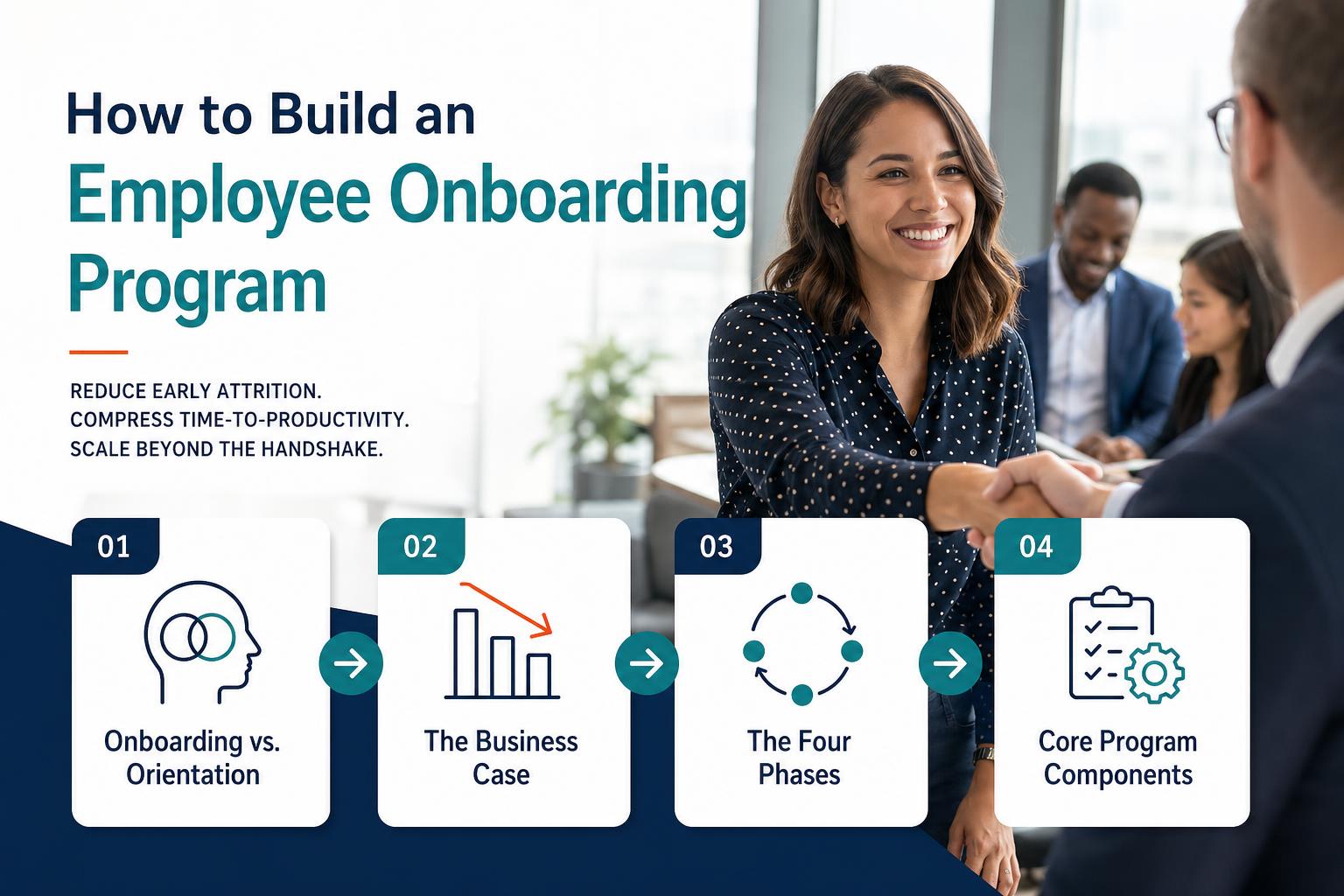
Onboarding vs. orientation: the distinction that matters
Orientation is a one-time event — typically the first day or first week — focused on administrative tasks: I-9 and W-4 completion, benefits enrollment, IT account setup, a facility tour, and a company overview. Orientation ends. Onboarding doesn’t.
Onboarding is the structured process of integrating a new employee into the role, the team, and the organization until they reach full productivity. SHRM research places that integration timeline at 8–12 months for professional roles. For most mid-market companies, what they call “onboarding” is orientation plus compliance training — and the 8–12 month integration window is left to manager initiative and chance.
The distinction matters because metrics follow from the definition. If onboarding means orientation, you measure day-one no-shows and form completion. If it means integration to full productivity, you measure time-to-contribution, 90-day retention, and readiness assessments — which connect directly to business outcomes. Most programs are measured on the wrong things because they were designed to the wrong definition.
The business case: what poor onboarding costs
The costs of poor onboarding are diffuse — distributed across turnover, productivity drag, and management overhead rather than appearing as a single line item. This diffusion is why onboarding programs are chronically under-resourced: the cost is real but it doesn’t show up anywhere obvious.
Early attrition cost
SHRM estimates the cost of replacing an employee at 50–200% of annual salary depending on seniority and role complexity. A mid-market company with 500 employees and 15% annual turnover replaces roughly 75 employees per year. If 20% of those exits happen within the first 90 days — a typical concentration for poor onboarding — that is 15 employees replaced in their first quarter, generating replacement costs of $75,000–$300,000 depending on average salary. Gallup data shows that employees with a positive onboarding experience are 2.6x more likely to be satisfied with their employer and significantly less likely to exit in the first year.
Extended time-to-productivity
The productivity ramp — the period between a new hire’s start date and the point where they produce net positive value — is the hidden cost most organizations never calculate. For a knowledge worker earning $80,000 per year, a ramp extended from 4 months to 6 months represents approximately $13,000 in unproductive salary cost before accounting for manager time invested. Across 75 annual hires, a 2-month ramp improvement is worth nearly $1M per year in recovered productive capacity.
Manager time absorption
Unstructured onboarding doesn’t eliminate the work — it transfers it to managers. When there is no program, managers fill the gap: answering repeated questions, providing context that should be documented, and running informal check-ins that are themselves inconsistent in quality and frequency. A reasonable estimate is 2–4 hours per week of manager time absorbed by each new hire in their first 90 days when no structured program exists. For a team with one or two new hires at any given time, that is a material fraction of management capacity that could be redirected to work that actually scales.
Inconsistent quality baseline
Without a structured program, onboarding quality is a function of which manager the new hire gets and how good that manager happens to be at communicating context. Two employees hired a month apart into the same role may have entirely different understandings of the job’s priorities, the team’s norms, and the organization’s expectations. This variance is the root cause of many performance management problems that surface at 6 months.
The four phases of effective onboarding
Phase 1: Pre-boarding (offer acceptance to day one)
Pre-boarding begins when the offer is accepted and ends when the employee arrives. Objectives: reduce first-day anxiety, complete administrative work before the employee arrives so day one is about the role rather than paperwork, and begin cultural integration before the first handshake.
Pre-boarding activities: welcome email from the hiring manager and team within 48 hours of acceptance, IT provisioning so accounts and equipment are ready before day one, access to a pre-start information pack (company overview, team bios, first-week schedule), and digital completion of forms that don’t require physical presence. The outcome: a new hire who arrives knowing where to go, who they’re meeting, and what to expect — rather than spending the first morning waiting for IT access.
Pre-boarding is the highest-leverage investment per hour of program design time. The anxiety-reduction effect is disproportionate to the effort, and the risk of offer retraction during the acceptance-to-start gap is highest when new hires receive no communication from the organization during that window.
Phase 2: First week (days 1–5)
The first week should deliver three things: context (what does this organization do, why does it matter, where does my role fit), connection (who are the people I depend on and who depend on me), and clarity (what am I expected to accomplish in my first 30 days and what does success look like).
Avoid packing week one with lecture-format information delivery. New hire information retention in the first week is low — the cognitive system is processing environmental novelty alongside curriculum, which degrades recall for both. Limit formal training to the highest-priority items. Prioritize role clarity and key introductions over compliance modules that can be completed asynchronously.
A 30-60-90 day plan, co-created between the manager and new hire in week one, is one of the highest-leverage onboarding tools available. It creates mutual alignment on priorities, gives the new hire a sense of control and direction, and provides the manager with a structured framework for check-in conversations that replace vague “how’s it going?” conversations with specific progress reviews.
Phase 3: First 30 days
Days 6–30 are the learning and orientation phase. The new hire is building context, establishing working relationships, and beginning to contribute at a limited scope. The manager’s role is structured weekly check-ins, clear and specific feedback on early work, and gradual expansion of responsibility as confidence builds.
Formal training should be concentrated in this window and should prioritize skills and knowledge the employee needs to begin contributing. Role-specific product knowledge, process documentation, and systems training should all be completed by day 30 — not because learning ends but because foundational knowledge must precede meaningful independent work.
Phase 4: Days 31–90
By day 31, the new hire should be contributing independently in at least some areas of their role. The focus shifts from orientation to integration: taking on real projects with increasing scope, building peer relationships across the organization, and receiving performance feedback that is specific and actionable rather than the reassuring vagueness of the early weeks.
The 90-day mark is the first meaningful performance checkpoint. A structured 90-day review — assessing both performance and onboarding program quality — closes the loop and provides the data to improve future cohorts. Most companies skip this entirely. Those that do it systematically catch flight risks earlier, have better data for improving the program, and create a natural conversation about the hire’s 6-month trajectory.
Core program components
Welcome and cultural orientation
Not a PowerPoint about company history. An effective cultural orientation answers the questions new hires actually want to know: how does work get done here, how are decisions made, what does success look like at this company, and what are the unwritten rules? These questions have no answers in a benefits handbook. The best format is direct conversation with senior leaders and peer employees in a small group setting where questions can be asked without social risk.
Role-specific training curriculum
Every role should have a documented training curriculum specifying what a new hire needs to know and be able to do within 30 days and by 90 days. This curriculum is distinct from the general onboarding program — it is owned by the hiring manager and the function, not by HR. Without it, onboarding training defaults to what is easy to deploy rather than what is actually important for the role.
The curriculum should distinguish between knowledge (what the employee needs to understand), skill (what they need to be able to do), and behavior (how they are expected to operate day-to-day). Each of these requires a different type of training intervention.
Peer buddy or mentor assignment
A peer buddy — a tenured employee in a similar role who is not the manager — accelerates informal integration in ways the program itself cannot. Buddies answer the questions new hires won’t ask their manager: how things actually work, who the key stakeholders are for a given problem, what the team norms are versus what the handbook says. SHRM data shows that new hires with an assigned buddy are 36% more likely to be highly productive by 90 days than those without one.
Buddy programs work best when the assignment is deliberate (matched by role and seniority rather than random), the buddy receives brief preparation on what their role is, and the arrangement runs for a defined period — typically 60 days — with a natural end rather than an awkward fade.
Manager check-in cadence
Weekly structured check-ins in the first 30 days; bi-weekly in days 31–90. Check-ins should follow a consistent format: how is the work going, what is going well, what is difficult, what do you need from me. The structure matters because without it, check-ins default to status updates rather than support conversations, and managers with high spans of control deprioritize them under deadline pressure. Manager check-in quality is the single biggest determinant of 90-day retention for mid-market companies.
Compliance and systems training
Required compliance training (harassment, safety, data privacy) and core systems training (HRIS, CRM, internal tools) should be assigned in pre-boarding or week one and completed by day 14. This creates the clean administrative foundation compliance requires while front-loading low-cognitive-demand tasks before the new hire is fully engaged in role work. Do not mix compliance modules with role-specific skill development in the same learning session — they are different types of learning with different cognitive demands and different retention requirements.
Onboarding for different roles
Individual contributor onboarding
IC onboarding is primarily about skill and context: what tools are used, how work is prioritized, what “good” looks like in the role’s output. The 30-day focus is knowledge and process; the 90-day focus is performance and peer integration. Manager check-ins are the primary feedback and coaching mechanism throughout. The most common IC onboarding failure is role clarity — new hires who reach day 30 without a clear understanding of how their priorities are set and how their work will be evaluated.
Manager and leadership onboarding
Manager onboarding requires a distinct curriculum. In addition to organizational context, new managers need: current state of their team including recent performance history, the performance management processes they are expected to run, their decision rights and escalation points, and a structured introduction to their direct reports that goes beyond an informal meet-and-greet.
The most common failure in manager onboarding is treating new managers like senior ICs — providing organizational context and role clarity but not the tools to manage their team from day one. A new manager who is unclear about performance management processes or their decision rights either avoids those responsibilities or improvises them, both of which are costly at scale.
AI workflow training has become a standard component of manager onboarding at forward-looking mid-market companies. A new manager who starts with a structured AI productivity framework builds habits with consistency that an ad hoc learner never achieves in the same timeframe.
Remote and hybrid new hires
Remote onboarding requires deliberate effort to replace the informal integration that happens naturally in a shared physical environment. The buddy system becomes more important, not less. Video check-ins should be more frequent in the first 30 days than they would be for tenured remote employees. Documentation becomes a structural requirement — the ambient context that would be overheard in an office needs to be written down and organized.
The most common failure in remote onboarding is treating digital delivery of the same content as equivalent to in-person delivery. It is not. Remote new hires require more structured relationship-building, more explicit communication of informal norms, and more deliberate check-in cadences to compensate for the absence of environmental context that office-based employees absorb passively.
How to measure onboarding effectiveness
Primary metrics
- 90-day retention rate: The percentage of new hires still employed at day 90. Benchmark for US mid-market professional roles: 85–90%+. Sustained rates below 80% indicate a structural problem in the onboarding program, the hiring process, or the hiring manager population — and the data by manager will tell you which.
- Manager-assessed time-to-productivity: The manager’s assessment of when the new hire reached independent contribution, measured against the target timeline in the 30-60-90 plan. Track by role and by manager to identify where ramps are consistently longer than the design expectation.
- 30-day and 90-day new hire satisfaction: A 3–5 question survey at both checkpoints measuring clarity of expectations, manager support, training quality, and likelihood to recommend the company as a good employer. This is both a program quality measure and an early retention signal — new hires who score poorly on this at day 30 are materially more likely to exit before 6 months.
Secondary metrics
- Training completion by day 14: Compliance and systems training should be complete in the first two weeks. Track this as a program execution metric rather than a learning quality metric — what it measures is process adherence, not whether the learning transferred.
- 30-60-90 plan creation rate: The percentage of new hires who have a documented 30-60-90 plan by end of week one. A low rate is a manager accountability metric, not a new hire problem.
- 6-month performance rating: Compare 6-month performance ratings for cohorts onboarded through the structured program versus historical cohorts onboarded without it. This is the clearest long-term signal of program impact and the one most credible in a CFO conversation.
Common onboarding mistakes
1. Information overload in week one
The instinct to give new hires everything they need in week one produces comprehension close to zero. New hire cognitive capacity in week one is substantially occupied with environmental novelty — there is limited bandwidth for curriculum. Prioritize ruthlessly: the five most important things a new hire needs to understand in week one are not the same as the fifty things in the onboarding checklist. What must they know to not fail in week two?
2. Manager abdication to HR
HR designs the program; managers deliver it. When managers treat onboarding as “an HR thing” and deprioritize check-ins under deadline pressure, the program quality collapses to whatever HR can deliver without manager involvement — which is the administrative and compliance layer, not the role integration layer. Hold managers accountable for onboarding participation with the same seriousness as any other management expectation. Track it, review it, and make it visible in manager performance discussions.
3. No 90-day close
Most onboarding programs fade rather than end. There is no defined completion, no structured review, and no data collected on whether the program worked. Without a 90-day close, you cannot improve the program and cannot demonstrate its value to the business. The close is also a retention intervention: a structured conversation at 90 days that asks how the employee is feeling about the role and the company will surface flight risks before they become exit interviews.
4. One-size-fits-all curriculum
A universal onboarding program is better than nothing. A general program with a role-specific curriculum layer on top is materially better. The general program handles cultural integration and administrative tasks — consistent for everyone. The role-specific layer handles the knowledge and skills needed to do the actual job, which varies by function, seniority, and team. Without the role-specific layer, new hires complete orientation but arrive in the role without the functional preparation the job requires.
5. Skipping pre-boarding
The window between offer acceptance and day one is the highest-anxiety period of the new hire experience — and the window where competing offers and second thoughts are most likely to result in a no-show. A pre-boarding sequence that takes 30 minutes to build reduces both anxiety and acceptance retraction risk at a cost that is negligible relative to the cost of re-running a search from scratch.
Sources and further reading
- SHRM, Onboarding New Employees: Maximizing Success — foundational framework for onboarding program design and time-to-productivity benchmarks for US employers
- Gallup, State of the American Workplace — research connecting onboarding experience quality to engagement, retention, and productivity at 90-day and 12-month marks
- Brandon Hall Group, State of Employee Onboarding Study — benchmark data comparing structured versus unstructured onboarding outcomes across US mid-market companies