Last updated: 30 March 2026
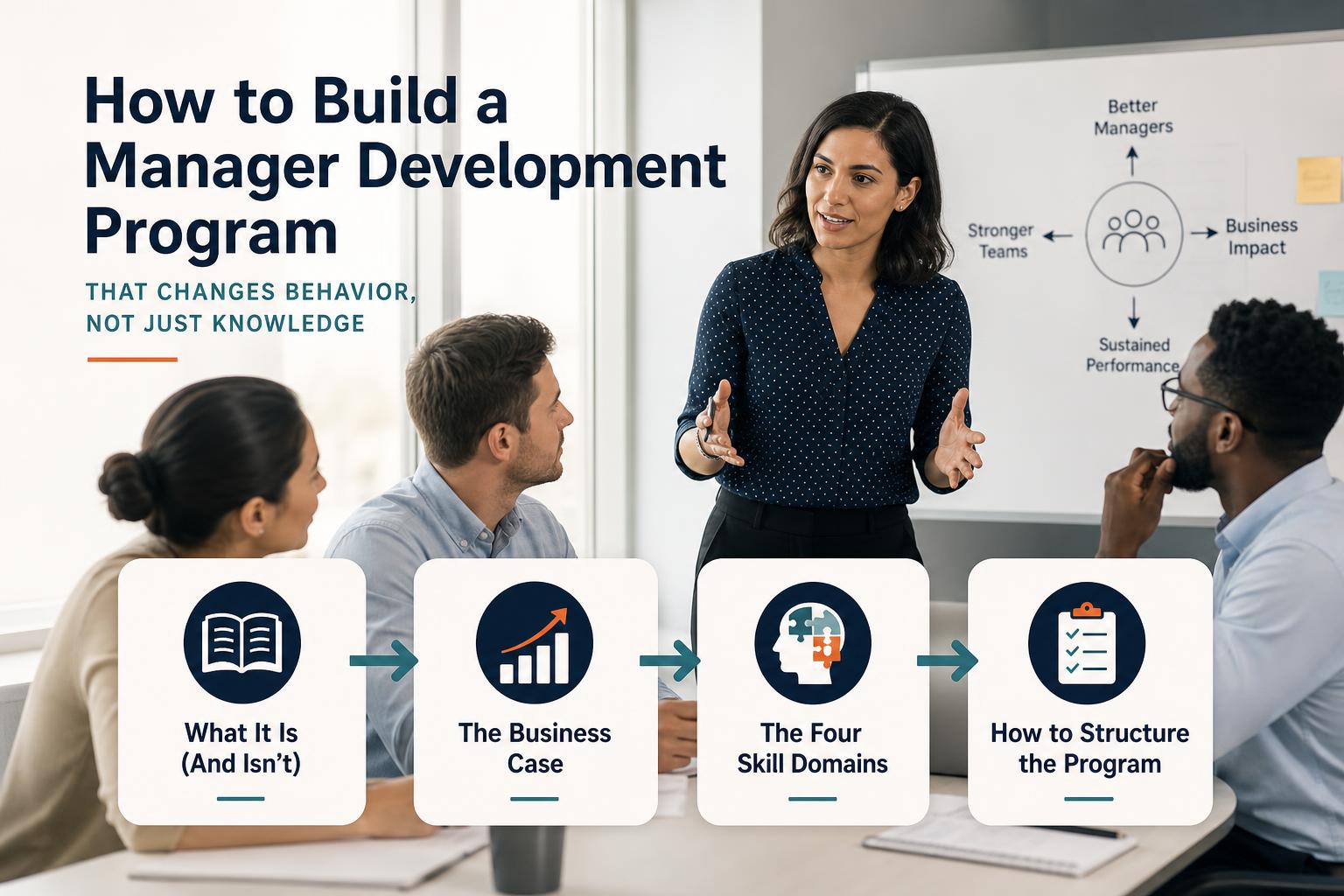
What a manager development program is (and what it isn’t)
A manager development program is a structured multi-week or multi-month learning experience designed to build the specific capabilities that enable managers to lead their teams more effectively — and to produce measurable improvements in manager behavior and team outcomes. This is distinct from a management training course, which is a single event with no sustained accountability or behavioral follow-through.
The distinction matters because the research on management training is largely discouraging: standalone training events produce short-term knowledge gains that dissipate rapidly without reinforcement and accountability structures. McKinsey research cited by HR executives consistently places the behavioral transfer rate for management training courses at 20–25% — three months after a standalone training event, 75-80% of managers are back to their prior behavior. The training budget was spent. The capability gap was not closed.
A development program addresses this by extending the intervention timeline, building in behavioral accountability, creating peer learning structures, and connecting the program to real work rather than abstract curriculum. The design goal is not to transfer knowledge about management — it is to change the daily behavior of managers in their actual role context.
The business case for manager development investment
Managers are the highest-leverage human capital investment in most organizations. Research from Gallup estimates that managers account for at least 70% of the variance in employee engagement scores — meaning that the quality of the manager population is the dominant factor in whether employees are productive, whether they stay, and whether they recommend the company to others.
Manager quality and team performance
A team with a strong manager and a team with a weak manager performing the same function with the same tools and the same resources will produce significantly different outputs. The performance gap attributable to manager quality is typically in the range of 20–40% on core productivity metrics for knowledge worker teams. For a team that generates $2M in annual revenue, a 20% performance gap attributable to manager quality represents $400,000 in unrealized value — which is a useful denominator when sizing the investment in manager development.
Manager quality and retention
SHRM data consistently shows that “my manager” is among the top three reasons employees exit voluntarily. Exit interview analysis at mid-market companies typically attributes 40–50% of voluntary exits to manager relationship problems — not to compensation, not to career opportunity, not to culture, but to a specific manager failing to provide the support, clarity, and recognition that drives retention. Improving manager capability reduces turnover directly and measurably.
The first-time manager problem
Most manager development programs in mid-market companies underinvest in first-time managers — the population with the steepest learning curve, the highest rate of behavioral failure, and the largest negative impact on team performance per capita. First-time managers are typically promoted for individual contributor excellence and receive minimal preparation for the skills that management actually requires, which are almost entirely different from the skills that drove their promotion. Targeting this population with a structured development program produces the highest return per development dollar of any management investment.
The four skill domains that move team performance
1. Clear expectation-setting and feedback
The foundation of effective management. Managers who set clear, specific, measurable expectations for their team and deliver timely, behavioral, actionable feedback produce teams with lower ambiguity, higher accountability, and faster performance improvement cycles. This is the most trainable management skill domain and the one with the most direct link to team performance variance.
Common failure patterns: expectations set at the goal level (“hit your target”) rather than the behavioral level (“here is what excellent performance in this role looks like day-to-day”); feedback delivered as evaluation (“you didn’t do this well”) rather than coaching (“here is what I observed, here is the impact, here is what would be more effective next time”). Both are correctable through structured practice with feedback.
2. One-on-one conversation quality
The weekly or bi-weekly one-on-one is the primary vehicle for manager impact on individual performance. Yet research consistently shows that the majority of one-on-ones are status updates rather than developmental conversations — the manager asks what the employee is working on, the employee reports, and both parties leave with no change in the employee’s capability or trajectory.
High-quality one-on-ones focus on three things: current performance and blockers (problem-solving mode), longer-term development and career direction (investment mode), and relationship and engagement (retention mode). Managers who run one-on-ones across all three modes consistently produce higher retention, faster performance improvement, and better employee engagement scores than managers who use the time primarily for status reporting.
3. Delegation and team capacity development
Manager bandwidth is finite. Managers who cannot or do not delegate effectively cap team productivity at their own individual capacity — they become the bottleneck rather than the multiplier. Effective delegation requires both the technical skill of matching tasks to capabilities and the psychological willingness to accept that delegated work will not be done exactly as the manager would do it.
AI workflow delegation has become a specific sub-skill in this domain at forward-looking organizations: managers who effectively identify which of their administrative workflows can be automated or augmented with AI free up a material fraction of their own capacity and model the behavior for their teams. The organizations that invest in this capability during manager development are building a compound advantage in team productivity that compounds over time.
4. Performance management and accountability
The ability to address underperformance directly, specifically, and early — before it becomes a termination conversation or a team morale problem — is one of the most poorly executed skills in most manager populations. Managers avoid difficult performance conversations because they are uncomfortable, because HR processes feel risky, and because the immediate cost of the conversation (awkwardness, potential conflict) is more salient than the deferred cost of tolerating underperformance (team morale, output quality, eventual more painful exit).
Development in this domain requires repeated practice with realistic scenarios, HR process literacy, and a framework that makes the conversation less adversarial and more productive. The organizations that invest in this skill domain systematically produce faster performance improvement cycles and lower involuntary turnover costs.
How to structure the program
Program length and cadence
Effective manager development programs run for a minimum of 8–12 weeks. This is not because learning requires 12 weeks — it is because behavioral change requires repeated cycles of learn, apply, reflect, adjust over time. A single two-day offsite deposits knowledge. A 12-week program with weekly practice assignments and bi-weekly group reflection creates the repetition and accountability loop that produces lasting behavior change.
Learning modalities
- Skill instruction: Formal content delivery covering frameworks, models, and best practices. Should represent no more than 30% of program time. The purpose is to provide shared language and conceptual scaffolding — not to fill participants with theory they won’t use.
- Practice with feedback: Role-play, simulation, and real scenario work with observer feedback. The most effective development modality for interpersonal skills. Uncomfortable for participants; non-negotiable for behavior change. Should represent 30–40% of program time.
- Peer cohort discussion: Small group reflection on real challenges from participants’ actual management work. Creates psychological safety for discussing failures, generates peer learning that instructor-led sessions cannot produce, and builds the peer support network that sustains behavior change after the program ends.
- Real work application: Weekly practice assignments that require participants to apply one specific skill in their actual role and document what they tried, what happened, and what they would do differently. This closes the theory-to-practice gap more reliably than any other program element.
Cohort design
Run programs in cohorts rather than as open enrollment. A cohort of 10–18 managers going through the program together builds peer relationships, creates group accountability norms, and produces better learning outcomes than the same content delivered to individuals on their own timeline. Cohort members who know each other and see each other regularly are more likely to sustain behavioral changes than managers who complete the same content in isolation.
Making it stick: behavior transfer and accountability
The most common reason manager development programs fail to produce behavioral change is not poor content — it is the absence of a transfer infrastructure after the program ends. When participants return to their role, the environment is the same as it was before the program. The old behavioral patterns are reinforced by habit and context. Without structural support for the new behaviors, reversion is the default outcome.
Manager of managers accountability
The most effective accountability structure for manager development is the participant’s own manager. When the program participants’ managers are briefed on the program curriculum, when they receive progress data on their direct reports, and when they hold structured conversations about program application, transfer rates increase substantially. The manager-of-managers layer is the single highest-leverage transfer mechanism and the one most consistently skipped in program design.
Post-program behavior commitments
Each program participant should leave with 2–3 specific behavioral commitments that they will sustain in their role — concrete, observable, linked to their team’s performance metrics. These commitments should be shared with their manager and reviewed at 30 and 90 days. The act of making commitments public and specific increases follow-through significantly compared to generic “I will use what I learned” intentions.
AI workflow adoption as a behavioral anchor
Manager development programs that include structured AI workflow skill building as a component create a particularly durable behavioral anchor. AI tools require repeated, consistent use to deliver productivity value — managers who adopt 3–5 specific AI workflows during the program period develop habits that persist after the program ends and that compound in productivity value over time. Unlike interpersonal skills where practice opportunities depend on situation frequency, AI workflow practice is available on demand every working day.
Measuring manager development impact
Leading indicators (during and immediately after program)
- Skill assessment score improvement: Pre- and post-program assessment on the specific skill domains the program targeted. Establishes that knowledge and self-assessed capability moved.
- Practice assignment completion: Whether participants completed weekly application assignments. A proxy for behavioral engagement with the program, not just content consumption.
- Manager satisfaction score: End-of-program rating on relevance, quality, and perceived applicability. Useful for program iteration but not a proxy for business impact.
Lagging indicators (30–90 days post-program)
- Direct report engagement scores: The most sensitive measure of manager behavioral change is the engagement score of the team being managed. Run a short engagement pulse on program participants’ teams 90 days after program completion and compare to pre-program baseline.
- Manager productivity metrics: For programs that include AI workflow and productivity components, measure admin time savings, task throughput, and workflow consistency before and after the program. These are finance-credible metrics that connect manager development investment to operational impact.
- Team retention: Voluntary turnover rate in program participants’ teams in the 12 months following the program versus the 12 months prior. Improvement here is the highest-value ROI argument for manager development investment.
Common mistakes
1. Confusing a training event with a development program
A two-day management bootcamp is not a manager development program. It is a knowledge transfer event. Run it as part of a program that provides accountability and application structures, and it has value. Run it as a standalone intervention and expect behavioral change, and you will be disappointed by the ROI conversation at six months.
2. Generic curriculum not connected to business context
Off-the-shelf management training covers generic concepts — communication styles, situational leadership models, motivation theory — that are disconnected from the specific performance challenges in your organization. The most effective programs are built around the specific management problems that are costing your organization money: your first-time manager failure rate, your team performance distribution, your management-driven retention losses. The curriculum should follow from the business problem, not from what was easy to license.
3. No post-program transfer structure
Addressed above — but worth repeating as the single most common failure point. A program without a transfer plan is a program that will produce positive participant ratings and minimal business impact. The transfer plan is not an afterthought; it is 50% of the program design.
4. Skipping first-time managers in favor of senior leaders
Senior leader development is important. First-time manager development is more important per dollar invested for most mid-market organizations. First-time managers manage the largest share of the workforce, have the steepest skill gaps, and produce the most variance in team performance and retention. Programs that focus exclusively on senior leadership are investing in the population that most likely already has development resources, at the expense of the population with the largest untapped improvement potential.
Sources and further reading
- Gallup, State of the American Manager — research on manager impact on engagement, performance, and retention in US organizations
- McKinsey & Company, Why Leadership Development Programs Fail — analysis of the structural reasons management training does not produce behavioral change and what programs that work do differently
- SHRM, Developing First-Line Managers: A Research Report — benchmark data on first-time manager development investment and ROI in mid-market US companies