Last updated: March 7, 2026
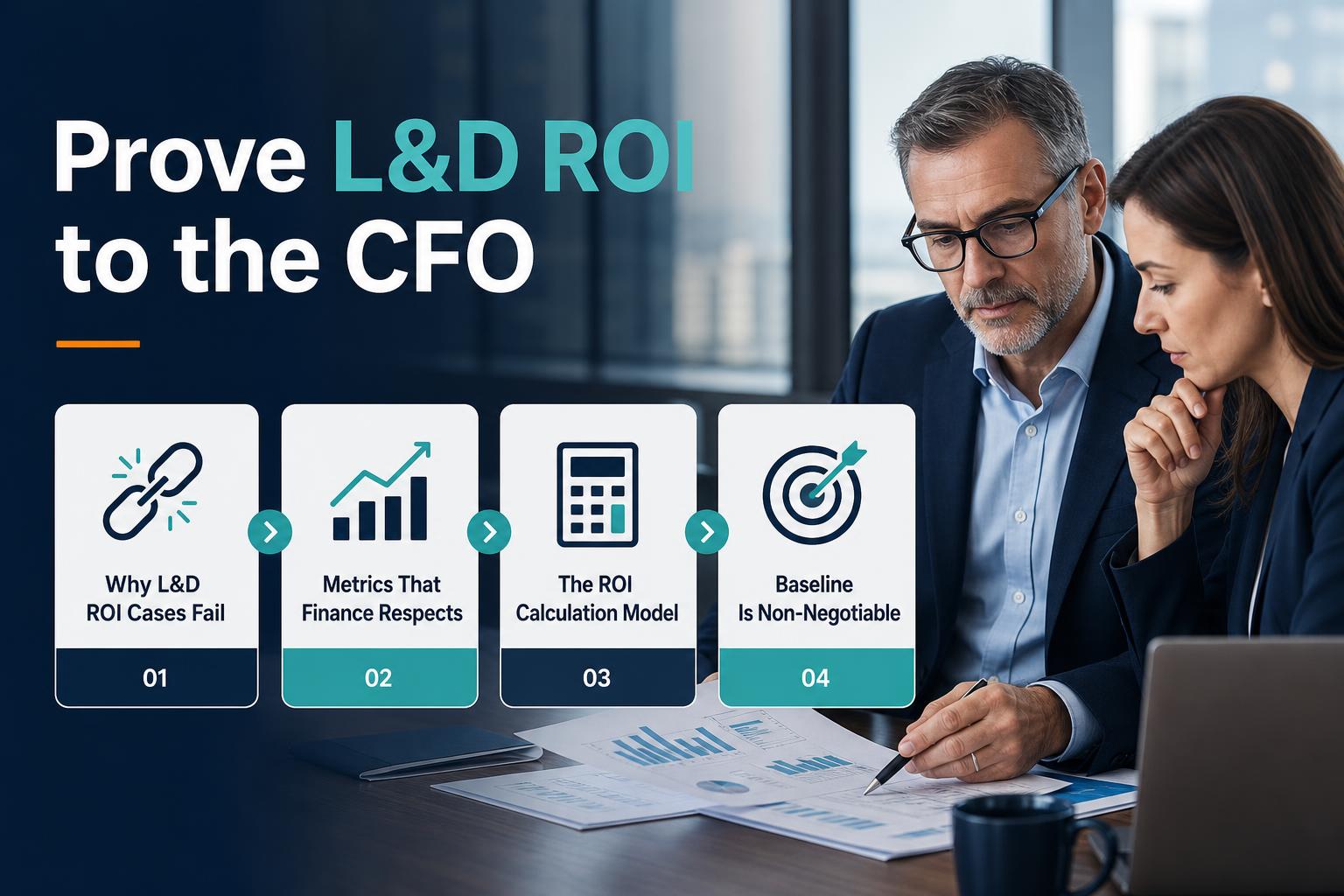
Why L&D ROI cases fail with finance
Most L&D ROI presentations fail because they present the wrong type of evidence. L&D leaders bring completion rates, learner satisfaction scores, and hours of training delivered. Finance leaders are looking for revenue impact, cost reduction, or productivity improvement expressed in dollars.
These are fundamentally different conversations. L&D is presenting inputs. Finance wants outputs.
The second failure mode is the attribution gap. Even when L&D leaders present outcome data — employee retention improved, promotion rates increased — finance reasonably asks: how do you know the training caused that? The attribution is weak, the lag time is long, and the confounding factors are many. CFOs who have seen this argument before are appropriately skeptical.
The third failure mode is presenting a projection model rather than observed data. "Our training program will save X hours and produce Y dollars of value" is a forecast, not evidence. Finance approves forecasts cautiously and cuts them first when budgets tighten. Finance defends observed results.
Solving all three failure modes requires a different approach to measurement — one that produces business-unit-level outcome data with clear attribution and a before/after structure that eliminates the "would have happened anyway" objection.
The metrics that finance actually respects
Not all L&D metrics translate to finance. These do:
Manager time recaptured (hours → dollars)
If AI workflow training reduces manager admin time by two hours per week for a cohort of 50 managers, that is 100 hours per week of recaptured capacity. At a fully-loaded manager cost of $75/hour, that is $7,500 per week — $360,000 per year. This is a direct cost-avoidance figure that finance can validate against payroll data. It doesn't require attribution assumptions. It requires a before/after time measurement.
Error and rework reduction
If training reduces the error rate in a high-volume process — a sales pipeline review, a customer onboarding workflow, a compliance checklist — the cost of the errors avoided is directly calculable. This requires knowing the average cost of an error before training (rework time, escalation time, customer impact) and measuring the error rate before and after.
Onboarding speed improvement
Reducing time-to-full-productivity for new hires by two weeks for a cohort of 20 hires per year at a fully-loaded cost of $60,000 per hire equates to approximately $46,000 in productivity value recovered. This is a measurable figure that finance can verify against hiring and onboarding data.
Retention impact (where attribution is possible)
Retention ROI calculations are credible when: the training was targeted at a specific cohort (not company-wide), the retention rate for the cohort can be compared to a comparable cohort that didn't receive training, and the cost-per-turnover figure used is conservative and defensible. The fully-loaded cost of replacing a mid-level manager (recruiting, onboarding, ramp time) is typically 50–150% of annual salary — a defensible assumption that finance will recognize.
What finance will not accept
Employee satisfaction scores, training completion rates, Net Promoter Scores from post-training surveys, and any metric that describes the training experience rather than a business outcome. These belong in an internal L&D dashboard, not a CFO presentation.
The ROI calculation model
The L&D business case generator assembles these inputs into a structured case you can take to finance, using the metrics described above.
The standard ROI formula applies directly to L&D when inputs are measured correctly:
ROI (%) = ((Benefit – Cost) / Cost) × 100
For a manager AI productivity program:
- Benefit: Hours saved per manager per week × number of managers × 48 weeks × fully-loaded hourly rate
- Cost: Program fee + internal time investment (L&D team hours × cost) + manager workshop time (hours × fully-loaded manager cost)
Example calculation for a 50-manager cohort:
- Benefit: 2 hrs/week × 50 managers × 48 weeks × $75/hr = $360,000/year
- Cost: $25,000 pilot fee + $8,000 internal L&D time + $12,500 manager workshop time = $45,500
- Year 1 ROI: (($360,000 – $45,500) / $45,500) × 100 = 691%
- Payback period: $45,500 / ($360,000/12) = 1.5 months
A 691% ROI sounds implausible to a CFO seeing a projection model. It is entirely credible as a result from a structured pilot with observed before/after data. The conversation changes when you replace the projection with a scorecard showing actual measured time savings from a real cohort at your company.
Why baseline measurement is non-negotiable
The single most important thing you can do to make an L&D ROI case credible to finance is measure a baseline before the program starts. Without a baseline:
- You cannot demonstrate change — only assert it
- The CFO has no anchor for evaluating whether the claimed improvement is plausible
- Any positive outcome can be attributed to factors other than the training (the "would have happened anyway" objection)
- You cannot improve the program — you don't know which elements drove results
A structured time audit takes 20 minutes per manager. For a 50-manager cohort, this is approximately 17 hours of total time investment. This is the lowest-cost insurance policy available for protecting your L&D budget.
The baseline does not need to be exhaustive. Three to five specific measurements suffice: total weekly admin hours, time to complete two or three standard recurring tasks (status report, 1:1 prep, data aggregation), and current AI tool usage frequency. A repeat measurement at the end of the program produces the before/after comparison that makes the ROI case credible.
How to present L&D ROI to the CFO
Structure your presentation around the CFO's decision, not your program narrative:
Slide 1: The business problem in their language
"Our 50 operations managers spend an estimated 14–18 hours per week on administrative work that doesn't require their judgment. At a fully-loaded cost of $75/hour, this represents approximately $1.8M–$2.3M per year in manager capacity currently allocated to automatable tasks."
This establishes the problem in financial terms before you present the solution. A CFO who has just been shown a $2M cost figure is receptive to a $45K intervention that captures a fraction of it back.
Slide 2: What we measured (the baseline)
Show the time audit results. Average admin hours per manager per week. Time per standard task. Current AI tool usage rate. This is your credibility slide — it shows you measured before you acted, which immediately differentiates your program from the typical L&D "we ran a course and think it helped" narrative.
Slide 3: What changed (the outcome)
Show the before/after comparison per KPI. Admin hours per week: before X, after Y, delta Z%. Specific task times: before, after, delta. AI adoption rate at week four. Use actual numbers from your pilot, not projections.
Slide 4: The financial value
Convert the time delta to dollars. Show the calculation transparently so the CFO can validate the inputs. Present the ROI percentage and the payback period. Include a sensitivity table: at the low end of measured savings (say 12% rather than 22%), what is the ROI? It should still be strongly positive.
Slide 5: The expansion recommendation
"Based on the pilot results, expanding to our full operations function (150 managers) would produce approximately $X in annual value at a total cost of $Y." This is the scale proposition. If the CFO approves the expansion, your program budget is secured for the year.
The pilot model that makes ROI provable
The reason most L&D ROI cases fail isn't methodology — it's that the program was deployed at scale before any ROI evidence was generated. A full-company rollout produces no clean before/after data because there's no control condition and the deployment lag makes attribution impossible.
A structured pilot — 25–50 managers, four weeks, clear KPI commitments, baseline measurement, weekly tracking, end-of-sprint readout — produces exactly the data structure that a CFO can evaluate. The pilot is small enough to be low-risk and fast enough to produce results before the next budget cycle.
TIQPlus's AI Manager Productivity Sprint is designed around this model. Fixed scope, fixed fee, KPI commitments before you sign, and a finance-ready executive readout at week four. The pilot is the ROI proof before the scale investment — not the other way around.
Sources and further reading
- Jack Phillips, Return on Investment in Training and Performance Improvement Programs — foundational ROI methodology
- ATD, State of the Industry Report 2025 — US L&D spending and measurement benchmarks
- Deloitte, Global Human Capital Trends 2025 — L&D investment and CFO alignment research