Last updated: 7 March 2026
Why traditional skills gap programs fail mid-market teams
Most skills gap programs in mid-market companies fail for three reasons that have nothing to do with content quality or budget size:
They measure inputs, not outcomes
Completion rates and training hours are the most commonly reported metrics in L&D — and they correlate poorly with actual skill change. A manager who completed a 4-hour leadership development course but returns to the same communication patterns the next week has not closed any gap. The measurement system is telling the organization the problem was addressed when it wasn't.
They target the wrong gaps
Most skills gap assessments are conducted annually via a survey of managers and employees rating their own confidence across a competency framework. This produces data that reflects perceived confidence gaps — which may or may not be the same as the gaps that are actually costing the business performance. The most expensive skills gaps are often invisible in self-reported assessments because people don't know what they don't know.
The development-to-application gap is too long
A five-day management development program in Q1 is expected to change how managers perform in Q3 and Q4. By the time the skill is needed, the training content is stale, the application context is different, and the manager has reverted to default behavior. For fast-moving skills like AI tool adoption, a six-month development cycle is approximately five months too slow.
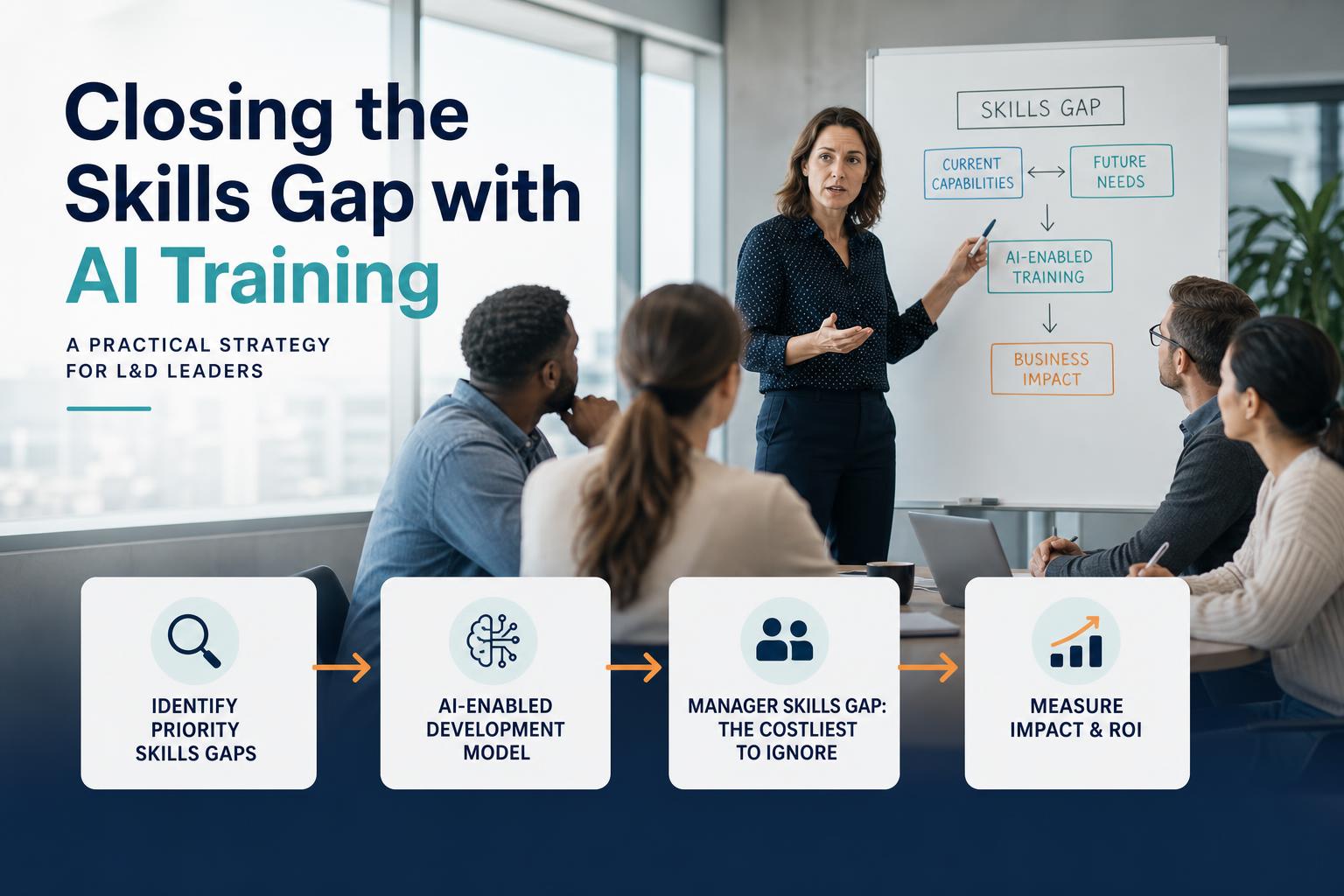
Identifying which skills gaps to prioritize
Not all skills gaps have equal business impact. Before investing in any development program, rank your gaps on two dimensions: business criticality (what happens to performance if this gap is not closed in the next 12 months?) and closure speed (how quickly can this gap realistically be closed with the right intervention?).
High-priority gaps: critical and closeable quickly
These are the gaps worth the most investment. Examples for most US mid-market companies in 2026:
- AI workflow adoption. Managers who are not using AI tools consistently and correctly are slower, produce less consistent output, and will increasingly struggle to manage the workload expectations of a leaner organization. This gap is real, material, and closeable in 4–8 weeks with the right workflow-embedded approach.
- Data-driven decision making. Mid-level managers who can't read a dashboard, interpret a trend, or frame a decision recommendation in quantitative terms are a growing bottleneck in organizations relying on data to operate efficiently.
- Cross-functional communication. As organizations flatten and matrix structures become more common, managers who can't communicate effectively across functions create decision delays that compound into significant throughput loss.
Lower-priority gaps: important but slow to close
Strategic thinking, executive presence, and complex negotiation are real skills gaps for many mid-market managers — but they close slowly, require sustained investment, and are difficult to measure with sufficient precision to satisfy a CFO. Don't lead with these when building a business case.
How AI changes the skills development model
AI-enabled skills development is not primarily about AI delivering training content. The more important application is using AI to create shorter feedback loops between skill development and skill application — collapsing the development-to-application gap from months to days.
Workflow-embedded skill practice
Instead of learning a communication framework in a workshop and then trying to apply it three weeks later in a different context, managers can practice the framework immediately by using AI-assisted drafting in real work situations. The AI provides structure; the manager provides judgment; the output is a real work product that the manager can see is better than what they would have produced unassisted.
This is faster skill transfer than any classroom model because the learning happens in the exact context where the skill will be applied — and the manager gets immediate positive reinforcement from seeing the output quality improve.
Consistent skill application across a cohort
One of the hardest problems in skills development is that training an individual doesn't produce consistent performance at a team level. Managers attend the same workshop and leave with different interpretations of the same framework — so performance variation persists.
AI workflow prompts, when standardized by role and shared across a manager cohort, produce a level of application consistency that workshop-based training cannot. The same prompt produces comparable outputs regardless of which manager uses it — creating a floor of quality that doesn't exist with purely human application of a framework.
Faster identification of lagging skill application
AI tools used consistently generate usage data that traditional training doesn't: which workflows are being used, how often, at what quality. This allows L&D teams to identify which managers are applying new skills and which are not — in real time, not at the next annual assessment.
The manager skills gap: the most expensive one to ignore
In most mid-market organizations, the single highest-value skills gap to close is not a technical skill or a domain skill — it's the gap in manager effectiveness. Managers are the primary lever for employee retention, team productivity, and the translation of strategy into daily execution. A 10% improvement in manager effectiveness at scale produces measurably more value than a 10% improvement in most other skills categories.
The specific manager skills gap that AI can close fastest in 2026 is AI workflow competence: the ability to integrate AI tools into daily workflows consistently, at a quality standard that improves output rather than introducing errors or inconsistency.
The data on this gap is significant. Research consistently shows that most managers are aware of AI tools and have experimented with them — but only a minority are using them systematically in a way that produces time savings or output improvement. The gap is not knowledge (most managers know AI tools exist) — it's structured application (most managers don't have role-specific workflows that make AI use reliable and consistent).
Closing this gap in a manager cohort of 25–50 people is achievable in 30 days with the right workflow-embedded approach. Measured time savings of 15–25% of admin time are achievable within the pilot window — producing a ROI case that is concrete enough to support further investment.
Building an AI-enabled skills gap program
Step 1: Identify your highest-priority gap with business evidence, not survey data
Before starting, get agreement from operations and finance on which skills gap is costing the most. For AI workflow adoption, the evidence is usually: how many hours per week are managers spending on automatable tasks? What is the dollar value of that time? If the answer to the second question is over $200,000 per year for a 50-person cohort, you have a business case that finance will understand.
Step 2: Design workflow-embedded practice, not a training event
For each target skill, design a specific workflow that allows managers to practice the skill in a real work context with AI support. For AI workflow adoption, this means creating role-specific prompt templates for the three to five highest-value use cases in each manager role. For data-driven decision making, it means creating an AI-assisted analysis framework that managers use in actual project or reporting contexts.
Step 3: Run a structured pilot with KPI measurement
Deploy the workflow with a cohort of 25–50 managers, measure before and after across the target KPIs, and produce a readout that quantifies the gap closure in terms the CFO can use. This pilot is your funding mechanism for the broader program: the before-and-after data replaces the theoretical ROI model with observed evidence.
Step 4: Expand by function with the pilot model as the template
Rather than rolling out to the whole organization at once (slow, expensive, hard to attribute), expand function by function using the pilot structure as the template. Each function cohort generates its own before-and-after data, which builds a growing body of evidence for the program and allows you to adapt the workflows for function-specific contexts.
Measuring skills gap closure — what actually matters
For an AI workflow skills gap, the metrics that matter to the business are behavioral, not attitudinal:
- Workflow adoption rate: What percentage of the target manager cohort is using the AI workflows at least three times per week at week four?
- Time to complete standard tasks: Has report production time, 1:1 prep time, or communication drafting time measurably reduced?
- Output quality consistency: Are outputs from across the cohort more consistent at week four than at baseline — or is quality still widely variable?
- Regression rate: At week eight (four weeks post-pilot), are managers still using the workflows at the same rate as week four, or has adoption dropped? Sustained adoption is the signal that the skill has transferred, not just been borrowed for the duration of the program.
What does not belong in a skills gap closure measurement report: training completion rates, satisfaction scores, and self-reported confidence ratings. These are inputs, not evidence of gap closure. Leadership teams that have been burned by previous training programs that showed high completion and satisfaction but no business impact are increasingly skeptical of these metrics — and rightly so. Outcome data is what changes the conversation.
Sources and further reading
- World Economic Forum, Future of Jobs Report 2025 — skills gap and workforce transition data
- Deloitte, 2025 Global Human Capital Trends — L&D investment and ROI research
- LinkedIn Learning, Workplace Learning Report 2025 — US L&D benchmark data