Last updated: 15 July 2026
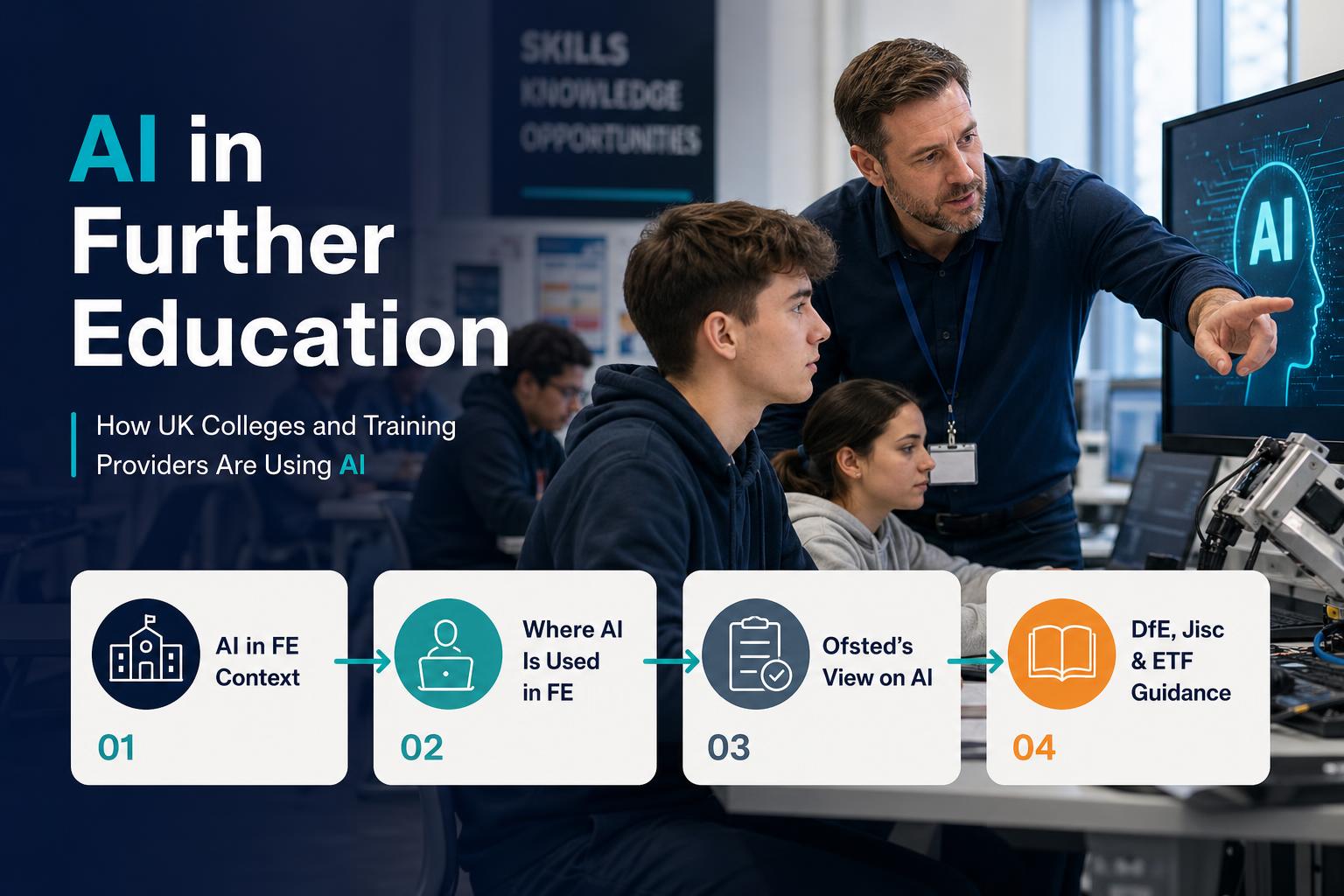
The further education sector in the UK is at an inflection point with artificial intelligence. According to the Education and Training Foundation (ETF) and Jisc’s joint research, 85% of FE senior leaders believe AI will significantly change the sector within three years. Yet frontline adoption remains uneven, governance frameworks are still being built, and inspectors are watching closely.
This guide is for FE college leaders, training provider managers, curriculum directors, and quality assurance professionals who want a clear, evidence-based picture of where AI is being used in FE, what the regulatory environment looks like, and how to move forward without creating new risks.
The AI Transformation in FE: Context
The FE sector has always been resource-constrained relative to the expectations placed on it. Providers are asked to deliver high-quality, Ofsted-ready teaching and learning across diverse cohorts, maintain impeccable ILR data, manage complex employer relationships, and run efficient operations — all within funding envelopes that have been under pressure for years.
AI does not solve the funding problem. But it does offer the prospect of doing more of the administrative and analytical work that currently consumes tutor and manager time, freeing human capacity for the work that genuinely requires it: building relationships, exercising professional judgement, and supporting learners through complex personal circumstances.
Jisc’s FE and Skills Digital Experience Insights surveys have tracked AI adoption since 2023. The pattern is consistent: senior leaders are more optimistic about AI’s potential than frontline staff; staff who have used AI tools tend to be more positive than those who haven’t; and the biggest barrier to adoption is not scepticism but the absence of structured guidance, training, and governance frameworks from leadership.
85% of FE senior leaders surveyed by ETF and Jisc believe AI will significantly change the sector within three years. Yet fewer than a third report having a formal AI strategy or governance policy in place.
Where AI Is Being Used in FE Right Now
AI applications in FE are not a future prospect. They are already in use across six distinct functional areas. The maturity and prevalence varies considerably, but providers at the leading edge are deploying AI across all six simultaneously.
1. Learning Management: Personalised Pathways and Adaptive Content
Traditional LMS platforms deliver content to all learners in the same sequence at the same pace. AI-enhanced learning management changes this fundamentally. Modern platforms can analyse a learner’s prior knowledge, assessment performance, and engagement patterns to recommend which content to tackle next, surface additional resources when a learner is struggling, and adjust the pace and sequencing of a programme to match individual needs.
For apprenticeship providers in particular, this matters. Apprentices arrive with widely varying prior attainment, work at different speeds, and have limited time for off-the-job learning. An adaptive learning management system can ensure that every hour of OTJ time is spent on material that is genuinely stretching for that individual learner, rather than covering ground they have already mastered.
AI-generated progress nudges — automated messages triggered when a learner has not engaged with material for a defined period — have shown measurable impact on completion rates in early provider pilots. These are not replacements for tutor contact; they are triggers that prompt human follow-up at the right moment.
2. Assessment and Feedback: AI Marking Assistance and Evidence Tagging
AI marking assistance is one of the most contested applications of AI in education, and for good reason. Fully automated marking of high-stakes qualifications raises serious questions about validity, reliability, and fairness. But AI-assisted marking — where AI provides a first-pass analysis that a human tutor then reviews, adjusts, and approves — is a different proposition.
In practice, the most valuable AI applications in assessment are not about marking at all. They are about evidence management. For apprenticeship providers, the task of mapping learner-produced evidence to KSBs (Knowledge, Skills, and Behaviours) is time-consuming, error-prone, and adds no pedagogical value. AI tools that can analyse a piece of evidence and suggest which KSBs it demonstrates — flagging for tutor review rather than making autonomous decisions — can dramatically reduce the administrative burden on assessors.
Automated feedback on written work is a related application. AI can provide immediate, formative feedback on draft assignments — pointing out structural issues, factual gaps, or areas where argument is underdeveloped — at a point in the learning cycle when tutor bandwidth is not always available. The critical requirement is that this feedback is positioned as a learning tool, not a marking service, and that assessment integrity safeguards are in place to ensure that the work submitted for formal assessment is the learner’s own.
3. Learner Support: Early Warning Systems and Chatbot Admin
Learner retention is one of the most significant challenges in FE. Withdrawals are costly for providers, damaging for learners, and have systemic consequences for funding. Research consistently shows that withdrawal is rarely sudden — it is preceded by a pattern of declining engagement, attendance, and performance that, if spotted early, can be addressed through targeted intervention.
AI-powered early warning systems analyse multiple data streams — attendance records, assessment submission patterns, portal login frequency, tutor note sentiment — to generate at-risk scores for individual learners. The best implementations translate these scores into prioritised intervention queues for personal tutors, ensuring that the learners most at risk receive proactive contact at the moment it can make the most difference.
Chatbot support for administrative queries represents a lower-stakes but high-volume application. Learners regularly contact providers with questions about timetables, deadlines, funding, and processes. Handling these at scale through human staff is inefficient; routing them through an AI chatbot that can answer common questions instantly and escalate complex queries to the right person frees staff time without degrading the learner experience.
Early warning systems should surface risk indicators for human review, not trigger automated interventions without staff involvement. Decisions about learner welfare always require human judgement — AI provides the data to inform that judgement, not a substitute for it.
4. Operations and Compliance: ILR, OTJ, and Data Quality
The administrative compliance burden in FE is substantial. ILR (Individualised Learner Record) data must be accurate and submitted to the applicable timetable; errors can affect funding. For apprenticeships, planned and actual off-the-job training must be recorded and supported under the rules that apply to the learner, including the standard-specific minimum for newer starts. These are not glamorous applications of AI, but they may be among the highest-value ones.
Tools can check ILR data against the current Submit Learner Data validation rules and flag anomalies before submission. They can also help staff compare apprenticeship activity with the planned and actual off-the-job training recorded under the applicable funding rules. These are prompts for reconciliation and human review; an automated match does not prove funding-rule or inspection compliance.
Timetabling optimisation is a further area where AI is beginning to show value: analysing room availability, staff specialisms, learner group requirements, and employer constraints to generate timetable options that a human scheduler then reviews and approves.
5. Marketing and Recruitment: Lead Scoring and Personalised Journeys
AI in FE marketing is perhaps the least discussed application but increasingly significant for providers operating in competitive markets. AI-driven lead scoring analyses enquiry data to predict which prospective learners are most likely to enrol — allowing recruitment teams to prioritise their follow-up effort on the leads most likely to convert.
Chatbot enquiry handling on provider websites allows prospective learners to get information about programmes, funding, and entry requirements at any time, with the conversation transcript and contact details passed to the recruitment team for personalised follow-up. Personalised recruitment journeys — tailoring the information and communications a prospective learner receives based on their interests and behaviour — are also being trialled by larger college groups.
6. Content Creation: AI-Assisted Curriculum Development
Generative AI tools are being used by FE practitioners to accelerate curriculum development, lesson plan generation, and resource creation. The ETF’s digital skills development programmes have documented tutors using AI to produce first drafts of scheme of work documents, generate case study scenarios for vocational programmes, and create differentiated versions of learning resources for learners with different needs.
The governance requirement here is clear: AI-generated content must be reviewed, adapted, and quality-assured by a human professional before use. The risk of factually incorrect, contextually inappropriate, or pedagogically weak content passing through to learners without adequate review is real and must be addressed through workflow design, not just policy statements.
What Ofsted Thinks About AI in FE
The current further education and skills inspection toolkit is concerned with the quality and impact of provision rather than approving particular technology products. A provider using AI should still be able to explain its curriculum, assessment, feedback and learner-support decisions with reliable evidence.
However, Ofsted has made its concerns clear in published commentary and HMCI speeches. The key concerns are:
Assessment integrity. Where a learner submits generated material as their own contrary to the applicable rules, follow the awarding or assessment organisation’s malpractice process. Use clear policies and reliable authentication methods; AI-detector scores alone are not proof.
Feedback quality. If AI-generated feedback is shallow, generic, or simply incorrect, and tutors pass it through to learners without review, the quality of education suffers. Inspectors look at the actual feedback learners receive — if it is clearly templated and unhelpful, that will be a finding regardless of whether a human or an algorithm produced it.
Over-reliance on AI in learner support. Vulnerable learners need human relationships. An at-risk alert system that generates an automated email rather than a human phone call is not adequate pastoral support. Ofsted’s concern is that providers use AI to scale efficiency without inadvertently scaling out the human contact that at-risk learners most need.
Inspectors assess outcomes and quality, not tools. If AI helps you deliver better teaching, more timely support, and more accurate data, it will be reflected in your inspection outcomes. If AI is used to cut corners in ways that harm learner experience, that will also be reflected.
DfE and DSIT Guidance on AI in Education
The Department for Education published “Generative AI in Education: Considerations for Use” guidance in 2023, with subsequent updates. The guidance applies to all educational settings in England, including FE providers. It is principles-based rather than prescriptive, and it establishes five key themes:
- Responsibility: Educational professionals remain responsible for the quality and appropriateness of all content and decisions, regardless of AI involvement.
- Data protection: document the purpose, lawful basis, roles, data flows, retention and individual-rights handling. Put processor terms in place where required and complete a DPIA where the processing is likely to result in high risk.
- Accuracy: AI outputs must be verified before use; providers are not protected from quality failures because AI was involved.
- Transparency: Learners should generally understand when AI tools are involved in their learning experience.
- Equity: AI must not be deployed in ways that disadvantage particular groups of learners.
DSIT’s AI Opportunities Action Plan (2025) signals the government’s intent to accelerate AI adoption across public services including education. For FE providers, this creates a policy tailwind for responsible AI adoption — but the word “responsible” is doing significant work. Providers that can demonstrate a principled, governed approach to AI will be better positioned than those that treat it as a consumer technology free-for-all.
What the Jisc and ETF Research Shows
Jisc’s annual FE and Skills Digital Experience Insights survey is the most comprehensive longitudinal dataset on technology adoption in the sector. Key findings relevant to AI:
- Around half of FE learners report using AI tools for their studies, with generative AI tools (ChatGPT, Copilot) dominant among those who do.
- Staff AI adoption lags learner adoption — a reversal of the traditional pattern where staff use technology before learners.
- The most cited barrier to staff AI adoption is not scepticism but lack of training and lack of clarity about what is and isn’t permitted.
- Providers with a named digital lead (e.g., a Director of Digital Learning) show significantly higher rates of structured AI adoption than those without.
The ETF’s work on digital and AI skills for FE practitioners has identified a substantial CPD gap. Many FE tutors have the curiosity and willingness to engage with AI tools but lack the structured development opportunities to build genuine competence. The ETF’s Digital Teaching Professional Framework provides a progression pathway from digital awareness to advanced AI-enhanced practice that providers can use to structure their staff development approach.
The Four-Stage AI Adoption Model for FE Providers
Providers that have successfully integrated AI into their operations tend to move through four recognisable stages:
Stage 1 — Awareness. Leadership and staff understand what AI is, what it can and cannot do, and what the governance requirements are. An AI strategy or policy is drafted. Staff are given time and resource to explore tools in low-stakes contexts. No procurement has happened yet.
Stage 2 — Experimentation. Selected teams or curriculum areas pilot specific AI tools against defined use cases. Pilots are time-limited, evaluated against clear criteria, and documented. Put appropriate contracts, acceptable-use controls and, where the risk threshold is met, a DPIA in place before live personal data is used.
Stage 3 — Integration. Proven AI tools are integrated into standard workflows and systems. Staff receive structured training on the specific tools they will use. Processes are redesigned to incorporate AI in ways that genuinely add value rather than adding steps. Quality assurance arrangements are updated to cover AI-assisted processes.
Stage 4 — Optimisation. AI use is continuously monitored and evaluated. Staff AI literacy is developed systematically. New use cases are regularly assessed. The provider contributes to sector learning through networks and sharing.
Most FE providers are currently at Stage 1 or early Stage 2. The providers likely to achieve competitive advantage from AI are those that move to Stage 3 with governance rigour — not those that move fastest without it.
Common Failure Modes
For every provider that has successfully integrated AI, there are others that have encountered significant problems. The most common failure modes are:
AI replacing human judgement in learner support. A provider implements an at-risk alert system and responds to high-risk flags with automated emails rather than human contact. Vulnerable learners receive less support than before, withdrawal rates do not improve, and the system is quietly abandoned. The lesson: AI in learner support must augment human capacity, not substitute for it.
AI-generated coursework without assessment integrity safeguards. A provider deploys an AI writing assistant to help learners with assignments without simultaneously designing assessments that require demonstrated competence rather than written output. Learners submit AI-generated text, assessors cannot distinguish it from genuine work, and qualification validity is compromised.
Tool sprawl without governance. Individual members of staff adopt AI tools they have found independently — consumer chatbots, free image generators, AI transcription tools — without any central awareness, data protection review, or quality oversight. Learner data is inadvertently shared with third-party AI systems. The provider has no visibility of the risk it is carrying.
What Training Providers Should Do Now
The providers that will benefit most from AI over the next three years are those that build sound governance foundations now, before the technology landscape stabilises. Specifically:
Establish an AI governance policy. This does not need to be lengthy. It needs to cover: which tools are approved for use, what types of data can and cannot be input into AI tools, what quality assurance requirements apply to AI-assisted outputs, and how incidents involving AI are reported and reviewed.
Invest in staff AI literacy. The ETF’s Digital Teaching Professional Framework and CPD programmes provide a structured route. Staff need to understand not just how to use specific tools but how to exercise professional judgement about when and whether to use them.
Build learner AI literacy into programme design. Learners are using AI tools whether or not their provider has a policy about it. Programmes that explicitly address AI literacy — helping learners understand what these tools are, how to use them productively, and why unverified AI output is a professional risk — are preparing learners for the workplace they will actually enter.
How TIQPlus Uses AI Responsibly in Apprenticeship Delivery
TIQPlus applies AI across three core functions in apprenticeship delivery: evidence tagging, progress tracking, and at-risk learner identification. In each case, the design principle is the same: AI surfaces information and recommendations; humans make decisions.
AI-assisted evidence tagging analyses apprentice-submitted work and suggests KSB mappings for tutor review. Tutors approve, modify, or reject the suggested mappings. The AI does not make final assessments; it reduces the time tutors spend on the administrative task of initial mapping, freeing them to focus on the quality and depth of the evidence itself.
Progress tracking uses AI to analyse engagement patterns, assessment performance, and OTJ hours accumulation across a caseload, generating a prioritised view of which apprentices need tutor attention this week. Again, the tutor decides what action to take — the AI ensures they are looking at the right learners at the right time.
At-risk alerts flag learners whose engagement and performance patterns suggest elevated withdrawal risk. The alert triggers a human follow-up — a phone call or visit from the personal tutor — not an automated communication.
FE Provider AI Readiness Checklist
Use this checklist to assess your organisation’s current AI readiness across five domains.
Governance
- AI strategy or policy document exists and is approved by leadership
- Approved and prohibited AI tools list is in place
- Data Protection Impact Assessments completed for AI tools processing learner data
- Data processing agreements in place with AI tool vendors
- AI incident reporting process defined
Delivery
- AI-assisted content creation outputs are reviewed and quality-assured before use
- Assessment design accounts for AI-generated work (assessment integrity safeguards in place)
- Learners are informed where AI tools are used in their learning experience
Assessment
- Academic integrity policy updated to address generative AI
- AI-assisted marking or evidence tagging requires human review and approval
- Assessment validity is periodically reviewed in light of AI capability changes
Staff Development
- Staff AI literacy needs have been assessed
- Structured CPD programme for AI skills is available to all staff
- Staff know what tools are approved and what the governance requirements are
Learner Support
- At-risk learner identification system in place with human escalation protocol
- Learner AI literacy addressed within programme design
- Chatbot or automated enquiry handling reviewed for accuracy and updated regularly
Frequently Asked Questions
What is DfE’s guidance on AI in further education?
The Department for Education published “Generative AI in Education” guidance that applies to all educational settings including FE providers. It is principles-based, emphasising professional responsibility, data protection, accuracy, transparency, and equity. It does not prescribe specific tools or prohibit AI use, but it makes clear that providers remain responsible for quality and compliance regardless of AI involvement. The guidance has been updated since initial publication as the technology and regulatory landscape has evolved.
How is AI used in FE colleges right now?
AI is being used in FE across learning management (personalised pathways, adaptive content), assessment (evidence tagging, AI-assisted feedback), learner support (early warning systems, chatbot admin), operations (ILR data quality, OTJ tracking), marketing (lead scoring, enquiry chatbots), and content creation (curriculum development, lesson planning). Adoption is uneven: leading providers have integrated AI across multiple functions with governance frameworks in place; others are at awareness or early experimentation stages.
What does Ofsted think about AI in teaching and assessment?
Ofsted does not assess tool choices. Inspectors look at the quality of education, the effectiveness of feedback, and the validity of assessment — all of which can be affected by AI use, positively or negatively. Ofsted’s published concerns centre on assessment integrity (AI-generated learner work), feedback quality (AI-generated feedback without adequate tutor review), and learner support (over-reliance on automated communications instead of human relationships). Providers that use AI to genuinely improve quality will see that reflected in inspection outcomes.
Sources & further reading
- Department for Education - Generative AI in Education: Considerations for Use (GOV.UK) — Department for Education - Generative AI in Education: Considerations for Use (GOV.UK)
- Jisc - FE and Skills Digital Experience Insights Survey (jisc.ac.uk) — Jisc - FE and Skills Digital Experience Insights Survey (jisc.ac.uk)
- Education and Training Foundation - Digital and AI in FE (etfoundation.co.uk) — Education and Training Foundation - Digital and AI in FE (etfoundation.co.uk)