Last updated: 19 March 2026
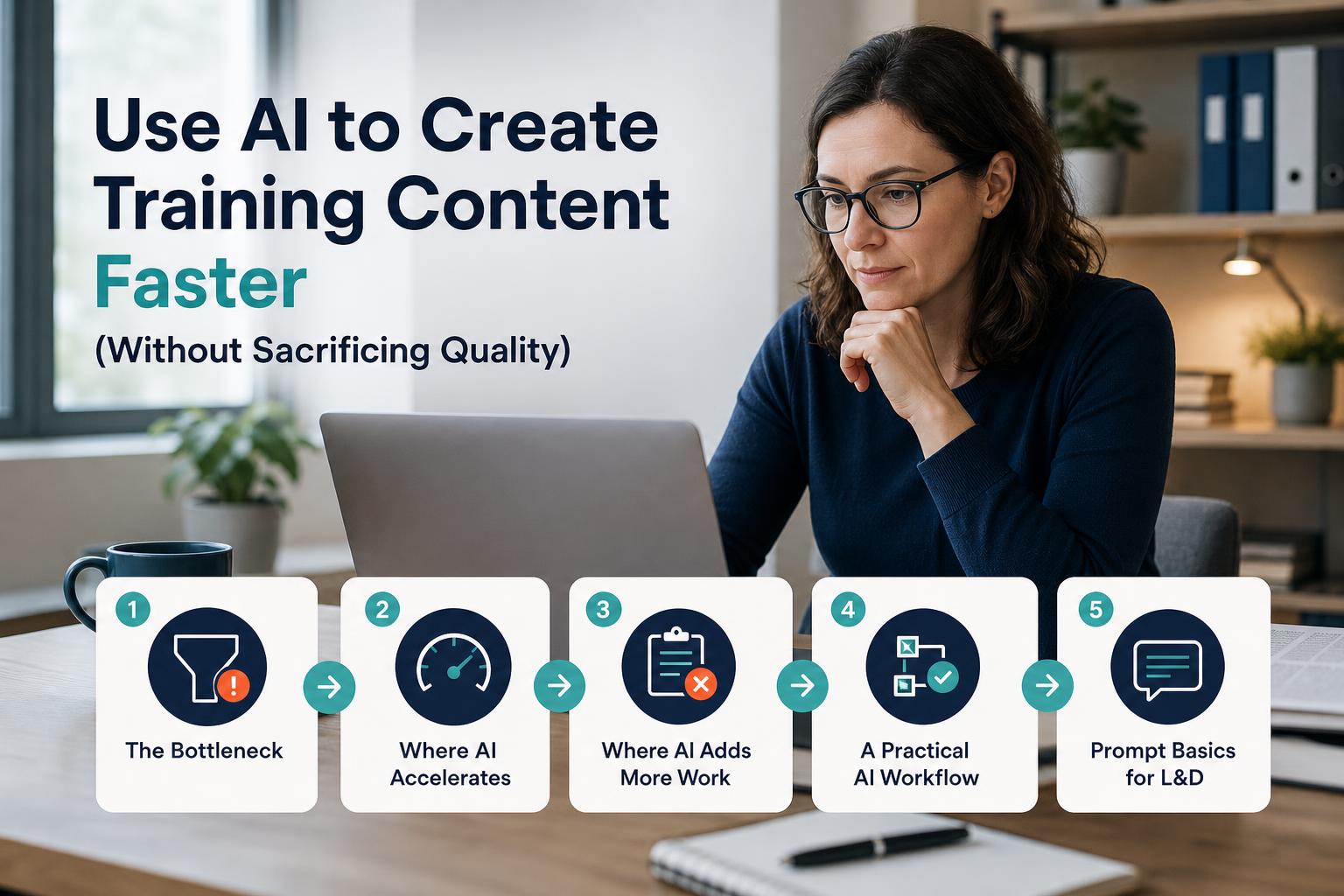
Why Content Creation Is the Biggest L&D Bottleneck
Ask most L&D managers where their team’s capacity disappears, and content creation is consistently near the top of the answer. Brandon Hall Group’s research puts the average time to develop one hour of e-learning at 100–200 hours of designer time — a figure that has remained largely unchanged despite decades of authoring tool advancement. For instructor-led training, the range is 40–80 hours per delivery hour, still before facilitation.
At these ratios, it is structurally impossible for most L&D teams to keep pace with organisational training demand. New product launches, compliance updates, onboarding programmes for growing teams, management development cycles — the content backlog compounds faster than teams can clear it. The result is either delayed training delivery, purchased off-the-shelf content that does not fit the organisational context, or a permanent prioritisation exercise that leaves some training needs unmet.
AI changes this bottleneck meaningfully — not by removing the need for instructional design expertise, but by changing where that expertise is applied. The time-consuming structural and drafting work that currently dominates the content development cycle can be substantially accelerated with AI tools. The judgment work — what should learners be able to do after this module? Is this scenario realistic? Does this assessment measure what we intend? — remains a human task.
The practical result for L&D teams that use AI effectively is a content development cycle measured in days rather than weeks for standard modules, and a meaningful reduction in the content backlog that limits most L&D teams’ strategic effectiveness.
Where AI Genuinely Accelerates Content Creation
Not all content development tasks benefit equally from AI assistance. The areas of clearest, most consistent impact are:
Course outlines and structure
Developing a logical, pedagogically sound module structure from a topic brief is one of the most time-intensive early-stage tasks in content development. It requires understanding the learning objective, analysing the topic for component knowledge and skills, sequencing those components appropriately, and organising them into a structure that a learner can navigate.
AI handles the structural generation phase of this task quickly and well for topics within its training data. Given a clear learning outcome, a target audience description, and an estimated module duration, AI produces a logical outline with section headings and sub-topics in seconds — not as a finished structure, but as a starting point that a designer can review, adjust, and confirm in minutes rather than hours.
The time saving on structural planning is approximately 1–2 hours per module — significant when multiplied across a content portfolio. More important than raw time saving is the reduction in the blank-page problem: starting from an AI-generated structure that is 70% right and editing it is substantially faster than building from nothing.
First draft scripts and text
Narration scripts for e-learning are among the highest-volume writing tasks in L&D. A one-hour e-learning module may require 8,000–12,000 words of narration script, in addition to on-screen text, interaction instructions, and assessment content. Writing this from scratch is time-consuming; editing a structured AI draft is substantially faster.
AI produces readable first-draft narration scripts from bullet-point outlines, topic briefs, or source documents. The quality is consistently sufficient for procedural content (how to complete a process), policy explanations (what the policy is and why it exists), and factual overviews (background knowledge a learner needs before applying a skill).
Three categories of content require more intensive human input even after an AI draft: tone and brand voice (AI defaults to corporate generic; your organisation’s voice requires editing); technical accuracy (AI may produce plausible-sounding content that is factually wrong in specialised domains); and regulatory or legal content (where the cost of an error is high and AI does not have sufficient domain-specific precision).
The practical workflow is: generate AI draft, SME review for accuracy, L&D editor review for tone and instructional quality, sign-off. This process is faster than starting from scratch even with the review steps included.
Quiz questions and scenario branches
Multiple-choice quiz question writing is one of the most labour-intensive and least intellectually rewarding tasks in content development. Writing plausible distractors — wrong answers that a learner might plausibly choose for identifiable reasons — is genuinely difficult at volume. AI produces multiple-choice questions from source text at speed, with distractors that are typically more varied and plausible than rushed human-written distractors produced under content backlog pressure.
Scenario branching — writing the consequences of a wrong decision in a branching scenario — is similarly well-suited to AI assistance. Given a scenario premise (a manager is having a performance conversation with an underperforming team member), AI generates decision branches, consequence text for each path, and recovery options. The output requires review for realism and contextual accuracy but provides a workable structure that can be edited rather than created.
Important caveat: AI-generated quiz answer keys must be independently verified. AI can generate an incorrect answer as the “correct” response, particularly for topics with nuance or where the AI training data contains conflicting information. Every AI-generated quiz item requires human answer key verification before publication.
Translation and localisation
For organisations with multilingual learner populations, translation has historically been a significant bottleneck — expensive, slow, and requiring external agency engagement that extends content development timelines by weeks. AI translation has changed this dynamic substantially.
For standard business and training content, AI translation now achieves accuracy sufficient for post-editing workflows: a human reviewer (ideally a fluent speaker with domain knowledge) reviewing and correcting an AI translation, rather than translating from scratch. Post-editing is typically 60–70% faster than full translation, and the cost difference is significant for organisations managing multi-language content portfolios.
AI translation also enables caption and subtitle generation from audio, which makes existing video content accessible to multilingual learners without costly re-narration. For organisations with legacy video libraries, this is a straightforward accessibility and reach improvement with relatively low implementation cost.
Where AI Creates More Work Than It Saves
Understanding the limits of AI in content creation is as important as understanding the opportunities. Teams that apply AI indiscriminately typically find that the review and correction overhead exceeds the drafting time saved.
Technical and specialist content. AI generates confident-sounding content in specialised domains — engineering, medicine, law, financial services regulation — that may contain factual errors that are not immediately visible to a non-specialist reviewer. In these domains, SME review is non-negotiable, and the SME review time required may approach or exceed the time that AI saved on drafting. The net gain depends on SME availability and the volume of errors in the AI output.
Highly contextualised scenarios. Realistic training scenarios require specific organisational context — the way your organisation handles a particular process, the specific regulatory environment you operate in, the actual culture of your workplace. AI scenarios are inherently generic. A healthcare compliance scenario requires the actual policies, roles, and escalation pathways of your organisation; AI cannot infer these from a prompt. Context-rich scenarios require human authors regardless of AI drafting assistance.
Emotionally intelligent content. Interpersonal skills training, mental health awareness, values-based leadership development, and wellbeing content require a level of emotional nuance that current AI tools consistently underperform on. AI-generated content in these areas tends toward the clinical, the superficial, or the tonally inappropriate. The risk is not just ineffective training — poorly written content in sensitive areas can cause active harm. These content types should be human-authored, with AI used only for structural support at most.
The most expensive AI content mistakes happen when L&D teams publish AI-generated content without subject matter expert review. A single factual error in compliance or technical training can have serious consequences — failed audits, regulatory non-compliance, or a learner applying incorrect information in a high-stakes situation. Build SME sign-off into every AI content workflow as a non-negotiable step, not an optional quality check. The time saved by skipping review is far outweighed by the cost of correcting errors that reach learners.
A Practical AI Content Development Workflow
The following workflow integrates AI at each stage where it adds genuine value whilst preserving human oversight where it matters:
- Define the learning outcome and audience first. AI needs a clear brief to produce useful output. “Create a module on GDPR” produces generic output. “Create a 20-minute e-learning module for customer service staff explaining their responsibilities under UK GDPR data subject access requests, with a learning outcome of: staff can correctly identify and escalate a DSA request within the required timeframe” produces something usable. The quality of AI output scales directly with the quality of the brief.
- Generate structure with AI. Use AI to produce a module outline — section headings, sub-topics, approximate word counts per section. Treat this as a starting point. Review and adjust the structure before proceeding to content drafting.
- Draft content with AI. Work section by section — script text, scenario descriptions, quiz questions. Keep prompts specific and include the tone, reading level, and format requirements. Generate in sections rather than all at once to maintain prompt quality.
- SME review. The subject matter expert reviews all factual content for accuracy, flags anything that is wrong or misleading, and provides the organisational context that AI cannot infer. This is not a quick skim — it is a substantive accuracy review. Budget the SME’s time explicitly and ensure they understand that they are reviewing for factual accuracy, not copy-editing.
- L&D design pass. The instructional designer reviews for tone, brand voice, accessibility (reading level, alt text requirements, caption coverage), and instructional design quality. Does the assessment actually measure the learning outcome? Are the scenario distractors plausible? Is the difficulty level appropriate for the audience?
- Learner pilot. Before full release, test with a small group of target learners. Pay attention to where learners hesitate, make unexpected errors, or report confusion. These are signals that the content is not achieving its learning objective in practice, regardless of how well it read on review.
- Iterate and build your prompt library. After each content build, review which prompts produced the best output and save them. A team prompt library of tested, working prompts for common content types (compliance module script, management scenario branches, quiz questions from policy text) is a compounding productivity asset — each new project benefits from the accumulated prompt engineering of all previous projects.
Prompt Engineering Basics for L&D Content
The difference between AI output that requires minimal editing and AI output that creates more work than it saves is often the quality of the prompt. Prompt engineering for L&D content does not require technical expertise — it requires the same clarity of brief that a good instructional designer would provide to a content writer.
Include these elements in every content prompt:
- Learning outcome: What should the learner be able to do after this content? State it specifically.
- Audience level: Who is this for? What prior knowledge should be assumed? What reading level is appropriate?
- Tone: Formal, conversational, authoritative, supportive? This is the most impactful single instruction for output quality.
- Format: E-learning script, facilitator guide, job aid, quiz, scenario branch? Be explicit.
- Length: Approximate word count. Without this, AI length is inconsistent and often incorrect for the module structure.
- Constraints: Avoid jargon. Use active voice. Do not include statistics unless sourced. Keep sentences under 25 words.
An example prompt structure:
“Write a 200-word e-learning script section for [audience: customer service staff with no prior compliance training] explaining [topic: what constitutes personal data under UK GDPR]. The learning outcome is: the learner can identify three examples of personal data from a list. Tone: clear, direct, professional but not legalistic. Use active voice. Avoid legal jargon. Define any technical terms introduced.”
If the first output is wrong, refine the prompt — do not simply regenerate with the same instruction. Changing the prompt is always more productive than repeated regeneration. Log what refinement improved the output; that knowledge is useful for the next similar content task.
Building a prompt library is one of the highest-leverage investments an L&D team can make in AI content productivity. When a prompt produces good output for a compliance module script, save it. When a prompt produces good quiz questions from a policy document, save it. After 10–15 content builds, the team has a tested library of prompts for common content types that can be reused and adapted, rather than recreated from scratch each time.
Quick Reference Checklist
Use this before publishing any AI-assisted training content:
- Learning outcome defined before prompting AI — not after generating content
- Audience level and tone specified in prompts, not left to AI defaults
- AI output treated as first draft only — not published without review
- SME review completed and signed off before content goes to design
- Quiz answer keys independently verified — not assumed correct from AI output
- Scenario realism checked against real organisational context — not just face validity
- Accessibility review included (reading level, alt text, captions)
- Successful prompts saved to the team prompt library for future reuse
Frequently asked questions
What AI tools are best for creating training content?
The most widely used AI tools for training content creation are: (1) AI authoring platforms (Articulate Rise with AI Assist, Adobe Captivate AI) for structured e-learning; (2) General LLMs (ChatGPT, Claude) with carefully designed prompts for script writing, scenario development, and quiz generation; (3) AI video tools (Synthesia, HeyGen) for presenter-style video without a studio; (4) AI image generators (Midjourney, DALL-E 3) for custom illustration; (5) AI voiceover tools for narration at scale. The right choice depends on your content type, volume, and audience.
How do I maintain quality when using AI to write training content?
The key is treating AI output as a structured first draft, not a finished product. A practical quality control process: (1) Subject matter expert review of all factual content — non-negotiable; (2) Tone and brand alignment check — AI tends toward generic corporate language; (3) Scenario and case study review — AI scenarios often lack the specificity that makes them useful for real role-play; (4) Accessibility check — AI-generated content often has readability issues. The goal is to use AI to handle the structural and time-consuming parts while keeping human expertise on accuracy and nuance.
Can I use AI to update existing training content?
Yes — updating existing content is actually one of the highest-ROI uses of AI in L&D. Feed your existing module into an AI tool and ask it to identify outdated references, flag sections that need updating for a policy change, or rewrite specific sections in a different tone or reading level. This is faster and less error-prone than manual updating and works well for compliance training refreshes, policy update modules, and annual reaccreditation content.
Sources & further reading
- Brandon Hall Group: How Long Does It Take to Create Learning? — brandon-hall.com
- CIPD Learning at Work Survey — cipd.org/en/knowledge/reports/learning-work-survey
- GOV.UK AI Opportunities Action Plan — gov.uk/government/publications/ai-opportunities-action-plan