Last updated: 15 July 2026
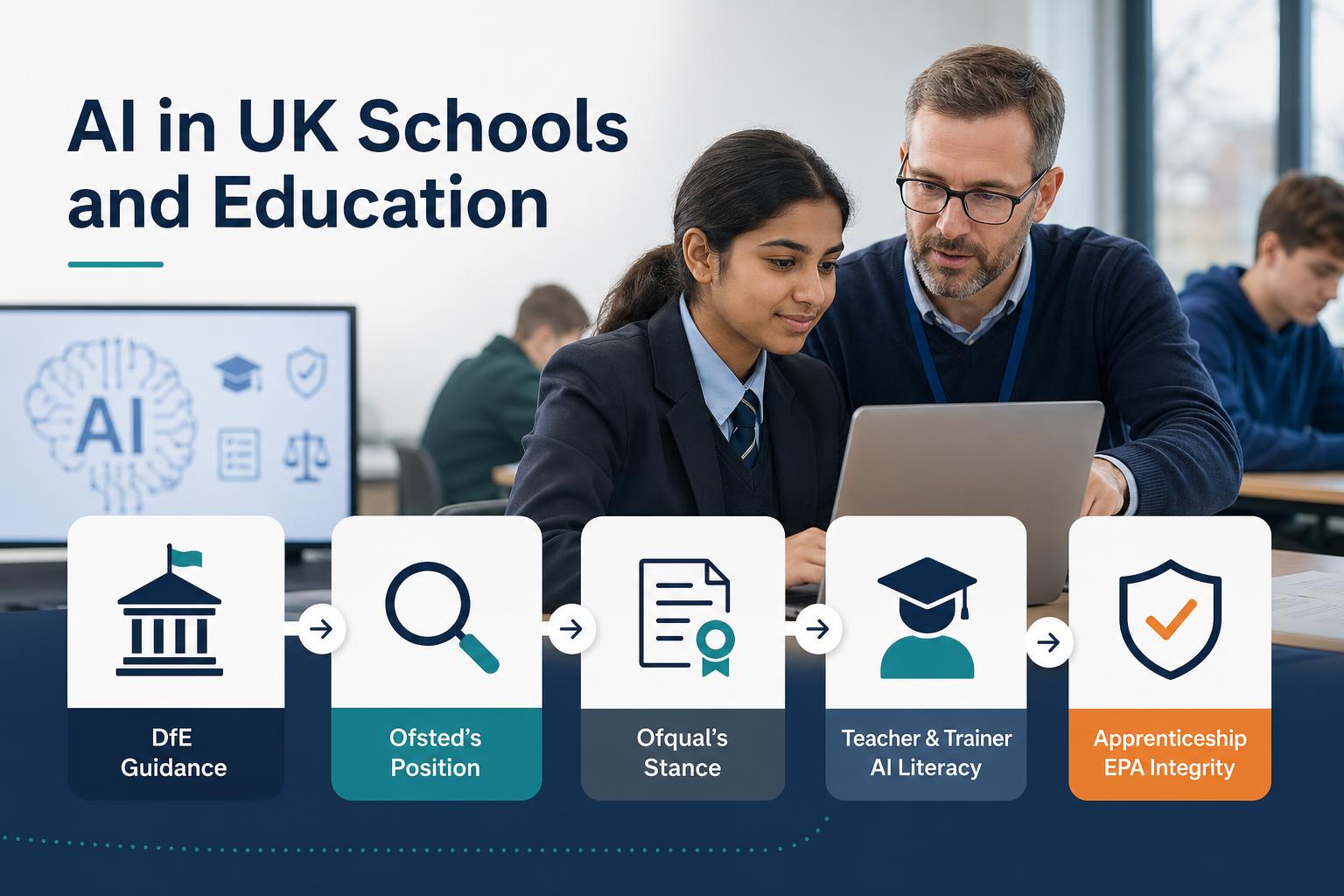
The DfE Generative AI in Education Guidance
The Department for Education maintains a collection of guidance on using technology and generative AI in education. The scope varies by document, so schools, colleges and training providers should check the audience named on the relevant page rather than assume every publication applies identically. The guidance sits alongside data protection, safeguarding, security, equality and assessment obligations.
The following four points are a practical synthesis for an internal AI policy; they are not the title of a single statutory DfE framework:
- Transparency: Staff, learners, and parents should be aware when AI tools are being used in educational processes. This does not require disclosure of every minor use, but AI-assisted decisions about learners, AI-generated materials used in teaching, and AI tools used in assessment must be visible and documented.
- Safety: AI tools must not compromise safeguarding, data protection, or the wellbeing of learners. This includes not inputting personal data about learners into consumer AI tools, not using AI in ways that could expose learners to harmful content, and maintaining GDPR-compliant data handling at all times.
- Appropriate use: AI should be used only where it supports the educational purpose, with professionals retaining responsibility for their decisions and materials.
- Human oversight: Educators retain responsibility for all AI-assisted decisions and outputs. This is not a soft principle — it is the central commitment of the DfE framework. No AI output in an educational context can be used without professional review and accountability.
These principles are useful across education and training, but the underlying legal, contractual and awarding-organisation requirements differ by setting. Apprenticeship and Skills Bootcamp providers should also check their funding rules, assessment requirements, safeguarding duties and customer contracts.
Ofsted’s Current Position on AI
Ofsted has been careful to position itself as a quality-of-education regulator, not a technology regulator. The current inspection framework assesses whether learners are making progress, whether teaching is effective, and whether assessment is valid and reliable. Ofsted does not specifically assess whether a provider uses AI or how — that is not their remit.
However, three areas of AI use create direct inspection risk that providers should understand:
Assessment validity
Ofsted inspectors assess whether assessment is valid — whether it genuinely measures learner knowledge and skill. If a provider’s assessment design is so vulnerable to AI generation that the submitted evidence cannot be reliably attributed to the learner, this is an assessment validity problem and an inspection risk, regardless of whether the inspector specifically mentions AI. Providers whose portfolio evidence could plausibly have been generated without learner engagement will struggle to demonstrate genuine learner progress during inspection.
AI-generated coursework without detection
There is no standalone Ofsted criterion requiring AI-detection software. A provider should nevertheless be able to explain how it knows that assessment evidence is authentic and how it responds to suspected malpractice, using the applicable qualification or assessment rules. AI detectors alone are not reliable proof of authorship.
Staff competence and curriculum quality
The current further education and skills inspection toolkit considers curriculum quality and learners’ progress. If staff use AI to draft curriculum materials or progress records, normal professional review and source checking still matter; a generated record should not be presented as a tutor’s observation unless the tutor has verified it.
Ofqual’s Stance on AI in Regulated Qualifications
Ofqual regulates qualifications, assessments, and examinations in England. Its AI guidance position, developed through 2024 and into 2025, takes a principles-based approach: AI is not inherently prohibited in assessment contexts, but awarding organisations must ensure that their assessments remain valid and that AI use does not create unfair advantage or undermine the integrity of the qualification.
In practice, awarding organisations need to manage risks to validity, reliability and fairness. Their instructions may require centres to:
- Review their assessment designs to identify where AI could be used to generate credible but inauthentic submissions
- Implement detection or assessment redesign measures where AI risk is material
- Update regulations for learners (the rules that learners must follow) to address AI use explicitly
- Provide guidance to centres — training providers and schools — on implementing those rules
For training providers acting as approved centres, the applicable awarding organisation’s regulations and centre agreement are the operational source of truth. Check the current instructions for each qualification and communicate them to staff and learners.
The Joint Council for Qualifications (JCQ) also publishes current guidance on AI use in assessments. Its focus is that candidates must submit work that is their own and acknowledge permitted AI use; using AI so that work submitted for assessment is not the candidate’s own can constitute malpractice. Apply the exact instructions for the qualification and assessment rather than treating every use of an AI tool as automatically prohibited.
Teacher and Trainer AI Literacy
There is no single statutory AI-literacy framework that every teacher, trainer and assessor must follow. A practical staff-development model can distinguish three levels of capability:
- AI awareness: understanding what generative AI is, how it works at a conceptual level, and its implications for education
- AI proficiency: being able to use AI tools effectively for planning, resource development, and administrative tasks
- AI leadership: being able to lead AI policy and practice development in the organisation, advise colleagues, and contribute to sector-level discussions
Use this model only as an internal planning aid. Check current offers from DfE, Jisc, the Education and Training Foundation and other sector bodies at the point of procurement; access, funding and eligibility can change.
Staff enter training roles with very different levels of AI experience. This matters because:
- confidence with consumer AI tools does not automatically translate into safe educational practice
- CPD should be based on role and risk rather than age, job tenure or assumed digital fluency
- staff need time to practise source checking, data handling and assessment-authenticity scenarios
Apprenticeship Assessment Integrity and AI
Some apprenticeship assessment plans use a portfolio, project or other work-based material as part of an assessment method; others do not. Generative AI can make polished text easier to produce without demonstrating the underlying occupational competence, so providers must start with the exact plan and the assessment organisation’s instructions.
Depending on the assessment plan, authenticity controls can include:
- Professional discussion formats: shifting assessment weight towards live professional discussions where the learner must demonstrate knowledge verbally, in real time, in ways that AI cannot generate for them
- Observation-based evidence: where the plan requires an independent observation of practice
- Direct questioning: where an assessor tests the apprentice’s understanding during a specified method
- Declaration requirements: where the assessment organisation requires candidates to declare or acknowledge assistance
Apprenticeship assessment reforms are being implemented standard by standard through revised assessment plans. Do not assume a universal sampling model, method or declaration rule.
Training providers should review the applicable assessment plan and the appointed assessment organisation’s current instructions, then build the relevant authenticity rules into induction and delivery.
T-Levels and AI
T-Levels are a post-16 qualification combining classroom learning with a significant industry placement component. The AI question for T-Levels has two dimensions.
First, the industry placement: the minimum is normally expressed as 315 hours, with programme-specific rules and permitted delivery models set out in current guidance. Placement completion and the technical qualification have distinct requirements; do not assume every placement log is formal assessment evidence.
Second, the technical qualification includes externally assessed components and an occupational specialism. Providers should follow the relevant awarding organisation’s current instructions on permitted AI use, authentication and malpractice for each assessment component.
The Skills Pipeline: AI Literacy for School Leavers
Exposure to AI varies widely between schools, qualifications and learners. Computing and digital programmes may address relevant concepts, but employers and providers should not assume that every school leaver has received a common, assessed level of AI literacy.
This creates both opportunity and responsibility for training providers:
- Opportunity: apprenticeship programmes that build on school-level AI literacy and develop it into workplace-applicable AI proficiency will be compelling to both employers and learners
- Responsibility: providers must ensure that their AI literacy content is pitched correctly — not teaching skills learners already have, and genuinely extending their capability into the occupational context
- Curriculum design: use initial assessment and recognition of prior learning to establish what each learner already knows, rather than relying on assumptions about their qualification
AI in Education Funding: EdTech, Jisc, and UKRI
Support and funding offers change. Useful starting points include:
- DfE: its using technology in education collection and generative AI product safety standards.
- Ofqual and awarding organisations: current assessment-integrity advice and qualification-specific centre instructions.
- Jisc and sector bodies: practical resources and events, checked at the point of use rather than described as a guaranteed funded entitlement.
What Training Providers Should Do
Translating DfE guidance, the inspection toolkit, Ofqual advice and awarding-organisation rules into operational practice requires action across four areas:
Update learner AI acceptable use policies
Every training provider should have a written AI acceptable use policy for learners that covers: what AI tools learners may use and for what purposes; what is prohibited (submitting AI-generated work as their own); how learners should declare AI assistance; and what the consequences of misuse are. This policy should be communicated at induction, built into the learner handbook, and reviewed annually as the policy landscape evolves.
Build tutor and assessor AI literacy
Tutors and assessors need to use approved tools safely, check generated materials, authenticate learner work using multiple sources and follow the applicable malpractice process. Internal scenario-based training, supported by current sector resources, is a practical starting point.
Monitor awarding and assessment-organisation guidance
Providers should monitor the awarding and apprenticeship assessment organisations relevant to their provision. Designate an owner to track policy updates, check them against the applicable assessment plan or qualification rules, and cascade material changes to staff and learners.
Integrate AI skills into programme design where relevant
For apprenticeship standards and qualifications that include digital or AI-related KSBs, providers should ensure that AI skills are genuinely embedded in learning — not added as an afterthought. Where the occupational standard does not explicitly reference AI but the occupation clearly uses AI tools (data analysis, marketing, finance, customer service), consider how AI workplace competence can be developed as part of the programme even if it is not formally assessed.
Training Provider AI in Education Readiness Checklist
Use this operational checklist alongside the guidance and contractual rules that actually apply to your provision:
- We have a written learner AI acceptable use policy that is communicated at induction
- Our policy clearly defines permitted and prohibited uses of AI tools for learners
- Learners follow the applicable awarding or assessment organisation’s rules for declaring AI assistance
- Our tutors use reliable authentication methods and do not treat AI-detector scores as proof
- Our assessment practice follows the specified assessment design and authenticity controls
- We have reviewed updated AI guidance from our awarding and apprenticeship assessment organisations
- Our quality assurance process includes review of assessment authenticity, including AI misuse
- We have a named lead responsible for tracking AI policy updates from DfE, Ofqual, and sector bodies
- Our tutors have role-appropriate AI CPD and time to practise
- Our learner induction explains our policy on transparency, safety, appropriate use and human oversight
- We have reviewed our data protection procedures to ensure AI tool use complies with UK GDPR
- Personal data is used with AI only where there is a lawful, documented and risk-assessed basis, using approved tools and contracts
Frequently asked questions
What is DfE’s guidance on AI in schools?
The Department for Education published ‘Generative AI in Education: Responsible Use Guidance’ in 2023, updated in 2024. It sets out four principles for AI use in schools: transparency (staff and learners should know when AI is being used), safety (AI must not compromise safeguarding or data protection), appropriate use (AI should only be used where it genuinely supports educational outcomes), and human oversight (educators must retain responsibility for all AI-assisted decisions). The guidance is permissive in tone — AI is not banned — but emphasises that professional judgement and human oversight are non-negotiable.
How does Ofsted approach AI use in training and education?
Ofsted’s current position is that inspectors assess the quality of education and outcomes — not the tools used to deliver it. AI is not specifically penalised or rewarded during inspection. However, inspectors will assess whether assessment is valid and reliable, which means AI-generated learner work submitted as authentic evidence is an inspection risk. Providers should ensure their AI acceptable use policies are in place, that tutors can identify AI-generated evidence, and that assessment design mitigates AI misuse risks.
What should training providers do about AI-generated learner work?
Training providers should define permitted and prohibited AI uses, then align declarations and authentication controls with each awarding or assessment organisation's current rules. Staff should be trained to authenticate work using reliable evidence and conversation, not AI-detector scores alone. For apprenticeships, use the methods and gateway requirements in the applicable assessment plan rather than adding or changing formal assessment methods locally.
Sources & further reading
- DfE: using technology in education collection — DfE: using technology in education collection
- Ofqual: artificial intelligence, malpractice and assessment advice note — Ofqual: artificial intelligence, malpractice and assessment advice note
- Ofsted: further education and skills inspection toolkit — Ofsted: further education and skills inspection toolkit