Last updated: 19 March 2026
The Real Cost of Slow Onboarding
Onboarding is one of the highest-leverage activities in any organisation, and one of the most consistently underinvested. The gap between what structured, well-supported onboarding achieves and what most organisations actually deliver is striking — and it shows up directly in productivity timelines and first-year attrition rates.
The numbers are well-documented. According to Brandon Hall Group, organisations with a strong onboarding process improve new hire retention by 82% and productivity by over 70%. Gallup research finds that only 12% of employees strongly agree their organisation does a great job of onboarding new employees. CIPD data consistently shows that employees who experience a poor onboarding process are significantly more likely to leave within the first six months — before the organisation has recovered even the cost of recruiting them.
The productivity gap is equally significant. Most mid-size organisations take between three and eight months to bring a new hire to full productivity, depending on role complexity. During that ramp period, the employee is consuming management time, drawing a full salary, and producing a fraction of the output they will eventually deliver. Every week that period is compressed — through better access to information, faster skills acquisition, and clearer role expectations — is measurable financial benefit.
There are two distinct problems embedded in most slow onboarding processes. The first is an administrative backlog: paperwork, policy sign-offs, system access requests, and compliance training completion that takes weeks to process because it runs through email chains and manual HR workflows. The second is a learning and integration gap: new hires who do not know what they need to know, do not have easy access to answers, and do not feel genuinely embedded in the team. The first problem is solvable largely through automation. The second requires a combination of technology and genuine human investment.
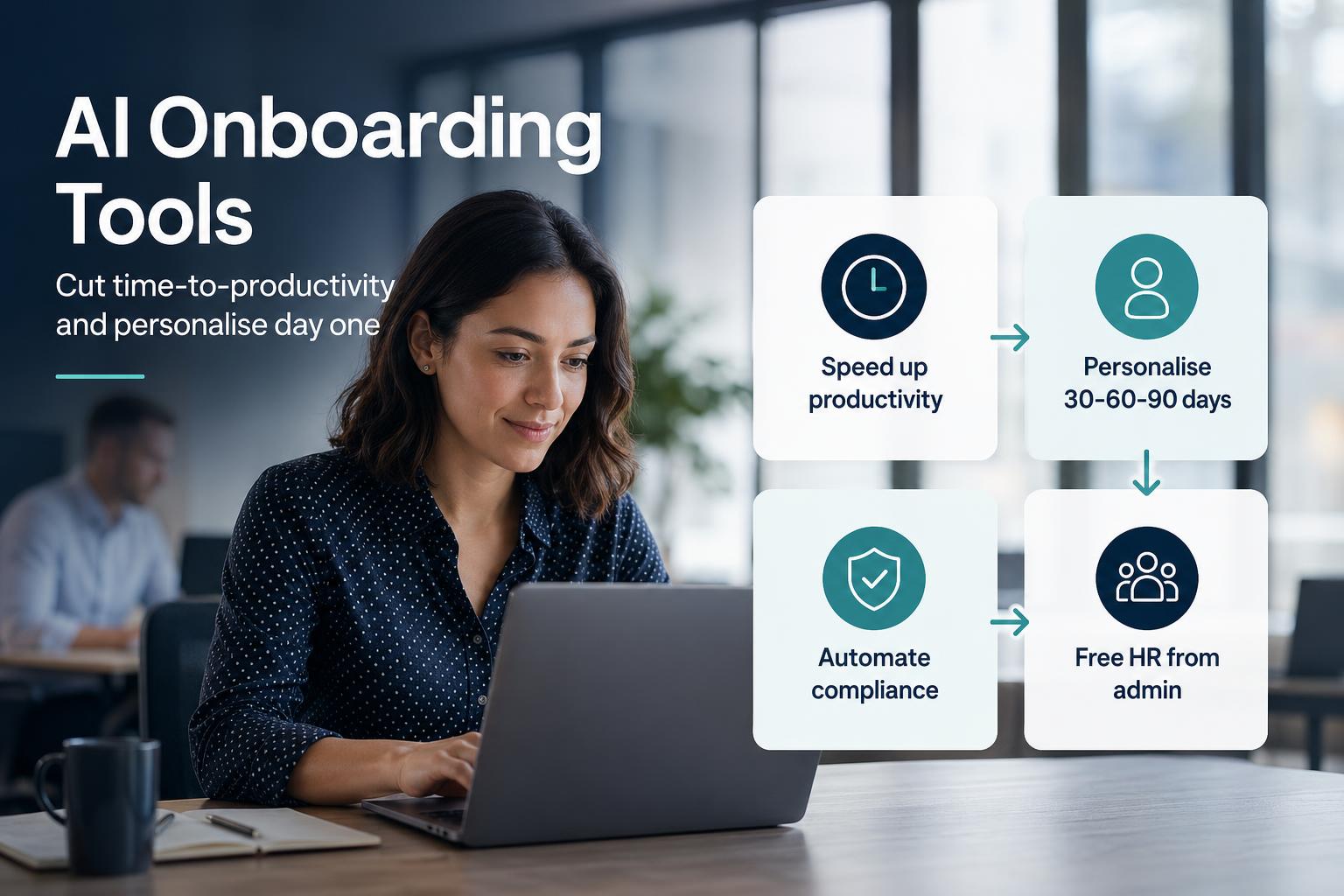
AI onboarding tools address both — but the balance of effort between them is the central design decision when evaluating what to implement.
Where AI Actually Helps in Onboarding
Not every part of onboarding benefits equally from AI. Understanding which components of the onboarding process AI genuinely changes — versus which it offers only marginal improvement — is the prerequisite for a sensible investment decision.
Personalised content delivery from day one
Traditional onboarding learning is overwhelmingly one-size-fits-all. Every new hire regardless of role, prior experience, or existing competence receives the same induction deck, the same compliance modules, and the same product knowledge content. Experienced hires sit through material they already know. Newer hires receive the same volume of content as veterans and either retain very little of it or feel overwhelmed.
AI changes this by enabling role-based and skills-based path assignment from the moment an employee is provisioned in the system. At the point of hire, data already available — job title, department, prior employment history, and where available, pre-hire assessment results — can be used to configure a personalised onboarding pathway. A senior software engineer does not need the same technical induction content as a graduate joiner. A hire with five years of sector experience can be routed past foundational content and into role-specific depth. This does not require complex AI at the outset; role-based path logic can be applied from day one with a well-structured onboarding platform. Where AI adds additional value is in adapting the path during onboarding itself — adjusting content recommendations based on knowledge check performance, module completion speed, and engagement signals as they emerge.
Conversational AI for new-hire Q&A
New hires generate a disproportionate volume of questions. Where do I find the expense policy? Who do I contact about IT access? What is the process for booking annual leave? What does this acronym mean? These questions are individually minor but collectively consume significant HR and manager time — time that would be better spent on the relationship-building and role-specific guidance that actually accelerates integration.
Conversational AI (onboarding chatbots) addresses this effectively for the long tail of information retrieval questions. A well-configured onboarding bot with access to the employee handbook, IT policies, benefits documentation, and org chart can resolve the majority of common new-hire queries without human involvement — at any hour, without the social friction of asking a colleague what might feel like an obvious question.
The critical implementation detail is scope definition. The most effective onboarding chatbots have a clearly defined knowledge base and escalation path. When a question falls outside the scope of what the bot can reliably answer, it escalates to a named human contact. Bots that attempt to answer everything — and hallucinate when they hit the edges of their knowledge — erode trust quickly with new hires who are already in an uncertain state.
Task automation: paperwork, provisioning, and compliance workflows
The administrative component of onboarding — collecting signed contracts, processing right-to-work documentation, triggering IT account requests, enrolling employees in pension schemes, and assigning mandatory compliance training — is highly automatable and widely un-automated. In many organisations it still runs through email, spreadsheets, and Outlook calendar reminders.
AI-powered onboarding platforms automate this workflow end-to-end. When a new hire is added to the system, a pre-configured sequence triggers: document collection requests go to the employee, provisioning requests go to IT, manager tasks appear in the manager dashboard, and compliance modules auto-enrol based on role. Automated reminders escalate if tasks are not completed within defined timeframes. The system tracks completion across every task, every new hire, and every cohort — producing an audit trail that would take hours per person to assemble manually.
The time savings here are among the most consistent and measurable of any AI onboarding capability. HR teams running onboarding on manual or semi-manual processes regularly report spending two to four hours per new hire on administrative coordination tasks. Automated workflows reduce this to minutes of exception handling.
Progress tracking and risk flagging
One of the most significant risks in onboarding is the employee who quietly disengages before anyone notices. They stop completing modules. Their check-in responses become shorter. They are not attending optional sessions. By the time a manager or HR partner realises there is a problem, the employee may already be in the job market.
AI-powered onboarding platforms monitor engagement signals continuously and surface at-risk new hires before they disengage fully. Low module completion rates relative to cohort peers, declining response rates to check-in prompts, and extended periods of inactivity all flag as risk indicators. The system nudges the employee and alerts their manager — enabling an early conversation rather than an exit interview.
This is not surveillance. The goal is to create the conditions for a proactive conversation with someone who may be struggling but has not yet felt comfortable raising it. Done well, it is the kind of attentive onboarding support that new hires remember positively.
AI Onboarding Tools: What to Evaluate
The AI employee onboarding software market has grown rapidly. There are now dedicated onboarding platforms with AI features, LMS platforms with built-in onboarding modules, and HRIS systems with onboarding workflow capability. Choosing between them requires clarity on what your onboarding process is actually weak at.
LMS-native AI vs standalone onboarding tools
LMS-native onboarding integrates onboarding learning into the same platform that manages ongoing employee development. The advantage is a unified learner record from day one: onboarding completion, skills assessed at induction, and compliance training all sit in the same system that tracks the employee’s development throughout their tenure. For organisations where the onboarding challenge is primarily a learning and skills gap problem — new hires do not have access to structured learning or are not progressing fast enough — an AI-powered LMS with strong onboarding path configuration is typically the right investment.
Standalone onboarding platforms (dedicated tools such as Enboarder, Leapsome, or WorkBright) are built specifically around the onboarding workflow — task checklists, document collection, manager nudges, new-hire portals, and pre-boarding experience. They tend to offer a richer new-hire experience interface and more sophisticated workflow automation than LMS-native onboarding. For organisations where the onboarding challenge is primarily an administrative and coordination problem — things fall through the cracks, tasks are not completed on time, managers are not engaged — a dedicated platform may justify the additional licence cost and the integration work required to connect it to the LMS.
The hybrid approach — a dedicated onboarding platform that integrates with an AI-powered LMS — is common in larger organisations and gives access to both the workflow richness of a dedicated tool and the learning depth of an established LMS. It also adds integration complexity and cost. Before choosing this path, be honest about whether the marginal benefit of the dedicated onboarding tool justifies the additional overhead.
Integration with HRIS: the deciding factor
The single most important technical consideration in AI employee onboarding software selection is HRIS integration. The onboarding system needs to know who is being onboarded, in what role, for which manager, starting on which date. This data lives in your HRIS. If the onboarding platform cannot reliably receive it, the automation falls over at the first step.
When evaluating vendors, ask specifically:
- Which HRIS systems have pre-built integrations, and at what data depth?
- Does new hire data sync automatically when a hire is confirmed, or does it require manual triggering?
- Does the integration update the HRIS when onboarding tasks are completed (bidirectional sync)?
- What is the typical integration implementation time, and is it included in the licence or charged separately?
- How is data conflict handled when the same field exists in both systems?
Poor integration design is the most common reason AI onboarding implementations underperform their theoretical capability. The AI can only automate what it knows about — and if the data feed from the HRIS is unreliable or incomplete, the automation breaks down at the point of first use.
What to prioritise in your evaluation
Different onboarding challenges require different platform capabilities. Use this prioritisation framework to focus your evaluation:
- If admin completion rates are the problem: Prioritise workflow automation depth, task management, automated reminders, and audit trail capability.
- If time-to-productivity is the problem: Prioritise learning path personalisation, role-based content configuration, and knowledge assessment at the point of hire.
- If compliance tracking is the problem: Prioritise mandatory training auto-enrolment, completion tracking, and reporting dashboards that produce audit-ready output.
- If new-hire engagement and retention is the problem: Prioritise the new-hire experience interface, conversational AI capability, check-in pulse survey features, and at-risk early warning.
- If manager involvement is the problem: Prioritise manager task dashboards, automated nudges, and the mobile experience (managers are unlikely to use an onboarding tool that requires logging into a desktop platform).
Personalising the First 30-60-90 Days with AI
The 30-60-90 day framework is standard in onboarding design because it reflects how new hire integration actually works: the first month is orientation, the second is role immersion, the third is independent performance. AI-powered onboarding tools are well-suited to managing this progression because they can track where each individual is against plan, adapt what comes next based on demonstrated readiness, and prompt managers at the right moment to have the right conversation.
Days 1–30: Orientation and foundations
The first month of onboarding is where administrative completion, compliance training, and foundational knowledge all need to land simultaneously. For HR and L&D teams managing cohorts of new hires, this is where the workload spikes and where manual processes most often break down.
AI tools handle this phase through automated sequencing: content is released progressively rather than all at once, reducing cognitive overload. Mandatory compliance modules (covered in more detail in the section below) are auto-enrolled based on role and tracked against completion deadlines. Knowledge checks after each content module provide early signal on where understanding is solid and where additional resource is needed before the new hire progresses to role-specific content.
The chatbot earns its keep here. New hires in week one have a high volume of procedural questions and a low threshold for asking them out loud. A 24/7 bot that answers policy, process, and administrative questions confidently — and escalates when it cannot — reduces the anxiety of not knowing whilst protecting HR bandwidth for higher-value new-hire interactions.
Days 30–60: Role immersion and skill building
By the end of the first month, the orientation foundations should be in place. The second phase shifts focus from compliance and orientation to role-specific skill development. This is where personalisation based on prior knowledge assessment pays dividends.
An AI-powered platform can use the knowledge check data from month one, combined with any pre-hire skills assessment data and the new hire’s prior experience profile, to configure a differentiated month two learning plan. Someone with ten years in the sector and a track record of managing the tools your organisation uses does not need the same depth of product training as a career changer. Routing experienced hires into stretch content sooner respects their existing capability and accelerates their time to meaningful contribution.
Manager involvement becomes more important in this phase. AI tools that include manager dashboards and automated check-in prompts ensure that the month-one-to-two transition — a high-risk period for early disengagement — is supported by a genuine human conversation rather than assumed to be handled by the platform alone.
Days 60–90: Independent performance and integration
The third month of onboarding is about transitioning from guided learning to independent performance. AI tools support this transition through completion tracking, skills gap identification, and the beginning of ongoing development path planning — connecting the onboarding experience to the employee’s longer-term career development within the organisation.
Research from CIPD’s Learning at Work Survey consistently shows that employees who see a clear development path from early in their tenure are significantly more engaged at the 12-month mark. AI-powered platforms can generate a development recommendation at the end of the onboarding period — based on completion data, knowledge assessment results, and role requirements — that provides the manager with a starting point for the first formal development conversation. This is low effort for the platform and high value for the employee and manager alike.
Compliance Onboarding and AI: Automating Policy Sign-offs and Mandatory Training
Compliance onboarding is, for many organisations, the most operationally problematic part of the process. The requirement to ensure every new hire has completed mandatory training — data protection, health and safety, code of conduct, sector-specific regulatory requirements — and signed the relevant policies before they begin substantive work is non-negotiable. The manual process for achieving this at scale is costly, error-prone, and produces audit records that are difficult to interrogate at short notice.
Automated training enrolment based on role
AI onboarding platforms handle compliance training enrolment automatically. When a new hire’s role is confirmed in the system, the platform applies enrolment rules to determine which mandatory modules apply and assigns them with completion deadlines. A customer-facing financial services hire automatically receives FCA conduct training. A warehouse hire receives manual handling and health and safety modules. A manager receives additional modules on grievance procedures and performance management.
This replaces a manual process that, in most mid-size organisations, involves an HR team member checking a role-to-training matrix in a spreadsheet and sending enrolment emails — a process that takes time, is dependent on the matrix being current, and produces no reliable audit trail of when enrolment happened versus when completion was confirmed.
Automated policy acknowledgement workflows
Policy sign-off — ensuring every employee has read and acknowledged key policies — is a compliance requirement that is chronically under-tracked in manual onboarding processes. AI-powered onboarding tools automate this workflow: policies are presented digitally, acknowledgement is captured electronically with a timestamp, and the completion record is stored against the employee profile with full audit capability.
Automated reminder sequences escalate non-completion: a gentle day-three nudge, a more direct day-seven prompt, and a manager alert at day ten if the sign-off is still outstanding. The compliance team receives a dashboard showing completion rates across all new hires and all policies in real time, rather than having to chase individually or run periodic manual audits.
Completion reporting and audit readiness
The business value of automated compliance tracking is most visible when an audit happens or a regulatory question arises. In a manual or semi-manual onboarding environment, answering “did all new hires in the past 12 months complete mandatory data protection training before accessing customer data?” requires compiling records from multiple systems, chasing managers for sign-off emails, and accepting meaningful uncertainty in the answer.
In an AI-powered onboarding platform, the answer is a report generated in seconds. Every completion event is timestamped and attributed. Every policy acknowledgement has an audit trail. Every escalation and reminder is logged. Regulatory confidence is a byproduct of systematic automation, not a separate compliance project.
What AI Cannot Replace in Onboarding
The operational case for AI onboarding tools is strong. But it is equally important to be clear about what AI cannot and should not replace — because the organisations that hand the entire onboarding experience to automation and disinvest from human connection consistently see higher early attrition, not lower.
Human connection and belonging
The data on early attrition is unambiguous. Gallup’s extensive research on employee engagement consistently finds that the single strongest predictor of new hire retention in the first 90 days is whether the employee feels a sense of belonging — specifically, whether they have made at least one genuine friendship at work and whether their manager has had substantive conversations with them beyond task briefings.
Neither of these things can be automated. A chatbot can answer the expense policy question; it cannot be the colleague who takes the new hire to lunch on day three and tells them honestly what the organisation is really like. A personalised learning path can sequence role knowledge efficiently; it cannot replace the manager who asks “how is this actually going for you?” in a way that invites a genuine answer.
The practical implication is that AI onboarding tools should be positioned as freeing human time — not replacing it. If automated workflows reduce HR onboarding administration by three hours per new hire, that time should go into higher-quality human touchpoints, not into cost reduction. The ROI of AI onboarding is partly measured in efficiency; it is also measured in what HR and managers do with the time that automation returns to them.
Culture embedding
Organisational culture — the informal norms, unwritten expectations, decision-making patterns, and values that define how an organisation actually operates — is transmitted through human interaction, not content modules. A new hire can complete a “culture and values” e-learning module in twenty minutes and emerge knowing the organisation’s stated values verbatim whilst remaining entirely ignorant of how those values manifest (or fail to manifest) in day-to-day work.
Culture embedding requires exposure: to how colleagues make decisions, how disagreement is handled, how success is recognised, how senior leaders behave when under pressure. AI can curate content about culture; it cannot create the experiences that transmit it. Buddy programmes, structured team introductions, shadowing opportunities, and inclusive team rituals are the mechanisms through which culture is actually embedded — and they require deliberate human design and investment.
AI tools can support culture embedding at the margins — prompting buddy conversations at the right moment, surfacing culture-related content at appropriate points in the onboarding journey, and tracking whether cultural integration activities have occurred. But the activities themselves must be human-driven. Technology that attempts to automate culture embedding without this foundation will produce employees who know the words but not the music.
Manager judgement and role clarity
The most common cause of early attrition identified in exit interviews is role ambiguity — new hires who are unclear about what success looks like in their role, unclear about priorities, and unclear about how their work connects to organisational goals. This is a manager problem, not a content problem. No amount of onboarding content will resolve role ambiguity if the manager has not clarified expectations in direct conversation.
AI onboarding platforms can prompt managers to have these conversations — reminders, check-in frameworks, suggested conversation topics — but they cannot have them. The investment in manager capability to onboard effectively, including training managers on what a good first 90 days looks like and what their specific responsibilities are, is consistently the highest-leverage human intervention in any onboarding improvement programme.
Frequently Asked Questions
What do AI onboarding tools actually do?
AI onboarding tools automate, personalise, and track the employee onboarding process. In practice this means: personalising learning paths based on role, prior experience, and skills gaps identified at hire; automating administrative tasks such as document collection, policy acknowledgements, and system account provisioning reminders; using conversational AI to answer common new-hire questions 24/7 without HR involvement; and tracking progress and compliance completion across cohorts, flagging individuals falling behind before they become a retention risk.
How much faster is AI-supported onboarding?
The time savings depend on how manual the existing process is. For organisations with largely paper-based or email-driven onboarding, AI tools can reduce administrative processing time by 50–70% and compress time-to-full-productivity by several weeks. Brandon Hall Group research indicates that organisations with structured, technology-supported onboarding achieve full productivity 34% faster than those relying on ad hoc processes. The largest time savings typically come from automating the compliance and documentation phase — tasks that are time-consuming for HR but do not require human judgement.
Can AI onboarding tools integrate with our HRIS?
Most enterprise-grade AI onboarding platforms offer pre-built integrations with major HRIS systems including Workday, SAP SuccessFactors, BambooHR, and Oracle HCM. The depth of integration varies: some platforms sync basic employee profile data whilst others enable bidirectional data flow including onboarding task completion, compliance sign-offs, and learning progress. When evaluating integration capability, ask specifically which data fields sync in which direction, how frequently the sync runs, and what happens when data conflicts between systems.
LMS-native AI or standalone onboarding platform — which is right?
If your onboarding challenge is primarily a learning and skills gap problem, an AI-powered LMS with onboarding path configuration is typically the right choice — it gives you a unified learner record from day one. If the challenge is primarily an administrative and coordination problem (things fall through the cracks, tasks are not completed, managers are disengaged), a dedicated onboarding platform may justify the additional licence cost and integration work. See the evaluation section above for a full breakdown.
What should AI not handle in onboarding?
AI should not replace the human connections that are the primary predictor of early retention. Gallup research consistently shows that new hires who feel a strong sense of belonging in their first 90 days are significantly less likely to leave in their first year. Buddy programmes, manager one-to-ones, team introductions, and culture immersion cannot be automated without destroying their purpose. AI is best understood as handling the logistics of onboarding — so that humans have more time and energy for the relationship-building that actually drives retention.
Sources & further reading
- Brandon Hall Group - The True Cost of a Bad Onboarding Experience — brandonhall.com
- Gallup - State of the Global Workplace Report and onboarding engagement research — gallup.com/workplace/onboarding
- CIPD - Learning at Work Survey — cipd.org/en/knowledge/reports/learning-work-survey