Last updated: 19 March 2026
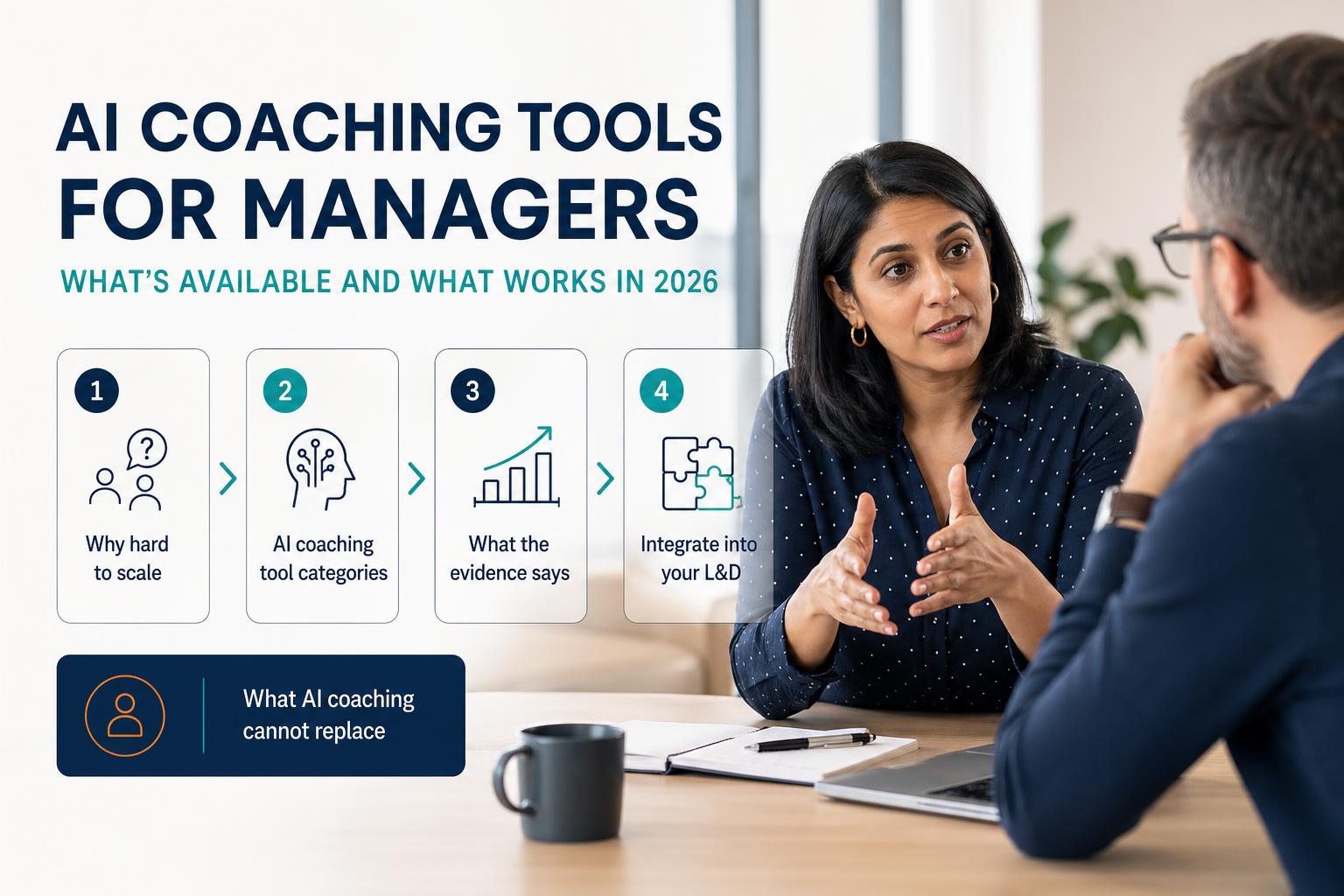
Why Manager Development Is Hard to Scale
Most organisations have far more managers than they have coaching capacity for. A mid-size enterprise with 500 managers and a coaching budget for 50 places per year is providing meaningful development to 10% of its management population in any given year. The other 90% receive, at best, a workshop and an annual performance review.
Traditional coaching — one-to-one with a qualified coach — costs between £150 and £500 per hour in the UK market. Most managers who receive it get fewer than five sessions per year. That is not enough to drive sustainable behaviour change in complex interpersonal skills.
The deeper problem is what researchers call the practice gap. Knowing what good management looks like is not the same as being able to do it under pressure — in a difficult performance conversation, in a heated team meeting, in the moment when a direct report needs coaching rather than direction. Closing this gap requires repeated deliberate practice, and neither classroom training nor one-to-one coaching can provide that at scale.
AI coaching tools address the practice gap specifically. They can provide unlimited repetition, at any time, with no scheduling requirements and no per-session cost. This does not replace human coaching — but it removes the constraint that has always limited the volume of practice managers can access.
Categories of AI Coaching Tools for Managers
Conversation simulation tools
Conversation simulation tools put managers into realistic scenarios with an AI that responds dynamically based on what the manager says. The AI is not following a script or branching through a decision tree — it is generating responses in context, creating a practice experience that can surface unexpected difficulties in the same way a real conversation does.
Useful scenarios for manager development include: giving constructive feedback to a high-performer who has missed a deadline; handling a grievance conversation; communicating a redundancy decision; coaching a team member who is resisting a change. The value is not in completing the scenario — it is in the feedback provided after it, which identifies specific moments where the manager’s approach was less effective than it could have been.
Tools in this space include Rehearsal (roleplay simulation), Mursion (avatar-based simulation), and Speeko. Custom GPT-based simulators are increasingly common in larger organisations building bespoke scenarios for their own management competency frameworks. The key differentiators are scenario realism, the quality of AI response generation, and the specificity of post-simulation feedback.
Communication and writing feedback tools
These tools analyse managers’ written communication — emails, performance review text, Slack messages — or spoken communication from meeting recordings, for tone, clarity, empathy, and directness. The application is identifying managers who consistently communicate in ways that reduce team engagement before it becomes a retention problem.
A manager who routinely uses passive-aggressive language in email, or who gives performance review feedback that is consistently vague and uncommitted, creates identifiable patterns in text data. AI can surface these patterns at scale across a management population without requiring each manager to be observed individually.
Privacy and data governance are significant considerations here. Communication analysis tools require explicit employee consent and clear data use policies. Organisations that deploy these tools without transparent governance frameworks risk significant trust damage. This is not a barrier to use, but it is a prerequisite — the governance conversation needs to happen before the tool is deployed.
Micro-coaching and nudge tools
Micro-coaching tools deliver contextual, just-in-time coaching content — a two-minute video, a checklist, a reflection prompt — triggered by a calendar event, a platform action, or a scheduled cadence. A manager with a performance review in their calendar tomorrow receives a nudge today with a structured preparation framework. A manager who has just been assigned a new team member receives onboarding guidance at the relevant moment.
These tools are most effective as a reinforcement layer for formal learning. A manager who has attended a feedback skills workshop and then receives a nudge checklist before their next feedback conversation is more likely to apply what they learned than one who attended the workshop with no follow-through. As standalone development tools, micro-coaching nudges have limited impact — the content is too brief to build new skills from scratch.
AI-assisted 360 feedback
360 feedback surveys often generate large volumes of qualitative open-text responses that are expensive and time-consuming to analyse at scale. AI-assisted analysis identifies patterns, recurring themes, and development priorities across hundreds of open-text responses in minutes — producing structured development summaries that a human reviewer might miss or that would require weeks of manual analysis to produce.
The output is not just a summary: AI can identify specific language patterns in feedback (for example, consistent references to a manager ‘not listening’ or ‘not being available’) that indicate development priorities, and connect these directly to learning resources targeted at those behaviours.
What the Evidence Says About AI Coaching Effectiveness
The evidence base for AI coaching is still developing, but some patterns are clear.
Conversation simulation has the strongest evidence base for interpersonal skills development. Practice volume — the number of deliberate repetitions — is consistently the variable most associated with behaviour change in interpersonal skills. AI simulation tools remove the constraint on practice volume, which is why they show the most consistent results.
Feedback-only tools are effective when feedback is specific and actionable (“in this moment you interrupted before the person had finished their point” is useful; “your communication style could be improved” is not). Generic feedback produces little behaviour change regardless of delivery mechanism.
Micro-learning nudges are effective at reinforcing existing learning and maintaining skill application over time. They are less effective as the primary mechanism for skill acquisition.
Research on skill acquisition consistently shows that the number of deliberate practice repetitions predicts skill improvement more than the quality of any individual session. AI coaching tools’ main advantage is that they can provide unlimited practice at zero marginal cost — removing the constraint that limits traditional coaching programmes.
Integrating AI Coaching into Your L&D Programme
AI coaching works best as a practice layer within a structured development programme, not as a standalone replacement for it. The organisations seeing the best results are using AI coaching to do something formal programmes cannot: provide repeated, contextual practice at scale between structured learning events.
Pre/post workshop practice is the most straightforward integration model. Managers prepare for a workshop by practising the target scenario in AI simulation — arriving with prior context rather than approaching the workshop cold. After the workshop, they repeat the scenario to consolidate learning. This pattern of prepare–learn–consolidate consistently outperforms workshop-only approaches.
Line manager integration matters for sustained usage. AI coaching tools that surface engagement and progress data to HR and L&D teams enable targeted follow-up for managers who are not using the tool or not improving on tracked competencies. Without this loop, AI coaching tools often follow the same adoption curve as most L&D technology — high initial engagement, sharp drop-off after eight weeks.
Avoiding coaching theatre is an underrated concern. Tools that look impressive in a procurement demo but see low sustained usage after six months are a consistent failure mode. When evaluating tools, ask vendors for engagement data at six and twelve months post-implementation, not just activation rates.
What AI Coaching Cannot Replace
The most important thing to understand about AI coaching tools is their boundary conditions — what they cannot do, and where human coaching remains essential.
Deep personal reflection and insight work. The kind of coaching that shifts a manager’s fundamental understanding of their leadership identity — their values, their default responses under pressure, their impact on others — requires a human relationship. AI can simulate a difficult conversation; it cannot hold space for the kind of reflection that produces genuine leadership development.
Complex team dynamics in a specific context. A human coach who knows a manager, understands their team, and has built a relationship over time can provide guidance that is precisely calibrated to the specific situation. AI coaching tools work from patterns and general scenarios; they cannot account for the specific individuals, history, and organisational context that shape real management challenges.
Accountability structures. A human coach holds a manager to commitments made in a session in a way that AI currently cannot replicate. The social accountability of a human coaching relationship — knowing you will be asked next session whether you did what you said you would — is a significant driver of follow-through that AI tools have not yet found a way to replace effectively.
The cheapest path to manager development is not always AI-first. Some managers need human coaching to make meaningful progress on deep development areas. AI coaching works best when the decision to use it is based on fit for purpose, not cost reduction.
Quick Reference: AI Coaching Tool Evaluation Checklist
Use this checklist when evaluating AI coaching tools for manager development:
- Use case defined (conversation practice / communication feedback / micro-coaching / 360 analysis)
- Scenario realism verified through live demo with your own scenarios
- Feedback quality assessed — is it specific and actionable, or generic?
- Privacy and data governance requirements confirmed
- Integration with existing LMS or HRIS assessed
- Manager engagement data from vendor (long-term usage at 6 and 12 months, not just initial activation)
- Success metrics defined — behavioural change, not just usage
- Human coaching programme still in place for complex development needs
Frequently asked questions
What can AI coaching tools do for manager development?
AI coaching tools can provide managers with: (1) on-demand conversation practice — simulating difficult conversations, feedback discussions, performance reviews, and conflict scenarios with an AI that responds dynamically; (2) personalised feedback on communication style, clarity, and empathy in written or spoken communication; (3) micro-learning nudges — short, contextual tips delivered at the point of need; (4) progress tracking — showing managers their development over time in specific competencies. The most effective AI coaching tools combine practice (simulation) with feedback (assessment) and reflection (review).
Can AI replace human coaches?
No — and the best AI coaching tools are explicit about this. AI coaching is most effective for skill practice and feedback on repeatable behaviours (conversation skills, feedback delivery, active listening). Human coaches add value in areas where context, relationship, and deep reflection matter: leadership identity, career transitions, complex team dynamics, and personal values. The best manager development programmes use AI coaching to scale practice volume and human coaching to address depth and complexity.
How do I measure the effectiveness of AI coaching tools?
Useful metrics for AI coaching effectiveness: (1) behavioural change indicators — 360 feedback scores before and after AI coaching on specific competencies; (2) usage and engagement data — do managers actually use the tool, or is it shelf-ware; (3) manager confidence self-assessment on targeted skills; (4) team outcomes — engagement scores, retention, and performance metrics in teams managed by participants vs a control group. Avoid measuring AI coaching effectiveness by usage statistics alone — a manager who completes 20 simulations with no behaviour change has not benefited.
Sources & further reading
- CIPD Learning at Work Survey - cipd.org — CIPD Learning at Work Survey - cipd.org
- Harvard Business Review: Evidence for Coaching Effectiveness - hbr.org — Harvard Business Review: Evidence for Coaching Effectiveness - hbr.org
- GOV.UK: Management and Leadership in the UK - gov.uk — GOV.UK: Management and Leadership in the UK - gov.uk