Last updated: 31 March 2026
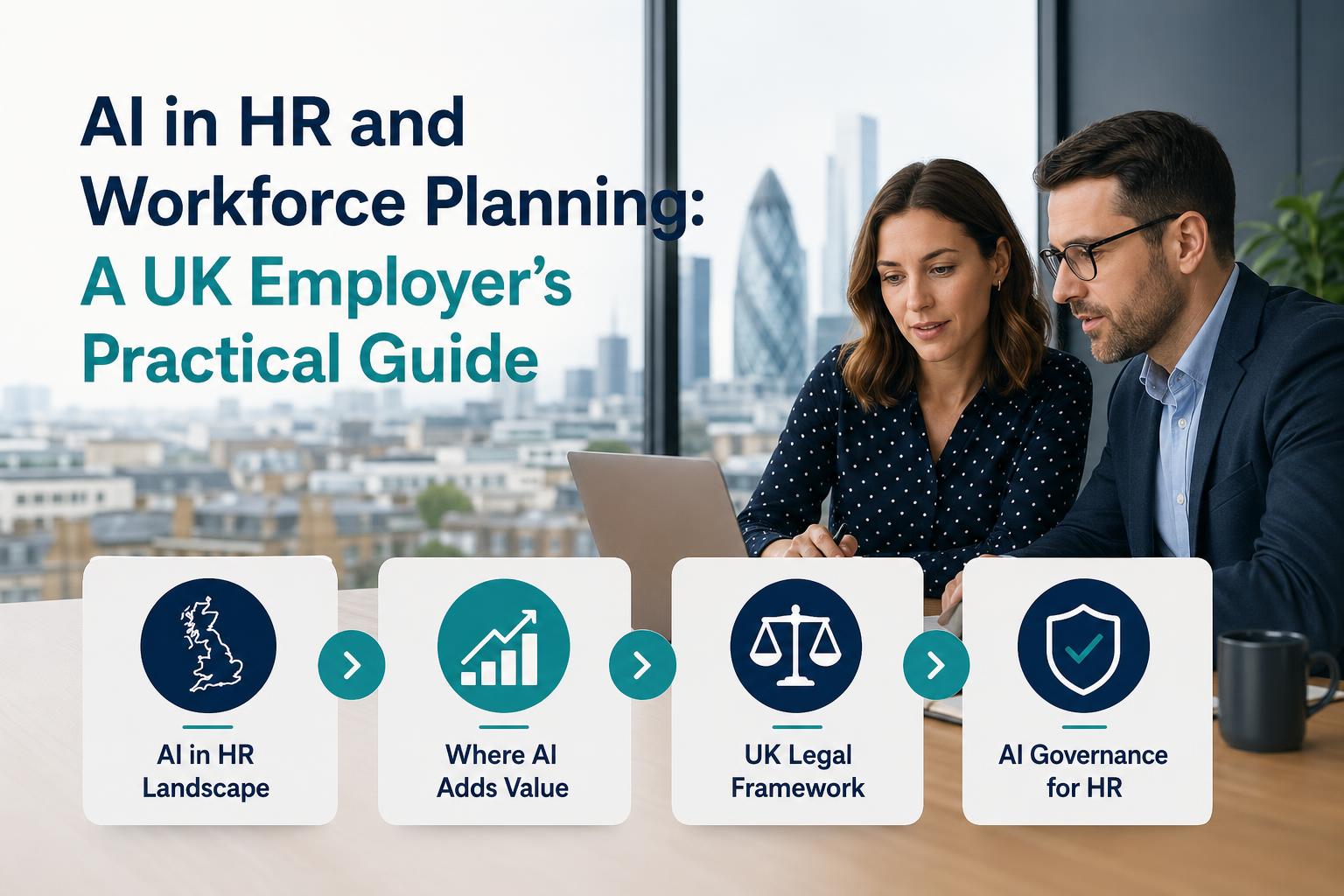
The AI in HR Landscape in the UK
IBM’s 2025 research on AI adoption in UK organisations found that 60% of HR leaders planned to deploy AI-assisted tools across core HR functions within the next 12–18 months. CIPD has noted a significant acceleration in AI adoption in HR since 2024, with the largest growth in recruitment technology, L&D personalisation, and workforce analytics. But alongside the adoption figures, CIPD has also documented the governance gap: many HR teams deploying AI tools have not completed the legal and ethical due diligence that the UK regulatory framework requires.
The risks in AI-assisted HR are different from risks in other business functions. HR decisions — who gets hired, who gets promoted, whose performance is flagged, who is included in a redundancy pool — directly affect people’s livelihoods and are governed by some of the strongest employee protections in UK law. Getting AI in HR wrong does not just create a compliance problem; it creates an equality problem, a trust problem, and potentially a reputational problem that is disproportionate to the efficiency gain the AI was intended to produce.
This guide maps where AI genuinely helps in HR, what the law requires, and how to build governance that enables the benefits while managing the risks.
Where AI Adds Value in HR
Recruitment and talent acquisition
AI recruitment tools can screen CVs against job requirements at scale, schedule interviews automatically, generate job description drafts, and score candidate applications. The efficiency gains are real — particularly for high-volume recruitment where manual screening is the bottleneck.
The governance requirement is equally real. AI CV screening tools trained on historical hiring data may encode historical bias — Amazon’s abandoned AI recruitment tool is the most cited example, but the pattern is widespread. Any AI tool used to screen, rank, or score candidates must be audited for bias before deployment and monitored for disparate impact on protected characteristic groups after deployment.
Onboarding
AI-driven onboarding — personalised onboarding journeys that adapt to the new hire’s role, function, and learning style; automated document completion and chasing; chatbot support for common first-week queries — is a low-risk, high-value AI use case. The decisions involved are procedural rather than consequential, and AI assistance here genuinely reduces the administrative burden on HR teams while improving the new hire experience.
Learning and development
AI-powered L&D tools — skills gap analysis, personalised learning pathway recommendations, training completion analytics, content recommendation engines — represent the highest-value AI use case in HR for most organisations. The ability to identify individual capability gaps at scale and recommend appropriate development actions was not practically feasible without AI. It is now.
For workforce planning, AI skills mapping tools that maintain a real-time skills inventory across the workforce — updated as employees complete training, take on new responsibilities, or develop new capabilities — provide the workforce intelligence that strategic L&D decisions require. TIQPlus uses this approach: AI-driven skills mapping that surfaces gaps and tracks capability development at individual and cohort level.
Performance management
Continuous feedback tools, AI-assisted 360 feedback analysis, sentiment analysis in employee surveys, and AI-generated development plan suggestions are all in active use by UK employers. The caution here is proportionality: AI in performance management is genuinely useful for aggregating information and identifying patterns. It must not be used to make performance ratings, redundancy selections, or disciplinary decisions without meaningful human review of the AI’s outputs.
Strategic workforce planning
Predictive attrition modelling — identifying employees at risk of leaving before they resign — is one of the most valuable applications of AI in workforce planning. When combined with skills inventory data and external labour market analysis, AI workforce planning tools can identify capability gaps 12–24 months before they become business-critical, enabling proactive recruitment, development, or succession planning.
UK Legal Framework for AI in HR
Equality Act 2010 and algorithmic bias
The Equality Act 2010 prohibits discrimination in employment on the basis of protected characteristics (age, disability, gender reassignment, marriage and civil partnership, pregnancy and maternity, race, religion or belief, sex, sexual orientation). If an AI HR tool produces outputs that disproportionately screen out, rate lower, or otherwise disadvantage individuals with a protected characteristic, the employer may be liable for indirect discrimination — even if the discrimination was unintended and originated in the AI’s training data.
The employer cannot escape liability by pointing to the AI supplier. The Equality Act obligation rests on the employer, and the employer is responsible for the decisions their tools produce. Due diligence on AI HR tools — including demographic testing and bias audits — is not optional; it is the mechanism by which the employer demonstrates they took reasonable steps to prevent discrimination.
UK GDPR Article 22: automated decision-making
Article 22 of UK GDPR gives individuals the right not to be subject to solely automated decisions that produce legal or similarly significant effects — which covers most high-stakes HR decisions. In practice, this means that decisions about hiring, promotion, pay, performance ratings, or redundancy cannot be made by AI alone without meaningful human review. “Meaningful” is the key word: a human who rubber-stamps an AI recommendation without independent assessment does not satisfy Article 22.
Where AI tools significantly inform high-stakes decisions, organisations should document the human decision-making layer — who reviewed the AI output, what they assessed, and what the basis for the final decision was. This documentation protects the organisation if an employee exercises their right to request an explanation or challenges the decision.
Employment Rights Bill 2024-25
The Employment Rights Bill includes provisions on algorithmic management — the use of AI and automated systems to monitor and manage employee performance. As the Bill progresses, employers may face new transparency obligations around how AI tools are used in performance monitoring and management. Staying current with the Bill’s provisions is important for HR teams deploying AI performance tools.
Amazon scrapped its AI recruitment tool in 2018 after discovering it systematically downgraded CVs from women — because it had been trained on 10 years of historical hiring data from a predominantly male workforce. The lesson is that AI tools learn patterns from historical data: if historical HR decisions had bias baked in, the AI will replicate and amplify that bias. Audit AI HR tools before deployment, not after the discrimination claim.
High-Risk vs Low-Risk AI Uses in HR
Not all AI uses in HR carry the same risk profile. Mapping your AI HR tools against a risk spectrum helps prioritise governance effort.
High risk — requires rigorous governance: AI tools that influence hiring decisions (CV screening, candidate scoring, video interview analysis); tools that influence performance ratings or bonuses; tools that inform redundancy selection; tools that monitor employee productivity and generate disciplinary alerts.
Medium risk — requires DPIA and human oversight: Predictive attrition models; sentiment analysis in employee surveys; performance management support tools; AI-generated development plans.
Lower risk — standard data protection compliance: AI onboarding chatbots for procedural queries; learning pathway recommendation engines; administrative automation (interview scheduling, document processing); L&D analytics dashboards.
Building AI Governance for HR
Data Protection Impact Assessments
Every AI tool that processes employee or candidate personal data requires a DPIA before deployment. The DPIA must assess: the purpose and lawful basis for processing; the data involved and the risk to individuals; the measures in place to mitigate those risks; and whether the processing is necessary and proportionate.
Vendor due diligence
When procuring AI HR tools, ask suppliers specifically about: the training data used to build the model (and whether it reflects your organisation’s context); demographic testing results showing bias audit outcomes; how the tool handles protected characteristics; the data processing agreement available; and whether the tool uses your organisation’s data to train its models.
Transparency to employees
Employees have a right under UK GDPR to be informed about how their personal data is processed, including processing by AI tools. Your privacy notice should describe AI HR tools and their purpose. For high-stakes uses — performance monitoring, attrition prediction — consider proactive communication beyond the privacy notice.
Using AI for Strategic Workforce Planning
The most underused AI capability in UK HR is strategic workforce planning — using AI skills mapping, market intelligence, and predictive modelling to answer the questions that matter most for long-term business performance: where will capability gaps emerge? Which roles are most exposed to AI displacement? Where should we invest in retraining vs. recruit? What will our skills inventory look like in 18 months if we continue on current trajectory?
AI workforce planning tools that maintain a live skills inventory — updated as employees develop capabilities through training, projects, and role changes — transform what is possible in workforce planning. Combining that skills inventory with sector AI workforce plans (NHS, financial services, manufacturing) and external market intelligence produces a workforce planning picture that supports evidence-based investment decisions rather than guesswork.
AI in HR Governance Checklist
- AI HR tools inventory completed — all tools identified and categorised by risk level
- DPIA completed for every AI tool processing employee or candidate data
- Data processing agreements in place with all AI HR tool suppliers
- Bias audit completed for AI recruitment and performance tools before deployment
- Equality Impact Assessment completed for high-risk AI HR tools
- Human decision-making layer documented for all high-stakes HR decisions
- Article 22 rights communicated in privacy notice
- Process in place for employees to request explanation of AI-influenced decisions
- HR team AI literacy training completed (bias recognition, GDPR obligations, output evaluation)
- Ongoing bias monitoring in place for AI recruitment tools
- Employment Rights Bill provisions monitored for algorithmic management obligations
- Supplier contracts reviewed for model training on organisation data
- AI HR governance reviewed annually
Frequently asked questions
Is it legal to use AI in UK recruitment?
Using AI in recruitment is legal in the UK, but subject to obligations under UK GDPR and the Equality Act 2010. Under UK GDPR Article 22, candidates have the right not to be subject to solely automated decisions that produce legal or similarly significant effects — which means a final recruitment decision cannot be made by AI alone without meaningful human review. Under the Equality Act 2010, if an AI recruitment tool produces outputs that disproportionately screen out candidates with a protected characteristic, the employer may be liable for indirect discrimination even if the bias originated in the AI tool’s training data. Employers must complete a DPIA before deploying AI recruitment tools and should conduct regular bias audits of the tools’ outputs.
Do employees have rights regarding AI decisions about them?
Yes. Under UK GDPR Article 22, employees have the right not to be subject to solely automated decisions that produce legal or similarly significant effects — including decisions about performance management, pay, promotion, redundancy selection, or disciplinary action. If an AI tool makes or substantially influences such a decision, employees have the right to request human review, to be given an explanation of the decision, and to contest the outcome. The Employment Rights Bill 2024-25 includes provisions that may extend disclosure obligations around algorithmic management. Employers should ensure that AI tools in HR are positioned as decision support tools, with a qualified human making the final decision in all high-stakes people processes.
How do you prevent algorithmic bias in AI HR tools?
Preventing algorithmic bias in AI HR tools requires action at three stages. Before procurement: require AI tool suppliers to provide bias audit results, demographic testing data, and details of training data sources. During deployment: conduct a Equality Impact Assessment alongside the DPIA, test the tool’s outputs across protected characteristic groups before going live, and set bias thresholds that trigger human review. After deployment: run regular bias audits of actual decision outcomes (not just tool outputs), monitor for emerging disparities across protected groups, and build a review cycle into the tool’s governance. Bias in AI HR tools is not a one-time risk — it can emerge as the tool adapts to new data over time.
Sources & further reading
- ICO: Guidance on AI and Employment Decisions — ico.org.uk/for-organisations/uk-gdpr-guidance-and-resources/artificial-intelligence
- EHRC: Equality and Human Rights Commission AI Guidance — equalityhumanrights.com
- CIPD: AI in HR Research — cipd.org/en/knowledge/guides/responsible-use-ai-hr