Last updated: 15 July 2026
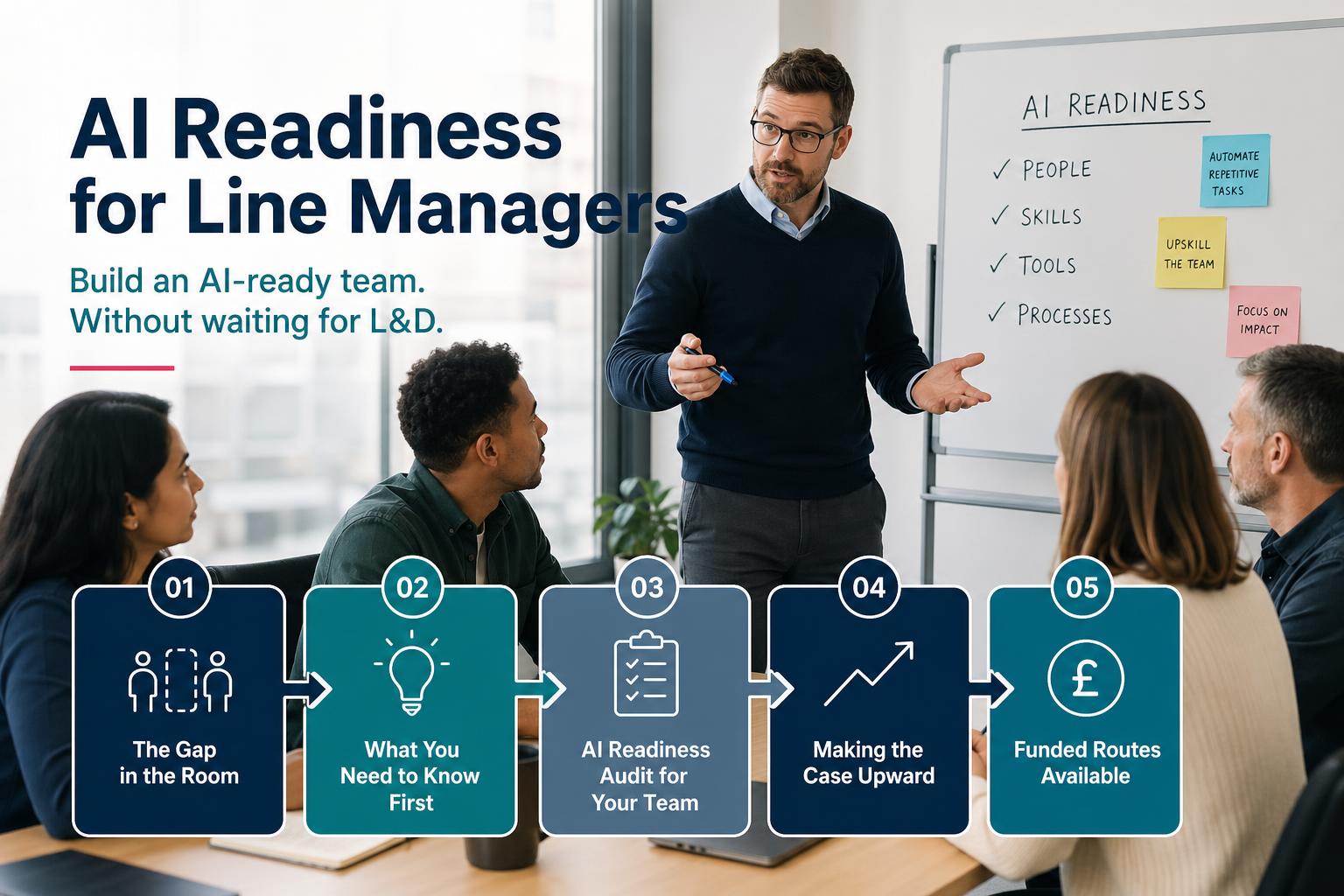
The Gap in the Room
Every week, somewhere in a UK organisation, a senior leader presents an AI strategy slide deck. Every few months, an L&D team launches an AI literacy e-learning module. Board papers reference “AI readiness” as a strategic priority. And in the middle of all of this, the line manager sits in their team meeting and wonders what exactly they are supposed to do on Monday morning.
This is the gap that almost no AI training strategy addresses directly. The people who design AI training programmes — whether that is central L&D, a specialist consultancy, or an executive team — tend to think in terms of two audiences: the individual learner who needs a skill, and the organisation that needs a capability. The line manager falls between both. They are not simply a learner — they have a team to manage through the transition. And they are not an executive with a strategy to set. They are the layer in between, and the layer on whom the daily reality of AI adoption will play out first.
When AI adoption fails in a team — when people revert to old ways of working, when AI-assisted outputs go unchecked, when capable team members become disengaged — it is usually the line manager who carries the consequence without having been given the tools to avoid it. That is not a management failure. It is a design failure in the training strategy.
This guide is written directly for you as a line manager. It assumes you are not an AI expert. It assumes you may not have a company AI strategy to work from. It is focused on what you can do now, within your own team, with the mandate you already have.
What You Need to Know First
You do not need to become an AI expert to build an AI-ready team. But you do need a working mental model of what AI can and cannot do in your team’s specific context — and what your obligations are as a manager when AI is involved in people-related decisions.
What AI can actually do in most teams right now
In 2026, the AI tools your team is most likely to encounter are generative AI assistants (such as Microsoft Copilot, Google Gemini, or similar tools embedded in existing software), and increasingly AI-assisted features built into the tools they already use for email, documents, scheduling, or data analysis.
These tools are genuinely useful for four categories of work: automating repetitive tasks (drafting standard documents, summarising meeting notes, reformatting data); decision support (surfacing relevant information quickly, producing first-draft analysis, generating options to consider); content drafting (producing early versions of reports, presentations, emails, or training materials that a human then edits); and data analysis (spotting patterns in datasets, generating visualisations, producing summaries of complex information). In each of these categories, AI tools are time-savers, not decision-makers. The human still owns the output.
What AI cannot do reliably
Being clear about this with your team is as important as being enthusiastic about the possibilities. AI tools in 2026 are not reliable for: judgment calls that depend on context, relationships, and organisational history your team carries; relationship management — AI can draft an email but cannot read the room; novel situations where there is no pattern in the training data to draw from; and ethical decisions that require weighing competing interests, exercising professional discretion, or taking accountability for a choice. When your team members understand where AI genuinely helps and where it produces confident-sounding but unreliable outputs, they are equipped to use it well. When they do not, they either over-trust it or dismiss it entirely.
Your legal obligations as a manager using AI
This is the part most manager guides on AI skip, and it matters. If you are using AI tools in any decisions that affect your team — workload allocation, performance assessment, scheduling, absence management — you carry legal responsibilities that do not transfer to the AI system.
Under the Equality Act 2010, you remain personally accountable for ensuring that decisions affecting your team do not discriminate against people with protected characteristics. An AI tool that systematically disadvantages a particular group in workload allocation or performance scoring does not absolve you of that obligation — it transfers the risk to you without your awareness. Under UK GDPR, automated or AI-assisted decisions that significantly affect employees require a lawful basis, and in many cases a right to human review. The Employment Rights Bill 2025 is expanding transparency requirements around algorithmic management. The practical rule: treat AI as a tool that informs your decision, never one that makes it, and document your reasoning in any people-related decision where AI was involved.
If an AI tool contributes to an unfair management decision, the legal accountability remains with you as the manager — not with the tool, the vendor, or the L&D team that recommended the tool. This is not a reason to avoid AI tools. It is a reason to use them with your eyes open.
A Five-Question AI Readiness Audit for Your Team
You do not need a formal assessment framework or an L&D-sponsored skills audit to understand where your team stands on AI readiness. You can get a clear enough picture through five questions — asked informally in 1:1s over the course of a couple of weeks. These are not quiz questions with right and wrong answers. They are conversation starters that surface what you actually need to know.
Work through one or two per 1:1 over the next few weeks. You are not testing people — you are listening. What you hear will tell you far more than any survey, and it will show your team that AI readiness is something you take seriously enough to discuss directly.
- Does each person know what AI tools are available to them in their role? You may be surprised by the answers. Some team members will have been quietly experimenting for months. Others will have no idea what their organisation’s policy is, or whether they are even allowed to use AI tools. This question establishes the baseline — and surfaces any policy gaps you need to escalate.
- Can each person evaluate an AI output for accuracy before using it? This is the critical judgment question. A team member who can use an AI tool to draft a document but cannot reliably identify when the output contains errors is a compliance or quality risk, depending on your sector. This is the skill gap that matters most, and the one most AI literacy training fails to address adequately.
- Does each person know when NOT to use AI for a task? This is the inverse of the above — and equally important. Team members who reach for AI tools for judgment calls, sensitive conversations, or novel situations where context is everything will produce worse outcomes than those who do not use AI at all. Knowing the limits is as much a skill as knowing the capabilities.
- Does each person understand the data and privacy implications of pasting information into AI tools? This is the one most people have not thought through carefully. If your team members are copying customer data, patient records, employee information, or commercially sensitive material into AI chat tools without understanding how that data is processed and retained, you have a data governance risk. This question needs to be asked and answered with your organisation’s acceptable use policy as the reference point — or escalated to IT and legal if that policy does not yet exist.
- Is each person’s anxiety or resistance about AI acknowledged and addressed? This is not asking whether every team member is enthusiastic about AI — that is neither realistic nor necessary. It is asking whether the people on your team who have concerns have had a genuine opportunity to voice them, and whether those concerns have been treated seriously rather than dismissed. Unaddressed anxiety about AI does not disappear. It becomes avoidance, or resentment, or a quiet sabotage of team adoption efforts.
After working through these questions across your team, you will have a clear picture of where to focus. Most managers who do this exercise find that the gaps are not evenly distributed — one or two team members are significantly ahead of the rest, one or two have significant data handling concerns, and the majority are somewhere in the middle with a mix of curiosity and unaddressed anxiety. That picture is actionable. A generic AI literacy score is not.
Making the Case Upward
If you want training budget, tool access, or organisational support for building AI readiness in your team, you are likely going to need to make a case to someone above you — particularly if there is no company-wide AI strategy yet. Here is how to frame that case in the language that tends to move decisions.
The productivity ROI frame
This is the most straightforward frame and usually the most persuasive. The question to answer is: what hours would be saved if your team used AI tools effectively for the tasks where AI genuinely helps? You do not need precise data. A reasonable estimate — “if each of my eight team members saves 30 minutes per day on drafting and summarising, that is 20 person-hours per week” — is enough to start a conversation. Translate that into a cost figure at your team’s average day rate, compare it to the cost of a Skills Bootcamp place or a structured training programme, and the ROI case makes itself.
The risk in this frame is overselling. Keep your estimates conservative and be explicit that they depend on the team actually being trained to use AI tools well. That framing — “the productivity gain is only available if we invest in the capability” — is both honest and persuasive.
The risk frame
This frame is often more effective with risk-averse organisations. The question is: what is the cost of AI misuse in your team? Consider the scenarios: a team member pastes client data into an AI tool without understanding the data handling implications; a team member acts on an AI-generated output that contains a factual error in a compliance-sensitive context; a manager uses an AI-assisted performance assessment that inadvertently disadvantages employees from a particular demographic group. Each of these is a real and plausible risk in 2026, and each has a financial, reputational, or legal cost.
The case is not “give us training to use AI more.” The case is “give us training so that when the team uses AI — which they already are, with or without a policy — they do it in a way that does not create risk for the organisation.”
The compliance angle
Where the organisation is a provider or deployer within the EU AI Act’s Article 2 territorial scope, Article 4 requires proportionate measures for sufficient AI literacy. Trading with an EU client or handling EU personal data does not by itself decide scope. The Commission also says Article 4 does not prescribe one course, certificate or documentation format. Use the full Article 4 scope guide before using compliance as a budget argument, and present role-based learning as one practical control rather than automatic proof of compliance.
The most effective manager-level business cases for AI training combine all three frames: “Here is the productivity opportunity we are missing (ROI). Here is the risk we are currently carrying (risk). Here is the compliance obligation that applies regardless of strategy (compliance).” Any one of these frames can be dismissed. All three together are much harder to ignore.
Funded Routes Available Without HR or L&D Involvement
One of the most useful things you can do as a line manager right now is know which funded training routes exist and be able to point a motivated team member toward one today — without waiting for a company training plan or a central L&D decision. These four routes are available now.
DfE free digital skills entitlement
Adults in England who do not hold a Level 3 qualification (equivalent to two A-levels or a BTEC) are entitled to funded digital skills qualifications up to Level 2 at no cost to them or their employer. These qualifications include Essential Digital Skills qualifications and a range of digital literacy programmes. This is not an AI-specific route — but for team members who lack confidence with digital tools generally, it is the right starting point and it costs nothing. The individual can apply directly without employer involvement. More information is available at gov.uk/government/publications/digital-skills-entitlement.
Skills Bootcamps in AI and digital skills
Skills Bootcamps are commissioned training offers covering selected digital, technical, and green skills. AI and data subjects may include AI literacy, data analysis with AI tools, and related areas, but availability is not uniform. Eligibility, content, timetable, course length, delivery mode and any employer contribution vary by the commissioned offer. A line manager may be able to nominate an employee, but the live offer and provider determine entry and employer requirements. Find current routes at gov.uk/skills-bootcamps and verify the terms before committing release time or budget.
Level 4 AI and Automation Practitioner Apprenticeship
The current Skills England record for AI and Automation Practitioner (ST1512) is version 2.1: a Level 4 apprenticeship that is approved and available, with a typical duration of 18 months, 420 minimum compliance hours and a maximum funding band of £18,000. Its revised assessment plan applies from 22 May 2026. The employee’s role must support the standard’s occupational duties and the provider must assess prior learning; employers can start with one suitable learner rather than a whole cohort. See also our Level 4 AI Apprenticeship guide.
Apprenticeship funding and delivery rules
Funding is not a blanket 5% rule. For starts from 1 August 2026, the government funds eligible training and assessment up to the funding-band maximum for an eligible non-levy apprentice aged 16–24. For a non-levy apprentice aged 25 or over, the employer pays 5% and government pays 95% up to that maximum. Levy payers normally use their account funds; where those funds are insufficient, the employer pays 25% of the eligible shortfall and government pays 75%. The employer pays any price above the funding-band maximum. Earlier starts normally continue under the funding rules in force on their start date.
Delivery rules are also start-date specific. For starts from 1 August 2025, use the exact standard’s published minimum off-the-job training volume, adjusted for evidenced recognition of prior learning subject to the funding-rule floor, rather than a generic percentage. The practical period must last at least eight months, although the standard may require longer; earlier starts retain the duration and training rules that applied when they began.
You can research these routes and identify a suitable learner without waiting for a company-wide AI strategy. Before enrolment, confirm the live provider offer, role fit, employer approval, release time and the contribution due under the learner’s start-date rules. Starting with one well-matched learner can create useful evidence for a wider plan.
Managing the Human Side
The hardest part of building AI readiness in your team is not the skills training. It is the human dynamics — the anxiety, the resistance, the unspoken fears about what AI means for each person’s role, status, and future. Getting this wrong costs more than getting the training wrong.
Creating psychological safety
Team members who are anxious about AI will not experiment openly with it unless they feel safe making mistakes. Psychological safety in an AI context means: making it clear that you expect your team to be learning, not already expert; that getting an AI output wrong and correcting it is the expected behaviour, not a performance issue; and that raising concerns about AI tools — accuracy, privacy, ethical implications — is valued, not dismissed.
The most powerful signal you can send is sharing your own learning experience. If you tell your team “I tried using AI to draft our team update this week and I had to rewrite most of it, but I saved 20 minutes on the first draft,” you do more for psychological safety than any amount of reassurance messaging. You normalise imperfect experimentation and you model the behaviour you want to see.
Being honest about what will and will not change
Vagueness is corrosive in AI transitions. When team members do not know whether AI means their role will change, whether some of their tasks will be removed, or whether AI performance will be factored into how they are assessed, they fill the gap with their worst-case assumption. You will not always have definitive answers — and if you don’t, say that, and say what you do know. “I genuinely don’t know yet whether this will change how we do X. What I can tell you is that I will give you as much notice as possible and involve you in how we transition” is an honest and respectful answer to a legitimate concern.
Where you can be specific, be specific. If AI tools will change how a particular task gets done in your team, name that task and describe how. The specificity is reassuring even when the news is that something will change — because it replaces formless anxiety with a concrete picture that people can respond to.
Distinguishing productive caution from counterproductive avoidance
Not all resistance to AI is the same, and treating it as if it were is a management mistake. Productive caution looks like: questioning whether an AI output is reliable before acting on it; flagging data privacy concerns before sharing information with an AI tool; being thoughtful about which tasks AI is actually suited to. This is exactly the critical thinking you want your team to apply. Encourage it.
Counterproductive avoidance looks like: refusing to engage with AI tools at all; creating a negative team atmosphere that discourages experimentation; dismissing colleagues who are finding AI tools useful. If this is rooted in genuine anxiety, a direct and compassionate conversation is the right response — acknowledging the concern and working through it together. If it persists after that conversation, it becomes a development issue like any other skill gap in your team, and it deserves the same structured response.
A 90-Day Action Plan
The following three-sprint plan is designed to take you from “not sure where to start” to “have a funded development route in place for at least one team member and a documented case for further investment.” None of it requires a company AI strategy to already exist.
Month 1: Learn and listen
- Spend four hours on your own AI literacy — complete a free AI fundamentals course (Google, Microsoft, and LinkedIn all offer free options), and spend time actually using the AI tools your organisation has access to
- Work through the five-question audit with each team member in 1:1s — listen, take notes, do not push solutions yet
- Map what you heard: who is ahead, who has concerns, who has data handling risks, who has specific skill gaps
- Identify the one or two team members most motivated to develop AI skills — they will be your early movers in Month 2
- Review your organisation’s AI acceptable use policy (if one exists) and flag any gaps to IT or legal
Month 2: Experiment and evidence
- Run one small, contained AI experiment with your most motivated team member — a specific task (meeting summaries, first-draft reports, data formatting) where you can measure the time saved
- Track the outcome honestly: how much time was saved? What did the output require in terms of human review and editing? What would the person do differently next time?
- Share what you learned with the wider team — not as a sales pitch for AI, but as an honest account of one experiment
- Start researching the funded routes that match your team members’ needs (Skills Bootcamps, Level 4 apprenticeship, free digital skills entitlement)
- Have one direct conversation with any team member whose anxiety or avoidance you identified in Month 1
Month 3: Formalise and fund
- Write a one-page business case for AI training investment — use the ROI, risk, and compliance frames described above, and include the evidence from your Month 2 experiment
- Connect at least one motivated team member to a specific funded training route and support them to start the process
- Present your business case to your manager or to L&D — not as a demand but as a proposal with evidence and a concrete next step
- Set a standing agenda item in your team meetings for “AI learning” — five minutes per meeting for team members to share what they’ve tried, what worked, and what didn’t
- Plan your next 90-day cycle with the data you now have
After 90 days you should have: a clear picture of your team’s AI readiness across the five dimensions; at least one evidenced experiment with a documented outcome; at least one team member in or starting a funded training route; and a business case on record. That is a strong foundation, built without waiting for anyone else to act first.
Frequently asked questions
Do I need permission from L&D or HR to start building AI readiness in my team?
No. There is a great deal a line manager can do right now without a company-wide AI strategy in place. You can develop your own AI literacy, have honest conversations with your team in 1:1s to understand their concerns and current capability, point individual team members toward free or government-funded training routes, and run small-scale experiments with AI tools your team already has access to. What requires organisational permission is large-scale formal training programmes and new tool procurement — but awareness, informal skill-building, and connecting individuals to funded opportunities do not.
What are my legal responsibilities as a manager using AI in people-related decisions?
If you use AI tools in any decisions relating to your team — performance assessment, workload allocation, recruitment shortlisting, absence management — you carry several legal obligations. Under the Equality Act 2010, you remain responsible for ensuring those decisions do not discriminate against protected characteristic groups, even if the decision was informed by an AI system. Under UK GDPR, any automated or AI-assisted decision that has a significant effect on an employee requires a lawful basis and, in some cases, human review. The Employment Rights Bill 2025 is expanding transparency obligations around algorithmic management. The safest position is to treat AI as a decision-support tool, never a decision-making tool, and to document your reasoning in any people-related decision where AI was involved.
How do I handle a team member who is anxious or resistant to AI?
Start by distinguishing between two very different things: productive caution (which is healthy and should be encouraged) and counterproductive avoidance (which needs to be addressed). Productive caution means a team member is asking good questions about AI accuracy, flagging risks, and being careful about which tasks they use AI for — this is exactly the behaviour you want. Counterproductive avoidance means refusing to engage with AI tools at all, or creating a negative atmosphere that discourages others from experimenting. For genuine anxiety, create psychological safety by being honest about what will and will not change, sharing your own learning experience, and making it clear that experimentation and mistakes are expected. For persistent avoidance that is affecting team performance, treat it as a development conversation — the same way you would any skill gap.
How can my team access AI training without a company training budget?
Several routes may be available without a central training budget. The DfE free digital skills entitlement supports eligible adults, while Skills Bootcamp subjects, entry criteria, timetables and employer contributions vary by commissioned offer and should be checked with the live provider. The Level 4 AI and Automation Practitioner apprenticeship (ST1512) is an approved and available route with a maximum funding band of £18,000. Apprenticeship contributions depend on the learner's start date, age and the employer's levy status; for starts from 1 August 2026, eligible non-levy apprentices aged 16–24 are government funded up to the band maximum, while non-levy apprentices aged 25 or over use 5% employer and 95% government co-investment. Earlier starts normally keep the rules that applied when they began.
Sources & further reading
- EU AI Act Article 4 - AI literacy obligations for organisations — eur-lex.europa.eu/legal-content/EN/TXT/?uri=CELEX:32024R1689
- GOV.UK Skills Bootcamps - eligibility and funding information — gov.uk/skills-bootcamps
- Skills England: AI and Automation Practitioner (ST1512), version 2.1 — skillsengland.education.gov.uk/apprenticeships/st1512