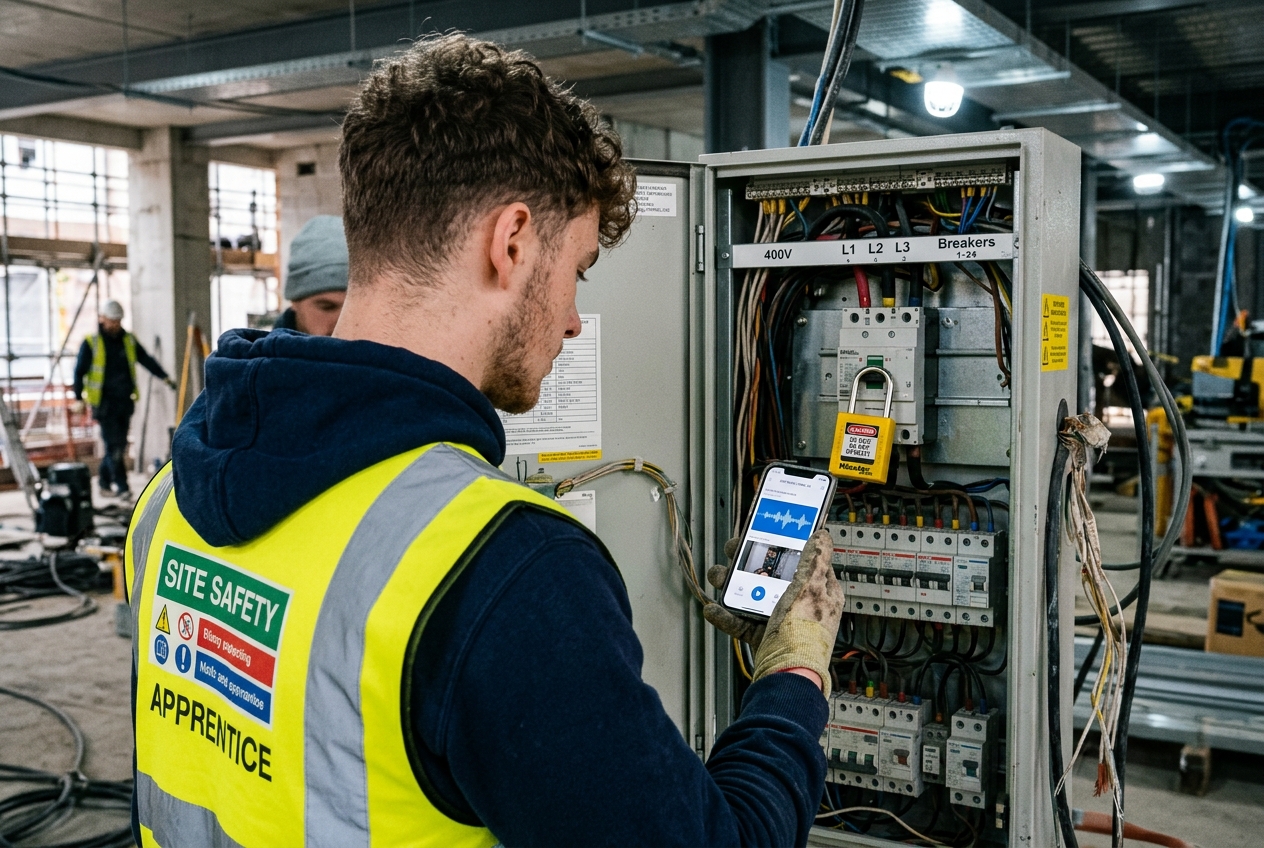
Spend ten minutes reading UK apprenticeship communities like r/ApprenticeshipsUK or r/LegalAdviceUK, and one grievance outnumbers every other thread combined: "My employer treats me as full-time cheap labour, refuses to give me time at work for my OneFile/Aptem coursework, and expects me to write my portfolio essays on Sunday nights unpaid." When training providers try to enforce off-the-job study blocks by demanding that a busy site manager or salon owner take the apprentice off the floor for four hours to sit at a desktop computer, the relationship fractures—and the apprentice withdraws. Here is how progressive training providers eliminate that conflict using in-workflow QuickSnap & Socratic Voice capture on WhatsApp (alongside our native Mobile Evidence Studio).
1. The "Unpaid Sunday Essay" Crisis Driving UK Apprentice Dropouts
Under the DfE Apprenticeship Funding Rules (including the Standard-Specific Minimum Off-the-Job Hours rules), every hour of statutory Off-the-Job (OTJ) training must be delivered within the apprentice's normal paid working hours. If any coursework or assessment preparation occurs outside paid hours, the employer must grant equivalent Time Off in Lieu (TOIL) or overtime pay.
Yet in legacy desktop e-portfolios, two dangerous things happen simultaneously:
- The Apprentice Burnout Loop: After working a 40-hour physical week on a construction site, in a commercial kitchen, or on an engineering floor, the apprentice is told to spend Sunday evening typing a 1,000-word reflective essay. Within four months, they fall behind and drop out.
- The Audit Timestamp Bomb: When an ESFA funding auditor inspects a provider's e-portfolio logs and sees that 70% of an apprentice's OTJ entries were submitted at 9:30 PM on Sundays with no documented TOIL record, those hours can be ruled ineligible—triggering severe funding clawbacks (see ESFA Funding Audit OTJ Evidence Guide).
2. Why SME Employers Block Traditional "Laptop Study Time"
Most line managers and SME owners do not actually object to teaching their apprentice the trade. On any given Tuesday, a senior electrician, lead chef, or site manager will gladly spend two hours coaching an apprentice through a new 3-phase fault diagnosis, an air-source heat pump commissioning sequence, or a new subcontractor handover protocol.
What employers fiercely resist is pulling the apprentice off the job for half a day to type an academic essay about what they already learned. To a busy employer, legacy e-portfolio admin looks like dead bureaucratic downtime.
3. What Actually Counts as Legitimate On-Site Off-the-Job Training
DfE funding rules explicitly allow—and encourage—workplace-based Off-the-Job training, provided it teaches new Knowledge, Skills, or Behaviours (KSBs) mapped to the apprenticeship standard rather than routine unsupervised productive labour:
| Workplace Activity During Paid Shift | Counts as Eligible OTJ? | How QuickSnap + Socratic Voice Evidences It in 90s |
|---|---|---|
| Shadowing a senior engineer on a new fault diagnostic or commissioning task | Yes (100% Eligible) | Apprentice snaps photo + 45s WhatsApp voice note explaining the new diagnostic method learned; supervisor confirms with 1 tap. |
| Guided practice of a new safety protocol, tool, or regulatory procedure | Yes (100% Eligible) | Socratic Voice Bot asks 1 follow-up question on site to verify what new knowledge/behaviour was acquired during the guided session. |
| Toolbox talks, manufacturer technical briefings, and mentor walk-throughs | Yes (100% Eligible) | Captured immediately on site at 11:30 AM or 2:00 PM with shift-hour webhook timestamps proving paid-hours delivery. |
| Unsupervised repetition of an already-mastered daily task | No (Ineligible Productive Work) | TIQPlus AI flags routine repetition and prompts the mentor via Employer Gap Radar to assign an unevidenced KSB task instead. |
4. How 90-Second WhatsApp + Socratic Voice Captures Paid-Hours OTJ on Site
When a provider enables the TIQPlus QuickSnap & Socratic Voice WhatsApp Bot alongside our native Mobile Evidence Studio, the "study time war" between the provider and the employer disappears overnight:
- Captured Inside Working Hours (e.g., Tuesday 14:15 GMT): Right after a senior mentor walks the apprentice through a new task, the apprentice takes 90 seconds on site to snap a photo in WhatsApp, attach a 1-tap location pin, and record a 45-second voice note.
- Socratic Verification of "New Learning": To satisfy DfE auditors that the hours represent genuine new learning rather than routine labour, the TIQPlus bot immediately replies with a 10-second Socratic question: "What was the new testing step Dave showed you on this manifold that you hadn't performed before, and how did you verify the reading?"
- 1-Tap Supervisor Paid-Hours Attestation: The supervisor receives a WhatsApp message on the spot and taps
[ ✅ Confirm 2.0 Paid OTJ Hours & Witness Sign-Off ]—requiring zero laptop downtime for either the learner or the employer.
5. Protecting Provider QAR and Passing DfE Paid-Hours Funding Audits
By shifting evidence capture from Sunday-night desktop essay writing to 90-second in-workflow WhatsApp and Mobile Studio capture, training providers achieve three immediate wins:
- 100% Daytime Paid-Hours Audit Timestamps: Every evidence pack and OTJ log carries a verified weekday shift timestamp (08:00–17:00) and employer confirmation, eliminating ESFA "out-of-hours OTJ" audit queries.
- Zero Employer Pushback: Line managers stop complaining that the apprenticeship is taking their staff away from site operations.
- Dramatically Lower Early Withdrawals: Apprentices never accumulate the dreaded 10-essay Sunday backlog that triggers Month-4 to Month-9 dropouts.
Frequently asked questions
Is it illegal for an employer to make an apprentice do Off-the-Job training outside normal working hours?
Under statutory DfE Apprenticeship Funding Rules, 100% of mandatory Off-the-Job (OTJ) training must take place within the apprentice's normal paid working hours. If any training or portfolio activity must exceptionally occur outside normal working hours, the employer is legally required under the Training Plan Commitment Statement to provide equivalent Time Off in Lieu (TOIL) or overtime pay.
Why do SME employers resist giving apprentices time for portfolio work?
Most site managers and SME owners do not object to teaching an apprentice new technical skills on the job; they object to losing an apprentice for half a shift to sit in front of a laptop typing 1,000-word essays into a legacy e-portfolio like OneFile or Aptem.
How does QuickSnap & Socratic Voice on WhatsApp solve employer OTJ resistance?
Instead of separating 'learning' from 'site work' via long written essays, the apprentice snaps a photo and sends a 45-second WhatsApp voice note immediately after completing a shadowed or newly learned workplace task during their normal shift. The TIQPlus bot asks a 10-second Socratic follow-up question, maps the KSBs, logs the legitimate OTJ hours within paid shift timestamps, and sends a 1-tap WhatsApp sign-off to the site supervisor.
Sources & further reading
- DfE Apprenticeship Funding Rules 2026 to 2027: Off-the-Job Training within Paid Hours — gov.uk/guidance/apprenticeship-funding-rules
- Skills England Standard-Specific Minimum Off-the-Job Hours Guidance — gov.uk/government/organisations/skills-england
- Ofsted Further Education and Skills Report Card Framework — gov.uk/government/organisations/ofsted