Last updated: 31 March 2026
Ofqual’s Role and Its AI Guidance
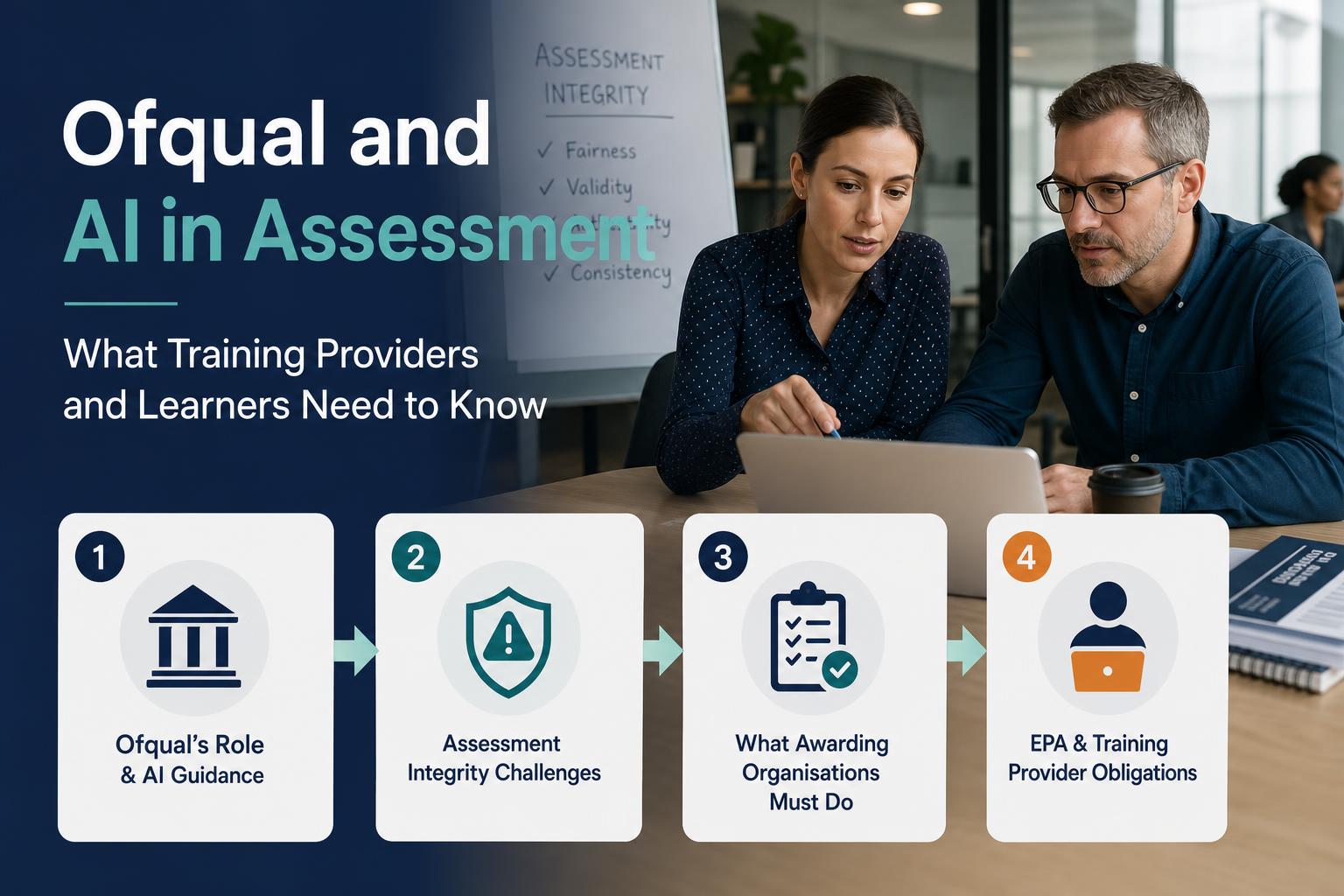
Ofqual (the Office of Qualifications and Examinations Regulation) regulates qualifications, assessments, and examinations in England. Its role is to set the conditions that awarding organisations must meet — not to run assessments directly. When Ofqual publishes guidance on AI in assessment, it is setting expectations for awarding organisations to act on, not rules that apply directly to training providers or learners. But the chain runs downward: what Ofqual requires of awarding organisations flows through into what EPAOs, awarding bodies, and training providers must do.
Ofqual’s position on AI in assessment (2024–25) is that AI use is not inherently prohibited, but awarding organisations must ensure that their assessments continue to be valid — that they accurately measure what they are designed to measure. If AI tools allow learners to produce work that appears to demonstrate competence without actually doing so, the assessment is no longer valid. Ofqual requires awarding organisations to assess this risk for their qualifications and take appropriate action.
The Three Assessment Integrity Challenges AI Creates
AI-generated work submitted as the learner’s own
The most common AI integrity challenge is learners using generative AI tools to produce written work — assignments, reflective accounts, case studies, reports — and submitting it as their own. This is functionally equivalent to plagiarism: the learner is representing work they did not produce as evidence of their own competence. The difference from traditional plagiarism is scale and sophistication. AI can produce thousands of words of plausible, subject-appropriate content in minutes, and the outputs are often fluent enough to pass surface-level review.
AI-assisted cheating in live assessments
For assessments conducted in controlled conditions — exams, observed practical assessments — the AI integrity risk is lower because the controlled environment limits tool access. For remote or unsupervised assessments, the risk is higher. Online exams and remote observation assessments need to consider whether learners can access AI tools during the assessment and, if so, whether that undermines validity.
AI-generated evidence in portfolio-based assessment
Portfolio-based assessment — which underpins most apprenticeship EPA and many vocational qualifications — is the area of highest AI integrity risk. A learner can use generative AI to produce reflective accounts, KSB-mapped statements, workplace project write-ups, and supporting documentation that appears authentic but was not produced by the learner. The assessment model depends on the authenticity of portfolio evidence. AI undermines that dependency if not managed.
This is not a hypothetical risk. EPAOs and IQAs in apprenticeship provision have identified AI-generated portfolio evidence as a growing quality concern since 2024. The patterns are recognisable to trained assessors — overly polished language, generic examples that lack the specific workplace detail that genuine reflection produces, suspiciously comprehensive KSB coverage without gaps — but are increasingly sophisticated as AI tools improve.
What Awarding Organisations Must Do
Ofqual’s conditions require awarding organisations to maintain assessment validity. In the context of AI, this means: reviewing their assessment designs for AI integrity risk; implementing detection or mitigation measures appropriate to their assessment type; updating learner regulations to address AI use clearly; and providing guidance to approved centres (training providers) on what is and is not permitted.
The specific measures different awarding organisations have taken vary: some have updated assessment designs to increase the proportion of observation and live discussion evidence; some are using AI detection tools as a supporting measure; some have strengthened declaration requirements; and some are redesigning written assessments to require learner-specific contextualisation that is harder to generate without genuine workplace experience.
EPA (End-Point Assessment) and AI
EPA in apprenticeships presents the full range of AI integrity challenges. Most EPA plans include portfolio-based evidence, professional discussion or interview, and observation of practice — each with different AI risk profiles.
Portfolio evidence: Highest risk. AI can generate plausible portfolio content at scale. EPAOs are responding by placing greater weight on employer witness statements, strengthening the professional discussion as a means of testing whether learners can speak to their evidence authentically, and providing more specific guidance to training providers on evidence quality expectations.
Professional discussion: Lower risk (AI is not present in a live discussion), but the discussion’s effectiveness as an integrity safeguard depends on assessors probing beyond what the written evidence says. An assessor who simply confirms that a learner can discuss their portfolio points is less effective at detecting AI-generated evidence than one who asks for specific, unrehearsed examples and contextual detail.
Observation: Lowest risk. Direct observation of practice in a real work context cannot be substituted by AI-generated evidence. The shift toward higher-weight observation in reformed EPA plans (part of the Skills England assessment reform programme) partially addresses AI integrity risk as a side benefit.
Skills England’s EPA reform programme — moving 93 standards in Wave 1 from the current model to a sampling approach — includes assessment design changes that reduce the weight of portfolio documentation and increase the weight of direct evidence from workplace observation and employer report. This shift has AI integrity benefits alongside its primary purpose of reducing administrative burden and improving validity.
Training Provider Obligations
Training providers sit between the awarding organisation/EPAO and the learner. Their obligations around AI assessment integrity flow from both the awarding organisation’s centre requirements and their own quality assurance responsibilities.
Learner AI acceptable use policy
Every training provider should have a clearly written AI acceptable use policy for learners that addresses assessment specifically. The policy needs to cover: what AI tools are permitted during learning activities; what is prohibited in assessment and coursework; the declaration requirement (learners confirming work is their own); and the consequences of misuse.
The policy should be communicated at induction, revisited at each assessment submission, and easy to find in the learner portal or handbook. A policy that is published but not communicated does not change behaviour.
Designing evidence activities that resist AI gaming
The most effective long-term approach to AI assessment integrity is designing evidence activities that genuinely require learner-specific workplace experience. Evidence prompts that ask for specific incidents (date, people involved, what the learner did, what they would do differently) are much harder to generate convincingly with AI than open-ended reflective questions. Witness testimonies and employer observations that reference specific events are more robust than generic statements of competency.
Training providers who review their portfolio guidance to require more specific, contextualised evidence are both improving evidence quality and building AI integrity into the programme design.
Training assessors and IQAs in AI recognition
Assessors and IQAs need to develop the ability to recognise AI-generated evidence patterns and to probe for authenticity in professional discussions. This is a professional development priority. The patterns to look for include: unusually fluent, comprehensive coverage with no gaps; overly academic language in learners who typically write informally; examples that lack the specific operational detail that genuine workplace experience produces; inconsistency between the sophistication of written evidence and the learner’s oral discussion.
Declaration and monitoring
Implement a declaration process where learners confirm at each submission that the work is their own. Log declarations in your learning management system so they are available for IQA sampling and any subsequent investigation. Use available AI detection tools as a supporting indicator — not as a definitive test, since detection tools are imperfect — and ensure that detection findings trigger assessor review rather than automated decisions.
Assessment Integrity and AI Checklist
- Learner AI acceptable use policy in place and communicated at induction
- Policy addresses assessment and portfolio evidence specifically
- Declaration process implemented for all assessment submissions
- Evidence activity design reviewed to require specific, contextualised workplace incidents
- Assessors trained to recognise AI-generated evidence patterns
- IQA sampling plan includes AI integrity as a sampling criterion
- Professional discussion guidance updated: assessors probe beyond written evidence
- AI detection tools evaluated and implemented as supporting measure
- Academic misconduct procedure updated to cover AI-generated work
- EPAO guidance on AI integrity reviewed for all standards delivered
- Awarding organisation’s updated learner regulations communicated to learners
- Employer partners briefed on witness testimony expectations and AI integrity
Frequently asked questions
What is Ofqual’s position on AI in assessment?
Ofqual’s position is that AI use in assessment is not inherently prohibited, but awarding organisations must ensure that their assessments remain valid — meaning they accurately measure what they are designed to measure, rather than measuring a learner’s ability to use AI. Awarding organisations must review their assessment designs for AI integrity risk and implement appropriate mitigation measures, which may include updating learner regulations, redesigning assessments to reduce AI gameability, or implementing AI detection measures. Ofqual has not mandated a single approach, recognising that the appropriate response depends on the assessment type and context.
Can learners use AI tools in assessments?
Whether learners can use AI tools in specific assessments depends on the awarding organisation’s regulations for that qualification. For most regulated qualifications, use of AI to generate responses or produce portfolio evidence that the learner submits as their own work constitutes academic misconduct — equivalent to plagiarism. However, some awarding organisations now permit the use of AI as a research or planning tool in certain assessments, where the final product must demonstrate the learner’s own analysis and judgement. Training providers must ensure learners are clear on the specific rules for each assessment. The JCQ (Joint Council for Qualifications) has updated its regulations to address AI-generated work, and EPAOs are updating EPA plans to address AI integrity specifically in portfolio and professional discussion formats.
How should training providers handle AI-generated portfolio evidence?
Training providers have a responsibility to take reasonable steps to ensure that portfolio evidence submitted by learners is the learner’s own work. This means: including AI acceptable use in the learner induction and regularly reminding learners of their obligations; designing evidence activities that are harder to generate convincingly with AI (reflective accounts tied to specific workplace incidents, witness testimonies from employers, observation records); training tutors and assessors to recognise AI-generated evidence patterns; using available AI detection tools as a supporting measure (not a sole determinant); and implementing a declaration process where learners confirm that portfolio evidence is their own. Where AI-generated evidence is identified, providers should follow their academic misconduct procedure.
Sources & further reading
- Ofqual: AI in Assessment — gov.uk/government/organisations/ofqual
- JCQ: AI Use in Assessments — jcq.org.uk/exams-office/malpractice/artificial-intelligence
- GOV.UK: DfE Generative AI in Education Guidance — gov.uk/government/publications/generative-artificial-intelligence-in-education